The Premium Slowdown Continues

Premiums

This is welcome news:

On Wednesday, the Kaiser Family Foundation published its annual survey on the health plans that employers are offering their workers. It’s large and comprehensive and generally regarded as the most reliable measure of what’s happening in the employer market.

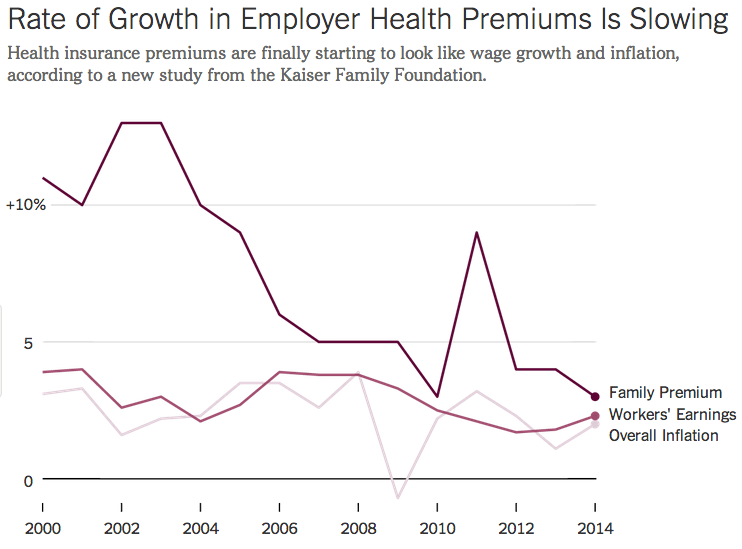
The big finding is that the growth in health insurance premiums was only 3 percent between 2013 and 2014. That’s tied for the lowest rate of increase since Kaiser started measuring (this is the 16th year of the survey).

Cohn unpacks the survey:

Critics of the Affordable Care Act insisted it would cause employers to jack up premiums. There’s no evidence of that happening.

And of course this data is consistent with all the other recent data we’ve gotten on health care spending under Obamacare. National health care spending, the amount of money we spend as a country, is rising at historically low rates. Premiums inside the new Obamacare exchanges, where people buy insurance on their own, are generally rising at moderate rates and in some cases declining, which is highly unusual.

It’s hard to say exactly how much Obamacare has to do with these changes. But it makes the critics’ arguments look awfully shaky.

Drum chips in his two cents:

How long will this slowdown in health care inflation last? My guess is that it’s more or less permanent. It will vary a bit from year to year, and I wouldn’t be surprised to see it hit 3-4 points above the general inflation rate in some years. But the downward trend has been in place for three decades now, and that’s long enough to suggest that it was the double-digit increases of the 80s and early 90s that were the outliers. Aside from those spikes, the current smaller increases are roughly similar to health care spending increases over the past half century.

Kliff explains “why, even with premiums rising slowly, it might not feel to workers they’re actually getting a better deal”:

Deductibles have grown 47 percent since 2009; 34 percent of workers are now enrolled in health insurance plans that have a deductible of $2,000 or higher. While premiums grow slowly, workers are essentially asked to spend money in other places with these rising deductibles.

Jason Millman also focuses on those increasing deductibles:

High-deductible plans are attractive to employers because they get to bear less of the insurance cost. Many economists also like the plans, because they’re supposed to make people spend more wisely on their health care.

The big question is whether employees are prepared to handle potentially big medical bills before they hit their deductible. As the The Upshot noted last week, people in employer insurance recently said they’re pretty happy with the services their health plans cover, but they’re much less satisfied with what they’re paying out of their own pockets.

The End Of Britain? Ctd

A reader responds to my take:

Well you may be indifferent to the Scots gaining independence, but in our family it’s Gilbert Johnstone Jr. pistolsabsolutely thrilling!  We were Jacobites who participated in the 1690, 1715 and 1745 rebellions.  We were at Culloden and the entire family had to flee to the Cape Fear River region in North Carolina after the battle.  They hid out at Brompton Plantation, which was owned by the Royal Governor Gabriel Johnston, a brother to my sixth great grandfather.  During the Revolution they were officers in the NC Militia, and then after the Tories burnt their home to the ground, they moved to South Carolina, where they fought a guerilla campaign with General Francis Marion (aka the Swamp Fox) against the English.  I have the pistols my gggggg-grandfather carried at Culloden and during the American Revolution next to my bed (photo attached).  To finally win independence and get from under the thumb of the English would be bloody brilliant and a long time coming!

Another takes a step back:

I am an agnostic on Scottish independence. I get the impulse; I get your possible acceptance. But how can anyone looking at our current world situation not be anything but appalled by the possible positive vote? If it passes, won’t every active independence movement – Quebec, Catalan Spain right away – get a boost? Doesn’t it give an easy way for Putin to insist that eastern Ukraine vote for the same? Wouldn’t it give a boost to parts of the U.S., particularly if Dems some time in the near future gain control of all levels of the federal government, that might start talking secession? As a true conservative (not tea-partier or corporatist), shouldn’t you be worried about the larger impact of a positive vote?

Yes, I can see those concerns. And that’s why I hope in my rational mind that they don’t secede. But given the existence of a separate nation, and given the peaceful, democratic manner in which this divorce could take place, I don’t see much of an analogy except for Catalonia. A reader notes:

More than 500,000 have actually signed up to participate in the V for Vote demonstration for Catalonia’s independence, with their IDs. And many, many more will come.

Another drills down into the Scottish question:

I wonder if the Scots might not end up shooting themselves in the foot? There’s a triumvirate of failures they are setting themselves up with:

1) I’m with the Betfair people. It’s easy to say “yes” to a pollster with no consequences, but much harder in a ballot box. I suspect a “no” vote is much the more likely.

2) If they do lose, they can’t come whining back to the table for a good 15 or 20 years.

3) They have, without thinking too much about it, aroused English nationalism, as you detected on your recent visits. I have always been mildly ticked off by the “West Lothian question”, as it used to be known: Scottish MPs voting on wholly English matters. However, since devolution and now with this independence debate, I am convinced that it is an injustice of titanic proportions on me and 53 million other English men and women who put up with Scottish, Welsh and Northern Irish MPs (the latter two to a lesser extent) having a say on matters that have no impact upon the people they represent. They can vote without personal consequence. The reverse would never be allowed.

As a natural Labour supporter, I can see that me and mine need the Scottish Labour vote to drive a left-of-centre agenda, but frankly, and you hit the nail on its head, all this self-serving “we want to be independent, but thanks England, we need you to bank-roll us,” has made me agree: “fuck ‘em”. I’m not sure I want them anymore. My public services are on their arse because of Tory cuts, yet Scotland’s flourish, not because of extraordinary financial management on the part of the Scots, but because my English pounds get spent disproportionately across the border. The Treasury reports that it spends £10,152 for every Scot. It spends £8,529 for every English man or woman. Here in the East Midlands where I live, it spends a miserly £8,118. It spends 25% more on a Scot than it spends on me. (See this linked pdf.)

What on earth is Scotland going to do without my money? I am completely convinced that if they do go their own way, Westminster will cave in and agree to bankroll them for years to come.

Whatever comes of this independence movement, one thing seems certain, and that is that they will lose a substantial amount of influence, either by becoming independent, or by the certainty that Scottish MPs must – must – be prevented from voting on wholly English matters. I might have to suffer a lifetime of damned old-Etonian, Oxbridge power and influence, but at least it’ll be English power and influence.

A final aside. I travel to the US a lot. About 20 years ago, when I first starting going to North America, I would take great pains to tell people I was British, or from the UK. Not anymore. I realised that in the last few years, I am English when asked. No conscious decision to change; I just did. I am more and more English and less and less British everyday.

All Dish coverage of Scottish independence here.

Genes And IQ: An Update

There’s not a huge debate about the heritability of IQ, but a huge amount of debate about how much intelligence can be tied to genes and how much to the environment. Alas, the science of this looks to be facing a very steep struggle to get anywhere – largely because so many genes may play a role and you need vast studies of human DNA to isolate or discover any of them. A new study of more than 126,000 people has made some incremental progress. Money quote from the authors:

Previously, using a genome-wide study in a sample of 18,000 individuals, we could not identify a single genetic variant associated with cognitive performance. Using the new proxy strategy, though, we identified three genetic variants associated with cognitive performance. As expected from the calculation, the effects of these variants on cognitive performance are tiny. A copy of each variant accounts for only 0.3 points on a standard IQ test (with a mean of 100 and standard deviation of 15). A person who inherits all six copies (note: one genetic variant has two copies) of increasing variants differs by 1.8 points compared to individual who inherits none. That’s a small difference.

What to make of this with respect to our cultural and political debate about genes and intelligence? For me, some relief that the area is so complex, and varied, and hard to decipher that we may have more time ahead before these things become more knowable, and thereby may avoid any of the worst social implications for longer than some of us feared. Also: we’re bound to come up with surprises that take us in different directions. So, in this study, they found that

a combination of genetic effect calculated from 60 education attainment-associated variants is correlated with memory and absence of dementia in an independent sample of almost 9,000 individuals. While it is premature to suggest the biological function of the genes identified, our additional analysis suggests that the genes are related to synaptic plasticity – the main mechanism in the brain for learning and memory.

Is Russia Withdrawing From Ukraine?

All eyes are on the impending ISIS war today, but things are still happening in Ukraine as well. Five days after the announcement of a ceasefire, Kiev now claims that most of the Russian forces that had invaded the country have left, while Poroshenko is making some concessions to separatist sentiments in the east:

President Petro Poroshenko told a televised cabinet meeting Ukraine would remain a sovereign, united country under the terms of a peace roadmap approved last Friday, but said parts of the east under rebel control would get special status. “According to the latest information I have received from our intelligence, 70 percent of Russian troops have been moved back across the border,” he said. “This further strengthens our hope that the peace initiatives have good prospects.” However, Poroshenko said the ceasefire was not proving easy to maintain because “terrorists” were constantly trying to provoke Kiev’s forces. Ukraine’s military recorded at least six violations of the ceasefire overnight but said there were no casualties. Five servicemen have been killed during the ceasefire, Ukraine says. A civilian was also killed at the weekend during shelling of the eastern port of Mariupol on the Sea of Azov in eastern Ukraine.

But Morrissey is skeptical of this supposed Russian retreat:

The “terrorists” may be rebels attempting to keep Russia from retreating. Moscow may not need much of a provocation, either. Yesterday, Sergei Lavrov accused Ukraine of building up forces for an attack on Donetsk, and multiple reports of artillery fire put the truce into serious question … Hopefully, the retreat of Russia from Ukraine is real and will continue. With Lavrov looking for an excuse to return and the rebels perhaps desperate to provide it, I wouldn’t count on it.

Alec Luhn remarks on the chaotic battlefield, noting that neither Moscow nor Kiev has enough control over its fighters to enforce an airtight ceasefire:

Both the rebel and government forces are comprised of a potpourri of fighting units, most of which center around an individual leader. This has led to a chaotic command structure that makes such truces difficult to enforce on the ground, according to Vladimir Ruban, a former lieutenant general in the Ukrainian Army who has been negotiating prisoner exchanges on behalf of Kiev and persuaded the rebels to participate in peace talks. “Some people aren’t interested in a cease-fire … on both sides,” Ruban said, suggesting rogue actors may keep fighting, despite their leadership’s intentions. Slovo i Delo, an NGO that monitors Ukrainian politicians, recently compiled a list of 37 volunteer battalions fighting on the side of Kiev, many of which include radical fighters who say they don’t trust the military leadership. Members of the Azov Battalion, which is defending the coastal city of Mariupol, griped last week about the cease-fire that was then being negotiated, with one calling it a “political game.”

Alina Polyakova is pessimistic about the effectiveness of the West’s response:

As a long-term strategy, sanctions could eventually constrain Russian action. But the Ukrainian crisis requires short- and medium-term solutions, which the West has been reluctant to explore. NATO’s plan to deploy a 4,000-strong rapid reaction force to the Baltic States is a step in the right direction, but it may come too late to influence Russian policy in Ukraine. Western leaders squandered a key opportunity to take a strong stance against Russia after the Crimean annexation in March. If the NATO force was deployed six months ago, Putin may have thought twice about invading Ukraine. Putin has exploited this tactical mistake masterfully. As Russia continues to set the agenda on Ukraine and the West continues to implement the same ineffective strategy, Ukrainians feel increasing abandoned. The crisis has reached a point of no return, and Poroshenko is left with no options.

Marc Champion scrutinizes the purpose of the EU’s sanctions on Russia:

Putin is claiming the right to determine the foreign and trade policies of his neighbors. He has claimed the right to intervene militarily in any country where Russian-speakers live. He has said as a matter of policy that Russia is the heart of a separate civilization, defining it against the values of Europe, and leaving open the question of where that civilization begins and ends. This is frightening stuff when carried out by a nuclear power that is re-militarizing. So the sanctions policy shouldn’t be seen as an attempt to secure victory for Ukraine (it will have to cut a deal). Nor should it be seen as an attempt to make Putin unpopular at home, or to get his inner circle to revolt (a ludicrous hope), as sometimes suggested. The sanctions should demonstrate what behavior Europe is unwilling to accept in a partner and what rules it will stand up for — even at the cost lost business and a bad relationship with Russia.

But at the same time, the West is also squeezing that partner. Josh Cohen warns that the IMF is doing the same thing to Ukraine today that it did to Russia in the ’90s:

Ukraine’s government is in the middle of implementing a set of stringent economic reforms agreed to in April with the International Monetary Fund (IMF) in exchange for a $17 billion bailout. Although Kiev has been commended by the IMF for a “bold economic program,” the loan’s terms, combined with Ukraine’s political and economic crisis, are a recipe for disaster. We have seen this story before. During the 1990s, when I worked at the U.S. Agency for International Development (USAID) in the office charged with managing economic reform projects in the former Soviet Union, I observed that the type of austerity now being required of Ukraine was the standard prescription for countries in economic crisis. The leading Washington financial institutions, such as the IMF, World Bank, and U.S. Treasury Department, were passing out this one-size-fits-all solution. And it almost never worked.

Meanwhile, Poland is reporting a mysterious 25 percent drop-off in its gas supplies from Gazprom, and Putin is beefing up Russia’s military defense capabilities and testing ICBMs:

Putin also took greater control of a commission that oversees the defense industry and made a new call for Russia to become less reliant on imported Western equipment. He said NATO was using rhetoric over the Ukraine crisis to “resuscitate itself” and noted that Russia had warned repeatedly that it would have to respond to such moves. Shortly before he spoke, Russia successfully tested its new submarine-launched Bulava intercontinental missile, a 12-metre- long weapon that can deliver a nuclear strike with up to 100 times the force of the atomic blast that devastated Hiroshima in 1945.

Larison sighs:

At each stage in the Ukraine crisis and for many years before that, Russia hawks in the West have urged the U.S. and its allies to goad and provoke Russia on the assumption that Russia won’t respond. Then each time that Russia responds more aggressively than they thought possible, the same people insist on more goading and provoking in order to “stop” Russia from what it is doing, which of course just leads to another harsh Russian response. It doesn’t occur to them that Russia will most likely keep matching any action that the U.S. takes by taking even more aggressive measures of its own. The country that stands to lose the most from continuing this back-and-forth is Ukraine.
Abuse In The Public Eye, Ctd

A reader is worried:

My first thought on hearing that the Ravens finally cut Ray Rice was that his wife is now in even greater danger.  How long before he works himself up into a rage over his lost career and blames her?  And what will he do to her then?  If the Ravens and the NFL had acted immediately, and if strings hadn’t been pulled to allow Rice to avoid jail time, maybe Janay Palmer would have gotten the counseling she needs and found the courage to leave her abuser while he was at least temporarily unable to inflict more pain on her.  As it stands now, as the Ravens and the NFL concentrate on “moving on” and the media eventually segues to the next Big Story, Palmer is in worse jeopardy than before – a lot worse.

Another ties in a related thread:

I think that #whyistayed and #whyileft are really powerful and valuable ways of helping people understand the victims’ perspectives. I wonder if a #whyiabused or #howistopped conversation would also be possible. (Certainly, anonymity would be required, as admitted abusers would be vilified.) I don’t want to suggest that the two paradigms are equal, but I think that a critical part to ending the cycle of abuse is to get the abusers to understand where their rage comes from and how to deal with it.

Another zooms out:

The Ray Rice video not only highlights the horror of domestic violence, it also shows the sanitizing effect of words alone.

We should have been able to deduce what had happened in the elevator, but many chose not to. The reasons are many and varied but the results were the same, denial of the intensity of the attack. The video eliminated that ability.

The same thing was true of the Abu Ghraib photos. The sanitizing slogan of “enhanced interrogations” could no longer hide the horrors that were going on. Seeing what stress positions actually meant was shocking.

Our ability to dismiss actions as not as bad as they sound, seems also to be effected by how much we support the perpetrators. Look at how many supported Ray Rice or his version of events until this video came out. Fans, teammates, coaches, all offered support until now. Look at how many still support George Bush and Dick Cheney. Let’s use the latest Ray Rice video not just to discuss domestic violence, but apply its lessons to broader aspects of public life.

Another is roughly on the same page:

I appreciate the mimetic appeal of sports as warfare, but must the NFL leadership – namely Commissioner Roger Goodell – do their best Donald Rumsfeld impressions as well? To me anyway, the parallels are uncanny. When chronic prisoner abuse and torture turned up in pictures from Abu Ghraib, Rummy and the Bush administration expressed shock and outrage. They claimed to have no idea about the violent misbehavior of “rogue individuals” but promised to get to the bottom of it with promises of harsh justice and zero tolerance. Of course, only the small fry unlucky enough to find themselves caught in the picture frame were punished. Execute a “find and replace” search of “Rumsfeld” for “Goodell” and “Lynndie England” for “Ray Rice” and voila, you hardly have to rewrite the story.

Then, of course, there is the deplorable way both institutions serve the needs of ex-soldiers and ex-players with traumatic brain injuries. In February, 41 senators voted against a $24 billion dollar VA funding bill to create 27 new facilities (in particular, satellite centers to deal with TBI). And now,only two days ago, NFL lawyers filed a motion to narrow the class of petitioners eligible for the league’s $765 million dollar TBI/Concussion settlement (see ya, NFL Europe players). They also moved to lower by 75% payouts to those who also suffer strokes. In years past, the NFL illegally administered Toradol, an anti-inflammatory, to its players. Toradol has been linked to strokes (it would not surprise me in the least if they sprayed Agent Orange on the gridiron to kill weeds).

I can’t think of a better way to end this two-step than to fire Goodell and hire Robert Gates to clean house. Without a Congress to gum up the works, Gate’s moral decency and competence might just save the NFL from itself.

The reader follows up:

I did a Google search to see if anyone else had noticed the similarities in style between Goodell and Rumsfeld. I didn’t find anything, but I did discover that Goodell’s father, Senator Charles Goodell, was good friends with Donald Rumsfeld. They along with Gerald Ford and others staged the Young Turks rebellion against the Republican House leadership in the early 1960s. Goodell, Sr. was a good Rockefeller Republican, an anti-Vietnam enemy of Nixon, who lost his seat to James Buckley. Rumsfeld survived by learning to keep his own counsel and evolve; seems Roger learned that lesson as well. (THIS aspect was covered in a Grantland article.)

Making Sense Of The Midterms

Sargent dwells on the finding that “62 percent of Republicans — and 67 percent of conservative Republicans — say a reason for their vote is to ‘express opposition to Obama'”:

[T]he high percentages of Republicans who flatly state that their vote is about Obama are pretty stark, and help explain GOP midterm strategy. The key to winning is all about getting out the base, even as core Dem voter groups like minorities, younger voters and single women drop off, helping ensure that the electorate is older and whiter than in presidential years. And one key to that — in a year that seems to fall somewhat short of the seismic levels of rage we saw in 2010 — is keeping Republicans and conservatives worked up about Obama.

Cillizza highlights how Obama’s numbers are dragging the Senate Democrats down:

In short: Alison Lundergan Grimes could win — not would win but could win — if President Obama’s approval ratings in Kentucky were at, say 38 percent. At 28 percent, it’s almost impossible to see how she ends up on top. The hardest thing about that reality for Senate Democrats is that there isn’t much they can do about it; they simply need to wait and hope that Obama’s numbers in 57 days time don’t look like they do today. If his numbers stay the same or erode even further, Democrats’ chances of holding the Senate disappear.

But the GOP’s own unpopularity isn’t holding it back:

[I]t’s always important to note that the GOP brand is worse than the Democratic brand in large part because of members of their own party. While 63 percent of Democrats approve of their party’s congressional members, just 34 percent of Republicans say the same. Among independents and members of the opposite party, it’s almost exactly even. And those other Republicans, we’ll bet you, will still vote GOP in 2014. So, again, the practical effect of the GOP’s poorer brand is probably more negligible than people think.

Stu Rothenberg expects Republicans to do very well:

After looking at recent national, state and congressional survey data and comparing this election cycle to previous ones, I am currently expecting a sizable Republican Senate wave. The combination of an unpopular president and a midterm election (indeed, a second midterm) can produce disastrous results for the president’s party. President Barack Obama’s numbers could rally, of course, and that would change my expectations in the blink of an eye. But as long as his approval sits in the 40-percent range (the August NBC News/Wall Street Journal poll), the signs are ominous for Democrats.

538’s forecast also favors Republicans:

The GOP’s odds of winning the Senate ticked down a bit on the Democrats’ strong poll in Michigan, but FiveThirtyEight still has Republicans with a 62.2 percent chance of taking control of the chamber.

But Sam Wang continues to argue that Democrats have a good shot a keeping the Senate. He currently calculates a 70 percent chance of a Democrat-controlled Senate:

Fundamentals can be useful when there are no polls to reference. But polls, when they are available, capture public opinion much better than a model does. In 2012, on Election Eve, for example, the Princeton Election Consortium relied on polls alone to predict every single Senate race correctly, while Silver, who used a polls-plus-fundamentals approach, called two races incorrectly, missing Heidi Heitkamp’s victory, in North Dakota, and Jon Tester’s, in Montana.

The Princeton Election Consortium generates a poll-based snapshot in which the win/lose probabilities in all races are combined to generate a distribution of all possible outcomes. The average of all outcomes, based on today’s polls, is 50.5 Democratic and Independent seats (two Independents, Bernie Sanders and Angus King, currently caucus with the Democrats).

No other major forecast is as favorable to the Democrats. Andrew Prokop explains why the different election models diverge. One significant caveat from the end of his piece:

[E]ven though models like these have performed well in recent years, they’re still all vulnerable to the possibility of a broad-based polling failure. “The volume of polling is way lower than it was 2 and 4 years ago, and the quality of polling is problematic,” Silver says. “The response rates get lower and lower every year. Pollsters have still been managing to get decent results, but sooner or later, something’s gonna break.” One particular problem Silver mentions is that “pollsters tend to herd, or copy off each other. Then, instead of having random variation around some mean, you can get weird patterns where you can be right for several elections in a row, and then you might have fat-tailed errors.”

“That does make me really nervous,” Silver adds. “Maybe it won’t be this year, but sooner or later you’re going to have a year when things were way off.”

Hathos Alert

Dick Cheney gets a faltering but ultimately decisive standing ovation at the American Enterprise Institute, the key think-tank behind the Iraq War. For them, every war is a reason for another war. But the two and a half decade war in Iraq is their real achievement. And they just managed to extend US involvement there … indefinitely. No wonder they’re ecstatic.

Ross On Child Sex Abuse

I have to say I was blown away by his sensitive, subtle and unflinching examination of the horrors of the Rotherham case – almost a model of conservative doubt and insight. And his defense against those who might be arguing that he is somehow covering for the Catholic hierarchy was just as subtle and deep. Money quote:

[A]ny wisdom drawn from the Catholic experience won’t take the form of some easy checklist for avoiding predation and abuse elsewhere in Six Easy Steps or Less. But what the complexity of the Catholic experience, the sheer mystery of the iniquity that unfolded within the church, can teach the wider world is twofold: First, the importance of vigilance no matter what kind of institution or environment you inhabit, and second, the necessity of being unsurprised.

The difficulty here is seeing child abuse as something far broader and more dangerous in society than merely in the Catholic church, while not dismissing or rationalizing or in any way looking away from the Catholic experience in this. I can’t imagine two better columns that manage to do just that.

A Libertopia?

9607555893_31107979d9_o

A reader writes:

Grover Norquist’s story from Burning Man is great, and while it seems silly to have a political argument, I do feel compelled to take one teaching moment regarding Denver Nicks’ argument that Burning Man isn’t libertarian:

And the government is everywhere at Burning Man, since the whole time you’re dancing or body painting or riding an enormous flame-spitting octopus or whatever in a landscape protected from spoilage by the Bureau of Land Management. And Black Rock City actually has lots of really important rules, like not dumping water on the ground and not driving. There aren’t persnickety rent-a-cops running around staking out potential litter bugs, but rules are enforced by Burning Man Rangers and more directly by the community itself through feelings like shame, withholding participation in taco night at camp or giving you a terrible “playa name” like Moophole or something.

The landscape is protected by the Bureau of Land Management, but it could just as easily be private property, like, say, Woodstock. But the main point is the fact that it has “rules” does not make it unlibertarian – libertarian does not equal anarchy.  This is what gets me when people make lazy characterizations of libertarianism.

The truth is, a libertarian utopia and a communal utopia would actually look pretty similar. Indeed, some of the most libertarian societies you can imagine are not things like Somalia (gangs of armed thugs trying to rob everyone of life, liberty and property), which is the liberals favorite gotchya, but rather things like the Amish, the Internet, and hippy co-ops.

It’s not the existence of rules that separates out libertarian from non-libertarian, it’s when there are agents of enforcement with a monopoly of force pointing a gun at your head demanding you adhere to the rules whether you agreed to them or not. That’s the great thing about Burning Man, and that’s what makes it libertarian.  Precisely as Nicks says, there are not rent-a-cops enforcing community standards – rather, there is the community.  And if you don’t like it, or are appropriately shamed, you can always GTFO.

Libertarianism, despite the popular misconception, does not mean anybody anywhere is free to be an asshole without consequence.  It’s the nature of the consequences that separate it.  A person who runs afoul of community standards finds themselves a pariah. If you act like an asshole, people won’t want to hang out with you, and so they won’t.  A product that is bad doesn’t make money.  A company operating practices that offend sensibilities loses customers and goes broke.  Speech that is unpopular is not sanctioned, but not banned; it’s just unpopular.  A governing body that doesn’t represent its constituents gets voted out of office.  A group of people can set up their own festival and tell whomever they like to take a damn hike for whatever reason they like (and those people can then go set up their own festival).  You can associate with, or not associate with, whomever you chose, and as long as you aren’t hurting anybody can do whatever you like – albeit paying whatever societal consequences are in play in that situation (i.e. talking loud in a movie theater gets you kicked out, being jerky at a dinner party gets you disinvited from other ones, carrying a gun to a place that doesn’t allow it bars you entry, throwing shit around Burning Man gets you run off).

A Burner shares his experience:

I just read your short account about Burning Man and I was actually touched by it, and by the paragraph before last I had tears in my eyes, as Burning Man caused big changes in me.

There were many incredible moments. One in particular is still very fresh in my mind. I visited the Temple of Grace several times. One time I went by myself and I was caught in this amazing and a bit scary white out sandstorm. As I trudged through the storm on my bike, I reached the temple and went inside into this calm and relaxing safe haven. There were many people solemnly and quietly seating and/or standing around. I went around observing and admiring the temple and I reflected on what I wanted to do at the temple. I left several messages on the walls and nooks and crannies of the edifice.

When I walked in the temple I noticed this beautiful woman kneeling near the center of the temple. She was clearly reflecting on a painful aspect or person in her life, as she seemed to meditate and would quietly cry and draw on a pad. After almost an hour that felt like 5 minutes, this lady started singing a very soul wrenching song. She had the sweetest voice and so much feeling and sentiment pouring out with the words and melody. Everyone else was quiet and all you could hear was this angelic voice. When she finished the song she got up and left the temple, she was done and you could see the peace on her face. I felt renewed.

Black Rock City and the Playa definitely felt like home. It did change me profoundly and thoroughly. I will definitely go back. I am a Burner now.

Welcome back to the default world. As I understand it from my veteran Burner friends, it will take some time for full decompression.

(Photo by BLM Nevada)