
Bordeaux, France, 1.10 pm
Bordeaux, France, 1.10 pm
A reader writes:
No doubt I’m not the first of your readers to bring your attention to this story, but just in case: Democratic candidate for Texas governor Wendy Davis has revealed that she had two abortions for medical reasons. I thought you all might be interested because of your previous coverage of late-term abortion.
Aman Batheja and Jay Root have details:
[Davis’s new book] reveals that Davis terminated a pregnancy in 1997 during the second trimester due to the fetus having an acute brain abnormality after Davis received multiple medical opinions suggesting that the baby would not survive. Davis describes in heart-wrenching detail how the experience crushed her. “I couldn’t breathe. I literally couldn’t catch my breath,” Davis wrote of her reaction when she first learned the diagnosis. “I don’t remember much else about that day other than calling [husband] Jeff, trying to contain my hysterical crying. The rest of it is a shocked, haze-filled blur.”
The doctor said that the baby wouldn’t survive to full term, and if she did, she would suffer and probably not survive delivery. “We had been told that even if she did survive, she would probably be deaf, blind, and in a permanent vegetative state,” Davis wrote.
Jessica Valenti praises Davis’s candor but defends women who stay quiet about abortions:
[W]omen’s abortions are none of your business – not even those of a public figure, not even one who became an international figure because of abortion rights. We shouldn’t have to explain ourselves or justify our life decisions: our abortions are ours alone.
Research shows that talking with people about issues like abortion helps to lessen stigma around terminating a pregnancy. But why must women splay their most intimate moments out into the world in order for people to understand how basic and necessary abortion rights really are?
And Sarah Kliff reminds us that Davis, while her situation was more extreme than most, is far from unusual for having terminated pregnancies:
Talking about abortion is rare — but the actual experience isn’t. More than one in every five pregnancies — 21 percent, excluding miscarriages — are terminated, according to the Guttmacher Institute, a non-profit research organization that supports abortion rights. Each year, 1.7 percent of American women between 15 and 44 have an abortion.
Researchers at the Guttmacher Institute published separate research in the journal Obstetrics and Gynecology, estimating that if the abortion rate from 2008 held, 30 percent of American women would have obtained an abortion by time they turned 45. One in 12 women, at the 2008 rate, would have had an abortion by age 20, and a quarter of all women under 30 would have terminated a pregnancy.
Update from a reader:
Wendy Davis is disingenuous, or is it disingenuous liberal media? The two abortions Davis revealed that she had would NOT have been prohibited by the Texas abortion bill she filibustered. An ectopic pregnancy can be considered life threatening or at least a severe medical complication and, in any event, typically is discovered well before the 20 week limit of the bill. Her second aborted pregnancy, “during the second trimester” anywhere from week 14 to week 26, (a) may not have been prohibited as prior to 20 weeks; and (b) as a severe and irremediable fetal defect would not have been prohibited by the bill.
Not to mention that, as a gubernatorial candidate, she went back on her opposition, claiming now to be for a ban on abortion after 20 weeks, subject to, provided that, blah, blah, blah … causing the left to explode.
Another:
Your update from a reader has a spurious line of reasoning. HB2 doesn’t just ban abortions after 20 weeks – that may be its least controversial aspect! It temporarily (and possibly permanently) closed more than half of the abortion clinics in the state because of restrictions meant to do just that. In its most restrictive interpretation it will leave 13 million Texas women with 7 clinics to serve their needs, down from 42 before it passed.
Sometimes I wonder if casual anti-choicers understand that you cannot get any kind of abortion in a regular OB/GYN practice, even if your abortion is perfectly legal and intended to save your life. Her opposition to the bill is because it restricts access to a basic medical procedure for all women who need it, no matter their reason. If Wendy Davis in 1997 was not able to physically get to a clinic for treatment, she would have had to continue with that pregnancy for who knows how long – one she knew to be doomed. Living every day in torture. This is what your reader wants? Her story and her opposition to the law strike at the heart of the It’s So Personal series.
PEN International condemns murder of journalists, Steven Sotloff and James Foley http://t.co/2SUxs3jmOZ pic.twitter.com/TJkPeV4dzb
— PEN International (@pen_int) September 3, 2014
Nicholas Schmidle gets the inside story on the June raid that failed to rescue James Foley and Steven Sotloff from ISIS:
Anticipating a possible rescue mission, a unit of Delta Force operators left from Fort Bragg, North Carolina, destined for a base in a country neighboring Syria. A geosynchronous satellite monitored the supposed safe house. On July 3rd, a little after 2 A.M. local time, several Black Hawk helicopters left the base, according to the special-operations officer, who asked to remain anonymous because he was not authorized to discuss the operation. Some of the Black Hawks carried Delta Force operators; others were Direct Action Penetrators, or DAPs, which do not carry personnel and are modified with rocket pods, 2.75-inch rockets, and chain guns. All of the aircraft crossed into Syrian airspace and headed toward the site outside of Raqqa.
As the helicopters approached the target, two armed Predator drones joined the operation, circling overhead.
(Warplanes were also in the vicinity, “on standby.”) With the DAPs providing cover, the manned helicopters landed and unloaded the team of Delta operators. A gunfight ensued, and two ISIS fighters were killed. The soldiers stormed the apparent safe house, but Foley and Sotloff were nowhere to be found. “It was a dry hole,” the special-operations officer said. The house matched, room for room, the sketches that the F.B.I. had. At one point, a bullet struck one of the helicopter pilots in the leg. The special-operations officer said that the Delta operators were confident that Foley and Sotloff had been there.
Meanwhile, speaking from her perspective as a former prisoner/hostage in Iran, Sarah Shourd urges the US to reconsider its policy of not paying ransoms:
The most frequently sited argument against paying ransom is that by doing so you fund terrorist organizations and create an incentive for groups like ISIS to capture more Americans. There is no doubt in my mind that this argument holds weight.
Still, there is more to consider. After over a year in isolated, incommunicado detention in Iran, during which I was never tried in court or allowed to meet with my lawyer, I was released to the Omani government in exchange for half a million dollars “bail”—in actuality a thinly veiled ransom. Regardless of who pays it, ransom is ransom. What’s the quantitative difference in paying ransom directly as opposed to through a third party when it comes to creating incentive and/or rewarding hostage taking?
The reality is that the U.S. government does negotiate for the release of U.S. hostages, and they clearly do this because they decide the benefits outweigh the risks.
Previous Dish on Foley’s “impossible ransom” here and here. My thoughts on the beheadings here.
‘Shaky’ Ukraine ceasefire holding. http://t.co/OXrnDZcOB2 pic.twitter.com/z14b4p2rNv
— Chicago Tribune (@chicagotribune) September 8, 2014
The ceasefire that went into effect on Friday appears to be holding – apart from sporadic fighting outside Mariupol – but few expect it to last very long:
Most argue there Ukraine had little alternative to calling a temporary halt to hostilities in order to regroup its shattered forces. “Under the conditions we have, any possibility for a ceasefire had to be accepted,” says Ukrainian political expert Viktor Zamyatin. “We have too many serious challenges piling up, which can’t be dealt with under fire.” But without a workable political agenda, the shooting is liable to resume at any moment. “Both sides have totally different visions of the way forward,” says [military expert Nikolai] Sungurovsky. “They should have focused on a cease-fire, exchange of prisoners and humanitarian issues… instead they tried to identify a political path forward.”
The most controversial measures include a requirement that the Ukrainian parliament pass a law granting “special status” to the rebel-held regions, who would then hold snap local elections. Analysts say there is zero chance Kiev would allow this, since such steps would freeze the conflict in place and allow rebel chiefs to legitimize their rule.
Linda Kinstler declares its failure a foregone conclusion:
It’s almost certain that this ceasefire will fall through; fractures between rebel groups mean that not all separatist fighters are receiving the same orders at once, and there is no evidence that Russia has stopped the flow of its armed forces into Ukraine. The border remains unsecured, and Russia’s next humanitarian convoy is due to enter Ukraine on Saturday. The ceasefire negotiations have already lent a much-needed air of legitimacy to the separatist leadership, which will now be able to strengthen its calls for independence. The result: Ukraine may very well turn into one of the Kremlin’s frozen conflicts, ensuring continued fighting and de-facto Russian control of the region. In the meantime, the people of Ukraine can only hope that this ceasefire means there will actually be a cessation of fire in eastern Ukraine.
But Daniel Berman argues that it’s in Putin’s interests to ensure it holds:
That Putin’s moves against Estonia over the last week were so clearly premeditated and logical goes a long way to explaining why the cease-fire he agreed to with the new Ukrainian government two days ago showed so many signs of lasting in a way its predecessors had not. Putin had by and large achieved his objectives; Crimea was off the table, Kiev was losing the military battle, and it was clear that the West would do nothing to change the trajectory of events. If Putin genuinely wanted more territory he might have wanted to push onward; if what he sought was a further political victory over the West he needed to force a battle else-ware in a place from which they could not so easily retreat.
It is also why I am willing to credit the idea that the breakdown in the cease-fire over the last hour was the one of the few things happening in Eastern Ukraine that was not orchestrated by Moscow.
Walter Russell Mead’s take is characteristically admiring of Putin’s strategy:
Putin keeps running circles around the West. The cease-fire deal is identical in its terms to the plan proposed by Ukrainian President Petro Poroshenko in late June, but Putin has set up a narrative for himself in which he appears as an irreplaceable peace broker—even as he still denies his soldiers are a part of the uprising. Furthermore, just as in June, there are indications that the ceasefire is being used to consolidate gains until the next act of aggression: Ukrainian intelligence is reporting that the flow of arms from Russia into eastern Ukraine continues unabated. Putin appears to be distinctly unimpressed by Western efforts to scare him into ceasing to do whatever he pleases. It’s far past time that Western leaders figure out that Putin is going to keep being Putin until and unless someone puts more than a symbolic obstacle in his way.
A reader writes:
I’m sure I’m among a legion of Dish readers to ask you to note in a follow-up post that “just” pouring water over a cloth on top of someone’s nose and mouth (or only their nose, while holding their mouth shut), absolutely induces the same psychological experience of desperate, drowning panic that immersing the person in a bath tub would. You have led the way in reminding the public of that. I believe it was Hitch who volunteered to experience it, and emerged ghastly and shaken, remarking that the only thing he could cling to during the traumatizing experience was that the people doing it to him were his allies in publicizing the procedure and wished him well, rather than enemies who could be presumed to enjoy his suffering and wish him dead. He said it was “absolutely torture.” Don’t let a government hack, no matter how well intentioned a leaker, obscure the fact that “traditional” water boarding is “real torture,” via some specious suggestion that shoving someone’s head under water and holding it there until a doctor says, that’s it, he’s almost dead, is worse.
Duly noted. And there’s a danger that these leaks are designed to create a category of particularly brutal torture that makes the previous euphemisms – “enhanced interrogation”, “stress positions” – somehow less repellent and evil. We must resist that. The report is about the totality of the torture program; and it should be seen and assessed as a whole.
Here’s another thing I missed last month: the horrific beheadings of James Foley and Steve Sotloff. Jonah made, I thought, a key point:
Foley and Sotloff are but two among nearly 70 journalists killed while covering the conflict in Syria, hundreds who have been brutally murdered by ISIS jihadists in similarly gruesome fashion, and nearly 200,000 casualties of a civil war gone hopelessly off the rails.
And yet the two beheadings seem to have turned public and elite opinion in ways that none of this previous horror has. In a month, the 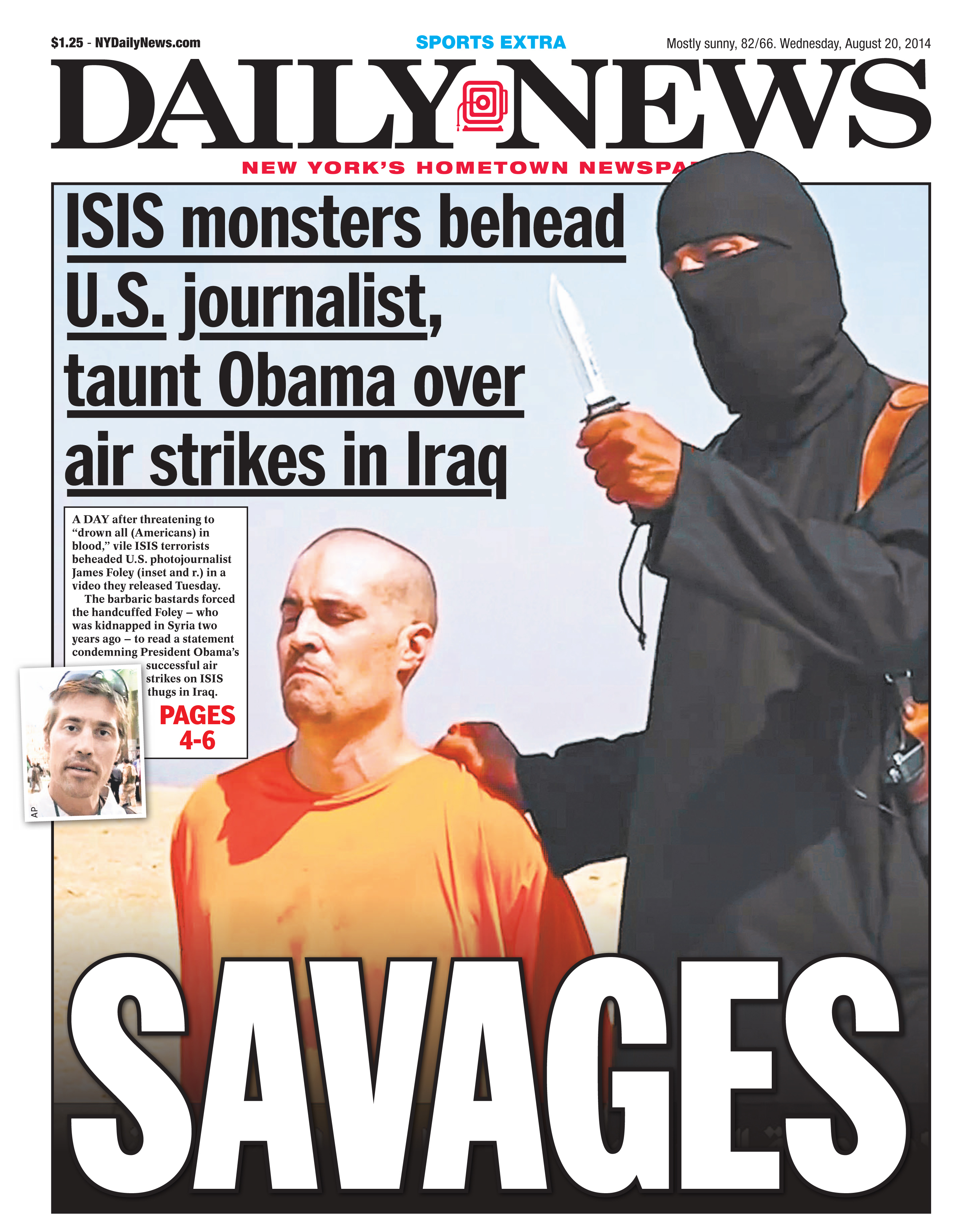 discourse has shifted from whether to counter ISIS to how to do so. In a month, everyone has agreed, it appears, that ISIS is a menace and that there has to be a US-led coalition to degrade and defeat it. The slippery slope toward the logic of war – which would be, by any estimation, a mere continuation of the war begun in 2003 – has been so greased there seems barely any friction.
This is the striking new fact of America this fall: re-starting the war in Iraq is now something that does not elicit immediate and horrified rejection by the president or the Congress. The GOP is daring Obama to go all-in as GWB, Round Two.
We should be wary of this! David Carr has a typically rich assessment of the production values and staging of the two beheading videos by ISIS, and it seems quite clear why they were made:
The executioner is cocky and ruthless, seemingly eager to get to the task at hand. When he does attack his bound victim, only the beginning is shown and then there is a fade to black. Once the picture returns, the head of the victim is carefully arranged on the body, all the violence of the act displayed in a bloody tableau. There is another cutaway, and the next potential victim is shown with a warning that he may be next.
“It is an interesting aesthetic choice not to show the actual beheading,” Alex Gibney, a documentary filmmaker, said. “I can’t be sure, but they seemed to dial it back just enough so that it would get passed around. In a way, it makes it all the more chilling, that it was so carefully stage-managed and edited to achieve the maximum impact.”
Like the horrifying images of 9/11, these images scramble our minds. And they are designed to. They are designed to awake the primordial instincts and the existential fear that Salafist fundamentalists thrive on. The direct spoken message to Obama puts this unbalanced British loser on a par with the president of a super-power – and, by reacting so comprehensively to it – the president has unwittingly given these poseurs a much bigger platform. More to the point, by already committing the United States to ultimately destroying ISIS, the president has committed this country to a war he was elected to avoid. Don’t tell me about “no ground troops”. If your mission is destroying something, and ground troops become at some point essential to that mission, the mission will creep – or they will claim victory.
I will wait and give the president a chance to make his best case Wednesday night. But let me say upfront: I deeply distrust wars that are prompted by this kind of emotion, however justified the emotion may be.
I lost my judgment completely as 9/11 coursed through my frontal cortex – and made errors that helped spawn more terror (like the current ISIS-dominated Sunni insurgency in Iraq). Many, many of us did. And when these slick, cartoonish nihilists press buttons designed to generate a reaction that they can then leverage some more, they are pulling the strings, not us.
The struggle in the Middle East right now is an infinitely complex series of overlapping civil wars, religious wars, and sectarian passions, exacerbated by demography, water, and the breaking of Iraq in 2003. It seems clear they are going to rage for years if not decades. What’s happening in Sunni Iraq right now is exactly what happened during the first insurgency: Salafists taking advantage of Sunni resentment to build an insurgency. But the fissures are obvious: even now, ISIS is murdering fellow Sunnis as well as Shiites and Turkmen and every other kind of infidel. The regional actors – placing bets and money and arms on various factions – pull all sorts of strings that can make any American initiative moot. And if we prevail, we will win no friends, merely new enemies. Notice this important nugget in a recent NYT story on the desperate, besieged Shiite Turkmen of Amerli, who finally defeated ISIS with the help of US air-strikes:
The fact that American air power had helped was not as celebrated. Some of the militiamen had fought the Americans after the invasion of Iraq in 2003. Mr. Abdullah spoke for many when he said, “We do not like the Americans, and we didn’t need their airstrikes.”
And that’s if we save them from imminent death. I’m with James Medaille on this:
Allow me to offer one hard and fast rule: to Americanize a civil war is to lose it. Not immediately, alas. In the short term, you get “mission accomplished”; in the long term, you get defeat. As soon as America takes over, America loses. The Vietnam War was going to be won or lost by the Vietnamese. The only question was which faction would triumph. When one faction entrusted their responsibilities to the Americans, they felt less need to defend themselves. Their defense became an American responsibility. When you outsource your defense, you become defenseless.
If we didn’t learn by now that trying to control or effect change in that part of the world by proxy or directly is a mug’s game, our amnesia truly is debilitating.
I await a full explanation of the actual, specific threat that ISIS poses to the US that requires a declaration of war; I certainly expect that the president should go to the Senate for a declaration of war after a robust debate; and I want an airing of all the many unintended consequences of entering into that vortex again.
What is happening in Iraq right now isn’t a war of Islam against the West. It is Islam against itself. And by making it our war, we may simply be endorsing a self-fulfilling prophesy. If any president were elected to avoid that, it was Obama.
The costs have come in significantly lower than expected. Kevin Drum more or less declares victory:
Paul Krugman calls this part of Obamacare’s “life spiral.” In other words, it’s exactly the opposite of the dreaded death spiral that every conservative in the country has been banging the drum about for years. Basically, as good news accumulates, it breeds more good news. As Krugman puts it, success feeds success. And that’s true. The news about Obamacare has been almost uniformly positive for months. There are still plenty of small problems here and there—most of which could be solved if Republicans would allow it—and the refusal of so many red states to adopt Obamacare’s Medicaid expansion is truly a scandal. Nonetheless, it’s clear that Obamacare is basically a success. There’s nothing much that’s likely to change that now.
But Robert Laszewski, one of the sharpest Obamacare critics out there, hasn’t popped the champagne. He expected modest premium increases this year:
[T]he reinsurance program virtually protects the carrier from losing any money through 2016. I’ve actually had reports of actuarial consultants going around to the plans that failed to gain substantial market share suggesting they lower their rates in order to grab market share because they have nothing to lose with the now unlimited (the administration took the lid on payments off this summer) Obamacare reinsurance program covering their losses.
We won’t know what the real Obamacare rates will be until we see the 2017 rates––when there will be plenty of valid claim data and the Obamacare reinsurance program, now propping the rates up, will have ended.
Despite those concerns, Greg Sargent feels the politics of Obamacare shifting:
Some misinterpret the suggestion of shifting health care politics as equivalent to claiming the law’s approval is rising or that it is becoming a winner for Dems. But that isn’t the argument. Straight approval/disapproval on the law has essentially remained unchanged for years — with some fluctuations around the botched rollout — and it remains a net negative for Dems that must be treated gingerly in red states. Those of us who argue the politics of the law are changing don’t mean to suggest otherwise.
Rather, the point is that the fading of negative headlines — combined with mounting enrollment — are shifting the ways candidates in both parties are talking about the law, potentially allowing Dems to mitigate the damage they might otherwise have sustained from it and to fight it out on other issues. There’s new evidence that this may be what’s happening. It’s now clear that the cooling passions over the issue are allowing Democrats more leeway to engage in debates over what is actually in the law, if not in debates over whether that thing called “Obamacare” is good or bad.
Suderman detects “a convergence of sorts, and also a kind of wary standoff, in which both parties are grappling with the fact that Obamacare is unpopular, but also that millions of people are now receiving its benefits”:
[I]t’s at least possible to imagine that the current convergence continues, and eventually results in a melding of the two party’s stances, leaving much of Obamacare’s basic infrastructure, including the exchanges, in place but altering them substantially and using them, in a kind of ju-jitsu move, as a vehicle to reform the rest of the entitlement system, which is ultimately a much bigger fiscal problem. That’s essentially what the Manhattan Institute’s Avik Roy has proposed in his recent health entitlement overhaulplan, which would deregulate the exchanges, end the individual mandate, transition Medicaid and Medicare to the exchanges, and, according to one estimate, could expand coverage even more than Obamacare.
The danger with that sort of plan is that no one will like it—that Republicans will see it as a concession to Obamacare, and Democrats as a fundamental attack on entitlements. Certainly it’s not something that the base on either side is willing to accept right now. But it’s also the sort of clever compromise that could eventually find backers on both sides of the aisle, especially as Obamacare settles in further.

When I first started blogging fourteen years ago, I always gave myself a month off in August. I’d never worked as hard as a journalist before, and the absorption of so much information together with the expenditure of so much energy and attention made me long for the empty days of late summer. And, of course, when I look now at the kind of blog I produced back then, it seems like a luxurious well of indolence. In a regular month, I’d write 70 posts; now the number is around a thousand – made possible by the team that now edits, creates and curates this blog. If the ratio of time off to blog-posts were calculated, even a month off now is really a week off back then. The exhaustion is more extreme; the recovery longer; the pace ever-faster.
It is fashionable to speak of the end of blogs these days, but in fact, almost everyone now has a blog, it seems to me. Everyone’s Facebook page is a blog of sorts; Twitter is a more efficient way of showering the world with little links and ideas (aka blogging like Glenn Reynolds, who was, in retrospect, a tweeter as a blogger); Instagram makes everyone a photo-blogger and aggregator. And so the month off becomes, in fact, much more necessary – and yet far more elusive. I get to take a month off because I own this thing – but it is not lost on me that, these days, that is almost a fathomless luxury. And to go not simply off-grid, but off-off-grid (in a place where no Internet signal can be found) suggests the desperation for rest and peace that we now all routinely experience.
So what do I see from off-off- the grid? I don’t see our virtual lives as chimerae, or imposters, or fakes. Like David Roberts, I see them as often rich aspects of our social lives, more accessible to the introvert (ahem), and opening up new avenues of communication and understanding. Roberts channels Montaigne here:
I don’t have any illusions about the inherent moral/spiritual superiority of meatspace friends and interactions. I don’t view my online life as some kind of inauthentic performance in contrast to a meatspace life lived as the Real Me. I can trace a great deal of the richness in my life back to digital roots.
The fact is, all our interactions are performances, even those interactions we experience as purely internal (that internal monologue). They are all shaped by larger cultural and economic forces. That’s because human beings are social creatures, not contingently but inherently. We are always ourselves in relation to someone or something; interacting with others is how children form their sense of being separate, autonomous agents. There is no homunculus, no true, authentic, indivisible self or soul underneath all the layers of social intercourse. It’s social all the way down.
I don’t think I’d go that far – there are things called genes, after all – but I do share his rejection of the notion that virtual life is inherently worth less than real life.
The trouble is that virtual life is like a cuckoo in the real life nest; it crowds out our real lives by seeming to replace them with something more addictive, compulsive, and energizing. And it requires discipline to keep it in its valuable, but delimited, space.
The trouble with one big off-grid break, in other words, is that it can become a means to be more effective at the virtual stuff once you get back to it. You get the rest and the perspective you need but only to dive back into the online rush. Our real lives become merely means to perpetuate our virtual lives; our play is designed to buttress work rather than to exist for its own sake. And those virtual lives distort us and exhaust us.
This seems to me to have a particular bite when it comes to my line of work. The president has been criticized for seeming to blame social media for exaggerating a sense of global crisis by broadcasting every single destabilizing incident in the world to everyone in the world, generating narratives and emotions that can overwhelm steady or sober analysis. But I think he’s onto something. To take the last month. All I hear from people is the sense that the world has been falling apart. And I’m not denying the genuineness of the feeling. But when I ask myself what has changed since I took off, I see nothing truly new. Russia continues to dick around with eastern Ukraine; the latest Sunni insurgency in Iraq has been beaten back a bit, but is still strong; the militarization of the police in the US has been more fully understood after Ferguson (Radley Balko, your hour is now); and the president should never, ever wear a tan suit.
Does that sound too calm an analysis? Maybe, and it usually takes a little time for me to acclimate myself to the news cycle and the conversation. So give me some time to get excitable again. But I’d wager the only reason I feel this way is that I was not pressed up against the window of unfolding history, trying to figure it out every minute of every day. Which perspective gets things right? A balance, surely, of the two. And a balance we have not yet mastered.
(Photo: a back route to Black Rock City, Nevada)
According to some sources (NYT), the Obama administration’s plan to stamp out ISIS is likely to last at least three years:
The first phase, an air campaign with nearly 145 airstrikes in the past month, is already underway to protect ethnic and religious minorities and American diplomatic, intelligence and military personnel, and their facilities, as well as to begin rolling back ISIS gains in northern and western Iraq. The next phase, which would begin sometime after Iraq forms a more inclusive government, scheduled this week, is expected to involve an intensified effort to train, advise or equip the Iraqi military, Kurdish fighters and possibly members of Sunni tribes. The final, toughest and most politically controversial phase of the operation — destroying the terrorist army in its sanctuary inside Syria — might not be completed until the next administration. Indeed, some Pentagon planners envision a military campaign lasting at least 36 months.
The president went on Meet the Press yesterday, where he intimated that going into Syria to fight ISIS is still very much on the table. To Max Fisher, this translates into good news for Assad whether Obama wants it to or not:
At this point … all of the US-supplied kalashnikovs and mortar rounds in the world are probably not going to be enough to help Syria’s moderate rebels take on both the Assad regime and ISIS at the same time, much less seize all that ISIS-held territory in eastern Syria. The possibility of US airstrikes against ISIS territory in Syria would make a difference, but far from a decisive one. The calculus of the war has to change, and that appears to mean that the United States will now form its own unspoken and unacknowledged agreement with the Assad regime: let’s put aside our differences, for now, and cooperate against ISIS, a mutual enemy we both hate more than each other. In its basic contours, it is almost identical to the tacit deal that the Assad regime made with ISIS against the moderate rebels.
But Ed Morrissey argues that ruling out boots on the ground, as Obama did yesterday, “tips our hand to ISIS and probably made them breathe a sigh of relief”:
The US can’t dislodge ISIS from the ground they firmly hold through bombings, because it would result in high numbers of civilian casualties. If Obama and whatever coalition he brings together can’t sustain boots on the ground, they won’t sustain that kind of collateral damage either, which means that ISIS’ leaders will only need to worry about assassinations via drones. Without boots on the ground, the US won’t be able to get reliable intel for that to make enough of an impact to drive ISIS back into the desert.
But the issue is more strategic than tactical, too. We will likely hear on Wednesday that only a united Iraq can defeat ISIS, but the Sunnis are not going to trust the Iranian-backed Shi’ites to share power again, and aren’t going to respond to American guarantees unless we put boots back on the ground. Given the choice between ISIS and the subjugation of their tribes by Iran, most of those tribal leaders will choose ISIS, which is the direct result of us abandoning them by leaving Iraq despite our earlier assurances that we could force Nouri al-Maliki to share power.
Meanwhile, Mark Thompson updates us on the weekend’s air strikes, some of which targeted Anbar province, expanding the campaign from northern to western Iraq. Juan Cole lists some other salient developments. One item on his list:
The mufti or chief legal adviser of Saudi Arabia on Islamic law (Sheikh Abd al-Aziz Al Sheikh) gave a fatwa or ruling on Sunday that ISIL is just a band of rebels and murderers who have blood in their hands. Those Western pundits demanding evidence that Muslims have condemned ISIL should take note. The mufti of a Wahhabi country has done so, showing that the Saudi elite has had a scare thrown into it, even if some Saudis secretly support ISIL.
Another bit of news Cole highlights:
The Arab League declared its enmity with the so-called “Islamic State.” All the governments are afraid of ISIL. Although Arab League Secretary-General Nabil Alaraby met with US Secretary of State John Kerry, however, it is not clear what exactly the body can do in any practical way for the war effort. The state best poised to intervene against ISIL, Jordan (which borders Iraq and has a good little military and intelligence capabilities) is at least in public begging off, for fear of ISIL reprisals in Amman.

From an assortment of emails that came in during the past month of guest-blogging:
Freddie deBoer’s blogging is the reason I finally renewed, specifically his Gaza posts, because he was saying such obvious things that no one else was saying, and I wanted to keep reading after the jump. He’s a really, smart clear writer whom I’d never heard of before. Nothing was annoying me about the Dish previously; it’s just that I’ve been reading Andrew since he started, and while I obviously like his writing, I’ve been reading him long enough to know what he’s going to say or think about most things, so I rarely feel the need to know what he’s going to add after the jump. In general, the guest bloggers have been better this summer than past years. If you’re looking for suggestions on how to improve the blog, you might think about having guest bloggers more often, even when Andrew isn’t on vacation.
Another joins the readers pictured above:
I have missed you. I wore my brand new shirt today (Meep Meep) and my subscription was renewed. I hope that you are renewed as well. Your sous chefs did a fine friggin job, so don’t sweat wearing the big hat again. The ball is still rolling, and in my opinion, it’s in your court.
You can buy your own Dish shirt here. More props to the guest-bloggers:
I’ve really enjoyed the posts from Elizabeth Nolan Brown and Phoebe Maltz Bovy. Andrew is great, but the thing I love most about the Dish has always been the different points of view and openness to those different points of view that show up everyday. That’s the magic that keeps me coming back again and again. In a media filled with people acting in bad faith, the Dish is a breath of fresh air. Seeing different people honestly engaging with their critics is a great example for the world.
On that note, a critic writes:
Although I’d been following Andrew since discovering him on Bill Maher’s show, his contempt for Hillary Clinton signaled to me that it was time for a divorce.
I’ve loved the Dish wherever I found it. I bought the Atlantic magazine subscription when Andrew asked, kept the Dish in the first spot on my Google favorites bar even when it was at the Daily Beast, and I regret none of the thousands of hours of non-billable time I’ve spent here. Because of my long and happy fanboy relationship with Andrew, I’m glad I was an original subscriber and when I re-upped, it felt like I was doing my part to maintain my sanity and that of hordes of other Disheads.
But the Clinton contempt is too ugly, too personal, too unhinged. I can’t make myself like her, but at least I understand she is a pol and hold her to the standard of pols, not the absolutes Andrew applies to her.
I’d been making mental preparations to find another site to check the ten times a day I’d otherwise be here. I was trying out Rolling Stone and Outside magazine. And then you brought on Bill McKibben and Alex Pareene as back to back subs. Climate change has never been covered enough here, even if you count the thought-provoking series about eating farm animals which is generally presented as an ethical, not environmental issue. But you brought on America’s foremost climate change writer and pretty well made my August. And, well, Pareene is a terrific and incisive writer and I’m glad he’s getting more exposure here than he gets at Salon. When he criticizes what some pol thinks rather than what they’ve said, he really offers a sparkling grasp of history and policy.
So, I may not keep the Dish as my first favorite on my bar and I may not even stop by very often once the 2016 campaign begins, but out of respect of the editorial decision to bring on McKibben and Pareene, I’ll re-up again in February.
More criticism from a different angle:
I hope you are having a great time on your break. I would never begrudge you your hard earned vacation time … but, it comes at some cost. I read the Dish virtually every day. It is a site unlike any other I know. The mix of politics, culture, art, science, and pure whimsy make it a joy to experience. I opened it today and was struck by what a difference your absence makes. I know your replacements are doing their best, but when you are gone, The Dish becomes just another rag. The whole feel and look of the site changes dramatically when your touch is absent. You have a brevity and economy of expression which is very rare. Your fill-ins write like they are paid by the word. I don’t mean to be harsh. The difference is just so stark … and inferior.
When you are gone, it’s like someone left the door open in mid-winter. Although, as I have said, I want you to have time off and thoroughly enjoy yourself, I am very much looking forward to your coming back and closing that damn door.
I’m both glad to be back and thrilled that the Dish can thrive – and even improve – in my absence. This blog is about the conversation, not me. But I can’t wait to be a full part of it again.
 The Dish