“Where Is The Republican Wave?”

That’s Charlie Cook’s question:

For Democrats, the good news is that there doesn’t appear to be an overwhelming Republican tide this year; the bad news is that Democrats could well lose the Senate even without such a wave. Six of the most competitive races are Democratic-held seats in states that Mitt Romney carried by 14 points or more. With a map like that, Republicans don’t need to dominate the country; they just have to win some select states.

Sean Trende adds his forecast to the pile:

I can emphatically say: It’s not certain that a big Republican wave is coming. Rather, the data we have are currently consistent with a wide range of potential outcomes, with a very good Republican year being the most likely result.

This is because our recent elections suggest that when a party holds the presidency, its candidates have a very difficult time winning over the votes of individuals who disapprove of the job that that president is doing. That could absolutely change in this election, but I believe the burden is on people who believe this time will be different.

Waldman talks up the Democrats chances of keeping the Senate:

For most of the year, the assumption among political observers has been that Republicans are likely to take control of the Senate in this November’s elections. … But in the last week or so, nearly all the well-respected predictive models are showing the Democrats with a better chance of keeping their majority than people thought. Republicans still have an advantage in most of the models, but in many cases it’s a smaller one than it was. What’s going on?

Let’s run down them quickly:

While two out of the five models show the GOP with an edge, it is not as large as it used to be in either — and three out of the five show it either very close to a toss-up or (as Princeton’s does) leaning Democratic.

But a recent poll on the Alaska race contains bad news for the Democrats. Nate Cohn analyzes it:

The only significant shift came in Alaska, where the result flipped from Mark Begich, the Democrat, who used to lead by 12 points, to the Republican Dan Sullivan, who now leads by six. Alaska, however, is a state where there are reasons to have reservations about the quality of the data. The panel had less than 500 respondents, despite recruitment efforts. There should be fairly low confidence in the exact finding.

Silver examines a bunch of new polls. His view:

The bottom line is not much has changed. The FiveThirtyEight forecast model gives Republicans a 65.1 percent chance of winning the Senate with the new polling added, similar to the 63.5 percent chance that our previous forecast gave them on Friday. … Republicans can win the Senate solely by winning Alaska, Arkansas, Louisiana, Montana, South Dakota and West Virginia, states which voted for Mitt Romney over Barack Obama by an average of 19 percentage points in 2012.
The End Of Britain?

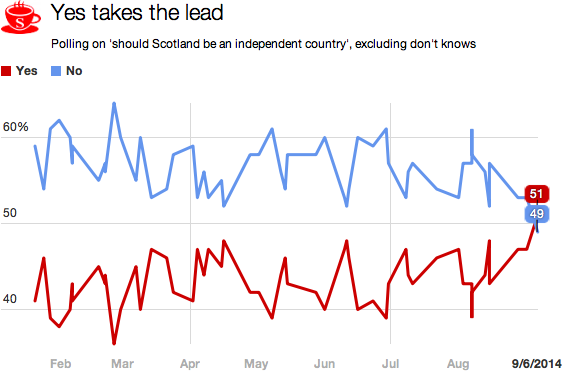
It’s looking more and more likely:

Scotland

Daniel Berman takes a close look at polling on the referendum. Why there is reason to question it:

British polling is problematic at the best of times, as anyone who observed Fivethirtyeight.com’s efforts to extend their successful model to the 2010 General Election, an effort I played a role in can testify. The Cleggmentum that dominated polling and media coverage of the campaign failed to materialize in practice. Was the media wrong? Only to the extent they focused on the polling.

Why then was the polling off? There are several reasons why UK polling is generally less reliable than its American equivalent. For one thing, “partisan weighting” the effort to ensure that your sample is politically and not just demographically representative of the electorate is an obsession for British pollsters, and has been ever since John Major’s surprise victory in the 1992 elections prompted a search for the “shy Tory” voter.

On the issue at hand:

YouGov’s Yes lead is the result of changes in sample composition rather than a clear shift, though a substantial shift in the preferences of Labour supporters was detected.

Angus Roxburgh, a Scot, is in favor of independence:

Independence is not about erecting barriers. The Scots and English would still be the closest allies. Yet independence would give us a chance to build a country that better reflects the identity and prioritiesthe political culture, if you willof the majority of those who live here (both “ethnic” Scots and those who have come here and taken the land to heart).

James Forsyth, on the other hand, wants to keep the union intact:

Given the closeness of the polls in Scotland, I suspect that the result might be determined by how clearly the Scots hear the rest of the UK saying ‘please, stay’. So, if you believe in this country and want to save it, pick up the phone and call your Scottish friends and family and urge them not to leave us.

The announcement that William and Kate are having a second child could be an additional factor. Hayes Brown explains:

[T]he as-of-yet-unnamed pending addition to the Royal Family could be just the boon needed to help turn back the tide against a surge of support for Scottish independence. Last year, William and Kate welcomed their first child — George — into the world amid a media blitz that even the media itself would later say was somewhat excessive. But George’s birth had some tangible benefits for the Windsor dynasty. A poll taken last year by British firm ComRes showed that since the wedding of the two young royals, and especially after the first appearance of Prince George, the popularity of the British Crown has skyrocketed. Beating out even the Diamond Jubilee and London Olympics in terms of support, last year’s Royal Birth led to two-thirds of Britons supporting the monarchy.

Krugman tells Scotland to think twice about independence:

In short, everything that has happened in Europe since 2009 or so has demonstrated that sharing a currency without sharing a government is very dangerous. In economics jargon, fiscal and banking integration are essential elements of an optimum currency area. And an independent Scotland using Britain’s pound would be in even worse shape than euro countries, which at least have some say in how the European Central Bank is run.

Daniel Clinkman, an American living in Scotland, shares his perspective on the forthcoming vote:

I am not Scottish, but the country became my home for many years and I am passionately in favor of what is best for Scotland’s people, whatever they decide. I think that the activism and thought given to this by Scots of both nationalist and unionist persuasions is very different from the stereotype of the emotional, skiving Scot put out by the Better Together campaign and its sympathizers in the press.

Last but not least, Alex Massie feels that “that Yes had an easier job  – and perhaps a better story to tell – in this campaign”:

Perhaps Scots will peer over the edge and think, jings, that’s a long way down. Perhaps we’ll conclude that, despite everything, all things still aren’t busy being equal but right now, this morning, that seems about the best the Union can hope for. Still time for things to change, right enough – only one poll and all that –  but, you know, there are peer and herd effects here: the more thinkable an idea becomes the more popular it is likely to prove. People say: Bloody hell, if you’re going to jump I’ll jump too. Even if it is a long way down.

I have to say that Krugman’s column, while pertinent, had a bit of the “What’s The Matter With Kansas?” about it. This decision is not only about economics; it’s about history, identity and the nation-state. At this point, I wouldn’t be shocked if the Yes’s win the day. These pressures have been building for some time.

Women And Children And Everyone Else First

Morwari Zafar suggests that humanitarians who use the phrase “women and children” as a “single term of reference” are misguided:

To address civilian casualties in terms of women and children in the context of war is one thing. However, extending the paradigm in international development is both myopic and wholly insufficient.

This is not to deny that women and children bear a devastating spectrum of atrocities, including targeted sexual violence as casualties of war when men are often combatants. The consolidation of women and children therefore can be a positive association, by ensuring adequate protection and prioritization during a crisis, as political scientist R. Charli Carpenter notes.

However, a study of the Srebrenica massacre in Bosnia by Laura Shepherd states that “in evacuating ‘women and children’ as synonymous with the ‘civilian population,’ protection agencies replicated the notion that the remaining population was composed of ‘fighters’ and legitimised [the Bosnian Serb army’s] targeting of those individuals.” As such, socially constructed norms about women and children as “innocent civilians” ended up marginalizing men who were not necessarily combatants. In development discourse, separating women and children by a conjunction only binds them together as mutually dependent, helpless victims whose protection and well-being rest in the hands of higher, more capable authorities, who are often male in patriarchal contexts such as Afghanistan.

Locked Out Of The House

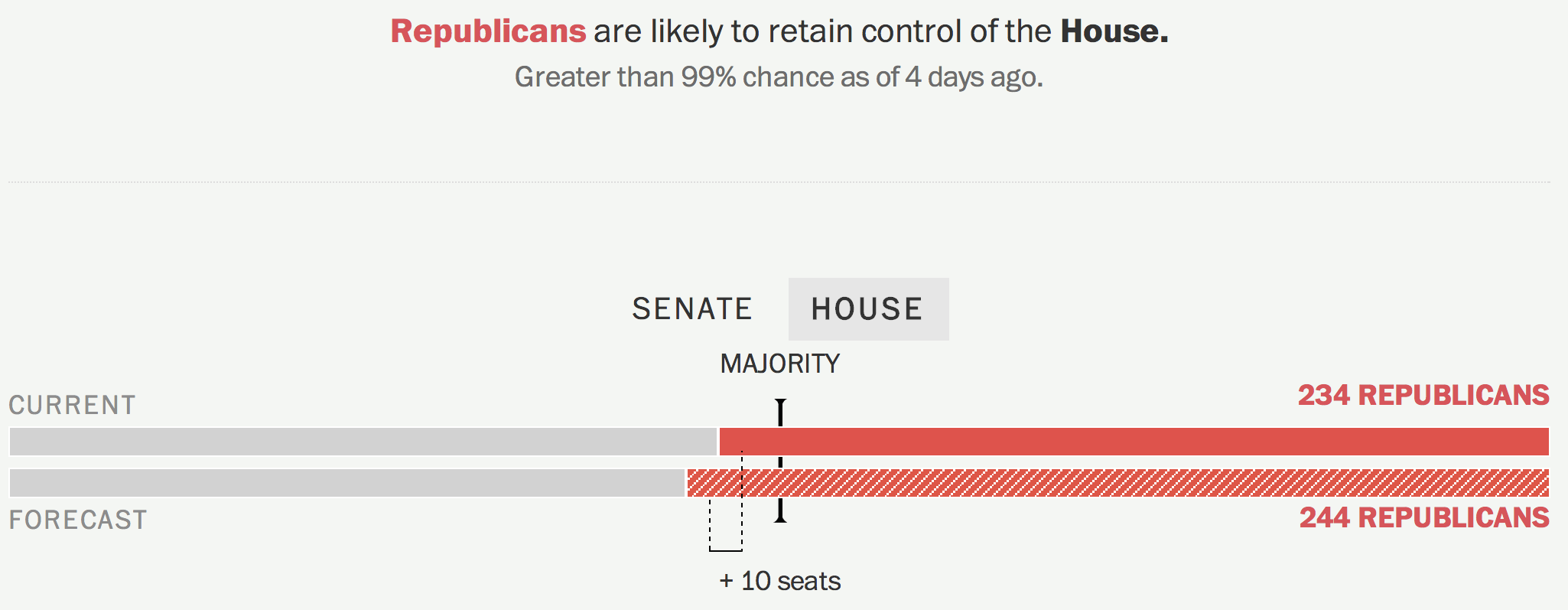
Republicans have a close to 100 percent chance of keeping control of the House this year:

GOP House

And it’s not just this election cycle. In Nate Cohn’s estimation, getting back the House anytime in the near future will be a very heavy lift for Democrats:

To retake the House, Democrats would not just need another great election year, like 2006 or 2008; they would need to build a much broader coalition than the one they currently focus on in presidential elections. They would need to attract the voters that some liberals thought they could abandon: the conservative Democrats of the South and Appalachia, where the vanquished Blue Dogs once reigned. …

A Democrat with more support than Mr. Obama in the traditionally Democratic South, like Hillary Rodham Clinton, could potentially help Democrats in these areas. But it is usually difficult for the incumbent president’s party to make gains in the House in any election year. A Democratic rebound in places like West Virginia or Arkansas might be easier to imagine if a Republican wins the presidency in 2016 and struggles heading into the 2018 midterms.

Waldman bounces off Cohn:

[T]here are two parallel processes happening, one of which benefits Democrats and one of which benefits Republicans.

By appealing to white voters and characterizing Democrats as the party of the non-white, Republicans can hold onto the House. But the more they’re perceived to be the party of white people, the harder it is for them to win presidential elections. As we’ve seen time and again over the last couple of years, even when national Republican leaders would like to make the party friendlier to minorities, right now the GOP is defined by the one place where it holds power: the House.

One answer to the question of what the Democrats can do to make taking back the House a possibility is simple: They can wait. The demographic groups that make up their coalition are increasing in size as a proportion of the population, while the group that makes up almost the entirety of the GOP’s base is shrinking. It’s a slow process, but as whites become a smaller and smaller portion of the American populace, it’ll be tougher and tougher for Republicans to maintain their lock on the House. They may have it for a while yet. But it won’t last forever.

About That Waterboarding

If you are wondering why the release of the Senate Intelligence Report has become a titanic death-struggle in the Beltway, this may help:

The CIA brought top al-Qaeda suspects close “to the point of death” by drowning them in water-filled baths during interrogation sessions in the years that followed the September 11 attacks, a security source has told The Telegraph. The description of the torture meted out to at least two leading al-Qaeda suspects, including the alleged 9/11 mastermind Khalid Sheikh Mohammed, far exceeds the conventional understanding of waterboarding, or “simulated drowning” so far admitted by the CIA.

“They weren’t just pouring water over their heads or over a cloth,” said the source who has first-hand knowledge of the period. “They were holding them under water until the point of death, with a doctor present to make sure they did not go too far. This was real torture.”

These, of course, are second-hand sources and we await the real thing. But how this democracy will handle these war crimes in plain sight in an age of a surging ISIS will be deeply telling.

The Immigration Can Gets Kicked Down The Road

ICE Detains And Deports Undocumented Immigrants From Arizona

Obama is delaying his executive order on immigration deportations until after the elections. Jonathan Cohn spells out the political logic of the move:

Vulnerable Democrats seeking reelection let the White House know, publicly and privately, that they feared an executive order would deal serious, maybe fatal, blows to their candidacies: While the ensuing debate would energize immigration reform supporters, particularly Latinos, it would also energize the conservative base. Given the political geography of the 2014 midterm elections, in which control of the Senate will depend on the ability of Democrats to hold seats in red states like Arkansas and North Carolina, the political downside seemed bigger than the political upside.

But Ezra Klein has a hard time squaring this political calculation with the White House’s former rhetoric:

This is the problem with the White House’s decision — and, to some degree, the way they’ve managed this whole issue. If these deportations are a crisis that merits deeply controversial, extra-congressional action, then it’s hard to countenance a politically motivated delay. If they’re not such a crisis that immediate action is needed, then why go around Congress in the first place?

Cillizza sees signs of political malpractice:

[W]hat Obama and his senior aides failed to account for — or underestimated — was the blowback from within his own party to a major executive action by an unpopular president on an extremely hot-button issue.  (Worth nothing: Obama’s approval numbers eroded steadily over the summer and into the early fall; his political standing today is weaker than it was when he pledged action on June 30.)  The move, it became clear, would have been seen as bigger than just immigration as well; it would have been cast (and was already being cast) by Republican candidates and strategists as simply the latest example — Obamacare being the big one — of federal government overreach.

This disconnect between the long-term legacy building prized by Obama and the near-term political concerns of many within his party is not new but, quite clearly, became a major point of tension.

Beutler is puzzled:

The political reasoning sounds incredibly straightforward. Most of the Senate Democrats running in tightly contested elections represent conservative states with low immigrant populations and deep hostility to “amnesty.” So why introduce more uncertainty into those campaigns, and potentially ignite a fire under the GOP base, when you could just as easily wait six weeks?

But it also seems suspiciously simple to me. That’s in part because I don’t entirely understand how much cover you buy for vulnerable Democrats if you put off the official announcement, but tell the press that the dreaded amnesty is coming just a few weeks later.

PM Carpenter is befuddled by the White House “political operation’s second-term bumbling”:

Now, everybody is pissed off. Immigration activists are screaming “betrayal” and “broken promise;” a major labor union is “deeply disheartened”; the nation’s most influential Spanish-language news anchor has denounced the delay as “the triumph of partisan politics”; Republicans are gleefully outraged; and Democrats are stuck with defending an executive action that never was, but still will be–“I’m going to act because it’s the right thing for the country,” said the president [Sunday] on “Meet the Press”–thus it might as well have been.

Gabriel Arana takes the president to task:

Given how long immigrants have had to wait for any sort of relief from the fear of deportation, another few weeks may seem like no big deal — that is, of course, if you’re not one of the tens of thousands of people who’ll be kicked out of the country while the president waits out the midterms.

But for many immigrant-rights supporters, the delay shows the president doesn’t understand the moral crisis at the heart of the immigration debate, in which those looking to escape poverty get branded as parasites, their children as “anchor babies.” Our dysfunctional immigration system has created a powerless class of millions of people; without the ability to vote or to advocate on behalf of themselves in public, they have no choice but to wait for our politicians to take sympathy. Lawmakers all “play politics,” but extending the suffering of this vulnerable population because it might save you a few votes at the ballot box is yet another sign you don’t fully consider them Americans.

How Tomasky sees this playing out:

Despite whatever acidic rhetoric Latino leaders are dishing out toward Obama today, I would expect that will change this fall. He’ll announce his unilateral moves on immigration after the election. The Republicans will boil with rage. In all likelihood, they’ll move to impeach. So then we’ll have the spectacle of one party—the party that has blocked the passage of an immigration bill in the first place—seeking to throw a president of the other party out of office for trying to do something on immigration that he wouldn’t have had to do if the first party hadn’t spent two years refusing to pass a bill. It’s pretty clear which side of that fence the vast majority of Latinos are going to come down on.

(Photo: A Honduran immigration detainee, his feet shackled and shoes laceless as a security precaution, boards a deportation flight in Mesa, Arizona to San Pedro Sula, Honduras on February 28, 2013. By John Moore/Getty Images)

A New Kind Of School Segregation?

Liza Long, author of The Price of Silence: A Mom’s Perspective on Mental Illness, objects to her psychologically troubled son being taught separately from the other kids:

At first glance, this might seem like an ideal solution: the neurotypical kids get to learn without disruptions, and the students with mental illness and/or developmental disabilities have a safe environment with additional dedicated support from teaching assistants. And since it’s a contained program, it saves the district money in the short term—and we all know how thin most school districts are stretched.

But I would suggest there is an uglier word for this approach to education: segregation.

What is the logical consequence of taking 100 students with behavioral and emotional symptoms between the ages of 12 to 21, 95% of whom are male, and putting them together in a program that will not allow them to earn a high school diploma or to learn to interact with neurotypical peers? In our society, too often the consequence is prison. … By not integrating children with mental illness, which admittedly sometimes manifests through challenging behavioral symptoms like unpredictable rage, into the general school population, we are contributing to the ongoing stigma of mental illness.

Meanwhile, Hyper: A Personal History of ADHD author Timothy Denevi meditates on raising a child while struggling with mental health problems himself:

One of the most difficult aspects of mental illness, especially within the context of parenthood, is finding a way, when it comes to your life and its influence on the people you love, to do more good than harm. In the end you can’t possibly predict what’s really coming: the moment in the future that will dislodge you from the balance you’ve worked so hard to achieve. It might be a random calamity, or one you’ve personally brought about. But the incredible truth is that it’s already on the way. And against such a prospect, what good can something like a therapist or exercise or a low-dosage psychostimulant actually do?

This isn’t to dismiss the idea of effort. In fact it’s the opposite: imagining all the things that could go wrong or right for my family, I can’t help but find solace in action. I’m lucky that there are steps I can take, and that often enough they do tend to help. What matters is the act itself: an expression of love for the most important people in my life. After all, there are many ways to show how you feel; is it so terrible that one of mine happens to take the form of self-preparedness?

Update from a reader:

I think someone at the Dish should have vetted the author before posting the latest Time fluff sympathy piece from Liza Long.  She has a well-documented history of being a mother of a significantly troubled son who writes about him and her experiences extensively, namely with her controversial piece “I am Adam Lanza’s Mother.”

I don’t waste time objecting to how much she’s exposed of her son and her life, because frankly, she bears a huge burden.  But I do object to her advocating for including significantly troubled children in a regular education setting to the disruption of other students, many of whom bear their own burdens of life and trying to get a decent education in school, and also because children who are significantly troubled require a different environment.  Those padded isolation rooms?  They are often used as a last resort for children who are so out of control they throw chairs at other students, hit their teachers, or yell, rock, or endlessly try other ways to calm themselves.

The school staff members who work with these children on a daily basis are uniquely qualified and incredibly devoted to working with these children.  They are required by law to be with a child during their time spent in a seclusion room.  Many times they sit in the room and wait for the children to calm down, they talk to the child and encourage them to express their feelings in a socially appropriate way (because depending on their individual needs, many of these children spend the majority of =their time trying to manage their own emotions and relate to others.  They are not sitting in their seats learning French.)  The staff members will remove themselves from the room – sitting outside maintaining visual contact to make sure the child isn’t hurting himself – if they can see that their presence is merely escalating the child’s behavior.  People who work in these positions are incredible.  They can read the child and they respond differently to different children in whatever way will help that child.

The laws that Liza Long denigrates – because it may interrupt an “important work presentation” – are two federal laws that are designed to provide every child with a way to receive an education in a way that recognizes and works with each child’s individual limitations and needs.  These laws have changed the lives of millions of children and parents.  Before these laws existed, children – who now have a legal right to the least restrictive environment in the school that their peers attend – were relegated to mental institutions, schools for the blind or deaf, or home.  And they have this right with no extra expense of their own (except to advocate for their rights, a cost that every person must bear) – school districts and public taxpayers pay all costs of these educations.  Parents pay NOTHING more than any other child who attends the school in regular education classrooms.

And frankly, from the way Liza Long describes her son and her own reaction to him, he should be in a place where his uniquely dangerous and difficult needs can be assisted by adults who are trained, and kept separate from other children who need to be able to attend school and learn in a safe environment.  She is absolutely the wrong person to advocate for the position in this incredibly shallow Time essay that is light years behind an actual discussion of the merits of these children’s needs.

Intellectualism At Odds With Democracy

800px-TeaPartyDC2009Sept12PennAve

Nicholas Lemann looks back at Richard Hofstadter’s Anti-Intellectualism in American Life, first published just over fifty years ago in 1963. He appreciates that Hofstadter “does not see anti-intellectualism as the corrupting serpent in the American Eden … as he demonstrates, it has been deeply ingrained in the national culture from the very beginning”:

[T]o Hofstadter, intellectualism is not at all the same thing as intelligence or devotion to a particular set of ideas. It is a distinctive habit of mind and thought that actually forbids the kind of complete self-assurance that we often associate with very smart or committed people. You can see how the all-out quality of fundamentalist religion, or of salesmanship, or of ideologically driven politics, would have been anathema to Hofstadter. Being himself an exemplar of his conception of the intellectual, he saw the essential problem that is the subject of the book as being an unresolvable tension between intellectualism and democracy:

Anti-intellectualism . . . is founded in the democratic institutions and the egalitarian sentiments of this country. The intellectual class, whether or not it enjoys many of the privileges of an elite, is of necessity an elite in its manner of thinking and functioning . . . . Intellectuals in the twentieth century have thus found themselves engaged in incompatible efforts: They have tried to be good and believing citizens of a democratic society and at the same time to resist the vulgarization of culture which that society constantly produces. It is rare for an American intellectual to confront candidly the unresolvable conflict between the elite character of his own class and his democratic aspirations.

Because Hofstadter does confront the conflict candidly, he winds up in a very small category. It’s interesting to think of him in contrast to, for example, Walter Lippmann, who wrestled with the same problem for years and wound up becoming more and more unsympathetic to democracy. Hofstadter’s position is far more morally attractive, because it acknowledges the appeal of both sides and proposes a continual struggle between them, rather than the establishment of an American version of Plato’s Republic. That has the advantages of descriptive accuracy, and of realism. Hofstadter’s lesson is that those who oppose anti-intellectualism should conceive of their lives as a struggle that will never conclude in victory but that also need not ever end in total defeat.

(Image: Tea Party rally, Pennsylvania Avenue, Washington DC, September 2009, via Wikimedia Commons)

Should Looks Be On A Resume?

Deborah L. Rhode addresses the persistence of appearance-based job discrimination:

In one national poll, 16 percent of workers reported that they had been subject to such bias, a percentage that is slightly greater than those reporting gender or racial prejudice (12 percent). Most women do not believe that employers should have the right to discriminate based on looks. The reasons are straightforward. Such discrimination compromises principles of individual dignity and equal opportunity to the same extent as other forms of bias that are now illegal. Yet only a small number of jurisdictions explicitly ban discrimination based on appearance. What accounts for the difference in treatment?

To many observers, appearance discrimination seems a rational response to customer preferences. Employees’ attractiveness can often be an effective selling point, and part of a strategy to “brand” the seller through a certain look. According to a spokesperson for the Borgata Hotel Casino & Spa, its weight limits and periodic “weigh-in” requirements for “Borgata Babes” cocktail waitresses responded to market demands: “Our customers like being served by an attractive cocktail server.”

Rhode argues for new employment laws:

Part of the problem is that attractiveness and grooming standards fall along a continuum.

How would employers or courts determine when an individual is unattractive enough to warrant protection? Critics worry that appearance discrimination laws will result in “litigiousness run wild,” impose “untold costs” on businesses, and erode support for other legislation prohibiting “truly invidious discrimination.” As one trial judge noted, courts “have too much to do” to become embroiled in petty grooming code disputes about where women can and can’t wear pants. …

[It is not] likely that prohibitions on appearance discrimination would unleash a barrage of loony litigation. The few jurisdictions that have such laws report relatively few complaints. Cities and counties average between zero and nine a year, and Michigan averages about 30, only one of which ends up in court. Given the costs and difficulties of proving bias, and the qualifications built into current legal prohibitions, their enforcement has proven far less burdensome than opponents have feared.

From a review of Rhode’s book The Beauty Bias, Emily Bazelon highlights a success story from such laws:

In 2002, Jennifer Portnick taught exercise classes and worked out almost every day. But the fitness company Jazzercise turned her down for a franchise because she weighed 240 pounds (height 5-foot-8). Jazzercise told Portnick that its instructors “must have a high muscle-to-fat ratio and look leaner than the public.” Portnick complained to the San Francisco Human Rights Commission, under a law the city had passed in 2000 to prevent discrimination on the basis of appearance. She won. And Jazzercise changed its tune nationally, saying it would no longer demand thinness from its instructors.

Back From The Desert

It’s particularly impressive, it seems to me, that Grover Norquist went to Burning Man and wrote this about it to be published on the Tuesday after. I can barely type even now, and it’s been almost a week since I left. I guess we had somewhat different experiences.

Which is the point, no? I loved this post on the Burning Man blog defending Grover from all the haters (which kinda channeled Freddie’s great post):

While you may disagree with [Grover] about aspects of Burning Man, and while his experiences of 2014′s Burning Man may not be your experiences, there’s absolutely no doubt that he did, in fact, experience Burning Man: that he got out of it what the rest of us get out of it, and that he wants more the same way we all do.

Good for him.  Good for us.  Not only because if “radical self-expression” means anything at all it means having your own opinions about important issues, and if “radical inclusion” means anything at all it means not imposing a party line if we can possibly avoid it.  More than that:  why would we want to belong to a movement so precious that you already have to agree with a set of pre-fabricated conclusions just to get your foot in the door?

Screw that.  If that’s what you want, there are already plenty of places you can go where people will sit around agreeing with each other in total smugness, thoroughly convinced that if there were to somehow be another opinion in the world it would be wrong because it would be different.

Screw that.

Yeah, screw that.

At this point, I suppose, I am expected to give my version of my week in the desert, in the bowels of a throbbing, mobile homosexual sheep (for that was my camp). But as I got more and more used to what was, to all intents and purposes, another world for a week, I realized I 10671349_756474594394418_1653192549247640600_ndidn’t want to share much of it with the outside. It was a wondrous experience, one hard to convey in words, in which a merry band of brothers made new friendships and deepened old ones. I need a special space for where words don’t matter and I would only befoul it with more words. So if you want to understand it – and I can’t say I fully do yet – go there. No one can experience it for you.

For me, part of its allure was that I was with an old dear friend, and part was its utter separation from my normal life. I had no phone service, let alone an Internet connection. I put my wallet away as soon as I got there. From then on, I had total freedom to explore a place which total freedom had created. My friend took almost poignant care of me – while occasionally (okay, often) bursting into laughter at something I had said or done. I guess it’s good to get laughed at in the desert once in a while. And we laughed a hell of a lot.

Two moments stick in my mind.

One night as we were traversing the darkest playa, the colored lights on our bikes serving as some kind of guide, we came across one of the countless art cars. This was a relatively simple one: it looked like an iron house perched on wheels, with a spiral staircase inside which you ascended to reach the second floor … which had nothing but a balcony. So we went out there and looked at the stars – you can actually see them there – and a tall dude in a white floor-length fur coat, covered with fairy lights, arrived with a ukelele. He proceeded, quite simply and quietly, to sing “Across The Universe” and we joined in.

And then, one morning, having stayed up all night (again), I was biking homeward in the gathering heat when I saw a man emerge from the dust ahead of me like an Old Testament prophet, holding a paper plate up high as if he were offering something to the gods. Then, in one of several Burning Man moments, I realized he was offering something to me. “Would you like some bacon?” he asked me, lowering the plate so I could see and deliriously smell the still-sizzling little things. “Yes, please,” I said, which was, at that point the extent of my conversational skills. I had nothing to offer him back, but by that time, I had gotten used to the random acts of kindness and generosity that peppered my time there. So I simply said thank you and went on my way.

A giant THANK YOU to the Dish team and the guest-bloggers who made my real vacation from everything possible: to the Dish staff who proved this blog can thrive independently of me, and who already edit and write most of the Dish with such flair, and passion and imagination – Chris and Patrick, Jessie and Chas, Matt, Jonah and Tracy, Alice and Phoebe; and to guest-bloggers Elizabeth Nolan-Brown, Bill McKibben, Sue Halpern, Freddie DeBoer and Alex Pareene. A thank you too to the reader who wrote her account of her own rape. It’s open tenderness like that that makes this such a vital, raw and real space.

And thanks to you for showing up in such large numbers – August was a huge traffic month without me – and sustaining the conversation about the world while I was in another one. So much happened while I was away that I am still grappling with all of it and will have much more to say tomorrow. But it was lovely for a while to be in something of a utopia, which like all utopias, cannot really exist, except as a mirage, and will always end in ashes and dust.

It stays with you, that sense of that place. And, with luck and grace, changes you.

See you in the morning.

(Photo of the BAAAHS sheep by Louisa Corbett.)