Our Fearless Freelancers

by Jonah Shepp

Among the many pieces written in memory of Steven Sotloff since the news of his death broke on Monday, a few of them struck a particular chord with me, touching on the dangerous, precarious, but potentially greatly rewarding life of a freelance war correspondent: a job in which many young journalists cut their teeth and often make their careers. Michael Totten, who corresponded with Sotloff but never met him in person, remarks that he was “a hell of a lot braver than I am”:

I have not for even a second considered going to Syria during this conflict, and I doubt I’d be willing to go there even a couple of years from now if the conflict were to miraculously end later today. When he lived in Benghazi and everyone was heading for the exits, he told me—and I believed him—that Benghazi was the same old Benghazi, by which he meant mostly fine aside from some unfortunate incidents. Dangerous places are often, though not always, less dangerous than they appear in the media. At least they appear that way. Maybe that’s just a trick of the mind.

Joe Klein didn’t know Sotloff at all, but praises his ilk of freelancers:

I’ve known many stringers like Steve Sotloff and admired almost all of them. They turn up in war zones or other difficult places, looking for adventure and hoping to make a splash…or just tell a compelling story. Many of the brilliant war correspondents whose words and photos have graced Time’s pages started off as stringers. Other stringers can also be academics, with a language skill or a love for the country in question. (Believe me, it is easy to fall in love with Syria and Syrians, or the Yemenis or, in a different era, the Vietnamese.) Still others are local nationals, who risk everything to work for the American media for a variety of reasons–money, truth, patriotism, professional pride. But they all have one thing in common: they are lovers of freedom, personal freedom, their right to pursue the news.

Recalling her time as a stringer in Moscow, Julia Ioffe wrestles with the question of why young journalists take these risks:

[I]f we’re honest with ourselves, we journalists are not just doing it to inform the reader. We’re also taking these risks for ourselves, making the calculation that, stringing and freelancing in places where papers and magazines are either too scared or too cheap to send permanent correspondents, going to iffy places and often for a pittance, someone will notice our labors and reward us with more work, and maybe even a job. It is a bright and risky way to launch a career. It’s also a way to discover that, even if it’s hard to break in, if this is what journalism is, you don’t want to do anything else for the rest of your life. … But the gambit never paid off for Sotloff. His beheading will be, for most anyone who hears his name, the sum total of his career. That is so immensely crushing and disappointing. It’s also, for us journalists, a reminder of the gambit’s downside, the shortness and slipperiness of the future, and the utter fragility of our plans.

I came into journalism through a side door, never having intended to enter the profession until a job as an sub-editor at The Jordan Times simply fell into my lap, mainly by dint of my ability to write in English. I did a little reporting, but nothing very substantial. What I liked about the job was getting to know the country through what my colleagues reported, as well as what our stories left out, which came to me in editorial meetings and cigarette breaks with the reporters. Friends advised me to do what my colleague Taylor Luck later managed to do and offer myself as a stringer to American newspapers. I e-mailed a high school friend who works at the WaPo to find out how to do that, but never followed through with the editor she referred me to.

The reason, to be perfectly honest, is that I never really had the disposition of a reporter. I love the news, but digging it up requires a certain fearlessness that I never really had. And I certainly could never hack it as the sort of reporter who travels to a war zone: I just don’t have the guts. I could never, like Nir Rosen once did, disguise myself as a member of the Taliban to get an angle on the Afghanistan war that those who followed the US Army could not.

So while Taylor immersed himself in his reporting, learning to speak Arabic 100 percent fluently and making such deep connections in Islamist circles that we joked around the office that he had become one of them, I sat at my desk and got to know Jordan mainly through the stories I edited and by becoming close friends with some of my Jordanian colleagues. By no means is that a bad way to get to know a country, but I always felt a little guilty that I wasn’t taking advantage of the opportunity to go deeper, and worried that I was missing that extra insight that comes from “being there” in the middle of the riot or the battle or the aftermath of the natural disaster.

It takes a great deal of courage, or at least much more than I have, to travel to a foreign war zone and report directly from the rubble and carnage, to embed among rogue militias, to see the destruction firsthand and actually look the widows and orphans in the eye and give them a voice with one’s writing. It’s especially brave to do so without a net. Dedicated war reporters like Foley and Sotloff, to say nothing of their Syrian colleagues who risk imprisonment, torture, and death to get the story, are heroes to humanity in that respect. Bravery like theirs is hard to come by.
Cops Cross Wrong People On Both Coasts

by Alex Pareene

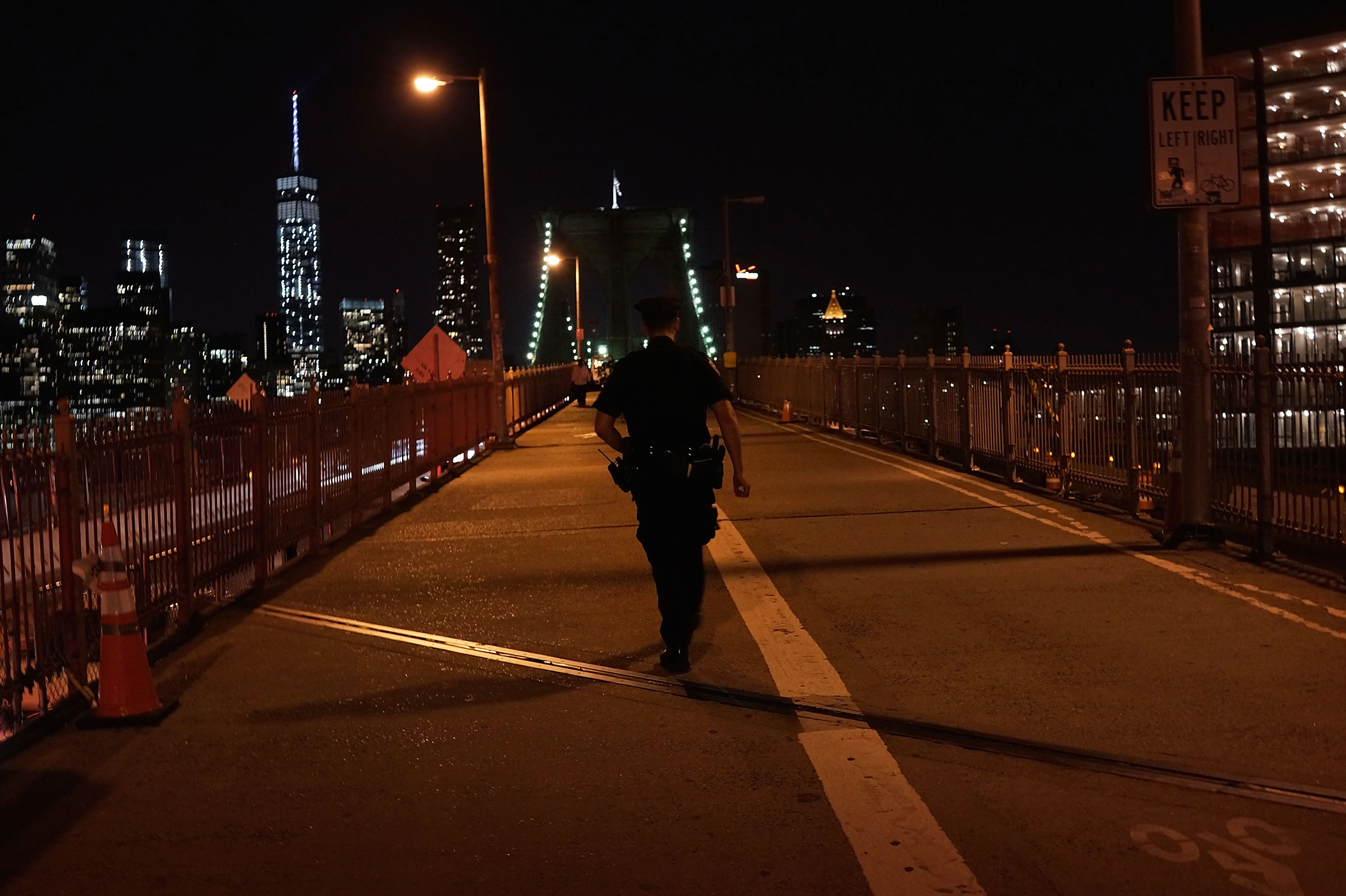
Police Presence Increased On Brooklyn Bridge After Recent Security Breaches

Speaking of cops: Two illuminating stories of officer-involved citizen interactions came across my Twitter feed within a few hours of each other. They occurred at opposite ends of the country, only one ended in an arrest, and neither ended in any serious injury or death, but they both illustrate what happens when urban cops apply their usual treatment of marginalized communities to people with actual power.

The first is from DNAinfo. Last month, following a pro-Palestinian rally in Times Square, Chaumtoli Huq was waiting outside a Ruby Tuesday in Midtown Manhattan while her husband and children used the bathroom inside. Two police officers approached and asked her to clear the sidewalk. She declined. They pinned her against the wall and arrested her. She was charged with obstructing governmental administration, resisting arrest and disorderly conduct. The resisting arrest charge was because she allegedly “flailed her arms and twisted her body” while the officer was attempting to handcuff her for waiting on a sidewalk for her family to come out of a restaurant. (A “resisting arrest” is frequently an indicator that a cop just really wanted to arrest someone but couldn’t come up with any actual crimes to justify it.)

She added that officers went through her purse without probable cause before taking her to the Midtown South Precinct — all while her family was still inside the restaurant. Huq’s husband and children were notified by another officer and eventually came looking for her at the precinct, according to her federal civil rights suit, which is expected to be filed Tuesday. Officers offered to deliver Huq’s purse and personal items out to her husband, but then became suspicious when she told the officer his last name was different than hers, according to the lawsuit. “In America wives take the names of their husbands,” the officer told her according to court papers.

The second story is from KPIX 5. In Oakland, California, not long after Huq’s arrest, a police officer pulled a gun threatened to pull a gun on Keith Jones and his two sons:

It was 10:45 p.m., after a recent Raiders game. Veteran firefighter Keith Jones and his two sons, ages 9 and 12, were walking back to their SUV at Station 29. A fire crew responding to an emergency had forgotten to close the garage door. Jones went in to make sure everything was secure. As Jones walked out, he said a police officer, responding to a possible burglary in progress, yelled “Don’t move, put your hands up.”

“And his hand is on his gun. He was crouched, he was low, and he was basically in a shooting stance,” Jones said. Jones complied, but noticed his 9-year-old son Trevon was starting to cry. The officer saw the two kids first and had already told them to raise their hands. Jones said he told the officer that he was an Oakland firefighter, that he worked at the station and that they were his kids. He asked the officer to allow his kids to lower their hands and tell them everything is OK. Jones said the officer told them to keep their hands up and not to move. The firefighter said this lasted for a few minutes.

Jones was eventually allowed to reach into his pocket and present his firefighter ID.

Jones, you have probably guessed, is black. Huq is Muslim and South Asian, and was dressed, at the time of her arrest, in “a traditional Indian tunic and pants.”

What Jones and Huq have in common is that they have the resources and connections necessary to get people in positions of authority to care. Huq is an attorney who formerly worked with Letitia James, New York City’s public advocate. Keith Jones is a firefighter, part of a tight-knit organization, beloved by the media, with a great deal of municipal power (not unlike most police departments). Huq is filing a federal lawsuit. Jones had the Oakland fire chief complain to the police chief on his behalf, and Internal Affairs is now investigating the incident.

I have no doubt that the interactions Huq and Jones had with those police officers are repeated multiple times a day, in cities across the country. (A police trainer tells KPIX 5 that the officer was “following protocol” but should have apologized to Jones and his children, which, ha ha, sir, good one.) Most of the time, people harassed or threatened by cops for no good reason have no recourse. Falsely arresting a human rights attorney and pointing a gun at a goddamn firefighter are just about two of the dumbest mistakes a cop can make. But most of the people they’re doing that sort of thing to aren’t human rights attorneys or firefighters. That’s why it continues to be “protocol” to point a gun at a guy for leaving work with his kids.

Update and a correction: The Oakland officer didn’t have his gun drawn, as I wrote. Jones described the officer as “in the crouch position” with his hand on his gun, “ready to pull his weapon,” but the weapon wasn’t actually drawn. I apologize for the error. (Additionally, the officer did say “I’m sorry for the scare,” despite my skepticism about cops apologizing.)

(Hat tip: Jamelle Bouie and Paul Ford)

Movin’ On Out

by Dish Staff

John Metcalfe takes note that “being non-white and being relatively low-income” is associated with being willing to pack up house:

Minorities across the U.S. were significantly more amenable to a hypothetical move than whites, at 42 percent and 33 percent, respectively. Among minority groups, African Americans were the most likely to consider moving (46 percent), while 39 percent of those who identified as Hispanic said they’d be willing to move.

Income also played a big role. Those who make less than $30,000 a year were much cozier with the notion of moving (44 percent) than those who make between $30,000 and $75,000 (35 percent) or those who make more than $75,000 (31 percent). Perhaps that has something to do with housing situations: More than half (54 percent) of those dreaming about living elsewhere were renters, compared to 26 percent among those who own their homes.

A Degrading Strategy?

by Jonah Shepp

President Obama’s statement yesterday that the US intends to “degrade and destroy” ISIS raised a few questions about just what he meant by that. Spencer Ackerman observes that the statement adds to the conflicting rhetoric coming from the administration:

Obama’s goals have caused confusion in recent weeks. The chairman of the Joint Chiefs of Staff has said in the short term Isis can be contained, while Obama’s secretary of state, John Kerry, said the group must be “crushed”. Each of those endpoints require different military approaches for achieving them. Degrading and destroying an adversary are also two different goals. Degradation is a line short of destruction, a difference Obama appeared to split by suggesting his desired end state is a neutralized, unthreatening Isis.

As Keating points out, if the goal is indeed to “destroy” ISIS, that strongly implies that our air war in Iraq will expand to Syria:

It seemed obvious that continued videotaped killings of U.S. citizens would provoke a more steadfast response than what we’ve seen so far. The goal of the U.S. operation has now expanded from averting a “potential act of genocide”—or recapturing control of a critical dam, or even propping up the Iraqi government—to eliminating ISIS as a force entirely. The thing is, Obama’s own military commanders say that destroying ISIS is impossible without strikes against its strongholds in Syria, a step this administration has been extremely reluctant to take. U.S. strikes on Syria probably aren’t imminent—for one thing,more intelligence gathering is probably needed before the military would take such a step—but eventual military action against ISIS on the other side of the border is starting to feel inevitable.

But Hassan Hassan calls that an opportunity, arguing that the US can leverage it to effect a solution to the Syrian civil war, provided we don’t sell out the opposition and work with the Assad regime:

Local communities and armed groups, even if many of them might be currently displaced, have a direct stake in fighting the Islamic State. However, there are already voices within the anti-jihadist opposition condemning the potential airstrikes against the Islamic State because the perception is that they will be coordinated with Assad. An activist who led a campaign against the jihadist group for months, for example, said he would join the Islamic State if intervention comes at the expense of the rebels. … If Washington plays its cards right, it can use the fight against the Islamic State to spur broader political change in Syria. There is already regional will to defeat the jihadists — American action has the power to unite disparate groups around a solution that could end the bloodshed. As Obama develops his strategy to combat the Islamic State, he would do well to keep that in mind.

That would be the ideal outcome, of course: it’s certainly preferable to the massive PR disaster of an alliance with Bashar al-Assad, and that might even be what Obama’s thinking as he looks to build a regional coalition to fight this war. I’m not as sanguine as Hassan that it will work, though, and I suspect the president himself is leery of “owning” the effort to resolve the Syrian crisis, lest it fail. Rand Paul, on the other hand, thinks an alliance with Damascus (and Tehran) is a no-brainer:

In addition to Iran and Syria, Paul said he believes “the Turks should be enjoined” in the fight. … Paul charged that the chain reaction of U.S. involvement in the Middle East is what, in part, led to the rise of ISIS: “I think part of the reason they’ve gotten so large is that we have armed Islamic allies of theirs, Islamic rebels, in Syria, to degrade Assad’s regime, and Assad, then, couldn’t take care of ISIS. Really, I think what we’ve done, the unintended consequences of being involved in the Syrian civil war, have been to encourage the growth of ISIS by supporting their allies… I think it’s our intervention that really held Assad at bay, and Assad would have wiped these people out long ago.”

But Larison rejects the premise that we should, or even can, fight this battle at all:

When people talk about “destroying ISIS,” they are setting a goal that doesn’t seem to be realistic at an acceptable cost, and their policy would require committing the U.S. to a war in Iraq and Syria that would almost certainly ensnare the U.S. in that country’s ongoing civil war for years to come. Opposing such a poorly thought-through and ill-defined policy doesn’t amount to pacifism, as [Richard] Epstein tendentiously claims, and one doesn’t need to be anything close to a pacifist to see the dangers of overreacting to potential threats with military action on a regular basis. ISIS and other groups like it thrive on such militarized overreaction, which is one reason why it is doubtful that such a group can ever be thoroughly “destroyed” without creating more like it in the process.

Waldman, meanwhile, monitors the outrage machine as it combs through Obama’s rhetoric for signs of weakness and perfidy:

[M]embers of the media (and conservatives, of course) were jumping all over Obama for another line: “We know that if we are joined by the international community, we can continue to shrink ISIL’s sphere of influence, its effectiveness, its military capability to the point where it is a manageable problem.” The sin here was apparently the word “manageable.” If Obama had said, “My plan is to go over there and punch Abu Bakr al-Baghadi in the face, whereupon all his followers will disappear in a puff of smoke and we’ll never have to worry about them again,” he would have been praised for being “tough.” But because he is acknowledging that dealing with ISIS is going to be a complex process that will play out over an extended period of time, Obama will get pilloried.

Zack Beauchamp has a voxplanation for that:

Obama’s rhetoric on ISIS is confused because his administration’s policy on ISIS is confused by internal contradictions. On the one hand, Obama really does have long term ambitions to destroy ISIS. On the other hand, he recognizes that this is impossible in the near term, and that the best the US can do is lay the groundwork for ISIS’ eventual collapse. This essential tension in American objectives explains why Obama’s rhetoric and actual policy on the group are so at odds.

Anyway, Goldblog argues, Obama is much more of a hawk than he gets credit for being:

It is important to remember that Obama is perhaps the greatest killer of terrorists in American history. … Obama has launched strikes against Islamist terror targets in several countries. He has devastated the leadership of core al Qaeda, and just this week — as Washington opinion-makers collectively decided that he was hopelessly weak on terror — the president launched a (quite possibly successful) strike in Somalia against the leader of al-Shabab, a terror group nearly as bloodthirsty as Islamic State. And here’s the important bit — at the same time the White House is the target of relentless complaints that it has not done enough to combat Islamic State, Obama is actually combating Islamic State, launching what appear to be, at this early stage, fairly effective strikes against Islamic State targets in Iraq. The rhetoric is not inspiring, but the actions should count for something.

The Gay Women’s Health Crisis

by Dish Staff

Well Being Gallup

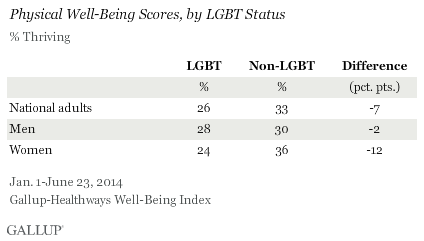
Shannon Keating flags a recent Gallup survey on well-being that shows “queer women lag behind straight women where queer men do not lag behind straight men as much – or even at all”:

Differences in physical well-being between straight and queer men, for example, are too small to be statistically significant; the overall deficit in physical well-being for the LGBTQ community at large is driven entirely by the low scores of queer women (24 percent to straight women’s 36 percent). Gallup indicates that reportedly high levels of smoking and drinking among lesbians and bi women could be a potential contributor to the discrepancy. I’ve seen from accompanying girlfriends on many a smoke break outside of bars how cigarettes and alcohol remain an obstinate fixture of queer girl culture.

Further, where queer men assess their communities with close to as much contentedness as straight men, queer women feel less connected to where they live than their straight female counterparts. Just 31 percent of queer women feel they are thriving in terms of community involvement, safety, and security, a full 9 percent less than straight women.

A recent national survey from Stop Street Harassment helps explain why queer women feel unsafe. The major finding – that two-thirds of American women have experienced street harassment at some point in their lives – is bolstered by two smaller key findings: Seven in 10 LGBT people have experienced street harassment by age 17, compared to 49 percent of straight people, and 41 percent of people of color say they experience street harassment regularly, compared to just a quarter of white people.

Relatedly, a reader flags this item:

A federal study to determine why 75 percent of lesbian women are obese and gay men are not has totaled nearly $3 million. … Researchers at Brigham and Women’s Hospital have come to several conclusions since studying “the striking interplay of gender and sexual orientation in obesity disparities,” which is slated to last until 2016. They have determined that gay and bisexual males had a “greater desire for toned muscles” than straight men, lesbians have lower “athletic self-esteem” that may lead to higher rates of obesity, and that lesbians are more likely to see themselves at a healthy weight even though they are not, the Free Beacon reported.

Update from a reader:

It astonishes me that anyone can look at those numbers and only see a crisis for gay women. True, they are the worst off by a big margin – I am not trying to minimize the main point of the article at all. But almost as shocking is the 6- to 8-point gap between men and straight women. Why is it not even mentioned that men generally are much worse off than women in this regard? (At ~5% of the female population, the lesbian numbers would bring women’s overall score down by about half a percent.)

Possibly because the suffering of men tends to get erased in favor of focusing on the suffering of women? Just saying, the fact that the male population as a whole is significantly less healthy than the female is also a big. fucking. deal, and one that affects far more people in absolute numbers. I guess us dudes are just so privileged to get to live sicker and die sooner.

Boozing Your Sense Of Smell

by Dish Staff

New research indicates that our “natural olfactory talents may be even greater when we use modest amounts of alcohol to reduce our inhibitions”:

A team led by Yaara Endevelt-Shapira tested participants on two days: on one, tests took place before and after drinking a cup of grape juice, and on the other day, before and after a drink containing a dose of alcohol (vodka). Even though the alcohol dose was based on a single measure (35ml) adjusted for the participants’ weight, differences in how people’s bodies process alcohol meant that breathalyser measures of Blood Alcohol Content (BAC) varied from as low as 0.01 to as high as 0.1 across participants.

A smell-detection experiment involved participants indicating which of three jars of oil contained a highly diluted scent. Higher BAC did not influence performance, but when a dose of alcohol produced a low BAC (below .06), participants were able to identify more highly diluted scents than they could on their no-booze day.

In a second experiment, participants sniffed three scents and tried to tell which one differed from the other (identical) two. High BAC made this discrimination task harder, but again, low BAC had a facilitative effect, making it easier to determine the odd smell out.

Celebrities: They Sext Like Us, Ctd

by Dish Staff

A reader responds to a previous one:

It amazes me how casually people presume to dictate to others what they can and can’t do with their own bodies, in the privacy of their own homes (or in the privacy of their own phones, as the case may be).  “Is your life going to suck if you can’t take nude pics on your telephone?”  What the hell kind of question is that?  Why exactly “can’t” a person take nude selfies?  Because of the inevitability that someone else will break into their phone/laptop/cloud storage account, steal this personal information or images and disseminate them without consent?  Do the people asking these questions not hear themselves and recognize they might as well ask women, “Is your life going to suck if you can’t wear a short skirt?”

I was the victim of identify theft last week; somebody got my debit card info and made some fraudulent purchases at Macy’s.  My bank, to their credit, immediately alerted me, canceled the card, reversed the charges, etc.  At no point in the process did anyone think to ask, “Would your life really suck if you just paid cash for your purchases?”  At no point did anyone suggest that if I didn’t want to have money stolen from me, that I shouldn’t purchase anything over the Internet.

Of course, our right to our own money is considered sacrosanct.  Women’s right to their own privacy? Their right to control the images they take of their own bodies and they keep private, by any reasonable measure? Not so much …

Another asks:

Why is it so important for everyone to argue about who’s ultimately at fault here? There’s plenty of blame to go around. The person who released these pictures is a terrible human being. If Apple has flaws in iCloud, then shame on them. And anyone taking naked pictures of themselves and sending them across the Internet is creating risk. There are a bunch of parties at fault here. Some are certainly more morally wrong than others, but that doesn’t mean that there are valid lessons to be learned for the rest of them.

If I don’t bother to lock my front door when I leave the house, is there any question that I made a mistake? That doesn’t mean I deserved to be robbed, but I should’ve known better. It doesn’t absolve the guy that wandered in and stole my stuff from his guilt at all, but it’s fair to criticize me as well. I wish we lived in a world where I could leave my doors unlocked, but that’s not the world that exists, and that should be obvious.

These celebrities did not deserve to have their pictures distributed, but they made decisions that made this event possible. If they’ve been paying any attention to the world around them, they’d have understood that there is a huge market for naked celebrity photos, and that being the case, maybe allowing them into “the cloud” wasn’t the best idea.

Is it fair that celebrities have to be extra wary of this sort of thing? Maybe not, but very little of the world is fair, and we have to live our lives accordingly.

Another makes a very similar argument and concludes:

This does circle back to the rape conversation on the Dish.  And it pains me to go here, but it neither bad nor victim-blaming for people of either sex to be educated on some steps to take to lower the probability of being assaulted (mainly having to do with very heavy alcohol consumption).  It does not mean anyone deserves to be assaulted in any way.  And when rape and other terrible assaults occur, our legal system should investigate and prosecute.  But even when a rapist is convicted, it doesn’t undo the trauma.  It would have been much better not to happen, and every reasonable* effort to reduce the chance of this is smart.  (*maybe this is where people differ – what is reasonable and what is overly cautious.)

But can we stop equating some thoughtful prudent advice with victim-blaming? I figured if there is a place where this can be posted and intelligent conversation can ensue, it’s the Dish.

Introducing “Finding The Words For Faith”

by Matthew Sitman

It’s an honor – and rather daunting – to see my essay on Christian Wiman, “Finding The Words For Faith,” published on Deep Dish today. Wiman’s poetry and prose have occupied much of my thinking over the past year, and this is my attempt at explaining why I find him such a singular, bracing writer. Indeed, as I assert in my essay, I believe he’s the most important Christian writer in America today.

finding-the-words-for-faithThat’s a big claim to make for a poet and essayist who, while certainly having devoted followers, probably can’t be described as famous. As an admirer of his work, and as someone who has pressed his books into the hands of many of my friends, I’m not the best judge of this. I trust that those immersed in Wiman’s work will appreciate my arguments about how to understand him, and I hope that those hearing about him for the first time will be intrigued by his approach to Christianity. Whether or not Wiman is new to you, however, I can say that when reviews of his latest and most important book, My Bright Abyss, began to emerge, I was disappointed. While many were admiring, I thought most skimmed the surface of Wiman’s thought, or focused too much on the cancer diagnosis that threatened his life. It’s impossible to ignore that a rare, incurable cancer nearly killed him, yet his grappling with faith far exceeds that biographical detail. Christian Wiman offers a creative, powerful account of the Christian faith, but I’m not convinced his work has generated the kind of debate it should have.

What I’ve tried to do in my essay, then, is give Wiman’s writing the sustained attention I believe it deserves. We’re living through a time in which Christianity no longer retains its persuasive force, when religious faith can seem anachronistic, obtuse, or irrelevant. My conviction is that Christian Wiman suggests a better way forward, advancing a credible, compelling way of re-imagining the meaning of faith that can connect with all of us doubting, anxious inhabitants of modern America. The essay available to you now is a result of that belief, and an explication of what he has to teach us.

It’s worth noting, too, that Andrew and I sat down with Christian for a conversation about all these matters, which will be released as a podcast tomorrow. You can have access both to my essay and the podcast by subscribing here.

The Good Soldier Story

by Dish Staff

Vanessa M. Gezari, author of The Tender Soldier: A True Story of War and Sacrificereflects on the US news media’s tendency to both lionize and demonize warfighters:

War stories reflect on our national character as many other stories don’t; they are also notoriously slippery, especially when told and retold back home. All kinds of falsehoods ensue, because war is complicated, messy, and inscrutable, even to those who witness it firsthand and certainly to those who occasionally watch it on TV thousands of miles away. Plots from books, movies, and TV shows like Homeland mix with real life; gaps get filled, missing minutes reconstructed. The press holds up a mirror to the rest of us, and what the rest of us know and want to hear over and over are folktales. To grapple with the idea that Bowe Bergdahl is not a carbon copy of the square-jawed men we see on recruiting billboards, or of the skulking deserters of wars past, is too laborious. Stories, after all, serve many purposes. They do not just help us know what happened. They also console, strengthen, or shame us. The United States in particular has excelled at telling stories about itself. We are a nation of idealists. We believe that we win wars because we are better than our opponents – not just better fighters, but better, period.