The Politics Of “Fertility Fog” Ctd

Several more women tell their stories:

Ugh, that last letter you published, which included this phrase “I, and many of my Ivy League, high-income friends” was HORRIBLE. Here’s what I have to say: Ladies, don’t be so selfish. If you choose to focus on yourself (and there is nothing wrong with that) for the first 20 years of your adult life, don’t COMPLAIN when you then have the a) money, and b) time to pursue IVF. Be HAPPY that you are so fortunate.

I’m 31, do not have children of my own. I am in a relationship with a man who has a 6 year old and an 8 year old. We live together and he has shared custody of his kids. I am there too, doing homework, helping out with dinner. Some might say I have a family – and in some ways, yes, I definitely do – but they are not my children and never really will be. He and I have discussed having one of our own someday, but honestly, I don’t know that it will happen. But that’s ok.

Because I made a CHOICE. Just like that Ivy-League educated, rich lady did. We make choices. These choices involve tradeoffs. She’s lucky to even be able to MAKE that choice. She had access to birth control to avoid pregnancy, and enough education and income to have a “pretty freaking awesome” life. So have I – but I am owning up to the fact that I prioritized awesomeness in my 20s over procreating, and perhaps that means I may not reproduce.

Don’t make a choice and then complain about the result of your choice.

Another is “really shocked and saddened to read these stories about doctors avoiding discussing fertility with their patients”:

It makes me even more grateful for my OB/GYN who, when I was 36 (and still single), directly addressed the subject at my annual appointment:

Her: “Do you want to have children?”
Me: “Hmm.  I haven’t really thought about it.  I guess so.  At some point.”
Her: “Well, if you do, here’s the name and address of a fertility clinic.  You shouldn’t wait any longer.”

And when I walked out of her office,  it hit me – yes, I did want to be a mother, and yes, it was about time to do that.  And thanks to her (and an anonymous sperm donor), I have spent the last sixteen years being a mother, and I can’t believe that I almost missed this experience and this life that I love were it not for the not-very-subtle prodding of my OB/GYN.

Another reader reminds us:

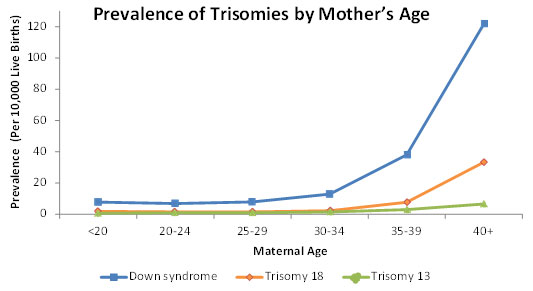
The risk of Downs’ syndrome and some kinds of birth defects increases with the age of the mother, others with the age of the father. The mother – from the CDC:

unnamed (8)

On the other hand, risk of gastroschisis (intestines outside the body) decreases with age of the mother. For fathers, their increased age is associated with increased risk of bipolar disorder, schizophrenia, and autism.
Another reader tells multiple stories:

I can tell you all about fertility fog. (Sorry this got really long.)

When I was about 34, in a serious relationship with a younger man, but not engaged, a friend told me she wanted to talk to me about something serious.  She told me that I shouldn’t wait to have a baby, that she’d had age-related fertility problems at 35 and didn’t want the same thing to happen to me.  It was upsetting, because I wasn’t in a position to go home and try and get pregnant that night. But I didn’t dismiss her.  I told my boyfriend (now husband) what she’d said, and that, while I wasn’t giving him an ultimatum, I couldn’t wait forever because I wanted a family.  When I started openly talking about adoption or donor sperm, he got the hint, and we got engaged. I was married just before turning 35.

Lo and behold, I had problems getting pregnant (which may not actually have been caused by my age, but being older didn’t help).  I learned a lot about infertility and was very quick to seek aggressive medical help when it didn’t happen right away.  With lots of medical help, I was able to have three children, including twins.  (By the way, my gynecologist acted like my age was a non-issue, and if I’d left it up to her, I would have waited a lot longer to seek help from a fertility specialist. I am very grateful to my friend for lighting a fire under me.)

I was quite open with my friends, all career women, about our struggles, and very clear about the perils of waiting. They were mostly skeptical that fertility really starts to decline in your late 20s, and falls off a cliff after 35.  They latched on to the stories that comforted them. They would read about celebrities seeming to get pregnant very easily in their mid to late-40s and assumed that they would also be able to do so.  They seemed to think I was just bitter when I assured them that the celebrities were almost certainly using donor eggs.  I can’t tell you how vindicated I felt when it was revealed in Cheryl Tiegs’ divorce that she had indeed used donor eggs to have her children at 52.  She had gone around on talk shows telling people that the twins had been conceived using her eggs and her husband’s sperm because she’d taken such good care of herself that her reproductive organs were “young.”  (I know for a fact that her doctor would be asked at infertility conferences to do for these regular women what he’d done for Tiegs.  He couldn’t tell the truth, of course, because of doctor/patient confidentiality, but he hinted.)

Anyway, two stories.  One friend seemingly took me seriously.  When she got engaged in her late 30s, she planned a short engagement, and we had a sit down where I told her everything I knew about how to up her odds of getting pregnant quickly.  She was quite worried.  Lucky for her, she got pregnant easily and had a healthy baby.  I think she probably felt I’d made her panic for nothing.  She also apparently thought that her pregnancy cured her of her age.  Instead of trying quickly for a second child (she wanted several), she decided it would be ideal to have at least two years between children, and although she was now in her 40s, decided to wait that long to start trying again.  I tried to gently hint that she might not want to wait, all the same issues applied, but, to my regret, I wasn’t pushy about it, and didn’t tell her she was an idiot for waiting (even though that’s what I thought).

Well, she did get pregnant again after a while and miscarried.  She miscarried several times. Her miscarriages were almost certainly as a result of her older eggs.  But she refused to believe it and refused any treatment that might increase her odds of success.  She even called me crying once to tell me that her new doctor had told her that her miscarriages were the result of her age, and that she should see a fertility doctor right away while there was still some hope.  I told her the doctor was being reasonable, but it was like she was deaf.  She switched doctors!  She never had another child and was sad about it for many years.  I always have felt badly that I did not push her harder not to wait.  But I don’t think she would have heard me.  If she wouldn’t hear a doctor, why would she hear me?

Second story.  A friend was having no luck meeting a guy, so decided to go the donor sperm route.  She got all set up, picked the clinic, the donors, the whole thing, and was ready to begin.  Then one day we were having lunch and she told me she’d decided to wait at least another year.  (She was in her late 30s.) I again tried to gently encourage her not to wait.  I remember asking her whether, if she knew that by waiting she wouldn’t be able to have a child would she still wait and she said yes. She also said she would never pursue treatment.  I left it at that.  She knew my story.

A year or so later, she finally tried to get pregnant and it didn’t work.  She had tests done and the results were not great, her likelihood of success not good, but she decided to do IVF (which she said she’d never do) anyway.  Her several attempts failed pretty miserably.  And she told me that I “should have told her that it was a mistake to wait”!!!   I felt awful, but also a little pissed.  I did tell her.  I just didn’t TELL her.  It was probably already too late anyway, to be honest.  She ended up adopting a child, eventually married, has stepchildren and is very happy.  I don’t think she has any regrets now, so it worked out for the best, but there was a lot of heartache in between.

Map Of The Day

[youtube https://www.youtube.com/watch?v=pJxrTzfG2bo&start=13]

History professor Claudio Saunt created the above time-lapse, as well as a corresponding interactive map, to emphasize “the fact that the United States is built on someone else’s land”:

By the time the Civil War came to an end in 1865, it had consumed the lives of 800,000 Americans, or 2.5 per cent of the population, according to recent estimates. If slavery was a moral failing, said Lincoln in his second inaugural address, then the war was ‘the woe due to those by whom the offense came’. The rupture between North and South forced white Americans to confront the nation’s deep investment in slavery and to emancipate and incorporate four million individuals. They did not do so willingly, and the reconstruction of the nation is in many ways still unfolding. By contrast, there has been no similar reckoning with the conquest of the continent, no serious reflection on its centrality to the rise of the United States, and no sustained engagement with the people who lost their homelands.

Update from a reader:

“The fact that the United States is built on someone else’s land”. Um, isn’t this true of every modern nation? Isn’t it true that the Native Americans fought and killed each other to take land from their neighbors?

(Hat tip: Nathan Yau)

Americans Need A Raise

But Dean Baker doubts it’s in the cards for the majority of them:

[M]ost workers are unlikely to see wage growth until the labor market has far less unemployment than at present. If the economy continues to add 240,000 jobs a month, we may be at this point somewhere in 2016, but we aren’t there now and we will almost certainly not be there any time in 2015. While the unemployment rate has fallen most of the way back to its pre-recession level, this is largely because millions of unemployed workers have dropped out of the labor force and are no longer counted as unemployed. Contrary to what is often claimed, this is not a story of aging baby boomers retiring.

Millions of prime age workers (ages 25-54) did not just suddenly decide to retire. They left the labor force because of weak labor demand. The number of people involuntarily working part-time is still 2 million above its pre-recession level. Furthermore, the share of unemployment due to people voluntarily quitting their previous jobs, a measure of confidence in the strength of the labor market, remains well below its pre-recession level.

[T]he National Federation of Independent Business Small Business Optimism survey, which just reached its highest level since October 2006, shows that the shares of small businesses reporting that they either recently raised wages or plan to in the next three months are at new post-recession highs … These numbers seem a bit hard to square with data from last week’s jobs report showing that wages have been flat for so long. Plans for future hiring in the NFIB index are also up, as are the number of job openings in another Labor Department survey released today; both suggest that upward pressure on wages should be rising, particular given the shrinking number of available idle workers out there.

Ben Casselman admits that it “isn’t clear why wages aren’t rising faster”:

One possibility is that the economy just hasn’t improved enough yet. Maybe if the workers-to-jobs ratio improves a bit more, employers will finally have to start offering raises. Or perhaps the ratio exaggerates improvements in the labor market because there are lots of workers who want jobs but don’t officially count as unemployed. (That can’t be the whole story, though. As I noted back in August, the workers-per-opening measure is improving even under less strict definitions of unemployment.)

The other possibility is that there are deeper, so-called structural reasons for the slow growth in wages, an issue I discussed in a bit more depth at the start of the year. Economists point to a range of possible explanations: globalization, technological change, declining unions, rising regulation. What they all share is that they won’t be solved through economic growth alone.

A Western Blind Spot? Ctd

A reader responds to the question of Western coverage of Boko Haram compared to Charlie Hebdo:

A blind spot? Not at all. Violence in places with strong traditions of law and order is news.  Violence in places where there is less of such a tradition is not. Francis Fukuyama in his seminal two-volume work reveals to us how hundreds of years of effort under favorable geographic and cultural circumstances are required even to hope for such traditions. There is nothing racist or materialist about the lack of coverage.  It is nothing more than human beings refusing to regard what can plainly be anticipated as news.

The Dish, which is a fairly representative gauge of Western media coverage, has produced about 25 posts on Boko Haram overall. CNN had the terrorist group in its top 10 list of most talked about stories of 2014. Regarding the most recent massacre, we posted two roundups that included pieces from the AP, WaPo, Time, TNR, New Yorker, Reuters, Bloomberg, BBC, Guardian, etc. – hardly a blind spot of Western media, though others will argue that coverage wasn’t quick enough. Matt Schiavenza is on the same page as our reader:

The main difference between France and Nigeria isn’t that the public and the media care about one and not the other. It is, rather, that one country has an effective government and the other does not.

The French may not be too fond of President Francois Hollande – his approval ratings last November had plunged to 12 percent – but he responded to his country’s twin terror attacks with decisiveness. Not so Nigeria’s Goodluck Jonathan. Since assuming the presidency in 2010, Jonathan has done little to contain Boko Haram. The group emerged in 2002 and has consolidated control over an area larger than West Virginia. And it’s gaining ground. Perversely, the seemingly routine nature of Nigeria’s violence may have diminished the perception of its newsworthiness.

Along those lines, Charlotte Alters adds:

The reports coming out of Baga are still sketchy, and there’s not yet an official death toll because Boko Haram still controls the area. The details of the Charlie Hebdo attacks were immediately available, and were accompanied by compelling video that quickly dominated every major news network. … More importantly, the attack in Paris was largely unprecedented (Charlie Hebdo was firebombed in 2011, but nobody was hurt), while the massacre in Nigeria is part of a long string of Boko Haram attacks that some are even calling a “war“: the group killed over 10,000 people last year, according to the Council on Foreign Relations, and 1.5 million have fled their homes since the insurgency started. Plus, the fact that the Charlie Hebdo attack was a dramatic ambush of journalists may have added a layer of panic to the media coverage.

The latest on those “sketchy” reports:

Now, new satellite imagery obtained and released by Amnesty International and Human Rights Watch (HRW) appears to confirm that considerable damage occurred in the towns of Baga and Doro Gowon in Borno state.

Screen Shot 2015-01-15 at 3.33.36 PM

The scale of the damage is remarkable. Adotei Akwei, managing director of government relations at Amnesty International USA, says that the images and other evidence suggested that the death toll was “certainly 700, if not 2,000 or close to it.”

Meanwhile, a few more readers add personal perspective to both the coverage and coverage of the coverage:

In 1984, I was with a group of Canadian volunteers who came to teach English in Nigeria. We spent two weeks in Yola, then moved out to our postings in the state. Within two weeks after our departure, the central part of Yola (Jimeta) was in flames. There had been a conflict between police and a heretical Muslim sect called the Maitatsine. The crisis went on for days, and was only resolved, as we were told, after the army bombarded the central part of the city. The report was that 800 people had been killed.

Here’s the relevant part with respect to your story on Boko Haram: when the Canadian organisation contacted our families to reassure them that we were all right, it turned out that they didn’t know about the violence at all. 800 people (apparently) had died in Nigeria, and the Canadian media ran nothing about it.

Media silence on Boko Haram has only become an issue now because Western media were running stories on it in the first place, and then they died down. In 1984, the situation was worse and got no attention.

Another writes, “Try putting your son on a plane back to Nigeria”:

Thank you for bringing attention to Boko Haram, and specifically linking to Hilary Matfess’s piece. She’s got it exactly right. Boko Haram is not ISIS or Al Qaida fighting for a caliphate, exactly. Rather, it’s more like the rebelling army in a Civil War. And, if you ask an average Nigerian, it’s not so black and white as our media reports as to whom are the bad guys.

Boko Haram does this crazy shit because they’re nuts, don’t get me wrong. But Nigeria is the most corrupt country on the planet. Goodluck Jonathan sits on the top of the money pile, denying everything and doing nothing. The north has been marginalized politically and economically for way too long. Anyone who has been marginalized – going without clean water while politicians buy houses and art in Malibu – can tell you that when you have nothing, you have nothing to lose.

On a similar note, my son’s students are offspring of oil executives and corrupt politicians (they freely say that’s their parents’ job title), as well as Pakistanis who have survived their villages’ drone strikes by the US. A mix of students from such backgrounds gives you perspective. When he teaches Speech, for example, students are required to research, deconstruct, and present an important speech from someone they admire. You would expect the choices of most of the students, but some of them choose from Osama bin Laden. When your best friend or family was killed in a US drone strike, you don’t expect them to pick the Gettysburg Address.

The Effect Of Obamacare

It’s starting to show up:

Every two years, the Commonwealth Fund surveys Americans on how difficult it is to afford medical care. The 2014 survey showed something new: for the first time in a decade, the number of Americans who say they can afford the health care they need went up.

John Tozzi provides necessary context:

A bunch of surveys and analyses have shown that insurance coverage is increasing under the Affordable Care Act (ACA). The new data are important because they show that financial barriers to care are coming down as well—even though many Obamacare plans come with high deductibles and other cost-sharing that makes patients shoulder greater costs.

Tara Culp-Ressler doesn’t overlook at those who still can’t afford treatment:

The high cost of health care remains an issue for millions of Americans; according to Commonwealth, there are still about 66 million adults who reported skipping out on care last year because they couldn’t afford it. And previous studies from the organization have documented a trend in employers pushing more health costs onto their workers, leaving some Americans struggling to pay their deductibles and co-pays. Medical debt is one of the leading causes of bankruptcy in the United States. Still, the new report provides significant evidence that the Affordable Care Act is taking steps to tackle the problem.

Peter Blair is skeptical of Commonwealth’s findings:

[A]ccording to the Commonwealth Fund, the growth of high deductible plans could reverse some of these trends and access problems still remain acute for lower-income Americans. And even those may not be caveats enough, given that Gallup’s study of the access question reached the opposite conclusion. According to that poll, “Despite a drop in the uninsured rate, a slightly higher percentage of Americans than in previous years report having put off medical treatment, suggesting that the Affordable Care Act has not immediately affected this measure.”

Lastly, in not so good news for Obamacare, Ben Casselman calculates that law has reduced some workers’ hours:

Taken together, the evidence suggests that the health law has likely led a few hundred thousand workers to see their hours cut or capped. That’s small in the context of an economy with 150 million workers. But it isn’t a minor issue for those workers. Most of them are among the economy’s most vulnerable: low-wage, part-time workers who likely have few other options.

But much of the increase in part-time work is voluntary:

The Congressional Budget Office, in a report before the law had fully taken effect, estimated that millions of Americans would voluntarily shift to part-time status once they no longer needed to work full-time to qualify for health benefits. It’s hard to know exactly how many have already done so. But there has been a marked increase in recent months in the number of people reporting they are working part-time by choice. It’s possible, as liberal economist Dean Baker has suggested, that this rise reflects the effect of the health law.

A Public Option For Internet Access

This week the White House announced a new effort to spur municipal broadband development. Amy Schatz puts the move in context:

Internet providers have mostly fought such locally owned systems, particularly ones that would be built in areas where local phone and cable companies offer services. Thanks in part to lobbying by Internet providers, there are laws in 19 states restricting municipalities from funding competing systems. Aside from concerns by competitors, there have been a few cases where locally owned systems have run into financial trouble, since it’s extremely expensive to build fiber networks and incumbent Internet providers in some cases have cut their prices to retain customers.

Sam Gustin takes note of the timing:

Next month, the FCC will decide whether to assist two cities—Wilson, North Carolina and Chattanooga, Tennessee —which have asked the feds to help them bypass state laws that pose barriers to super-fast community networks. Obama’s latest statement provides a powerful political boost to FCC chairman Tom Wheeler, who has made clear his intention to “preempt state laws that ban competition from community broadband.”

Timothy B. Lee looks at the politics:

Last year, the Republican-controlled House passed language banning the FCC from banning states from banning cities from building municipal networks. It never became law, thanks to opposition from Senate Democrats and President Obama. But it could become another flashpoint in the relationship between Republicans in Congress and the FCC — a relationship that’s already been strained by disagreements over network neutrality regulations.

This is one reason President Obama’s support for municipal broadband is important. Now that he’s on the record supporting the concept, he’s more likely to veto legislation that tried to overrule the FCC on the issue.

Meanwhile, the new GOP Senate may be planning to preempt the upcoming FCC ruling. Drilling down, Jason Koebler finds there are in fact 21 states that restrict municipal Internet efforts in one way or another:

There are three different “categories” of state law banning municipal broadband. There are “If-Then” laws, which have some requirements for municipal networks such as a voter referendum or a requirement to give telecom companies the option to build the network themselves, rather than restrictions (some are easier to meet than others). Then there are “Minefield” laws, which are written confusingly so as to ​invite lawsuits from incumbent ISPs, financial burden on a city starting a network, or other various restrictions. Finally, you’ve got the outright bans. Some of these are simple, others are worded in a way that make it seem like it’d be possible to jump through the hoops necessary to start a network, but in practice, it’s essentially impossible.

Yglesias elaborates on the funding blocks, noting that Big Internet seems much happier to spend money on lobbying than expanded infrastructure:

The 2009 stimulus bill, for example, provided a grant to the District of Columbia to build a publicly owned fiber-optic network, but the city’s not allowed to use it to deliver fiber connections to its residents. In San Antonio, the city-owned electrical utility already built a fiber network but lobbyists got the state legislature to pass a law making it illegal for households to use the fiber.

So even though we have the technical ability to deliver cheap, super-fast internet and we have the financial ability to finance the construction, we don’t actually have the network. In fact, we’re so in hock to the interests of the broadband incumbents that we don’t even use all the fiber networks we’ve already built.

Evan Swarztrauber doesn’t like the president’s plan:

The greatest regulatory barriers to deployment are local, not Federal: cities make it painfully difficult to deploy new infrastructure. Google Fiber’s great accomplishment is convincing cities to get out of the way. Yet the White House focuses entirely on cities as the solution — not by cutting red tape, but by building their own networks to compete with private providers. That means taxpayer dollars that should go to pay teachers and fix potholes, are instead squandered on inefficient and expensive networks.Governments, unlike private companies, can simply borrow and throw money at broadband projects until they “work,” leaving taxpayers on the hook.

But Tim Fernholz thinks Obama’s play might prove to be smart jujitsu:

Put simply, competition spurs faster and cheaper broadband service. The administration notes that academic studies and empirical data show that when new networks come to town, everyone gets better: When Google built a fiber-optic network in Kansas, speeds on existing networks there nearly doubled; when it announced a similar plan in Austin, Texas, AT&T hastily unveiled its own investment plan.

The White House isn’t really expecting municipal internet to make a major dent the market share of existing cable providers. As with the short-lived “public option” for health insurance before it was cut from the president’s health care proposal, the idea here—and on a much smaller scale—is to hold telecoms’ feet to the fire by providing a baseline level of service.

Who Does Torrenting Hurt? Ctd

You can review the whole Dish debate so far here. A half-dozen readers below are pro-torrenting to some extent or another. The first:

Loving the thread on torrenting.  I was about to write my thoughts on it, but I’m lazy and this cartoon from The Oatmeal basically sums it all up anyway.

Another reader:

You seem to have had a dearth of confessed pirates who aren’t total dicks, so I thought I’d write in. Like a lot of your other readers, I’m a Netflix and Amazon Prime subscriber (and Dish subscriber from day one!), a cable subscriber, and I’m really looking forward to HBO’s standalone Go service.

Nonetheless, I pirate. But I’m an ethical pirate, in that I only pirate media that are out of print or have not been distributed in the U.S. I mainly consume foreign TV shows that are not distributed here, or have no imminent distribution planned. For example, I used to pirate Doctor Who until BBC America finally got on the stick and offered a day and date release for the last few seasons. Until then, it was a six-month wait to see it, and spoilers abounded by then. U.K. shows are increasingly getting distributed here, but there’s a ton of other quality programming produced in Europe that never gets distributed in the U.S. And some of the shows that eventually surface are exclusive to one carrier, like Black Mirror, which showed up on DirecTV two years after it aired on Channel 4.

Another zooms out:

Art is not some onerous task that nobody wants to do unless you bribe them with enough money.  There are zillions of creative people who are already longing to make art.  The relevance of money is not to motivate them to make art – as if artists are a bunch of pissy John Galts threatening to take their toys and go home – rather, it is to enable them to do what they already want to do anyway.

I saw this all the time in my days as a starving artist.

Artists who can afford to make art will do it; artists who can’t won’t.  But there’s more than one way to make an artist’s life affordable.  One is to make sure that payment and royalties find their way back to the artist, but another more effective way is simply to make art a less expensive proposition.  Technology is doing that.  Today there is more music, literature, visual art, etc, being produced and made available than ever before in history.  The reason is that you no longer need your own recording studio or printing press to make it, and you no longer need an elaborate distribution and marketing program to get it out there.

Another is on the same page:

What follows here is NOT a moral judgment, or a judgment of value. It is simply to state that, with the Internet, many things are changing dramatically and we may be incapable to stop that change, for good or bad.

Let me use a metaphor related to what the IP lawyer wrote. Let’s suppose I am an sculptor, and I make a really beautiful sculpture, and then I put said sculpture in a public park. Then, from everybody that passes by and looks at it, I say: “Hey, you DID see that sculpture, now you should pay some money for that, after all I do deserve a compensation for my work! And if you don’t pay, I’ll sue you!” Everybody would just laugh at me. Well, the fact is that now we all live in the world’s largest public park. It is called the Internet.

You don’t want your movie to be pirated? Very simple: make it in celluloid. And only make copies in celluloid. There, problem solved.

The fact of the matter is that, once you go digital, there is simply no way to keep your artwork out of the Internet. Some people are counting on Digital Rights Management (DRM) as being the savior. However, I work with DRM, and I can say from first hand experience that DRM only gives you a brief interval before a digital artwork reaches the Internet for free anyway. Major corporations are putting billions of dollars in coming up with more and more elaborate DRM schemes, and still piracy thrives.

The only thing I know for sure is that trying to put the Internet genie back in the bottle is impossible. We will just have to create a new mindset for the Internet age.

Another sorta sees both sides:

Almost indisputably, it is unethical to download and watch torrented films one didn’t pay for, while also being true that almost all torrenters wouldn’t have seen those films anyway and the artist therefore isn’t out the cash. An illegally downloaded film or music cd does not equal a lost sale. It just does not.

In the five years before I got torrent, I would see maybe five movies a year in the theaters, generally action flicks deserving of the big screen experience. After getting set up with a torrent client, I starting watching dozens of films each year at home, in addition to still going to the theater about five times. But there is no way I’d have gone to see any of those downloaded movies in the theater. The artists involved did not lose out on my money. The overriding reason I watched the films is because I could get them for free. If I couldn’t get them for free, I wouldn’t watch them. Period.

Another sees a lot of gray area:

I just wanted to push back a bit on the idea put forth by some of your commenters who say torrenting The Godfather is no different than going into Best Buy and walking out with a DVD of The Godfather under your jacket.  That’s nuts, and I don’t think anyone actually thinks that, at least not in any consistent way.  Consider some hypotheticals.

1.  I rent The Godfather on Blu-Ray from the local library.  When I get home, I find the disc is scratched and it won’t play.  I download it instead.  Stealing?

2.  I buy the premium cable TV package, but I’m usually working when the shows I watch are airing, so I download the shows after they air.  Stealing?

3.  My girlfriend buys all the Game of Thrones DVDs and invites me over to watch them with her.  But I have a larger TV, so I want to watch them at my house.  I download the first few episodes.  Stealing?

4.  I go out and buy Rubber Soul on vinyl.  But I want to listen to it on my iPod, so I also download Rubber Soul in mp3 form.  Stealing?

5.  I see 12 Years A Slave in theaters three times.  I buy the DVD for my aunt and for my grandfather.  Ten years from now, I haven’t seen it in awhile, so I download it.  Stealing?

6.  I buy a hardcover copy of The Cider House Rules.  I leave it on the train accidentally, losing it before I started it.  So I download an e-book copy.  Stealing?

None of these is intended as some “nyah-nyah” rhetorical gotcha, and none is a slam dunk one way or the other in my view.  And I’m obviously not claiming, because it would be ludicrous to do so, that everyone who torrents the latest album by The Arcade Fire only did so because they were out of money from buying copies for everyone in their immediate family.  But I think most people would at least see some ambiguity in the rightness or wrongness of each of the above actions, whereas nobody would see any ambiguity if I had just gone into a store and stolen hard copies of all the items in question instead.  If that’s true, I think that gives lie to the idea that torrenting is the same as theft.

One more reader:

On the bright side for musicians, many may not have had the audience they do now without file sharing, meaning they can gain more in your revenue. Unfortunately, for some that means constantly touring and many (like Grizzly Bear) still couldn’t afford health insurance when they had broken fairly big pre-Obamacare.  Under major labels (and I’m guessing many minor), stealing music tends to hurt the label more than the band since bands rarely make much of anything off of album sales. Similarly, bands rarely hold the rights to their masters so bad you stolen Beatles music for a long time you would’ve been stealing from Michael Jackson.

I’m all for a system that continues to employ the sound engineers, production assistants, etc., but let’s not pretend that what existed pre-Napster was great for artists.  The recent Black Swan lawsuit showed just how exploitative the film industry is of (unpaid) interns. I think another reader’s question about executives stands and I’ll alter it: why do they get to make millions when some people work for nothing?

The Liberal Reagan? Ctd

obamasmug

It’s been a theme on this blog from as far back as 2007 that Barack Obama could be as significant a president for the center-left as Ronald Reagan was for the conservative right. And in policy terms, as Jon Chait rather brilliantly argues, he still stands a good chance of that. If the ACA survives SCOTUS, it will be a real shift in social policy as durable as welfare reform or as Reagan’s tax cuts. If a deal with Iran is reached, along with the opening to Cuba, you have a foreign policy paradigm shift. The impact on climate change will be greater than under any previous president (not a high bar, but a real one). The gay civil rights revolution makes Obama our LBJ. The growing momentum behind legal marijuana is also a huge shift – along with a real tidal change in police tactics and sentencing. And this ignores the biggest negative achievement, saving us from a Second Great Depression. If the economy continues to pick up speed, and continues to beat every other advanced democracy’s, it’s hard not to see it helping cement this broader truth in the public consciousness, however intense the propaganda campaign has been against the guy.

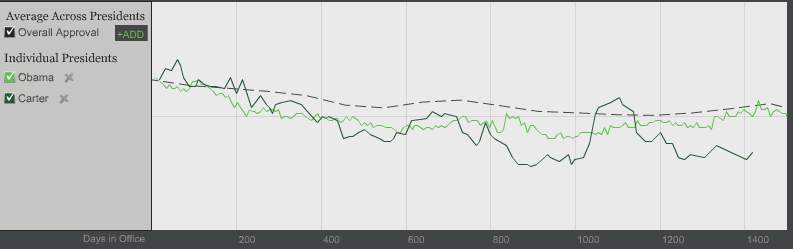
There are, of course, events that can still up-end all this. But it seems clear to me that the attempt to turn Obama into another Carter – a project of the brain-dead right for the past six years – will fail. Here are two graphs from Gallup of presidential approval ratings, noted by Aaron Blake. Here’s how Obama stacks up against Carter:

Screen Shot 2015-01-15 at 2.07.52 PM

Obama never reached 31 percent in approval ratings, was handily re-elected, and his current approval level is almost exactly the average of all presidencies at this point in their term. Here’s the Reagan comparison, which I’ve deployed before.

Screen Shot 2015-01-15 at 1.57.45 PM

You’ll see at this point that Obama and Reagan are virtually tied – in the wake of the Iran-Contra scandal. And you’ll notice that Obama never reached Reagan’s 35 percent approval low either. Is it possible, given increased growth in employment and now even wages that Obama could end up where Reagan was in his last two years? Perfectly possible. Which will frame the next election very differently, if Hillary doesn’t fuck it up the way Gore did after Clinton.

Meep meep?

(Photo by Dennis Brack/Black Star via Getty)

Clinton Gears Up

Jonathan Bernstein wonders if she just “clinched” the nomination:

There were two indicators this week. First, after months of playing around, Senator Elizabeth Warren finally declared herself out more definitively. It wasn’t Shermanesque, and plenty of politicians  have entered or re-entered past presidential races after more solid exits, but it’s getting late for someone to rule out a run and still have time to mount a serious one. …

The other development this week  is that several big-name operatives have signed on to Clinton’s campaign, even though she hasn’t even made an informal announcement yet that she is running.

First Read covers the recent hires:

[B]y grabbing Obama’s chief pollster (Joel Benenson) and media consultant (Jim Margolis), Clinton has decided to enlist key parts of Obama’s campaign 2008-2012 team, discarding the folks who ran her polling and media in ’08. And she isn’t only grabbing Benenson — she’s lured the other part of Obama’s polling/analytics organization (John Anzalone and David Binder), the Washington Post reported. When you add the fact that John Podesta is leaving the Obama White House to serve as a liaison between the Clinton campaign and White House (as well as to handle the Clinton Old Guard), it’s pretty easy to conclude that Clinton won’t be running away from Obama. In fact, it’s looking like she will be more connected to him than ever. And the people she’s hiring are the best-equipped campaign folks to reassemble the Obama-voter coalition.

Dave Roberts is happy about Podesta joining the Clinton campaign:

Podesta’s got long history in Washington and most of it speaks well of him. He was by all accounts a shrewd chief of staff for Bill Clinton; he founded the Center for American Progress, which has been a huge success; and more recently he has been working inside the White House to encourage Obama to be bolder, which is paying dividends in a sustained burst of executive action from immigration to community college to paid work leave to climate change.

Speaking of that: Perhaps Podesta’s greatest recent achievement is to convince the White House to be bold on climate even in the face of Republican wins in the 2014 midterms.

Cassidy chips in two cents:

The move was hardly unexpected: Podesta is a Clintonite through and through. He served in Bill Clinton’s White House from start to finish, rising through the ranks to become Chief of Staff, a post he held from October, 1998, to January, 2001. For months now, Podesta has been telling people that if Hillary decided to run he would most likely join her.

Now that Podesta has taken the plunge, it almost makes official what we already know: Hillary is in. And so are many longtime residents of Planet Clinton.