The Cutting Edge Of Translation

Google is on it:

Translation

Jim Edwards calls the Google Translate app “the most astonishing piece of mobile software I’ve seen in months”:

Google Translate lets you read anything in a foreign language; translate any text, even handwriting; and carry on a live conversation with another person as the app translates what you’re saying. The software translates instantly, whether via text, photo, or voice.

Or as Lance Ulanoff explains, “once you select the two speaking languages, Google Translate can auto detect them as they are spoken.” Below is a demo that’s almost as remarkable as the GIF seen above:

Ulanoff tried it with a Turkish-speaking intern:

At first, we stumbled because the intern, who is also fluent in English, kept responding to what I was saying and not waiting for Google Translates’ interpretation. Eventually, she got it right and started waiting for my translated words to be spoken by the app.

Initially, she told me, the translation was perfect, but when I started to speak in longer sentences, it basically fell apart and got a lot of it wrong. As I tested with others who spoke in Greek, German and French, we noticed the same thing. We could never completely rely on Google translate to get the words right.

He found a lot of similarities between Google’s app and Skype Translator. John Pavlus tested out the latter:

The limitations of Skype’s translation software are … revealing, since they show how difficult it is for even the smartest machine to mimic the subtleties of effective human conversation. Determining which meaning of a word is appropriate in different contexts can be vexing. “If software is translating between American and British English, and it recognizes the word ‘football,’ it also needs to know when to change it to ‘soccer’ and when to keep it as ‘football’ or ‘gridiron,’” says Christopher Manning, a professor of linguistics and computer science in Stanford University’s Natural Language Processing Group.

Matthew Braga explains why realtime translation is so difficult:

“The reason that real-time [translation] is difficult for most of us is that it’s really a matter of probabilities,” said Gerald Penn, associate chair of the University of Toronto’s department of computer science, and a specialist in natural language processing. In a modern speech recognition system, a computer is typically trained on a language model—essentially, a database of what people are most likely to say, and in what order. Using this model, a computer gathers speech data from a microphone, and makes some educated guesses about what was actually said.

“The modern approach is not to make the guess right away,” Penn explained, “but to collect the evidence, and then rank it, score it, and augment it.” The challenge is performing this process fast and accurately enough that you can create the illusion of a conversation, where the translation appears to happen in real-time.

Charlie, Blasphemer, Ctd

A few words to add to my post yesterday on the religious roots of today’s era of terrorism. I think it’s perfectly possible to agree with that analysis of what is going on, while disagreeing on what to actually do about it. There’s this tendency to conflate a willingness to recognize some core illiberal parts of Islam as the problem with an invade-occupy-and-torture strategy of the last administration. But the two are easily separable. In fact, it is perfectly obvious at this point that a military strategy will not only fail but actually make things worse. There is no doubt in my mind that the invasion of Iraq, for example, advanced the cause of Jihadism as much as the brutal torture of Muslims by the CIA and every other branch of the armed services as well. The two brothers behind the Charlie massacre were both converted, we are told, by images from Abu Ghraib and Gitmo.

So what can we do? We cannot be the reformers of the Islamic world – again, that would make matters worse. Equally, in my view, we must not give an inch on freedom of expression, especially blasphemy. We need to drop the double standards and not self-censor with some religions, while ripping on others. We should have the right to rip on them all. If you’re going to publish photos of Andres Serrano’s Piss Christ, you sure can publish the rather innocuous cover of Charlie now at large. Ross makes some excellent points on this today.

Our main current tool is NSA spying. It’s very hard to know how necessary our current expansive spying apparatus really is – because it’s cloaked in the secrecy that effectively ends democratic accountability, except via the executive branch, which, even when held by a liberal Democrat, is far too terrified of presiding over another attack to question anything the CIA or NSA tells them. But do I prefer that kind of surveillance to drone wars that seem to be fomenting more Jihadism than they eliminate? I’d say so. I’d rather not do either, but it’s clear we have a real problem, and that terror directed at basic freedoms of travel and expression requires vigilance. If that means a retreat on privacy, that’s a trade-off I’m prepared to make.

But even the best intelligence will fail in the face of well-concealed sleeper cells or lone wolves or lone packs.

The French identified the Charlie mass-murderers long before the attack. They failed to prevent it. (They tell us they are preventing many plots, and again, we have to trust them, even though in the US, little trust can exist when high intelligence officials like Clapper and Brennan lie directly to the Congress and the public and even spy on their over-seers and are never held to account by the president.) But the fact remains that some of these attacks will succeed – because they only need to win once, while we have to win every time. We cannot ultimately control that but we can control our response. We must make sure we do not take the Jihadist bait, with racist or polarization, and ratchet up a cycle that only leads to more Jihadism and more terror. That’s where I think Obama’s strength lies in this: with his remarkable imperturbability and emotional calm. I think that’s a shrewder defense than declaring a “war” on Jihadism with every attack.

We can end the worst provocations – by closing GTMO and truly pressuring the Israelis to stop the explosive settlement campaign to wipe Palestine off the map. And we can keep calm and carry on. The huge crowds in France last Sunday were magnificent. A bigger test comes now – whether we can soldier on without further polarization and a common defense of core Western ideas. I think we can. Because I think we must. Even as so many dead lie round.

The Iran Hawks Chomping At The Bit For War

While Secretary Kerry and Iran’s minister of foreign affairs, Mohammad Zarif, met in Geneva to continue their pursuit of a nuclear deal, Josh Rogin reports on the new GOP-led Senate:

The final language for the updated Iran sanctions bill by Republican Mark Kirk and Democrat Robert Menendez was agreed on this week, according to several lawmakers and senior staffers in both parties. The bill, which both senators want to pass as soon as possible, would impose several escalating rounds of increased sanctions on the Iranian economy that would begin on June 30 — but only if Iran fails to sign on the dotted line of any negotiated agreement or fails to live up to whatever it stipulates.

The Obama team has made it clear they oppose Congress voting on a new law before the negotiations are complete, even though the actual sanctions implementation would be delayed. The new Republican Senate leadership, however, is committed to moving forward, setting up a political brawl that could peak just as the negotiations enter their crucial final stages. … [Bob Corker, the new chair of Foreign Relations,] is preparing his own legislation that would mandate that the Senate vote on a joint resolution of disapproval of any final nuclear deal with Iran. He feels this is necessary in case the White House decides not to designate any new Iran pact a “treaty,” and thus avoid a ratification process in the Senate.

Larison responds to newly minted senator Tom Cotton’s remark that the US needs to make our military threats to Iran “more credible”:

Hawks imagine that Tehran sees Washington as weak vacillating when Iranian leaders have consistently perceived the U.S. as an extraordinarily powerful, menacing, and implacable foreign power. The Iranians are the ones caught in the bind of having to appease Washington or potentially face even more serious consequences. Our threats are not doubted. It is our pledges not to strike that so few believe, and after the last fifteen years it is no surprise. … Of course, hard-liners everywhere always assume that the other regime in any negotiation is getting the upper hand, because that is what being a hard-liner requires, but it makes for appallingly bad “analysis.”

And doing their part, the hardliners in Iran are still attacking President Rouhani over his administration’s continued push for a deal. Roger Einhorn believes one is still possible, but it won’t be easy:

[W]hile the Republican-controlled Congress will undoubtedly give the administration a tough time, it is likely that President Obama will be able, without legislative interference, to continue negotiating an agreement that he believes is in the U.S. interest. … [T]he domestic obstacles are more formidable on the Iranian side.  Iran’s failure to show sufficient flexibility over the last year on the central issues in the nuclear negotiations has raised questions not just about its willingness to reach a balanced agreement but also, given internal divisions, its ability to do so.  The answer to the question of whether Iran is capable of reaching a nuclear agreement lies with the Supreme Leader.  If he is prepared to overcome his own reservations, overrule hardline opponents of a deal, and give his negotiators the green light to work out the necessary compromises, there can be an agreement.  If not, there will be no deal.

Potentially making matters worse for the US side, Rouhani just announced that Iran would be building two more reactors in the country’s southern province of Bushehr. Jonathan Tobin pounces:

The supposed moderate [Rouhani] claimed that this shows that Iran was only interested in peaceful uses of nuclear power, but the massive investment in nuclear infrastructure for a country with some of the largest oil reserves in the world is inherently suspicious. Western intelligence agencies have already conceded that they have little confidence about their ability to detect any secret military nuclear programs hidden throughout the country. The decision to build more expensive nuclear plants at a time when the country is financially pressed demonstrates that their commitment to expanding their capability is about more than clean energy.

We can’t know exactly what the Iranians are up to in Bushehr. But the brazen nature of this effort while they continue to stall the Geneva talks speaks volumes about their belief that they can tell the Americans anything they like and still expect Kerry to keep crawling back to see them in the vain hope that next time they’ll gratify his zeal for a deal.

Meanwhile, it’s the price of oil that may be having the biggest effect on ordinary Iranians:

The nosedive in global crude oil prices to around $50 a barrel places additional strain on next year’s state budget, which reckoned with a projected rate of $72 per barrel. The budget for this fiscal year, which ends in March, assumes a rate of $100 per barrel. While the general population has yet to feel the impact of the resulting spending cuts, it makes for foreboding news at the currency bazaars as well as supermarkets.

Who Is Funding The Fight Against Disease?

Drug Funding

America is no longer the only game in town:

Though the United States is still leading the world in research related to diseases, it is rapidly losing its edge, according to an analysis in the American Medical Association’s flagship journal JAMA. If you look at biomedical research around the globe, the United States funded 57 percent of that work a decade ago. The U.S. share has since dropped to 44 percent, according to the study published online Tuesday.

Jason Millman adds that “medical investment in the United States grew at just .8 percent per year between 2004-2012, a major slowdown from the 6 percent annual growth between 1994 and 2004.” And, using the above chart as evidence, he questions how wisely that money is being spent:

It’s not just that the investment is slipping, the authors argue. The funding priorities are leaving major research gaps. In all, 27 diseases account for 84 percent of U.S. mortality, but together they receive just 48 percent of funding from the National Institutes of Health. Some diseases, like cancer and HIV/AIDS, get funded at better rates than predicted based on the disease burden, while others like stroke and depression fall short, according to an analysis by study author Hamilton Moses III of Alerion Advisors. Research into migraines is particularly underfunded, even though 36 million Americans, or 12 percent of the population, suffer from migraine headaches, according to the American Migraine Foundation.

Bill Gardner thinks America’s declining dominance is a “concern only to the degree that the US is doing less than it could”:

The growth of investment in health research across the rest of the world is only to the good. But here is the thing that shocked me. The authors looked at what health systems (that is, hospitals and hospital systems) and insurers invest in improving the services they provide. I would have hoped that insurers — who finance health care — and health systems — who deliver care to patients — would have invested significantly in service innovations. This is not the case. …

To get a sense of how little health systems (that is, hospitals and larger integrated systems) invest in improving their product, you should know that the median US industry invests about 2% of its revenue in research and development. Health system investment in service innovation is an order of magnitude less than that.

Quotes For The Day

Pope Francis:

If my good friend Dr. Gasparri says a curse word against my mother, he can expect a punch. It’s normal. You cannot provoke. You cannot insult the faith of others. You cannot make fun of the faith of others. …

There are so many people who speak badly about religions or other religions, who make fun of them, who make a game out of the religions of others. They are provocateurs. And what happens to them is what would happen to Dr. Gasparri if he says a curse word against my mother. There is a limit.

Jesus (Gospel of Matthew):

You have heard that it was said, ‘an eye for an eye, a tooth for a tooth.’ But I say to you, do not resist an evil person; but whoever slaps you on your right cheek, turn the other to him also. If anyone wants to sue you and take your shirt, let him have your coat also .…

The GOP’s Opening Move On Immigration

President Obama to Announce Executive Action on Undocumented Immigration Issue

After yesterday’s vote in the House, Francis Wilkinson asserts that “Republicans are now openly supporting mass deportation for the nation’s estimated 11 million undocumented immigrants”:

Republicans voted for what might be called “comprehensive anti-immigration reform.” As promised, they backed an amendment to a Department of Homeland Security appropriations bill to roll back President Barack Obama’s November 2014 executive action easing deportations for up to five million undocumented immigrants living in the U.S. Then they kept pushing. They proposed to undo Obama’s 2012 executive action easing enforcement against more than half a million “Dreamers” — undocumented immigrants who were brought to the U.S. as children. And to unravel the administration’s edifice of enforcement discretion, which enables government agents to prioritize enforcement against different classes of undocumented immigrants — thugs now, grandmothers later — and dates back to Obama’s first term.

Dara Lind’s take is more nuanced:

What’s interesting about these amendments is that they would return to a world where unauthorized immigrants lived in constant fear of deportation — but they don’t do much to ratchet up deportation itself.

Republicans were reportedly considering some measures that would require state and local law enforcement to turn over all unauthorized immigrants in local jails to the federal government, for example, or even to allow local police to force the federal government to take any unauthorized immigrant they’d picked up. But that wasn’t reflected in the bill they brought to the floor.

And while the bill maintains the current mandate for ICE to keep 34,000 beds in immigration detention facilities (while providing more money for detaining families and children coming over the US/Mexico border), it doesn’t force ICE to expand detention capacity for people living in the US — nor, importantly, does it actually require those beds to be filled.

So the bill isn’t exactly mass deportation.

Not all Republicans voted for the bill:

Notably, eight of the ten Republicans who voted against the funding bill did so because they rejected the attached anti-immigration provisions. Though all five amendments passed, the one amendment that received the most opposition was also the one that exclusively rolls back President Obama’s existing 2012 executive action for the undocumented community. More than two dozen Republicans opposed Rep. Marsha Blackburn’s (R-TN) amendment, which strips away the Deferred Action for Childhood Arrivals (DACA) program that has already granted temporary legal presence and work authorization to more than 600,000 undocumented immigrants.

What [Michigan’s Republican Gov. Rick] Snyder—and [Ohio’s Republican Gov. John] Kasich, to some extent—are articulating is a viewpoint on immigration from the Midwest that is different from the national debate, which tends to center on border fences and deportation. In these post-industrial states, which have seen huge population loss and economic distress in cities such as Detroit and Cleveland, Snyder and other Republican political leaders are seeing immigration as a tool to help the region “grow and thrive,” as Snyder said in his statement. Or as Karen Phillippi, deputy director of Michigan’s Office of New Americans, puts it: “The focus of our immigration policy is more on economic impact than on social justice.”

The main thrust of the Midwestern pro-immigration argument is based on two points: first, that immigrants tend to be more entrepreneurial than native-borns and therefore are job creators; and second, Midwestern colleges and universities have large numbers of foreign students, and the region wants to keep them after they graduate by opening up the number of visas available.

Sargent wants to know where the presidential contenders stand:

Does today’s House GOP stance have the support of Jeb Bush (who has explicitly called for recognizing the moral complexity of illegal immigrants’ plight); Mitt Romney (who presumably learned the pitfalls of a hard line on immigration); and Marco Rubio (who championed the Senate bill)? Spokespeople for all three have not answered emails asking that question.

(Photo: A man walks next to the U.S. – Mexico border wall on November 19, 2014 in Calexico, California. By Sandy Huffaker/Getty Images)

The CIA Kicks Its Outgoing IG In The Nuts

I wrote a little about this yesterday, but the actual details of the fallout of the CIA’s spying on its Senate overseers are jaw-dropping. The CIA “Accountability Review Board” (try not to burst out laughing) put out a report over some Senators’ objections exonerating everyone at the CIA and castigating the CIA’s out-going inspector general, David Buckley, for finding fault with the spying on the Senate ordered by John Brennan, Obama’s duplicitous, self-serving CIA chief. Buckley announced he was quitting only last week.

So the CIA wins yet one more round against the Senate, its purported over-seer, cementing its role as the government agency in which no one is ever held accountable for anything, including torturing innocent prisoners to death:

Feinstein noted that Brennan himself had previously apologized for the actions of some CIA officials in the dispute. “The decision was made to search committee computers, and someone should be found responsible for those actions,” Feinstein said in her statement. But Bayh, in a statement, said the board found that no discipline was warranted for the five CIA employees — two of whom were lawyers — because “they acted reasonably under the complex and unprecedented circumstances.”

That would require reversing every conclusion made by the previous inspector-general; and so the report does exactly that:

The accountability board headed by Bayh and Bauer rejected nearly every finding by the inspector general. It concluded that there was “no basis” for the Justice Department referral, noting that one of the officials who oversaw the matter “reasonably believed” he was acting under the authority of Brennan himself and that the director had cautioned against intruding on the Senate’s internal work product.

The board also found there was no basis for the charges against the officials for showing a lack of candor, noting that the inspector general’s office did not record its interviews with the officials or keep a record of the questions it had asked them. Among the panel’s recommendations were that the inspector general keep “more complete records of interviews.”

So the only two men actually held accountable in any way by the CIA and the president on the issue of torture and of unconstitutionally wire-tapping the Senate staffers’ emails are the whistle-blower on torture and the very inspector-general who had the integrity to call a crime a crime. They are thorough at the CIA. Anyone guilty of war crimes must be protected at all costs; anyone who challenges that cover-up will be jailed or publicly castigated. And the president is fine with all of it. He has created precedents which essentially grant impunity to future torture, which many Republican candidates will surely want to bring back, and to future wire-tapping of Senate staffers tasked with oversight.

Obama has made torture much more likely to return – and will bequeath to his successor a CIA that knows it can do anything and no one can touch it. In this long game, the torturers have won. Because the president surrendered.

Where Censoring Muhammad Drawings Leads

Alyssa Rosenberg thinks “it’s important that we acknowledge the full spectrum of speech that’s in potential danger.” She contends that “more moderate people should recognize that they owe a debt to blasphemers and satirists, who create a free speech zone in which the rest of us can operate”:

The violent responses to “The Innocence of Muslims,” the provocative – and low-quality – film that played a role in sparking protests that gave cover to the attack in Benghazi, Libya, might not seem to be an indicator of risk for a more respectful project about Muhammad, like two that are in production in Qatar and Iran. But as the Hollywood Reporter explained in 2013, one of the projects had already been met with calls that it be banned on the grounds that it showed part of the prophet’s body, though it does not reveal his face.

Among other incidents, she highlights “when Yale University Press published an academic book about the response to the [Danish Muhammad] cartoons that declined to reproduce those images or other depictions of Muhammad, discussing them in absentia“:

[Reza] Aslan suggests that while such decisions often come out of a desire to be respectful, they don’t just deny audiences important opportunities to see powerful relevant images, but they reinforce a kind of soft anti-Muslim sentiment.

“The idea that Yale University Press thought that a book that 13 people would read anyway, an academic tome about the cultural, political and religious ramifications of these images,” he said, “that somehow that would threaten the lives of Yale University Press employees, it’s that kind of silly, knee-jerk cowardice that only feeds into this notion that Muslims are this kind of irrational, almost animal-like being who have to be handled with gloves.”

Satire intended for a small readership of Danish nativists no longer stays in Denmark. Cartoons that work for a sophisticated Parisian audience are now flashed around the world to an audience that wouldn’t know the difference between brie and Beaujolais. All that most people in places like Yemen or Pakistan see in those cartoons is someone defiling a religious tenet. They also fail to understand the difference between Charlie Hebdo and Le Monde, or Mad Magazine and Time.

This, I think, is the crux of why, in this day and age, “those damn cartoons” seem to be so uniquely inflammatory. Cartoons, because they’re mostly visual, can uniquely carry satire across cultural and language barriers. In some ways, this is a great asset, but that transmission of images doesn’t mean the joke, the intent, the cultural resonance is transmitted as well. In fact, the tone and humor often are lost in transmission while the offense and provocation are not.

Taking A Stand On The Can, Ctd

drunk-octopus

Probably the last batch of the bunch. A reader sends the above photo:

I had to share my favorite piece of bathroom graffiti – not the most sophisticated I’ve ever seen, but it made me laugh out loud.

This one probably will:

A buddy of mine is in the U.S. Navy. In one of the restroom stalls at his naval base someone wrote, “Describe your shit using the name of a movie.” Dozens of people contributed to the list. Some examples from the crowd-sourced latrinalia: Children of the Corn, The Green Mile, Grease, Little Rascals, and (my personal favorite) Big.

Another passes along an apocryphal story:

Abraham Lincoln loved to tell a story about [Ethan] Allen. He returned to England after the war, and the British made fun of him. One day they put a picture of George Washington in an outhouse where Allen would be sure to see it. He used the outhouse but said nothing about he picture. Then the British asked him about it and Allen said it was a very appropriate place for an Englishman to hang the picture because “nothing will make an Englishman shit so quick as the sight of General Washington.”

Many more below:

Okay … okay … I can’t resist submitting my favorite one.

I think I saw this at Cafe Intermezzo on Berkeley’s Telegraph Avenue back in the mid-’90s. Of course, someone had written “Free Mumia” on the wall. Someone edited that to read “Free Mumia action figure included with every Happy Meal!”

Another:

In one of the stalls at school in the UK in the ’80s, I still remember it fondly …

The US has Ronald Reagan, Bob Hope, and Stevie Wonder.
The UK has Maggie Thatcher, No Hope and No Bloody Wonder.

Another reader:

Here are a few I have enjoyed over the years. Above the urinals in Waggoner Hall at the University of Texas at Austin and home of the Classics and Philosophy Departments, circa 1972: “Veni, Vidi, Wee Wee.”

In the same men’s room: “Don’t throw toothpicks in the toilets. The crabs here can pole vault.” And written just below: “Yeah, but do they throw the javelin?”

Another passes along this photo “from the bookstore here in Greenwood”:

unnamed (29)

Another:

I’ve hesitated to join in on the bathroom graffiti thread, simply because the two I remember are not quite the stuff for family viewing, but I still thought they were funny. One was in a bathroom at the famous Hole in the Wall club in Austin, Texas: “I don’t care how gorgeous she is – somebody, somewhere, is sick of her shit.”

And another, spotted in a stall in Arkansas during a road trip: “What does Texas have in common with a old lady’s [vagina]? Everybody knows it’s down there, but nobody gives a shit.”

(Upon reflection I think either could be transposed to the other sex.)

Another:

Many years ago I read an article (in Esquire, I think) about graffiti on the walls of women’s public restrooms.  My favorite was “Let him sleep on the wet spot tonight.”

Another:

Seen in ladies room, Oslo, Norway, 1974:

I saw a man ride up on a bike.
He took off his knickers and said,
“Take what you like.”
I didn’t like his knickers
So I took his bike.

Another:

Could I submit one that I saw in Germany many years ago? Translation wouldn’t carry the rhyme.

In diesem Hause wohnt ein Geist,
Der, wenn man drin zu lange scheisst,
Kommt, und dir in die Eier beisst.

Update from a reader:

Oh, but I have to try and translate and still make it rhyme:

In this house there lives a Geist (Ghost)
Who, when you sit too long and shites
Appears and you in the cajones bites

In another update, a reader provides a “variant on the German submitted by a reader, this one with a reply (and my own rhyming translation)”:

In diesem Hause wohnt ein Geist,
Der jedem, der zu lange scheisst
Von unten auf die Eier beisst.

Mich aber hat er nicht gebissen,
Ich hab ihm auf den Kopf geschissen.

Translation:

Within this stall a ghost doth flit
Who, if you take too long to shit
Will nibble on your balls a bit.

So far I’m safe, he hasn’t bitten,
Because upon his head I’m shittin’

Wunderbar. Another reader:

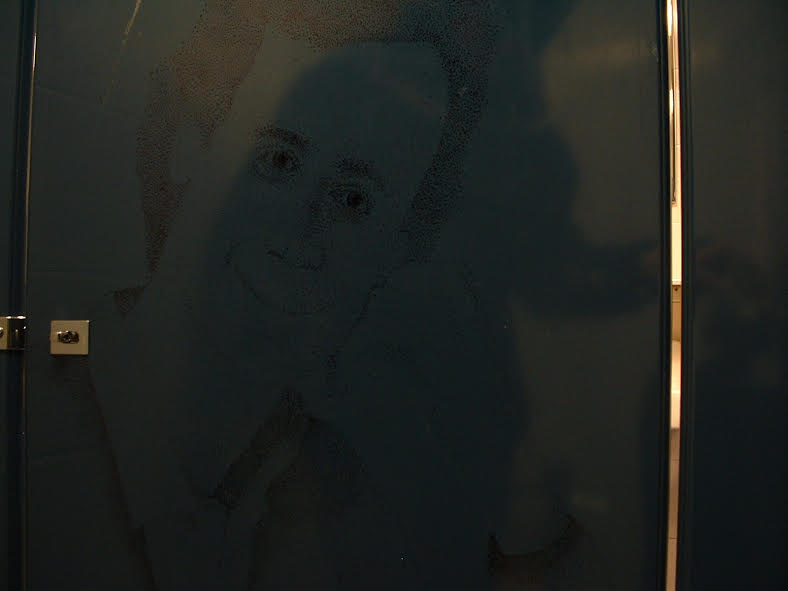
If you happened to sit down in the first stall of the fourth floor bathroom of the Folsom Library on the campus of Rensselaer Polytechnic Institute in 2006, you would find a portrait of Bob Saget staring directly at you – in pointillist style of course:

unnamed (30)

Why did someone spend hours of their own time on this? Because Bob Saget.

Another:

My all-time favorite: “I’d rather have a bottle in front of me than a frontal lobotomy.”

And one more:

My personal favourite from college (between the Theology and Ancient History departments):

Don’t worry if you don’t know what eschatology is
It’s not the end of the world …