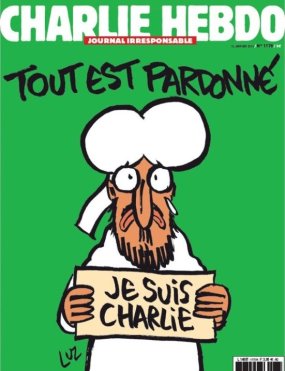
On Sky News, former Charlie Hebdo journalist Caroline Fourest was trying to explain how “crazy” it is that certain journalism mills in the United Kingdom won’t show the cover of the latest edition of the magazine. Well, Sky News provided a stronger explanation than Fourest ever could have.
Why humiliate a grieving person this way? She has the balls to stand by her work in the name of free speech, at great personal risk to herself, and this is how she’s treated? Literally pissing on Stephane Charbonnier’s grave would be less hurtful, I think, than taking up his killers’ cause this way.
Allahpundit also points to Buzzfeed’s list of Western outlets that did and didn’t show the cover. And Barbie Latza Nadeau looks at which publications ran the cover around the world.
Popping up in the in-tray, Freddie comments on the discussion thread:
I note with a little frustration that one of your readers has endorsed the “trade school is the answer to our economic problems” meme. I don’t blame that particular reader, as it’s a very common claim. But as I noted in a piece last year, there’s essentially no credible evidence to suggest that we need to send more people to trade school. The ranks of the jobs with the highest unemployment are riddled with skilled trades, which is not surprising in the post-financial crisis world; skilled trades are massively exposed to the boom-and-bust cycle of the housing market. I’m not saying that I’m sure that more people going to trade school is a terrible idea, and like the reader I am an opponent of the “college for everyone” attitude. But it’s an idea that gets asserted as a solution a lot with a remarkable lack of compelling evidence for it.
While I agree that more education is not the solution, I differ from your reader (with his complaints of Marxist academics) in that I believe the problems with our labor market stem from very deliberate policy choices to favor the desires of a tiny percentage of the vastly rich over the needs of the great mass of working people.
To anyone who has studied economics, the thought immediately comes to mind. The rapid increase in tuition costs happened right when the government started spending extraordinary sums to subsidize college tuition. It seems very unlikely this is a coincidence. As with anything, there is a market price for college, and giving out money to people to be spent specifically on college allows colleges to charge more than the market price. The Post article reviews all the research on this topic. From the last paragraph of the article: “All but one study I’ve seen found some evidence of a price response to increases in aid, for some section of the higher ed market.”
Here’s a likely outcome if government starts paying for two-year community college: four-year universities will raise their prices. The reason for this is because their customers were always willing to spend a certain total amount of money on an education. If government foots the bill for the first two years, the university providing the second two years can raise its prices and find its customers still willing to attend, since they got the first two years for free.
Another illustrates a point made by Shackford that, in the reader’s words, “Obama’s proposal will incentivize community colleges to dilute their curriculum to ensure they get a steady stream of funding from the federal government”:
The proposal requires student maintain a C- average. Instructors and teachers will be pressured to grant C’s even when students don’t deserve it or will back students who appeal their low grades. This already occurs to some extent. The Mrs. is an adjunct at a local community college for a course program that requires students keep a C- in all classes to maintain enrollment. Her students who have prior military service get their tuition paid by the federal government. She has some students who are barely literate. When they inevitably fail, they often dispute the grade and the administration always backs the student for the simple fact they want the money.
The average incoming college freshman reads at the 7th grade level because these same incentives promote grade inflation at the high school level. School simply do not flunk and expel students because the number of students enrolled determines the funding they receive from the state and federal government.
And regarding your reader’s comparison of another to Judge Smails, a more apt movie analogy may be Ben Kingsley’s character in Searching for Bobby Fischer:
Are we actually helping young adults, or society at large, just because we give students a certificate that is meaningless? Like Josh’s Grand Master certificate in the film, a community college degree will mean nothing.
Another provides “a view from a Community College Professor”:
Many of the statements by readers reflect a lack of specific knowledge regarding community colleges, their role and their student populations. They seem to equate some idyllic image of Harvard+Animal House with all of college; a dream world of fuzzy ideas, tweed wearing professors and Voltaire.
1. In NJ, all of our courses are legally transferable to public (and most private) schools in NJ. The Lampitt Bill has streamlined a lot of our coursework. Gone are the electives – there’s no time for leftist indoctrination of academians. Also, community college is overwhelmingly taught by part-time adjuncts. They are not researchers, writers on sabbatical and certainly not Marxist indoctrinators (BTW, Marxism-Leninism-Stalinism failed, so no one indoctrinates that philosophy anymore, or ever – please take a history course at your local community college to find out how and why).
If you took a factory and transferred the model to education you would have a modern community college. I really wish community college was that idyllic dream of high-minded liberalness the political right accuses us of but, alas, we go to work, teach our classes overfull classes, prep more classes, deal with student problems and concerns, and then grade, edit, and comment on papers and tests – all for a pay significantly less than the level of required degree would indicate. Ph.Ds are held by less than 1% of Americans yet professors earn decidedly middle American wages. I could triple my income if I went into international corporate consulting, for example.
2. We have over 100 certificate programs, from cooking to nursing. Our dental program is 35 years old – and gives free cleanings to kids in the community. The great lie of education is that the for-profit schools do this training while college does some soft liberal arts reading and thinking stuff. In fact, we offer more programs than the three for-profit schools in our neighborhood and do it at a tenth of the cost. (Our advertising budget though can’t compete.) Air conditioner repair – we got it. Computer animation – got it. Want to build apps for a startup? We got all the hands-on coursework you need. Community colleges have filled this space for a long time – but the stigma that they are the “13th grade” looms large. More money would mean more services, which would mean more programs, certificates and training.
3. 70% of our students are remedial. This means they are not prepared for college-level reading, writing or math. Reading I is a third grade reading level – and those classes are full. So while we should spend more money on pre-K education, there is still a massive number of people failed by K-12 education. With high-stakes testing, No Child Left Behind, and teacher pay tied to grades, these numbers have gone up. There is less incentive to educate and more incentive to pass high-cost standardized tests.
4. Community College students are, in our case, poorer, less educated, and much more racially diverse than the surrounding schools. Those with means and drive head off to the private schools of Philadelphia, Baltimore and Washington. Or they go to the public schools of Northern Jersey and Pennsylvania. We also take in a far larger number of immigrants, ESL students, first-time college families, working adults, mentally and physically handicapped, and military veterans than the surrounding colleges. All of these students require expensive services and programs. The idea is that we educate a large number of people who have limited choices in their education – and who are expensive to educate.
Which brings us to the most important part of the President Obama’s proposal: forcing states to pay. Our school was set up in the 1960s, and the charter indicated that for tuition, the state and the county would each contribute an equal share to operating costs (33% each). In 2014, our budget received 12% from the county and 17% from the state meaning tuition made up 71% of our operating budget. All the pledges of “no new taxes” is being paid for by higher tuition, fees and less services. This budget situation is simply breaking the back of the school and the students. We are not a school that can charge $50K for tuition nor can we pre-screen our students. If the state just paid the amount it guaranteed in our charter, we could educate students pretty easily and cheaply. So if the president can force states to pay their actual fair share (or more), that would be a budgetary godsend for us.
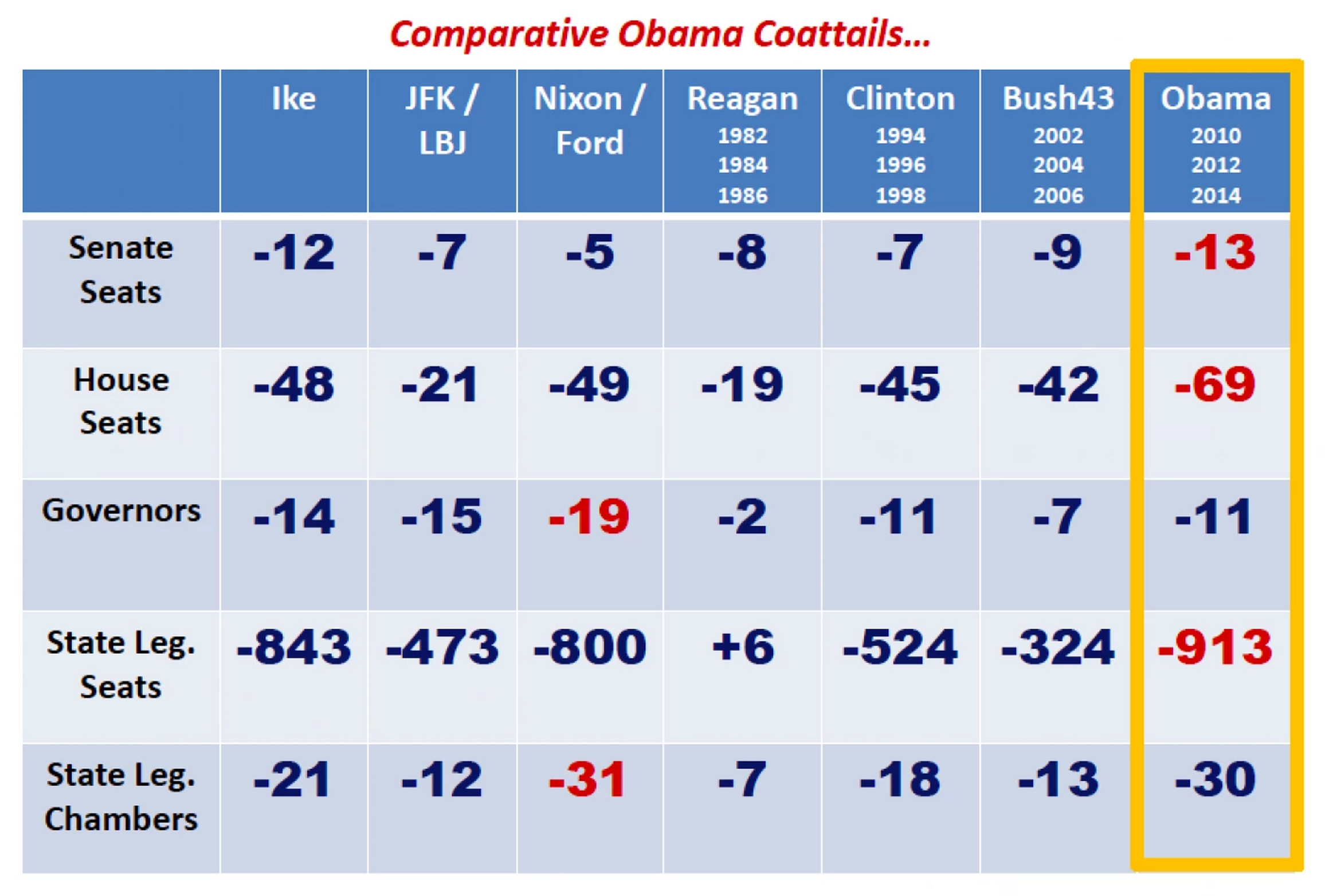
Based on Sabato’s calculations, Cilizza charts the Obama effect on Dems in state legislatures:
Now, there are more 7,000 state legislative seats in the country, according to the National Conference of State Legislatures, which makes that 913 number slightly less eye popping. Still, the Democratic losses between 2010 and 2014 amount to 12 percent of all state legislative seats nationwide. As NCSL notes, Republicans now control over 4,100 seats — their highest number since 1920. After taking over 11 legislative chambers from Democrats in 2014, Republicans now control 30 state legislatures completely — and have full control of state government (state legislature and governor) in 23 states.
He points out how it also gives the national GOP an advantage in prospective candidates:
State legislatures are the minor leagues. Most of the politicians — Barack Obama included — who have gone on to great things, politically speaking, honed their craft in the state legislature of their home (or adopted home) state.
Melissa Dahl, who admits she cries “embarrassingly easily,” investigates the question. One reason? Women seem to have shallower tear ducts:
“There are several studies over the years that have shown that men have larger tear ducts in their eyes, so that it is less likely for the tears to well up to the point of spilling over the eyelid onto the cheek,” said Dr. Geoffrey Goodfellow, an associate professor at the Illinois College of Optometry in Chicago. There’s also this paper from the 1960s, in which a physician from the University of Michigan reports how he used male and female skulls to measure the length and depth of tear ducts, finding that women’s were shorter and shallower.
Hormones may also play a role:
[Researcher Ad] Vingerhoets believes [testosterone] inhibits crying. Male prostate cancer patients, for example, tend to become more emotional when treated with medications that lower their testosterone levels.
But this isn’t just about testosterone: Back in the 1980s, biochemist William H. Frey and his team analyzed the chemical makeup of emotional tears and compared them to tears caused by irritants. They found, among other things, that emotional tears tend to contain prolactin, a hormone produced by the pituitary gland that is associated with emotion. … Lauren Bylsma, an associate professor in psychiatry at the University of Pittsburgh who has studied crying with Vingerhoets, said that this difference in prolactin levels “may help explain these differences in crying, as well as other differences in emotional expression and depression vulnerability between men and women.”
Speaking of such differences, Walt Hickey compares men and women when it comes to the movies that make them cry.
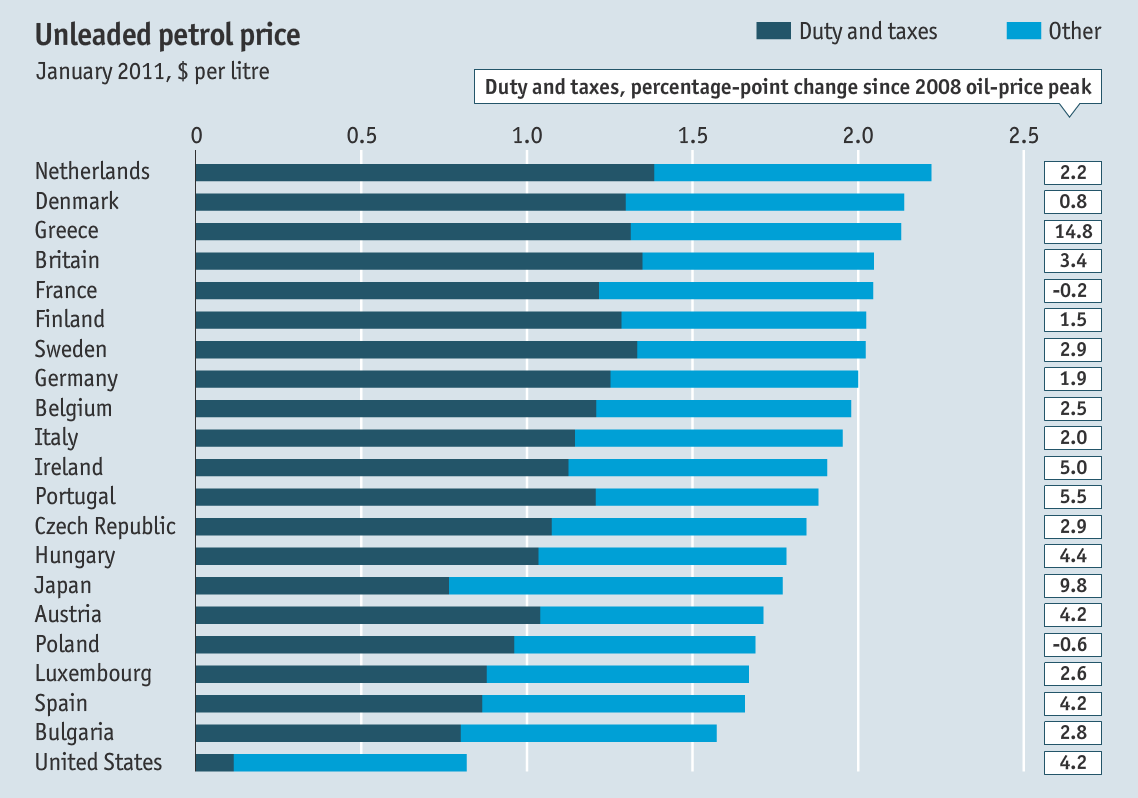
Yes, Mr. Edwards, the percentage increases in the gas tax between 1984 and 1992, seems rather large, but this a rather lazy argument and ignores almost all of the developed world. Take a look at this article in The Economist from 2011. My coworker – back when I used to work at the Energy Information Administration – used to have [the above] graph contained therein posted outside his door for a good reason. Developed countries’ gas taxes are almost all at least a $1 higher than ours!
Another also pounces on Edwards:
You know what else happened between 1982 and today? A wee bit of inflation. The 18.4¢ today is equal to just 7.5¢ when adjusted for inflation. That’s a slightly less meteoric rise. But what’s perhaps even more disingenuous – and this is from someone who apparently has a masters in economics – is where Edwards starts his chart and analysis.
There’s really no good reason for him to start that chart in 1982 that I can find. If you extend it backwards, the gas tax was unchanged at 4¢ from 1959 to 1982. The 4¢ gas tax in 1959, had it been adjusted for inflation, would stand at 32.5¢ today (about what the 18.4¢ 1993 figure would buy today if adjusted). In other words, thee gas tax that built the Interstate Highway system 50 years ago was nearly double what it is today. Of course, we now have to maintain that system, but no longer have the tax base to do so. The 1993 hike merely brought it up to where it had been originally, but it has slipped by nearly half that value in the past 20+ years.
Unlike most other taxes that are per dollar, gas taxes are per gallon (which makes some sense due to the volatility of gas prices), but unlike those taxes, they don’t rise with inflation. They should, but good luck getting that through Congress. So any time inflation ticks up, it’s a backdoor tax cut for drivers, with the only side effects being the condition of the roads they drive upon.
Ilana E. Strauss covers delayed sleep phase syndrome (DSPS) – “a disorder that affects one in 750 adults,” or about 400,000 Americans:
DSPS sufferers have internal clocks that run at least two hours slower than normal, giving them “social jet lag” which is pretty much what it sounds like: They’re out of sync with the rest of society. They struggle to keep their eyes open during morning business meetings because their bodies are convinced it’s the middle of the night.
Michael Lewis stands up for the nocturnal among us:
Lewis wrote his first book entirely after midnight, and he continues to write at night. “I can’t get the best stuff out of me any other way,” Lewis said. “I used to write until five in the morning. I think my books would be better if I could still do that.”
I don’t know about you, but I thought a word from Hitch at this moment might well be appropriate. Have you not missed him these past couple of weeks?
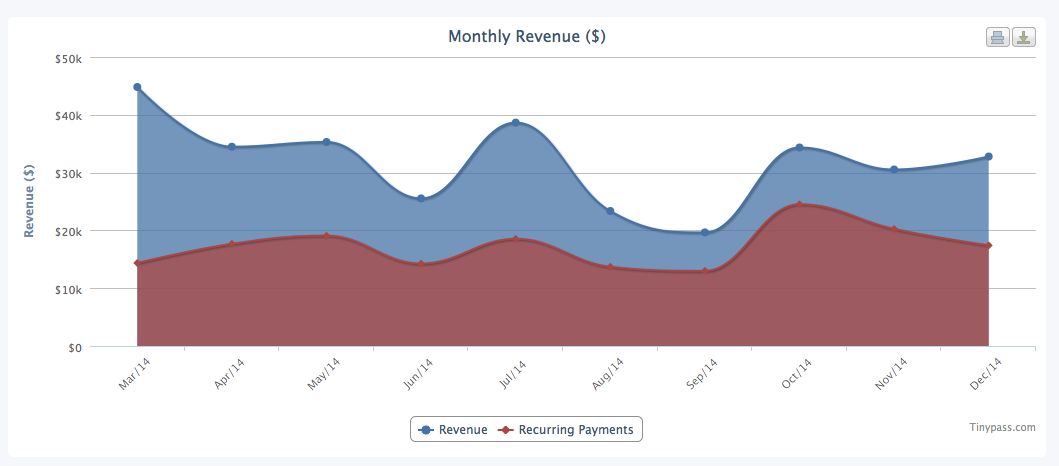
I’m two weeks late for my monthly report on the State of the Dish because of, well, not being able to get out of bed, but here goes. December was a strong month for us: we brought in $33K in revenue. Here’s the gross revenue chart since last March:
The red is from last year’s subscribers and the blue from new ones this year. Our total gross revenue from subs in 2014 came to $967K. In 2013, it was $851K. That’s a 14 percent increase, year on year. It wasn’t our only source of income, because we also got some Amazon affiliate money and some merchandise profits – about $51K total. So that bit of revenue added to our subs makes the Dish a million dollar company in 2014. Traffic also came in at over a million unique visitors in December and 5.8 million pageviews.
A massive thanks to all of our 30,478 subscribers. I had no idea if we’d make it to Year 3, but we have. Your commitment to this little platform for open debate and conversation is, mercifully, rock-solid. I’ve been at other magazines. You guys are different and special. If you haven’t yet, please join us. If you’d like to introduce a friend to the Dish, gift subscriptions are here. A reader writes:
I’ve followed your website for some time now, a time during which my wife was in a six-year battle with breast cancer. I always hesitated to subscribe out of the need to ensure all my resources, both financially or other, were directed toward her care. I lost her last July after 32 years of marriage and have been struggling to come to terms with the aftermath. Believe it or not, your site and its diverse content has helped me, and I have been intending to subscribe … but was stuck for some reason.
One of Sunday’s posts, “The Way Time Heals“, struck a cord that has finally moved me to subscribe. One quote from Mantel’s article:
Recovery can seem like a betrayal. Passionately, you desire a way back to the lost object, but the only possible road, the road to life, leads away.
It’s a perfect description of the feelings one has in grief. Every step I take, changing names on bank accounts and titles, buying groceries for one, and the things I do for myself – like finally subscribing to The Dish – are painstaking steps away from my former life. And each decision and change can feel like you’re erasing a former life, so the finality of each action can be heartbreaking.
So as strange as it might seem, this is a big, difficult, and heartbreaking decision, but one that is part of moving forward instead of remaining in stasis. You need to know that your site is a beacon and godsend of intelligent and thoughtful content, and it can help people in ways you might not fully understand.
I subscribed at twice the requested rate, half for me, and half in memory of my beautiful wife. Thanks again for all the amazing everything you and your cohorts do each day.
You can probably tell I’ve been really sick because I couldn’t manage to write about the Charlie Hebdo Jihadist mass murder. Now that the immediate crisis is past and my fevers are back under some control, some thoughts.
I was actually surprised and gladdened by the response to the slaughter – an overwhelming wave of revulsion and disgust, expressed with great dignity and courage (and yes, it was an absolute disgrace that Obama sent no one of a higher rank than the ambassador). I had begun to think that a defense of free speech was no longer a pillar of the American right or left, but for a while, at least, I was wrong. People do draw the line at the murder of blasphemous cartoonists in the name of God. It seems we have at least achieved a consensus on that. Two cheers!
Was it enough to prompt the New York Times to be a newspaper, instead of a quivering pile of bullshit fearful of offending people? Nah. Baquet is a man worthy to succeed Bill Keller, the editor who refused to use the word torture because it would offend the American government, which was trying to conceal war crimes (and has gotten away with all of it). The NYT is a fantastic paper in so many ways. But it is run by those educated in the view that anything that might offend any non-white minority is the worst human sin imaginable. The brutal truth is: Charlie Hebdo employees would last a week at most at the NYT before being fired. A liberal church like that will not tolerate blasphemy either. And can you imagine Charlie being allowed to be published on any US campus? For merely its depictions of Jews and Christians, it would never survive. It is, after all, a “macro-aggression”, right? Students would need counseling for years to recover from such images. Still, hypocrisy is the compliment vice pays to virtue, and in an America dedicated to rooting out “hate speech”, this is probably as good as we’re likely to get.
Then the deeper disappointment. Even now, many will not concede that religion was the root cause of the attack, and that the name of that religion is Islam. Reading the cartoonishly liberal Nick Kristof was like watching a Monty Python Piranha Brothers sketch (see above). Yeah, they have murdered thousands of Westerners and far larger numbers of Middle Eastern and Nigerian and Pakistani Muslims. Yeah, they did that. They also declared at every one of their slaughters that their motivation is Islam. They have beheaded people, mass murdered school children, flown planes into buildings, cut women’s genitals, employ sex slaves, commit mass rape, and on and on. They have taken over a large part of the Iraqi and Syrian deserts to advance their desire for religious purity.
But Islam has nothing to do with this. There are just a few loonies who are suffering from false consciousness, and their real motivations are economic or personal or secular or just purely violent. You can believe that, if you want. Or you can pretend to believe it because it might be more pragmatic to do so. Or you can open your eyes. This is not to say that most Muslims support this kind of mass murder – and the global Muslim response was particularly encouraging. But it is to say that it is not a coincidence that so much terror and violence all over the world is currently being committed in the name of Islam. Some core parts of it are, quite simply, incompatible with post-Enlightenment thought and practice. And those parts have all the energy right now.
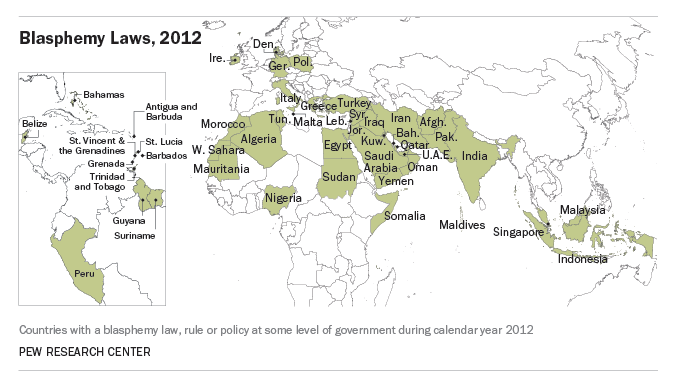
And the core issue here is blasphemy. For almost all of human history, rooting out blasphemy has been the norm. Many Western countries still have moribund blasphemy laws and the Muslim world is crammed with them. The death penalty is common. Prison time is expected. Mob mass murder is another phenomenon. Today, the NYT dutifully cites some verses from the Koran that instruct Muslims to simply “not sit with” blasphemers. There are others:
Those who annoy Allah and His Messenger – Allah has cursed them in this World and in the Hereafter, and has prepared for them a humiliating Punishment. Truly, if the Hypocrites, and those in whose hearts is a disease, and those who stir up sedition in the City, desist not, We shall certainly stir thee up against them: Then will they not be able to stay in it as thy neighbours for any length of time: They shall have a curse on them: whenever they are found, they shall be seized and slain (without mercy).
Or the prophet himself:
The Prophet said, “Who is ready to kill Ka’b ibn al-Ashraf who has really hurt Allah and His Apostle?” Muhammad bin Maslama said, “O Allah’s Apostle! Do you like me to kill him?” He replied in the affirmative.
You can get thrown in jail and have mobs calling for your execution by teaching kids about a teddy bear in Sudan, to give a simple 2007 case. In Pakistan, 50 people arrested for blasphemy over the last three decades have been murdered before they got to trial. In Saudi Arabia, an ally, blasphemy is on the same level as apostasy: it’s punishable by death.
The map above from the Pew Foundation shows where blasphemy laws are on the books. See a pattern here? Pew notes that 64 percent of the world’s populations still live under blasphemy laws and they are marginally more common than the other deeply anti-Enlightenment prohibition on apostasy.
Again, it’s vital to point out that Islam is the norm for most religions on planet earth since the beginning of time – except for a brief period in the modern West. It is not so much that they have gone backward so much as we have gone forward so rapidly on the question of religious liberty and free speech that some core elements of Islam cannot tolerate it. It’s too great a cultural gulf. I have tentative hope that this vast gap on a fundamental question may take as long for Islam to arrive at as Christianity did. But that means a century at least of more bloodletting – and given the presence of so many disaffected young Muslims in Europe, a series of slaughters to come, and the possible erosion of support for free speech outside these rare moments of cherished unity. I see no other way of getting through this: surveillance, vigilance, an end to invasion, occupation and torture, and patience. And to give not an inch to any infringement on free speech.
A group of people stage a demonstration on January 14, 2015 during the celebration of the 4th anniversary of the beginning of the “Arab Spring” revolution at Avenue Habib Bourguiba in Tunis, the capital of Tunisia. Four years ago today, longtime president Zine El Abidine Ben Ali was deposed. By Yassine Gaidi/Anadolu Agency/Getty Images.
 educated in the view that anything that might offend any non-white minority is the worst human sin imaginable. The brutal truth is: Charlie Hebdo employees would last a week at most at the NYT before being fired. A liberal church like that will not tolerate blasphemy either. And can you imagine Charlie being allowed to be published on any US campus? For merely its depictions of Jews and Christians, it would never survive. It is, after all, a “macro-aggression”, right? Students would need counseling for years to recover from such images. Still, hypocrisy is the compliment vice pays to virtue, and in an America dedicated to rooting out “hate speech”, this is probably as good as we’re likely to get.