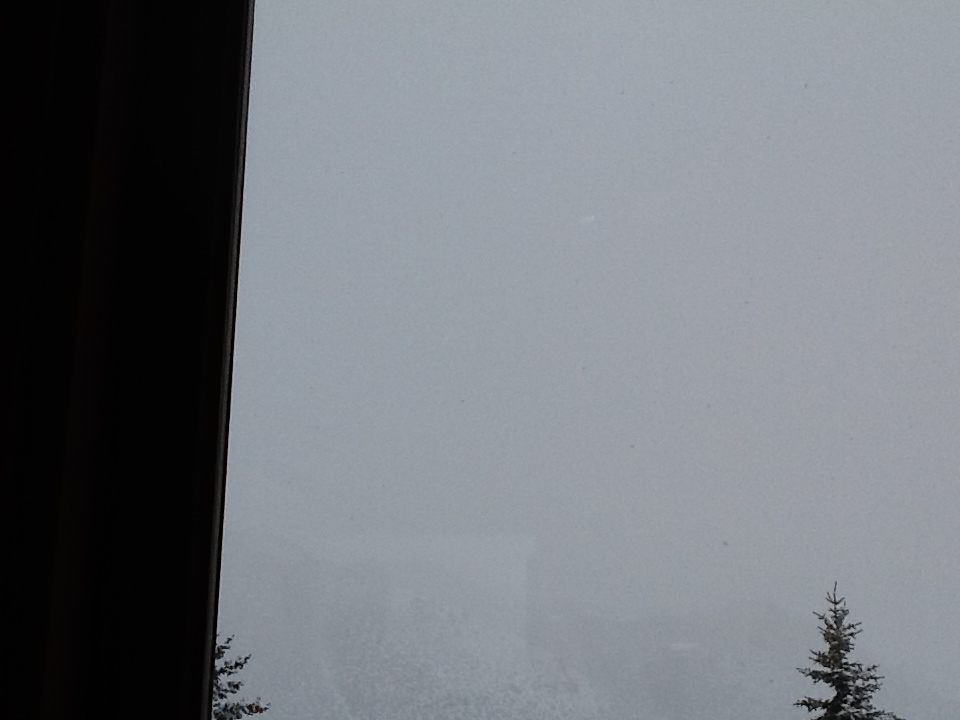
The View From Your Window Contest: Winner #238

VFYWC_-238

Chini comes clean:

Canada. My first guess was Canada. That’s how bad my gut is at this. It’s as if my subconscious took one look at the image and said, “Well, let’s see. Lots of snow. Looks real cold too. Probably north of here. Yup, definitely Canada.” Having disregarded that brilliant bit of instinctual wisdom, I got down to the business at hand. And what a fascinating set of clues to work with …

Another reader’s brain explodes

Too many conflicting clues, and no clever detail I can seize – I am pretty sure it’s in the USA, in an area that doesn’t get snow all that often, but is not in a hot zone either; mountains look like Western arid ones; houses with brick chimneys and hip roofs whisper “east”; evidence of abandoned building sites; I can’t quite settle on exactly what the sports complex is (the lighting with those two towers on one side only??); strange combination of urban density and urban sprawl (along with the odd-shaped lorries in the parking lot) almost give hints it’s not even North American.

My wild guess, with a pretty broad stroke – somewhere in the Logan-Salt-Lake-Provo corridor of Utah. Or Tennessee. Or West Virginia. Or Kentucky. Or . . . Portugal.

Or Idaho?

A hunch that might just be a wild hair, I believe this is a photo of a section of Boise.

Or maybe it’s in Mongolia:

Ulaanbaatar is my best guess, though even if I’m right, I’ve not been able to narrow it down any more than this and have now stayed up *way* past my bedtime trying.

Another ended up closer to target, guessing Sofia, Bulgaria “because of the mountain skyline and VIP Massage sign.” Another adds that “it doesn’t take long before that search turns NSFW”. Regardless, the parlor did end up leading many readers to the right city:

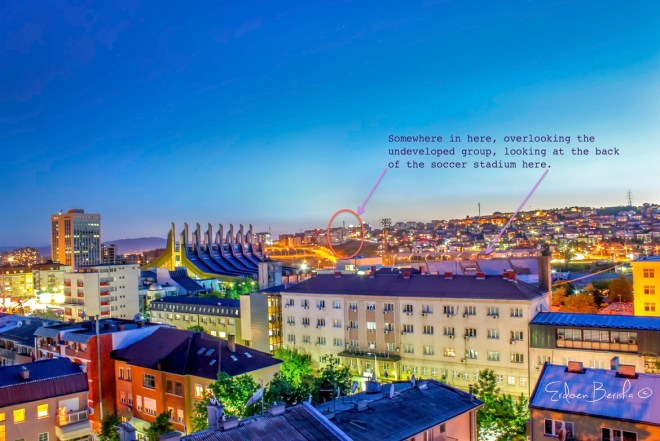
The soccer stadium, weather, English, and mountains pointed to somewhere in Europe, but there seemed to be little to indicate precisely where.  The best clue was something that forced me vip-massageto do my research from my smartphone rather than my office computer, a small sign that appeared to say “VIP Massage.”  It took some time to realize that the sign was in fact a reflection of the roadside billboard rather than a sign on the building, meaning searches for an establishment named “VIP Massage” were unlikely to bear fruit.  Eventually I came across a Relax Center VIP Massage located in Pristina, Kosovo (I don’t remember exactly what search provided this and was searching incognito) which seemed legit enough to have a billboard, so I took a look at the city.

Another notes a trend:

Minarets. Again. I could not believe my eyes. Antalya. Then Dakar. Now this. However, as luck would have it, this time there was no need to review one hundred mosques, nor to look for stadiums in Islamic countries, thanks to the Relax Center VIP Massage and to its easily readable shop sign.

And a correct guess of the building:

So … we’ve got mountainous terrain, snow, and lots of minarets. Where do you have Muslims in cold mountains? Latin letters instead of Cyrillic rules out the former Soviet Union, so I spent a long time looking at soccer stadiums in forlorn inland regions of Turkey. That got me precisely nowhere.

Then I tried something else. A billboard in lower left looked like it read “VIP massage.” Googling that got me to Pristina, Kosovo, and I felt VERY good about my chances. That would explain the vaguely Austrian / Alpine look of much of the architecture. The Wikimedia picture from inside the Pristina soccer stadium, taken on a much nicer day, overlapped with lots of the buildings in the picture and I was home and dry:

Interior of stadium

We’re about a kilometer west-south-west of the Pristina stadium, looking at the back of the main stands at the stadium. The funky curved roof building to the right is the Palace of Youth and Sport. We’re across Ahmet Krasniqi street from a couple of hotels (the Denis and Adria) and the US Embassy. Now, what the building actually is proved a little tougher. No Google Street View, Google Maps doesn’t tell us much, no obvious hits from tourist sites. I can see the building from above:

OverheadView

And in a city panorama:

targetwindow

But can’t say what it is, aside from that it’s on Ahmet Krasniqi.

A few readers passed along photos of the exterior of the Palace of Youth and Sport, which though obscured in the view, was another key clue:
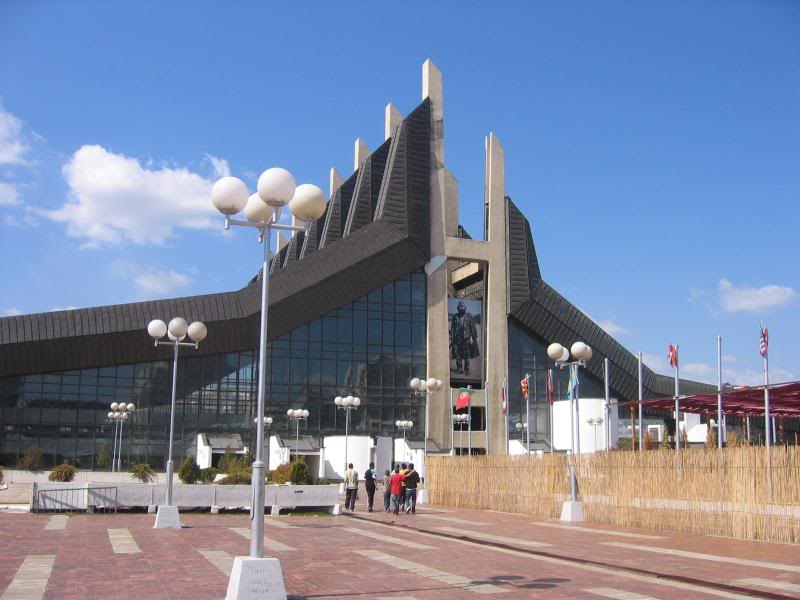
Pristina04040

Another adds:

Constructed in the late 1970s, it now features a large portrait of Kosovo Liberation Army commander Adem Jashari. Quite the beard on that one:
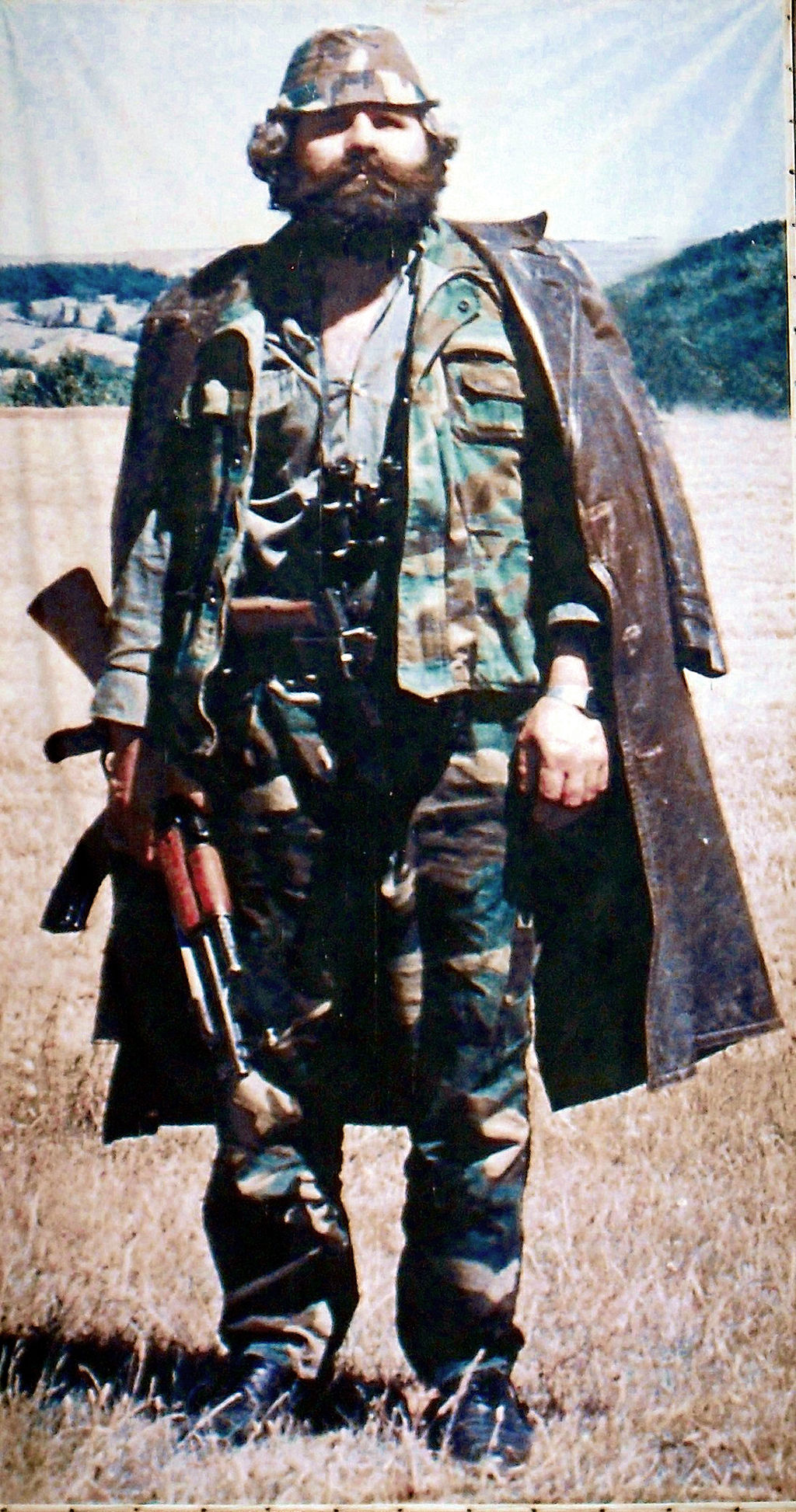
Adem_Jashari

This reader used the roads to help zero in:

A traffic warning sign not found in the western hemisphere, where our warning signs are diamond shaped.  And NOT an English speaking country either, because the cars are being driven on the right:
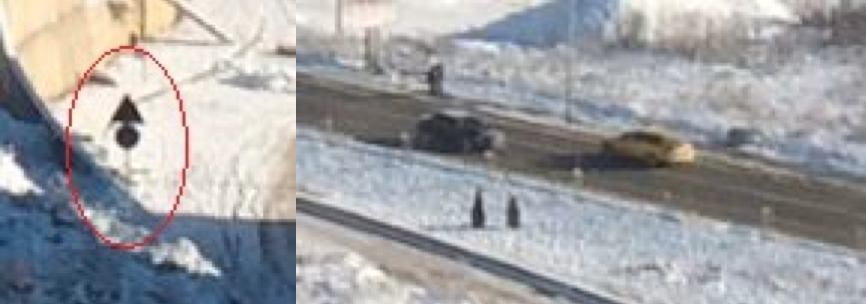
Screen Shot 2015-01-13 at 12.29.23 PM

And a former winner takes us on a trivia tour:

mashupsmaller

This week we are in Pristina, Kosovo just south of NATO Kosovo Force’s (KFOR) headquarters and about a 25-minute walk to the Statute of Bill Clinton on Bill Clinton Boulevard.  Given the hills, snow, and mosques, I looked at every football stadium with a 10,000 to 30,000 seating capacity in Turkey, Bosnia, and Albania.  Then I checked the ones in Kosovo.  The stadium in the center of the picture is the Pristina City Stadium, home to FC Prishtina.  The weird roof encroaching on the view from the right is the communist era Palace of Youth and Sport.

As for the window’s location, I couldn’t find a street address.  The best I have is Street Ahmet Krasniqi in Prishtinë’s Arbëri neighborhood (or coordinates 42.660684, 21.150451).  (The street is named in memory of Colonel Ahmet Krasniqi who defected from the Milosevic’s Yugoslavian army and organized a militia group fighting for Kosovo’s independence before internal purges led to his 1998 murder in Tirana, Albania (see NYTimes article here)).  The window is on the northeast side of the northeastern most building within the City Front Apartments development, a series of five mostly residential buildings.  Alternatively, this zoning map of unknown provenance shows the City Front development as Arbëri 3, Prishtinë, Block C1.  That means the construction in the contest picture’s foreground is the Redoni Apartments.

After giving up on finding the building’s street address, I searched for pictures taken nearby.  The presence of Five Star Fitness in the next-door City Front building caused one particular search engines to display an avalanche of beefcake selfies (like this guy; and, yes Sully, he has a beard).  But I did find a picture of the City Front buildings taken on Street Ahmet Krasniqi facing away from the Pristina City Stadium.  It shows that the development’s balconies have the same railings as those shown in the contest picture.  Looking for apartments for rent in the City Front buildings returned this Airbnb rental.  Although airbnb’s map places the apartment a couple of blocks away, I think this is the apartment with the contest window.  I’m guessing that Airbnb blurred the exact location.
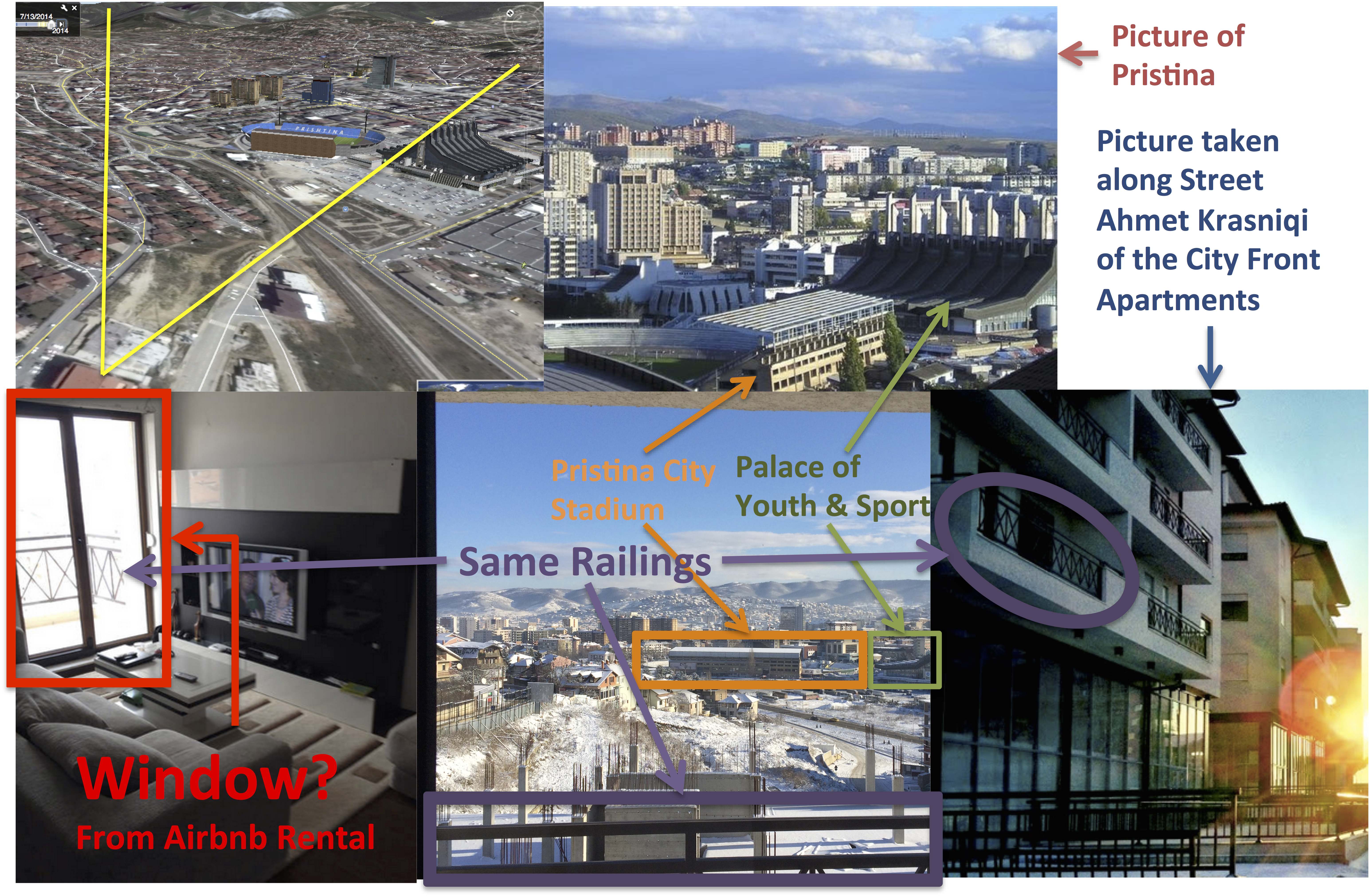
A bunch of readers thought it was that Airbnb, or one of the nearby hotels, but in fact, this week’s contest was over a rare residential view. Another reader landed in the right region because he noticed the “relatively recent construction & the good condition of virtually all the buildings in the view, suggesting rebuilding after a catastrophe or war.” Of course, readers have stories along those lines:

This week’s photo took me back to 1988, when I took some time off from my job at the U.S. Embassy in Rome and drove through Greece and what was then Yugoslavia. It would be another year before civil war broke out and Yugoslavia fell apart, but there had already been demonstrations and violence and the country was tense.

Two memories of Pristina, Kosovo stand out in my mind: getting stopped by the cops, who seemed curious about what an American diplomat was doing driving around in Kosovo, and the bizarre and massive Palace of Youth and Sports, part of which is visible in the right-hand corner of the contest photo, which seemed both out of place and out of scale. Between my faux Russian and the cops’ faux English, I thought I satisfied them that I was just a tourist and not on some mission for the CIA. As I drove on through Kosovo and into Bosnia, though, I couldn’t shake the feeling I was being followed. Later that night, in my hotel in Mostar, five uniformed officers of some sort materialized between the time I checked in and retrieved the luggage from my car, followed me up the stairs and planted themselves in the room next to mine. I couldn’t decide if they were spying on me or just needed a place to goof off and play cards. I didn’t sleep a wink that night.

This reader was in country around the end of the war:

I haven’t had the time to really look for one of these in a while. Work has been a lot more busy and with two kids under 3, I haven’t had much time on Sundays to search. But today, my wife was looking at The Dish on my phone and left the VFYW contest open. In about half a minute I recognized Pristina – the Youth and Sports Center roof was the give away.

I spent 12 of the hardest months of my life between Belgrade, Pristina, Pejë (Peć), and the Kukes border in Albania. I moved to Pristina in the ’90s, when things were heating up but it was still part of Serbia. Then we evacuated because NATO was about to bomb. Lots of memories. Two that stick with me: standing on the border on the Albanian side drinking a cola while watching NATO plans fly overhead and drop bombs. Surreal. And standing at the same border late one night and realizing the refugees were from Pejë when out of the crowd a refugee came up and called me by name. It made it a much more personal conflict.

I suppose those aren’t even Pristina memories. Ha. What do I remember about Pristina? Bone jarring cold in winter, excellent Turkish coffee. Cigarettes that smelled like 100% tar. Damn fine homemade raki – rice vodka if I remember correctly. I’ve been back a couple of times and my best friend still works there with the EU. I’m glad I worked there when I did, it taught me a lot about myself. But I’m still unsettled by it all, and still surprised I supported the bombing before it started.

Another reader can’t wait to visit, because trains:

I have not yet been to Kosovo but it is definitely on my list. I work for German Railways and my European travels are almost exclusively by train, but since Kosovo’s declaration of independence in 2008 it is only accessible by rail via Macedonia — which suits me just fine, as those are the two countries I have yet to visit in the former Yugoslavia. Kosovo is much beloved by many in the railfan community, as it is the last country in Europe to operate so-called “NoHAB” locomotives – a 1950s American streamliner diesel locomotive design licensed and built in Europe:
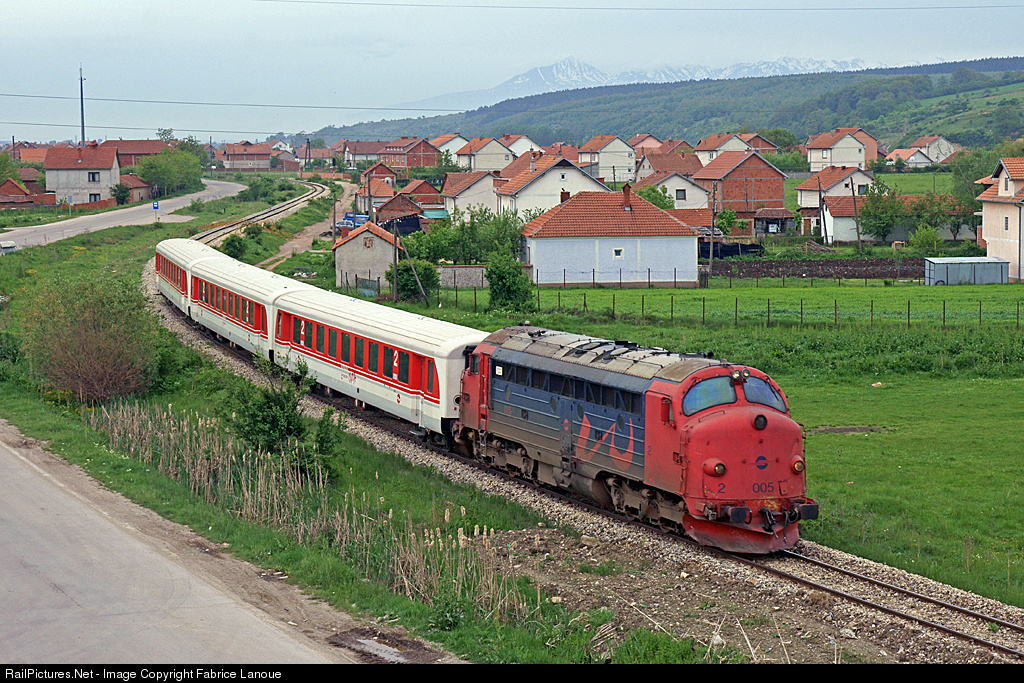
SONY DSC

Nobody got the exact right window this week, but our winner, from the vaunted difficult-view-guesser-without-a-win list, only missed it by one floor:

Snow cover. Distinctly eastern European buses in the parking lot and socialist architecture in the angle-roofed building on the right. And then the key detail: a minaret (I missed one in the Turkey competition a few weeks ago). It looked like but didn’t quite match my recollection of Sarajevo (the Olympic stadium is different) and maps confirmed it wasn’t. Medium-sized city in former Yugoslavia with a large Muslim population? Next guess, Pristina. First picture showed the theater with the angled roof. From then on it was easy-ish. Found the right building. No streetview so had to use Google Panorama but found something close enough below. No addresses so I resorted to the Facebook Group “Why We Study Eastern Europe.” Success! Thanks to the members there for letting me post occasionally. The prize, if I get it, goes to the founder of the group and my new acquaintance in Pristina.

As for the window? Triangulation says the middle balcony of this bloc of flats. The floor depends on whether they added another floor since this picture was taken. I’m going to guess no but I may be wrong.

image002

The best part in exploring this was the accidental architectural typography.  There are whole projects devoted to buildings that look from above like letters, but I can’t imagine that the world holds a better “F”.  According to the Fontfinder at Whatthefont.com, the building was built in Luzaine Ultra:

image005

An A for this one. The correct window?

This view should be among the easier VFYWs given the neighbourhood it’s taken from. The shot is from my apartment balcony in Pristina where I’ve been the last few years. It happens to be a stone’s throw away from a few embassies, including the American one, so anyone who has passed through should quickly recognize the view of the city.  On the right side is a glimpse of an otherwise unmistakable Pristina landmark – the Palace of YouthIn any case, the location is across the street from Krasniqi Street peering out eastwardly, window on the corner, 4th floor:

this-window

Thanks so much to all our players this week. And yes, Chini ended up guessing correctly, though he missed the window by one floor:
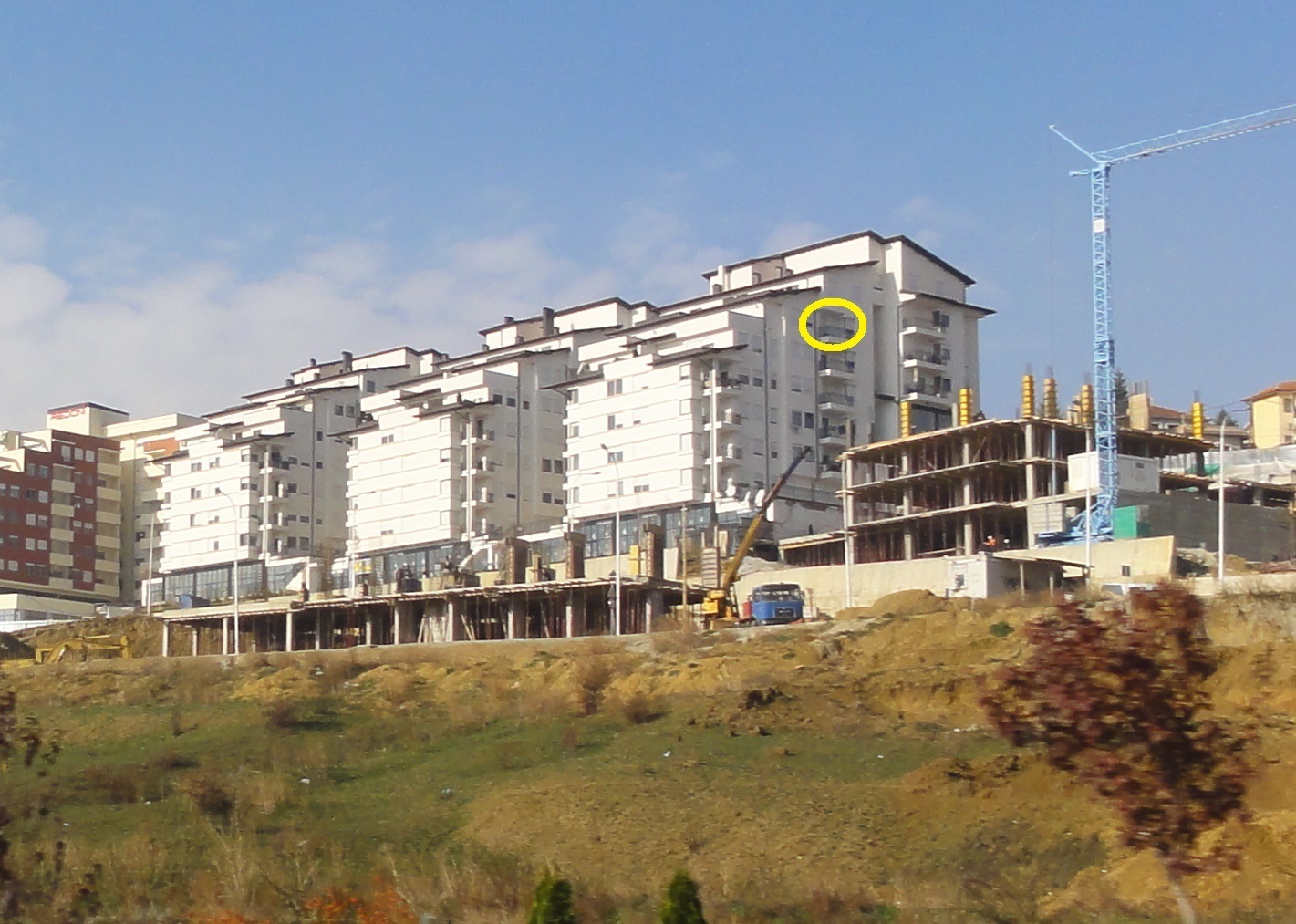
VFYW Pristina Actual Window Marked Revised Balcony - Copy

The Profanity Of Blasphemy Laws

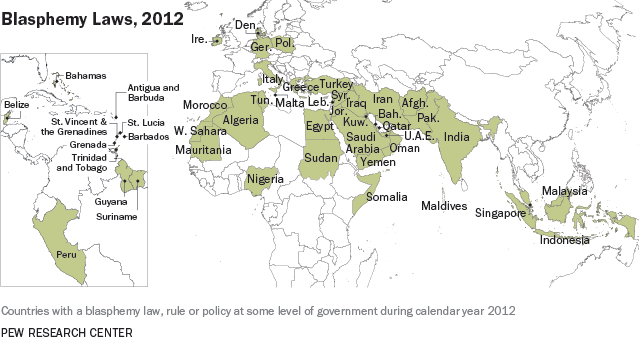
Such laws are still common in much of the world:

blasphemy

Doug Bandow calls the murders of Charlie Hebdo staffers “the international cousins of those who murder alleged blasphemers and apostates in Muslim nations”:

Earlier this year the U.S. Commission on International Religious Freedom reported that victims of the ongoing attack on free expression include people from Bangladesh, Egypt, Indonesia, Iran, Kazakhstan, Pakistan, Saudi Arabia, Tunisia, and Turkey.  Nowhere are blasphemy laws more used and abused than in Pakistan.

In its study on the issue USCIRF explained how the law encourages abuse:

“The so-called crime carries the death penalty or life in prison, does not require proof of intent or evidence to be presented after allegations are made, and does not include penalties for false allegations.”  Judges prefer not to hear evidence, since doing so could be construed as blasphemy.  A claim usually is sufficient to send someone to prison, making the law a common weapon in personal and business disputes.

Non-Muslims are peculiarly vulnerable.  Many people do not reach trial:  mobs have killed more than 50 people charged with the offense. And thugs like those who gunned down the Charlie Hebdo staffers have murdered judges who acquitted defendants, attorneys who represented those accused, and politicians who proposed reforming the laws.

Ireland, at least, is now rethinking its laws against blasphemy:

One article published by the Irish Times newspaper, titled “Why a referendum on blasphemy is long overdue,” specifically cites the words of Charlie Hebdo editor Stéphane Charbonnier (aka “Charb”) as justification for an end to Ireland’s blasphemy laws. “Let’s repeal our blasphemy law if we really want to honor ‘Charlie,’ ” read a separate op-ed in the Irish Independent.

Meanwhile, an online poll conducted in response to the Paris attacks by news Web site TheJournal.ie found 64 percent in favor of scrapping the laws as quickly as possible.

Recent Dish on blasphemy laws here.

Reality Check

How Allahpundit frames a new YouGov poll: “Majority of Republicans think media should publish satires of religion, plurality of Dems disagree”:

In case you’re wondering which party is the anti-blasphemy party. Remember this the next time you stumble across a lefty thinkpiece on how Christian theocrats run the GOP. The top line is “should publish,” the second is “should not,” the third is “not sure”:

makefunofreligion2

Some caveats are in order.

For one thing, when asked whether the media has an obligation to show controversial but newsworthy images even if they might offend the religious views of some, both parties are heavily in favor. Democrats split 76/24 while Republicans split 82/18. (The overall public split is 80/20.) That means that outfits like CNN and people like NYT editor Dean Baquet are crossways with fully 80 percent of the public in suppressing the Charlie Hebdo cartoons, at least for their stated fig-leaf reason of “sensitivity.”

Another caveat: When asked if it’s acceptable or unacceptable to ridicule Christianity, both parties tilt narrowly towards “unacceptable.” (Democrats split 38/44 while Republicans divide 45/47.) When asked if it’s acceptable or unacceptable to ridicule Islam, both tilt towards “acceptable” — 42/38 for Democrats and a clear majority of 53/30 for Republicans. It’s actually the age split that’s more interesting on that question though. For some reason, young adults and seniors are more circumspect while the middle-aged say “go for it.”

But he sees the gender and race divides as “far more interesting”:

Women clearly, to an almost majority extent, believe religious satires shouldn’t be published; among blacks, that opinion is held by a clear majority.

Did ISIS And Al Qaeda Team Up?

Bobby Ghosh contemplates the French terrorists’ connections to the global terrorist groups:

At least one of the Kouachi brothers, the gunmen in the Charlie Hebdomassacre, traveled to Yemen to train with al-Qaeda in the Arabian Peninsula, or AQAP, and U.S. officials believe the attack was ordered by the group’s high command. But Amedy Coulibaly, who carried out several other attacks in conjunction with the Kouachis, including taking hostages at a kosher supermarket, had pledged loyalty to ISIS.

If there’s a difference between al-Qaeda and ISIS, it was lost on these men. The brothers Kouachi attacked Charlie Hebdo because of its cartoons depicting the Prophet Muhammad. Coulibaly said he was motivated by France’s role in the war against ISIS. But their allegiances and affiliations didn’t prevent them from working together, from killing together.

How Keating understands the cooperation:

While ISIS and al-Qaida, as centralized organizations, may be sworn enemies, things may be more fluid for their adherents around the world, who share a common ideology and common goals. As the counterterrorism researcher Thomas Hegghammer wrote on Twitter today, the dual claims in Paris suggest that “some jihadis relate to IS/AQ like football teams. You can support different clubs and still watch game together.” Certainly, supporters of the two groups online seem to be reacting to the events in Paris with common enthusiasm.

Jeremy Scahill lends his perspective:

AQAP and ISIS have been engaged in a very public and bitter feud on social media and through official communications for the past year. While not impossible, it is unlikely that AQAP and ISIS at a high level agreed to cooperate on such a mission. An AQAP source told me that the group supports what Coulibaly did and that it does not matter what group — if any — assisted him, just that he was a Muslim who took the action. ISIS, clearly seeking to capitalize on the events in Paris, has now reportedly issued a call for its supporters to attack police forces. Of course, it is also plausible that all three of the men received some degree of outside help, but created their own cells to plot the Paris attacks. Whether Coulibaly was actually working with the Kouachi brothers or was inspired by their attack is also unknown.

For now, we have little more than verified statements from an AQAP source, a claim of responsibility from an ISIS figure and words of praise from both ISIS and some key AQAP figures. Taking responsibility for the attacks, whether true or not, could aid either group in fundraising and in elevating its prominence in the broader jihadist movement globally.

All The ████ That’s Fit To Print

Matt Welch wonders which outlets will reprint Charlie Hebdo’s latest cover:

o-CHARLIE-COVER-570It’s a fortunate thing that the new Charlie Hebdo cover image became known [Monday] at 4:30 p.m. ET, because that means the same deep-pocketed, overlawyered, American news organizations that have so spectacularly avoided reprinting allegedly “offensive” CH covers thus far will have plenty of time to wrestle with their starkest yes-or-no choice yet: Are you really going to opt out of showing the most newsworthy cover image of the year, one that carries a legitimately sweet (if sardonic) message, just because it portrays (a grieving and empathetic) Mohammed?

Unsurprisingly, The New York Times is out of the gate with a resounding “yes.” The Paper of Record is in the awkward position of having a (very good) article up titled “Charlie Hebdo’s New Issue Has Muhammad on the Cover,” absent a certain, shall we say, illustrative element. In contrast, USA TodayThe Wall Street Journal and the L.A. Times have shared with their readers (at least online) what the hullaballoo is about.

Emmanuelle Richard translates part of an interview with cartoonist Renald Luzier, who drew the cover:

We tried to stick close to the news (laughs). Today is wrap day, and we’re trying to do our best. Our best is doing a bit better, in fact—we have good news: [CH cartoonist] Riss [who was injured in the attack] is back at drawing. He sent a strip, he’s sending drawings. It means that someone else has joined in, meaning that we’re all hanging in there, including those still in the hospital.


Did Terrorists Just Elect Le Pen? Ctd

Philip Gourevitch scrutinizes how the French right-wing leader has played her cards over the past week:

In the immediate aftermath of the attack on Wednesday, as traffic surged on her Facebook page and she picked up thousands of new followers, she did nothing special to insert herself into the story or to exploit the fears that the Front has long fed on. She reiterated her longstanding call for France to withdraw, unilaterally and at once, from the Schengen Agreement, which allows for open borders within the extended European community, but that was hardly newsworthy. Rather, Le Pen appeared to adopt the time-tested opposition strategy of waiting for the political establishment to make a misstep that would turn attention her way—and she did not have to wait long. Within hours of the Charlie Hebdo massacre, the ruling Socialists and a coalition of allied parties of the left announced plans for a massive solidarity rally on Sunday—a silent march through the heart of Paris in the cause of “national unity”—without extending an invitation to the National Front.

The exclusion of the Front was great news for Le Pen. Nobody believed that she would have wanted to go and be associated with the political mainstream, but, by failing to invite her, the Socialists had given her a cudgel.

Comparing Le Pen to her father, Jean-Marie, and other intellectual forebears of the French right, John Gaffney finds her wanting as a standard bearer:

Marine is good on TV, she’s a reasonable debater, and she seems to have chosen to walk away from lots of the right’s traditions and manners. But the detox also involves – apart from all the other things it involves – losing one’s intellectual tradition. Does this have advantages – for her and/or for those who oppose the FN?

Marine Le Pen is ‘ordinary’, in fact, very and deliberately ordinary. She is, in the true tradition of the far right, a very forceful personality. But she’s a particular forceful, and a particular ordinary. She’s a twice divorced mum who lives with her partner and their respective kids. That is a far cry from far right values, in itself. And the fact that it is a woman leading this movement is fascinating, a movement whose philosophy and populism loves the leader, but never imagined it might be a female leader. But she is not like Joan of Arc, the FN’s female heroine. She has no visions. No grace inhabits her; she is more like a bossy and assertive middle manager at Asda.

She certainly doesn’t look as if – unlike her father – she has read Barrès or Voyage au bout de la nuit…. as have all French politicians and intellectuals. One gets the impression that not only has she not read them, she doesn’t give a toss either.

Meanwhile, Martin Robbins demolishes Le Pen’s call for France to bring back the death penalty in response to the Charlie Hebdo massacre:

What, exactly, are executions supposed to achieve? You can’t execute a suicide bomber. Death isn’t a big problem for the kind of fanatics willing to die for a cause. Even if you just look at ordinary crime, there’s no real reason to think that execution would deter people. As Amnesty put it, “The threat of execution at some future date is unlikely to enter the minds of those acting under the influence of drugs and/or alcohol, those who are in the grip of fear or rage, those who are panicking while committing another crime (such as a robbery), or those who suffer from mental illness or mental retardation and do not fully understand the gravity of their crime.” They note that murder rates are considerably higher in those American states that still have the death penalty.

David Corn piles on:

The goal of martyrdom has motivated numerous jihadists to conduct murderous action. Suicide bombers, the 9/11 plotters, and others seek to die in pursuit of their cause and believe that there will be a reward on the other side. So the best punishment, when such criminals are apprehended, would be to deny them martyrdom and force them to wait decades, maybe half a century, to meet their violence-supporting maker—preferably in a small, isolated cell for all that time. Recruiters of jihadist killers might have a tougher time selling a decades-long stint in prison than a glorious exit in a blaze of gunfire or a high-profile state execution that would receive attention around the world.

Our Deep Divide Over Guns

A couple weeks ago, Adam Gopnik claimed that “the majority of Americans agree that there should be limits and controls on the manufacture and sale and ownership of weapons intended only to kill en masse.” Lisa Miller disagrees:

Americans are perhaps more divided on the issue of guns than they’ve ever been. In 2014, just 47 percent — less than half — of Americans said that gun laws should be “more strict,” according to Gallup, down from 58 percent after the Newtown shootings and 78 percent in 1990, the year James Pough killed ten people, most of them at a General Motors office, with a semi-automatic rifle.

Forty-two percent of Americans have a gun in their home, a percentage that has fluctuated by about 10 percentage points over the past generation but is not so far from the proportion that owned guns in 1960: 49 percent. Yes, according to a year-old Rasmussen poll, 59 percent of Americans favor a ban on semi-automatic weapons, like the one Adam Lanza used in Sandy Hook. At the same time, 70 percent of people say they’d feel safer living in a neighborhood where owning a gun was allowed. “The majority is there,” writes Gopnik, but nearly every shred of evidence points the other way: Despite what would seem to be its obvious benefits, a majority on gun control has thus far been impossible to muster, even in the aftermath of the Newtown shooting. …

To frame the gun debate, as Gopnik does, as sane versus insane, with gun-control advocates, such as himself, as those “who actually want to reduce the number of gun massacres” and pro-gun forces as both (his language) dishonest and unscrupulous “prefer[ring] an attachment to lethal symbols of power” is to misunderstand the issue — or to miscast it to support his fictional notion of a consensus of right-thinking people like himself.

And nowhere are the murky, volatile, and heartbreaking conflicts within the gun debate laid bare more than in Newtown. I spent a good deal of time there in 2013, reporting a story about the aftereffects of the shooting, and was surprised to find so much sensitivity — and so much disagreement — around the subject of guns. There was no consensus. The town priest, ostensibly a strong moral voice in town, shied from articulating a principled allegiance to one side or the other. Even in a place where 20 children had died at the hands of a madman with a gun, the most basic questions of how to prevent a reoccurrence hit the rawest of nerves. No one wanted to say where they stood for fear of offending a neighbor who might feel another way. On the question of assault rifles, “I don’t want to demonize anyone,” said a parent whose child was in the school that day and lived. He had become an activist for stronger gun laws, but he lives in town, and his pro-gun friends were as devastated by the events of December 14, 2012 as he was.

Update from a reader:

The Beltway consensus seems to be that meaningful gun control is no longer possible in the U.S. But there is lots of room for change that can protect lives. Here in WA state, we passed Initiative 594 in Nov., that closes the gun show and online sales loophole. We had hundreds of passionate volunteers working on this initiative, and backing by deep pockets both here and outside the state, people like Bill Gates and Nick Hanauer. Now we are mobilized to pursue additional legislation to keep guns away from the mentally ill, hold parents responsible when their underage kids use guns in crimes, and inform people when confiscated guns are returned to those they had filed restraining orders against. There is pride that we beat the NRA at their own game, and this is now a state-by-state battle.

The Poor Rich Kids Of Instagram

Natasha Vargas-Cooper surveys the Rich Kids of Instagram phenomenon, which spans from Tumblr to a reality show to a new novel. She admits that browsing the kids’ photos inspires a kind of sympathy:

Yes, the rich kids seem determined to remind us that they have stuff the rest dish_rkoi1 of us will never have. The captions they post with their photos are, at times, slyly aware of their part in inequality (cf. a picture of a private jet and a luxury car with the caption “The struggle is real”). But for all that, the kids don’t seem especially power-hungry so much as aimless and languid. Behind these faux-provocative posts lurks a desperate clamor for attention that almost verges on a cry for help—something that makes you feel a certain involuntary (and certainly undeserved) pity for these manically self-documented upper-crusters.

She has a less charitable view of the book:

The book’s main gimmick is identical to the Tumblr’s MO: the outrage is all imputed to you, the reader, in advance, by its ostensible targets or by the medium itself. This means, in turn, that the proceedings float serenely above any semblance of real-world criticism. So, not surprisingly, the book suffers from the same thing the actual rich kids of Instagram kids do, only at far more tedious length: a depressing lack of imagination.

Here, for example, is one of the novel’s rich kids fuming about her maid while also clumsily name-checking her 1,200-thread-count sateen sheet set: “Woven in Italy. For what I paid, I could buy your illegal Guatemalan cousins. That is, if you weren’t from Jersey.”

There’s no pulse-pounding social tension or class resentment on offer here—unless you’re especially aroused by inarticulate dialogue. The novel doesn’t proceed in a mood of detached anthropological inquiry, the way that, say, Louis Auchincloss or John Marquand’s old-money fictions did. There’s no anger, no weight, no insight. All you have in the way of a rich-kid call-to-arms is the empty bravado of the anonymous site creator’s acknowledgements at the front of the book: “To all the RKOI kids, who are unapologetically themselves; in a world where so few people will live out loud, you guys have guts, and for that you deserve admiration.”

In a recent issue of Bookforum, Choire Sicha also reviewed the novel, writing that “you could be convinced, while reading it, that this is a Vile Bodies of our times, or one of the cloddier Henry James morality plays, as told by the children of Heathers.” He singles out a choice internal monologue:

I feel the heat rise to my face and wonder, for the gazillionth time, if crazy runs in the family. Maybe it’s already laser-cut into my DNA, and one day it will bubble up from inside. Just like that, I’ll go from Junior Class Perfect with a 3.87 GPA (fuck that granola art teacher, B-minus? She wears Crocs, for fucksake. What does she know about aesthetics?) and morph into Girl, Interrupted.

Dead-on impersonations like this run throughout; the price tags are all correct and the cultural touchstones are all stomped on nicely. There’s something charming about this Waugh wannabe, as it truly is viciously faithful to each and every archetype. But then the instigators of the book thank darklord David Kuhn, and CAA, and a bunch of richies in the acknowledgments, and you remember it’s just a bit of harmless insider fun. What could a book do to the oligarchy, anyway? Piketty didn’t pike them, so no one will. So we learn that the anonymous proprietors of Rich Kids of Instagram are wholeheartedly on Team Join Them, since they, and we, are certainly not going to beat them. After all, it’s not like they can spell acquiescence in a hashtag.

(Image via Rich Kids of Instagram. Caption: “Don’t hate the player, hate the game! #gamesetmatch”)

The NYPD’s Record On Chokeholds

German Lopez voxplains a new set of findings:

The report, by the NYPD inspector general, looked at 10 cases involving chokeholds between 2009 and 2014. The Civilian Complaint Review Board recommended the most serious penalty in nine of 10 cases, but the NYPD reduced the punishment to lesser penalties — or none at all — in the cases that have been carried out to completion.

The NYPD’s guidelines explicitly ban the use of chokeholds no matter the circumstance. But the inspector general found police officers, in a practice called “particularly alarming” by the report, sometimes used chokeholds “as a first act of physical force in response to verbal resistance.”

Friedersdorf is troubled:

Consider one of those incidents:

In a Nov. 19, 2008, incident, a 15-year-old detained on robbery charges alleged he was choked by a sergeant while handcuffed to a rail inside a Bronx precinct house. CCRB substantiated the allegation based on another teenage witness in the station and the sergeant’s account.

Then-Commissioner Ray Kelly decided to impose the following punishment: no punishment at all.

New York City is policed on the theory that if small transgressions against law-and-order go unpunished, the ensuing disorder will result in a city where more serious crimes like homicide are more common. The NYPD flagrantly failed to police itself as officers engaged in violations of chokehold policy. Predictably, the tactic persisted. Yet later, when a chokehold contributed to Garner’s death, the cops disclaimed responsibility. They don’t want to be policed using the logic of their policing.

More incidents from the IG report highlighted here. The embattled mayor is downplaying the report, which, by the way, doesn’t include Garner’s fatal encounter. De Blasio’s nemesis, union boss Patrick Lynch, was true to form, calling the inspector general’s findings “anti-police bias”. And the police commissioner?

[Bill Bratton] believes better training can give cops better alternatives, and reduce not just the use of chokeholds but the chances of chokehold-related tragedies like the death of Eric Garner. … And Bratton is vehemently opposed to one step, proposed by the City Council — to make chokeholds illegal. “You cannot make it illegal because then it is really putting cops at risk,” Bratton told me in December. “Because there’s going to be times when they’re in one of these street fights, if they feel that they’re at risk of losing and they’re worried about themselves being overcome. Cops are authorized to use force appropriate to the threat.”

And this time cops should have no doubt about whose side Bill de Blasio is on. “Oh yeah, the mayor clearly understands that there are going to be instances where a cop is going to use a chokehold in a life-or-death situation,” Bratton says. “In that case, anything goes.”

Meanwhile, Caroline Bankoff checks in on the stoppage:

At the end of last week, Bill Bratton declared the NYPD work stoppage “over in the sense that the numbers are starting to go back up again.” “I anticipate by early next week that the numbers will return to their normalcy,” he added. The New York Times reports that the numbers do seem to be behaving as Bratton predicted: “In total, officers made 4,690 arrests in the week ending on Sunday, police statistics showed, according to a precinct commander who saw the numbers. The number is below the 7,508 in the same week in 2014, but above the 2,401 made between Dec.

Update from a reader:

The post regarding the recent report by NYC’s Civilian Complaint Review Board is quite misleading. A full report is available in this pdf. A crucial point that is being overlooked by many is as follows:

In its more comprehensive report on chokeholds issued in October 2014, CCRB reported that from 2009 through June 2014, CCRB received and disposed of 1,082 complaints alleging 1,128 chokehold allegations by NYPD officers. Of the 520 chokehold allegations that it investigated fully, CCRB substantiated ten chokehold allegations.

Thus, the CCRB was able to substantiate around 0.9% of the chokehold allegations during a 5-year period. I will grant you that a harder look should have been taken at those cases and perhaps some additional training might be helpful. But we all need to remain mindful of the big picture here and lay off of the sensationalism. Less than 1% is a microscopic number in a city the size of New York with a police force of over 30,000.