How Ukrainian Rebels See The World

Noah Sneider provides a glimpse:

There was hope that the tragedy of MH17 would force Russia, Ukraine, and the rebels to wake up from their post-Soviet fever dream. But following the crash, the parallel realities that exist across eastern Ukraine only became sharper. Prospects for peace have all but disappeared. Among rebels, blaming the Ukrainian forces for downing MH17 is an article of faith. Most locals (fed by the Russian media) agree, seeing it as a plot concocted in Kiev to discredit the separatist movement. And the Ukrainian forces, meanwhile, have pressed their offensive further, both at Saur-Mogila and around the cities of Donetsk and Luhansk.

After the recent downing of two Ukrainian fighter jets, Max Fisher sees “no reason to believe that the rebels have become any more cautious or restrained about shooting down airplanes since the MH17 disaster”:

Crucially, the planes were flying at 17,000 feet, according to the Ukrainian government — meaning that shooting them down would, as with MH17, require a sophisticated and highly complicated surface-to-air missile system. That is just way too high to be shot down by amateur fighters wielding shoulder-fired missiles. Ukraine’s rebels have admitted to possessing such military hardware, the Buk (also known as SA-11) surface-to-air system.

The point is that these two most recent jets were shot down by people who had the professional military training necessary to operate complex, vehicle-based missile systems.

Meanwhile, Olga Kashin profiles separatist leader Igor Strelkov:

Through all the years of Putin’s rule, Russian politics had become a dull play, with fictitious political parties and a Parliament in Putin’s pocket. Political journalists were forced to write day after day about meaningless initiatives and empty statements. Everything changed when the Ukrainian crisis began: For the first time in many years, there was an epic drama involving imperial ambitions, business interests, history, geopolitics, and warfare. Reenactor Igor Strelkov became the main hero of this drama. He has, perhaps, more fans in Russia now than any politician of the older generation, of whom the Russian television viewer has long grown weary. The Russian journalist Andrei Arkhangelsky conducted a special study of Russian talk radio stations and has come to the conclusion that Strelkov’s name is mentioned even more frequently than Putin’s. Arkhangelsky even speaks of a “Strelkov generation” that has come to replace the “Putin generation”but this is an exaggeration. Putin needed Strelkov in order to rattle the new Ukrainian authorities. Thanks to him, part of the Ukrainian territory has remained volatile, and this has allowed Putin to claim that Kiev is not in control, that Ukraine’s revolution is a dead end.

But now that Strelkov is suspected of international terrorism, Putin will not need him much longer. Probably in the coming days, Vladimir Putin will do everything possible to get rid of an ally who has become a deadly danger, whose war games now force Putin to make midnight phone calls to Western leaders and to publically justify himself in a way unheard of in Putin’s Russia.

Anna Nemtsova also covers Strelkov:

An article published by Strelkov’s adviser, Igor Druzd, on Wednesday laid out the case that Putin, today, is facing the same choice that ousted Ukrainian President Victor Yanukovych faced a few months ago: either send in the army and win control over Novorossia territories in eastern Ukraine—or lose his presidency. “I hope that the Ukrainian tragedy will neither become the tragedy of Russia nor the personal tragedy of Putin,” wrote Strelkov’s adviser.

Ukrainian authorities insist that, in fact, Russian heavy weapons already are deployed and Russian personnel already are fighting in Donbass, as eastern Ukraine is known. The Ukrainian authorities say it was the Kremlin, specifically Russian Defense Minister Sergei Shoygu, which coordinated all Strelkov’s actions.

Paul Ryan Wants To Expand Your Opportunity

GOP caucus

Well, at least if you receive public assistance he does. Callie Gable outlines the main features of the anti-poverty plan Paul Ryan released yesterday, the centerpiece of which is the “Opportunity Grant”:

The Opportunity Grant would consolidate several existing aid programs into one funding stream to states, which states would then be required to offer to recipients of means-tested welfare benefits as part of a consolidated recovery and mobility plan. Disadvantaged Americans would each be [paired] with an individual case worker, with whom they would agree on personalized short and long-term goals (e.g., apply for child support or begin drug counseling) set out in “contracts.” Most important, Ryan is building on the success of the 1990s welfare-reform laws here: A key element of the contracts would be encouraging work, which, currently, only cash welfare requires. Food stamps, federal housing aid, utilities assistance, and more don’t have work requirements — this would essentially mandate that states opting for the Opportunity Grant implement work requirements.

Tyler Cowen is skeptical:

I’m not crazy about the complicated plan to monitor the lives of the poor in more detail (“…work with families to design a customized life plan to provide a structured roadmap out of poverty.”)  And my biggest conceptual objection is the heavy stress on block grants and letting the states figure things out. I’m not opposed to that in principle, and I might even favor it, but I think it’s often the lazy man’s way of avoiding talk about difficult trade-offs.

I’d like to see a possible plan for just a single state, or better yet two or three, that is supposed to represent an improvement.  That shouldn’t be too hard to do, or if it is maybe the states can’t do it either. It’s not as if fifty states are giving us a market-based discovery process, as the rhetoric sometimes implies.  Furthermore we have a bunch of large states with ongoing bad governance, such as CA, NY, and IL, and maybe the federal government really can do better for those places.

Other critics are less charitable. “Oh goodness,” Annie Lowrey exclaims, “let’s run through the ways that this is condescending and wrongheaded”:

First, it presupposes that the poor somehow want to be poor; that they don’t have the skills to plan and achieve and grow their way out of poverty. The truth is that many do have the skills, and what they lack are resources — say, enough money to pay for a decent daycare for your infant so you can work a full-time job, or cash to get your car fixed so you don’t have to take the bus to your overnight gig at Walmart. Ryan is not putting more resources on the table, as far as I can tell, and thus for many families he will not be addressing the root problem.

Second, it isolates the poor. Middle-class families don’t need to justify and prostrate themselves for tax credits. Businesses aren’t required to submit an “action plan” to let the government know when they’ll stop sucking the oxygen provided by federal grant programs. The old don’t need to show receipts demonstrating their attendance at water aerobics in order to get Medicare. Nope, it’s just the poor who need to answer for their poverty. That strikes me as flatly wrong.

To be fair, she adds, there’s “a lot for liberals to like in here, and there is a significant amount of evidentiary backing for some of his policy proposals”:

Ryan proposes a number of common-sense reforms with broad bipartisan appeal: reducing licensing requirements, getting rid of kinks in anti-poverty programs and the tax code that create a disincentive for families to earn more; prison and sentencing reform, as well as recidivism reduction; supporting evidence-based policies; moving to a system that addresses poverty individually and comprehensively. I especially like the idea of providing more aid to the poor in the form of cash. (Money is more valuable when it’s fungible, and the poor can decide how best to use it.)

Emily Badger expands on Lowrey’s criticism:

An incentive system like this assumes that end goals such as employment are entirely within the control of a poor people if they would just try hard enough. This notion fails to recognize that, while personal responsibility is important, so too are structural obstacles in the economy, in the education system, in the housing market. We can hardly expect personal effort alone to overcome poverty without systemic investment on society’s part on the fronts beyond a poor person’s control.

The idea of a contract with punitive benchmarks also ignores lessons that researchers have learned about the effects of poverty on cognition. Princeton psychologist Eldar Shfair and Harvard economist Sendhil Mullainathan have argued that the stress of living in poverty sucks up mental bandwidth the rest of us take for granted. That mental tax means that a mom may forget to take her medication, or to pay a utility bill on time, with each mistake yielding a cascade of other problems. This means that living in poverty is like living without room for error. It also means that we should design anti-poverty programs that are flexible and forgiving, not punitive and deadline-oriented.

But Reihan defends Ryan’s paternalistic approach:

But wait a second, you might say—Social Security beneficiaries aren’t required to present a plan! Why should poor people be treated differently than workers who’ve been making Social Security contributions for decades, and who are collecting benefits at the end of a long working life? There’s actually a pretty straightforward reason: Social Security is designed for old people. No two old people are the same, to be sure, but they all have the same basic problem: They are too old to work, or to work very long hours. That’s a problem we can deal with.

People with low or no earnings, in contrast, face diverse obstacles. Some need short-term help to, say, fix their car, which will allow them to commute to work, or to make a deposit on a rental apartment. Others don’t have the skills they need to earn enough to support themselves and, for whatever reason, will have a very hard time acquiring them. Sure, you could give both kinds of people food stamps and call it a day. Or you could recognize that one-size-fits-all programs don’t do justice to the ways in which individual circumstances vary.

Waldman’s beef, meanwhile, is with the concept of block-granting welfare funds:

This sounds reasonable until you start to think about how it would play out. In practice, it’s likely that the states most eager to sign on would be precisely those that aren’t too happy about the ways the federal government provides benefits now. The devil would be in the details; what if a state decided to take its entire block grant and devote it to giving lectures to poor people on why they should get married? There could be a lot of needs going unmet while states implement their ideologically-driven visions of how poverty ought to be addressed.

Drum also has his doubts:

Overall, my initial reaction is that I like the idea of more rigorously testing different anti-poverty approaches, but I’m pretty skeptical of Ryan’s obvious preference for eventually eliminating most federal anti-poverty programs and simply sending the money to the states as block grants. This is a longtime conservative hobbyhorse, and not because states are models of efficiency. They like it because it restricts spending, especially during recessions when federal entitlement programs automatically increase but block grants don’t. That may please the tea party set, but it’s bad for poor people and it’s bad for the economy, which benefits from countercyclical spending during economic downturns.

Dylan Matthews voxplains the other main component of the plan, which entails an expansion of the earned income tax credit. In another post on the subject, Reihan comments on this aspect:

Ryan has not only embraced expanding the EITC for childless workers — he has largely embraced President Obama’s proposal for doing so, the difference being that he favors funding it via different means, the details of which will (of course) have to be fleshed out in the future. The EITC is not a perfect program, and there is an ongoing debate over how exactly it impacts the labor market. There is room to reform the EITC. Yet it is hard to deny that for workers with modest skills who’ve found that the market value of their labor has been under severe pressure, it has been a lifeline. Ryan has, in this discussion draft at least, chosen to accept the EITC’s flaws for now and to expand it. When asked to put up or shut up on raising the returns to work for low-wage workers, he has decided to put up. That strikes me as a pretty big deal. Where Ryan leads, let’s hope other GOP lawmakers will follow.

Highlighting a less prominent feature of the plan, Sullum cheers Ryan’s embrace of sentencing reform:

Under current law, Ryan notes in the paper outlining his proposals, “a single gram of crack cocaine could be all that separates a convict from a less-than-five-year sentence and a 40-year sentence. Rigid and excessive mandatory sentences for low-level drug offenders, like these, may add to an already over-crowded prison system without appreciably enhancing public safety.” Ryan also endorsed the Public Safety Enhancement Act, which would let nonviolent offenders leave prison early if they complete evidence-based reintegration programs. “Here’s the point,” he said in his speech. “Nonviolent, low-risk offenders—don’t lock them up and throw away the key. Get them in counseling; get them in job training; help them rejoin and contribute to our society.”

(Photo: By Douglas Graham/CQ Roll Call via Getty)

The Worrying Vacuity Of Hillary Clinton, Ctd

Outside the fever swamps, Ben Smith detects relatively little interest in Clinton’s candidacy:

All this data suggests that Clinton still hasn’t unlocked the only thing that could really turn a campaign into a movement, and make her a figure of the future and not just the past: authentic excitement among American women at her historic candidacy. There have been blips of real, viral enthusiasm — Texts From Hillary is the best I know. And this too could surely come. Indeed, I expect it to come. But for all the ersatz hashtags pushed by would-be grassroots support groups, it sure hasn’t happened yet.

But the data also suggests that perhaps Clinton shouldn’t rely on inspiration for her candidacy. There is, after all, another way to win. Perhaps she can’t run a campaign modeled on the Obama 2008 movement. The alternative is Obama 2012 — a boring, grinding affair that sold a nascent economic recovery, scorched the Republican, and plodded to the White House.

It’s what happens when you’re running on a thin resumé and soundbites designed to offend no one.

All Wars Are Important, But Some Wars …

Goldblog wonders why the press is paying so much attention to Gaza and so little to Syria, when the implications of the latter conflict are, in his view, much broader (and the death toll much higher):

[T]he Arab Spring (or Awakening, or whatever word you choose) has given lie to the idea—shorthanded as “linkage”—that the key to American success in the broader Middle East is dependent on finding a solution to the Israeli-Palestinian conflict. This idea, that all roads run through  Jerusalem, has traditionally motivated a great deal of journalistic and foreign policy expert interest in this conflict. Finding a solution to this conflict is very important to the future of Israelis and Palestinians, of course, but not nearly so much to Americans. A peaceful resolution to this conflict would do little to bring about good governance in Arab states, or an end to Islamist extremism in the greater Middle East. Which brings me back to Syria. The war in Syria (and Iraq, since it is more or less a single war now) is of greater national security importance to the United States than the war in Gaza, and it should be covered in a way that reflects this reality.

It’s a familiar, ancient device for Israel apologists: there are worse massacres elsewhere; solving Israel-Palestine won’t help us much in foreign policy anyway; so let’s move right along, shall we? And don’t mention the settlements, except in asides that are designed to credentialize the writer as someone who naturally opposes them – even as he also opposes any serious pressure on Israel to stop the provocations. He attributes the discrepancy to the Western world’s weird obsession with criticizing Israel, which is subtler version of the accusation of anti-Semitism.

One reason, of course, which Goldblog mentions, is that the US is partly paying for the slaughter in Gaza and for the clean-up afterwards. More to the point, condemnation of Assad is universal in the US (while Netanyahu is lionized and egged on by one political party), and the conflict there is an evenly matched civil war, rather than one more relentless pounding of a weak mini-state under Israeli control with casualties massively lop-sided in one direction. This is not to say that what is going on in Syria isn’t unbelievably awful and worse in many ways than what’s occurring in Gaza. We noted the massacre here that Goldblog says the NYT ignored. It is simply to say that we would be far more involved if we were supplying the weapons that were killing Syrians en masse.

Keating, on the other hand, agrees that the world is paying attention to the wrong events, but thinks the reason has more to do with how we react to short-term vs. long-term conflicts:

One big problem with the now prevalent “arc of global instability” narrative is that it lumps together short-lived flare-ups of long-running local conflicts with much larger and more transformative events. Sooner or later, the violence in Gaza will be resolved by a cease-fire, though the question is how many more people will die before it happens. The violence in eastern Ukraine flares up and dies down, but despite the understandable wariness in Eastern Europe, it seems unlikely to spread beyond its immediate region.

The twin civil wars in Iraq and Syria are another story: a long-running and increasingly chaotic situation without an obvious political solution, even a short term one. The violence challenges long-standing borders in the region and could increase the risk of international terrorism, and the refugee crisis it has created will continue to place strain on surrounding countries. Given the Iraq war and the deepening U.S. involvement in Syria, I would also argue that it’s the crisis the U.S. bears the most direct responsibility for. This week’s most discussed tragedies will eventually come to an end. But the chaos in Iraq and Syria isn’t going anywhere.

Taxing Our Way To Equality

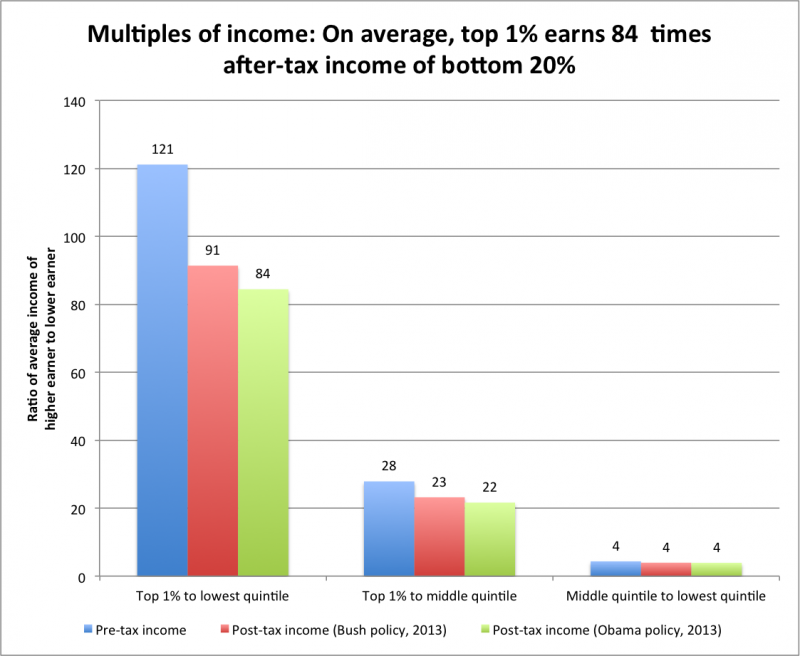
inequality-800x656

Zachary Goldfarb presents the findings of a Tax Policy Center analysis showing that by one measure, income inequality has declined appreciably in the Obama era:

Today, the average after-tax income of a member of the top 1 percent of earners is $1.12 million. The average after-tax income of someone in the bottom 20 percent is $13,300. That means the average person at the top takes home 84 times the income that the average person in the bottom takes home. Now, consider what it would be like if none of President Obama’s tax policy changes had happened: not the upper-income tax hikes negotiated at the beginning of last year, not the upper-income tax increases imposed by the Affordable Care Act, not the low-income tax credits enacted in the 2009 stimulus and later renewed.

In this alternative universe, the average member of the top 1 percent would take home $1.2 million, or 6.5 percent more in income, according to a new analysis. The average member of the bottom 20 percent would bring home $13,100, or 1.2 percent less in income. As a result, the average member of the 1 percent would take home 91 times what the average person in the bottom would bring home. If you’ve wondered whether Obama has made any headway at reducing income inequality, here’s evidence that he has.

For Jordan Weissmann, this finding illustrates the importance of measuring inequality both before and after taxes and transfers:

Between the tax changes and health reform, Council of Economic Advisers Chairman Jason Furman argues that the administration has undone “more than a decade” of growing inequality. And he has a point. Liberals prefer talking about pre-tax inequality in large part because it’s a raw reading of how egalitarian our economy is—it tells us how bad the income gap would be were it not for Washington’s intervention. But looking at post-tax-and-transfer inequality tells us how much more work needs to be done to even outcomes—and whether the government’s interventions are having an effect. Both sets of numbers tell us important stories. One says the rich are still pulling away from the rest of us. The other says that the administration has managed, ever so slightly, to pull them back.

Violence Triumphs Over Pluralism

That’s the essence of Shadi Hamid’s take on the aftermath of the Arab uprisings and the rise of armed Islamist groups throughout the Middle East:

The July 3, 2013 coup in Egypt has had a chilling effect beyond the country’s borders, strengthening one particular narrative among both regimes and their opposition: that the only currency worth caring about is force. With the relative decline (for now) of the Muslim Brotherhood and other mainstream Islamist groups that had made their peace with parliamentary politics, radicals and extremists have quickly moved to fill the vacuum. They do not counsel patience. They tell followers and fence-sitters that there is little need to wait 20, 30, or 80 years for the Islamic State, or something like it. The Islamic State can be realized now through brute, unyielding violence. Within the varied, often fractious world of political Islam, the radicals remain a minority, but their numbers belie an outsized influence.

We might not like to admit it, but violence can, and often does, “work” in today’s Middle East. This is not just a reference to the Islamic State of Iraq and Syria (ISIS), but also to less extreme militant groups that control territory throughout Syria, providing security and social services to local populations. From Libya to Palestine to parts of the Egyptian Sinai, armed—and increasingly hard-line—Islamist groups are making significant inroads.

William Dalrymple argues that the rise of ISIS and its persecution of Christians bode ill for secularism in the Arab world:

Certainly since the 19th century Christian Arabs have played a vital role in defining a secular Arab cultural identity. It is no coincidence that most of the founders of secular Arab nationalism were men like Michel Aflaq – the Greek Orthodox Christian from Damascus who, with other Syrian students freshly returned from the Sorbonne, founded the Ba’ath party in the 1940s – or Faris al-Khoury, Syria’s only Christian prime minister. Then there were intellectuals like the Palestinian George Antonius, who in 1938 wrote in The Arab Awakening of the crucial role Christians played in reviving Arab literature and the arts after their long slumber under Ottoman rule.

If the Islamic state proclaimed by Isis turns into a permanent, Christian-free zone, it could signal the demise not just of an important part of the Arab Christian realm but also of the secular Arab nationalism Christians helped create.

Relatedly, noting the unusually cold shoulder Hamas has gotten from some Arab states during the Gaza war, Juan Cole attributes this to the region’s recent political realignment around the struggle between states and Islamist non-state actors:

[Y]ou have a bloc of nationalist states– Egypt, Jordan, and Syria — facing off against movements of political Islam, and Hamas has to be counted among the latter. (Iraq, ruled by parties of Shiite political Islam, is trying to join the nationalists in the region in alliance against the “Islamic State”). It is therefore difficult for these states to intervene on behalf of Hamas, since they want the organization, and the whole tendency to political Islam, to drop dead. …

Even the so-called “Islamic State” turns out to be useless to Hamas. Its leadership says that it has to tackle the “hypocrites” among the Muslims before turning to “the Jews.” This is a reference to early Islam. When the Prophet Muhammad emigrated from Mecca to Medina, most people in the latter city came to embrace Islam, even if only pro forma. City notables who outwardly had become Muslims but inwardly resented and tried to undermine the Prophet, were termed “hypocrites” or “those in whose hearts there is a sickness”. The so-called Islamic State views all other Muslims this way. So the struggle between nationalism and political Islam has neutralized most of the Middle East if it hasn’t made them de facto allies of Israel.

The Able-Bodied Actor’s Handicap

Christopher Shinn, a playwright who underwent a below-the-knee amputation in his late 30s, discusses the limited depth that able-bodied performers bring to disabled characters and why actors with disabilities don’t get cast in these roles instead:

Able-bodied actors can listen to the disabled, can do research, can use imagination and empathy to create believable characters. But they can’t draw on their direct experience. That means that audiences will be able to “enjoy” them without really confronting disability’s deepest implications for human life. Often, one fears, that’s the point: Pop culture’s more interested in disability as a metaphor than in disability as something that happens to real people.

For example, in his review of Side ShowNew York Times theater critic Charles Isherwood wrote, “Of course, in some sense, we all know what it’s like to feel self-divided, or alienated from the world, which is what makes ‘Side Show’ emotionally stirring.” Disabled characters are often seen as symbolizing the triumph of the human spirit, or the freakishness we all feel inside. That may be another reason disabled actors are overlooked—they don’t allow disability-as-metaphor to flourish as easily.

I may not have been much bothered by any of this until my own disability asserted itself. But now I know that the physical pain and challenges that come in the wake of disability, alongside the insensitivity and lack of understanding one encounters, are profound experiences that cannot be truly known until they are endured. Perhaps the worst feeling is when people avert their eyes. Even someone gawking is better than their looking away.

(Video: Daniel Day-Lewis as Irish poet Christy Brown, who suffered from cerebral palsy, in the 1989 film My Left Foot. He won an Academy Award for his performance.)

The Islamic State In Iraq And Only Iraq

Jacob Siegel casts doubt on ISIS’s ability to extend the reach of its “caliphate” beyond Iraq, given that its Sunni rebel allies there don’t share its objective of world conquest:

There is a paradox to ISIS’s power. The caliphate has grown to rival al Qaeda for prestige in the global jihad movement but it becomes clearer with every day that, within Iraq, the Islamic State doesn’t extend very far outside of Mosul. As an attacking force, ISIS might be the most powerful army in Iraq, able to ambush the army in lightning assaults that have either scattered or slaughtered government and militia soldiers. But the skills and composition that have led to ISIS successes on the battlefield haven’t set them up to rule in any more than a handful of cities. They are too small to impose their authority over extended territory. For that they rely on their allies, using them until the day they are no longer needed, just as they, in turn, are being used.

ISIS’s victories and social media theatrics have won it a flock of Internet supporters and death-seeking recruits, but most of its potential followers in Iraq aren’t looking online to choose a cause, they take orders from tribal leaders or other local authorities.

Likewise, Yezid Sayigh contends that “in fact ISIS is following a well-worn path for taking power and consolidating it in the limited geographical space of a single nation-state where its true social base lies”:

To legitimize itself ideologically and acquire leverage over its partners and competitors, ISIS calls Muslims to jihad, labels western governments “crusaders,” and pledges to free Palestine. This again mimics Saddam, who appealed to pan-Arabism and the Gulf monarchies to support his war against revolutionary Islamist Iran in 1980, and in 1990 linked his invasion of Kuwait to the liberation of Palestine and evoked Islamic solidarity by having “Allahu Akbar” inscribed on the national flag.

But Saddam remained an Iraqi leader in the Iraqi setting, benefitting from the country’s oil wealth to cement his rule internally but remaining bound by its limitations, especially its deep social cleavages and weak national identity. ISIS is even more dependent than he was on its societal balances and alliances within the narrower domestic demographic base of the Arab Sunnis of Iraq, a vulnerability that is not seriously compensated by its partial extension into Syria.

Superhero Social Justice, Ctd

In the wake of the announcement of a female Thor, Noah Berlatsky considers the female comic-book readership:

Lots of women do read comics in general, and superhero comics in particular.  That fact should be self evident enough by now, given the way the Internet has given voice to many female fans of the genre. And yet sexism in the comics world persists. The effort to firmly debunk gendered stereotypes about who enjoys comics and who doesn’t would seem to benefit from hard statistics about just how many women are reading. Those statistics are surprisingly difficult to come by—but the ones that are available suggest that comics, and superhero comics, historically did appeal to both genders and very well could again.

Because of low critical standing or low readership or some combination of both, good data about comics readership over the years is rare. We do know that comics were much, much more popular during the 1940s, when superheroes first burst on the scene, than they are today. Comics then were more like film or television—a mass entertainment option, rather than a niche one. A Market Research Company of America report from 1944 found that 95 percent of all boys and 91 percent of all girls between six and 11 read comics; 87 percent of boys and 81 percent of girls between 12 and 17, and 41 percent of men and 28 percent of women between 18 and 30. Comics scholar Trina Robbins told me that The Newsdealer, a magazine for newsstand owners, actually published figures suggesting that girls at the time read more comics than boys.

Previous Dish on superhero diversity here.