How Much Humor Can America Handle?

God bless Tina Fey and Amy Poehler:

Poniewozik reviews the Golden Globe’s jokes through the lens of Charlie Hebdo. He pays particular attention to outrage over Margaret Cho’s impersonation of a North Korean general and Fey and Poehler’s skewering of Cosby:

For all the horror at the shootings and support for the right to expression, Americans get nervous about satire long before it reaches the scathing, vicious tone of Charlie Hebdo‘s cartoons. We’ve had numerous debates over whether a rape joke can ever be good and funny (though I’d say Fey and Poehler’s, aimed at a powerful person accused of assault, are Exhibit A of how one can be). And though Cho herself is Korean, playing a foreign character–and though she already played dictator Kim Jong Il on Fey’s 30 Rock–any lampooning of a heavily accented Asian character on this stage was likely to trip the outrage meter.

As with the Charlie Hebdo cartoons themselves, it was an example of a tension in American melting-pot culture, especially in left-leaning communities like Hollywood: classical liberalism (which emphasizes expression and personal and artistic liberties) bumps up against progressivism (which emphasizes identity politics and power dynamics).

So, nous sommes tous Charlie? Maybe. But more in theory than in practice.

#JeSuisJuif

Noah Rayman discusses how last week’s attack on the Hyper Cacher supermarket is affecting Jewish communities in France:

The assault on the Kosher supermarket shook the Jewish community in France and abroad. As dual hostage situations unfolded, police ordered the closure of all shops in the tourist-filled Jewish neighborhood in central Paris, far from the supermarket under siege in the city’s east, according to the Associated Press. And ahead of the Sabbath Friday evening, the iconic Grand Synagogue of Paris was closed, USA Today reported.

The Jewish community in France, numbering more than 400,000, had already been on guard after an uptick in anti-Semitic violence in recent years, including the shooting of four people at the Jewish Museum of Belgium in May 2014, allegedly by a French Muslim man. After the attack on Charlie Hebdo on Wednesday, Jewish institutions were on maximum alert, the Jewish Telegraphic Agency reported. Volunteers joined police deployed by the French authorities to secure schools and religious sites.

Elliot Abrams wonders why there isn’t more sympathy for the Jewish victims:

Terrorism against French Jews is not new. In 2012 a terrorist murdered three schoolchildren and a rabbi at a Jewish school in Toulouse. There was no million-citizen march.

And suppose that last week’s terror attack in Paris had not aimed at Charlie Hebdo, but “only” killed four Jews–or eight or twelve, for that matter. Does anyone believe a million French citizens would be marching in Paris, with scores of world leaders joining them?

One is reminded of the synagogue bombing on Rue Copernic in Paris in 1980, after which Prime Minister Raymond Barre publicly declared that “A bomb set for Jews killed four innocent Frenchmen.” That shocking lack of solidarity– that definition of Frenchmen to exclude the Jews – does not seem to have been cured, and the French today appear to feel more solidarity with the journalists who were killed than with the Jews who were killed.

But Jeffrey Goldberg observes that the current French leadership has been taking the issue of anti-semitism seriously:

[French Prime Minister Manuel] Valls, who on Saturday declared that France was now at war with radical Islam, has become a hero to his country’s besieged Jews for speaking bluntly about the threat of Islamist anti-Semitism, a subject often discussed in euphemistic terms by the country’s political and intellectual elite. His fight, as interior minister, to ban performances of the anti-Semitic comedian Dieudonne (the innovator of the inverted Nazi salute known as the quenelle) endeared him to the country’s Jewish leadership, and he is almost alone on the European left in calling anti-Zionism a form of anti-Semitism.

“There is a new anti-Semitism in France,” he told me. “We have the old anti-Semitism, and I’m obviously not downplaying it, that comes from the extreme right, but this new anti-Semitism comes from the difficult neighborhoods, from immigrants from the Middle East and North Africa, who have turned anger about Gaza into something very dangerous. Israel and Palestine are just a pretext. There is something far more profound taking place now.”

And Adam Taylor holds out the #JeSuisJuif solidarity campaign on Twitter as evidence that the world isn’t ignoring those victims, though anti-semitism remains a real problem in France:

#JeSuisJuif began to trend after news spread about hostages being taken at the grocery store, which is called Hyper Cacher, or Hyper Kosher, in Porte de Vincennes. The attack took place at the start of the Jewish Sabbath, when the store was busy, and there were fears that other Jewish businesses in the area could be targets. Later, French President Francois Hollande described the hostage taking as an “anti-Semitic attack”

The attack comes at a fraught time for France’s Jewish community. Many French Jews have perceived a rise in anti-Semitism in the country in recent years. Reports of violence against Jews skyrocketed at the start of 2014, and things became worse over summer as a conflict in Gaza prompted anti-Israel protests that blurred the line with anti-Semitism. One survey by the New York-based Anti-Defamation League estimated that 37 percent of French people openly held anti-Semitic views – the highest number in Europe.

“Take Your Medicine” Taken To The Extreme

A reader writes:

Essentially the question is whether a 17 year-old can commit suicide, but with the added complication that she doesn’t understand that’s what she’s doing. She is misinformed, to put it gently. I’ve had aggressive chemo for a different cancer. It sucks, sure. It’s strong medicine with strong side effects. But there are a lot of dangerous myths online that are simply not true. It doesn’t kill the rest of you. It isn’t more harmful than the disease itself (we’re talking cancer here). And we know from many, many years of experience and studies that more often than not it works. I can’t tell you how many posts I’ve seen on an Internet discussion board for my cancer from people who say that they chose to skip chemo, against their doctor’s recommendation, because they bought into these myths and now they have terminal, metastatic disease. And regrets.

We have to draw the line somewhere. We don’t let 12 year-olds make this kind of decision. It seems to me that 18 is a pretty good place to draw this line. And this girl has not demonstrated that she is particularly mature for her age.

I remember the series you had on suicide. I can’t remember the expert’s name, but one thing she said stayed with me: your future self will thank you for not committing suicide. There is no question in my mind that Cassandra’s future self will thank the judge for not allowing her to commit suicide.

Another reader also relates to the story from personal experience:

I am the parent of a cancer survivor, and I feel compelled to ask who is it who helped convince Cassandra she was being poisoned?

Her parents quite clearly.  My son was diagnosed with a rare, aggressive and very often fatal cancer when he was five years old. His treatment was as aggressive and toxic as was his disease and lasted more than three years. My wife and I spent those years – each and every day – agonizing over the question whether we were doing our level best to save him,  or torturing him to no avail and thus destroying whatever quality of life he might ever have. He had eight rounds of such high-dose and toxic chemo that one dose would have killed an adult because  mature organs would not be able to withstand the treatment.

Several surgeries, extensive radiation, and a host of experimental treatments on top of that exposed him to an array of side effects and collateral risks.  Many times we didn’t know if he would make it through the night. But we saw our duty to comfort and support him as best we could and not to quit until we were told there was no hope for him to survive.  We cried in private and smiled and joked whenever we were with him.  We felt we had to be strong for him, to explain that the medicine was killing the cancer, not hurting him, and reminding him that we loved him and wanted only for him to live a full and happy life. We NEVER suggested that avoiding the near term suffering was an option.

We held him close through the hard parts but tried to make him as happy as we could during the rest of it. We developed comedy routines about some of the worst aspects, and he soon was able to laugh about it all when he wasn’t too sick. We made it, and are eternally grateful to the most wonderful doctors and nurses on the planet and their commitment to trying to cure him. He is now 21 and healthy, happy and in love.

I have cried like a baby reading Cassandra’s story, as I have attended more funerals of children than anyone should have to, as has my son. I can assure you that all of the parents of those lost souls would give anything to trade places with Cassandra’s parents and have the hope of survival for their child, and that none of them would ever suggest to her – by either  commission or omission – that her treatment – as awful as it may seem – was worse than the disease.

Of course she doesn’t want to undergo the treatment. Her mother has told her or agreed with her that it is poison, and whom does a child trust more than her mother?  The discussion of legal rights and the boundaries between childhood and adulthood miss the real tragedy here. That a bit of parental courage and support and the situation would likely be much different; Cassandra would in my experience be viewing the treatment very differently despite its effects. But as it is, it seems a no-win situation for no reason other than fear.  It is absolutely shattering, but not because it is abrogating Cassandra’s rights.

How Will History Judge Obama?

US-POLITICS-OBAMA

Chait expects historians to be relatively kind:

In an April speech at the Lyndon Baines Johnson Presidential Library to praise the 36th president’s legacy, Obama turned to the theme of vindication in an explicit way. His choice of Johnson was a telling one. No American president left such a gap between the scale of his lasting accomplishments and the indignities he suffered in his own time. The Democrat who dismantled legal apartheid in the South and created Medicare and Medicaid was so loathed he did not even bother trying to run for reelection. At times in the speech, Obama linked Johnson’s travails to his own. The triumphs of history that seem clear and simple in retrospect, he noted, felt contemporaneously grueling and ugly. “From a distance, sometimes these commemorations seem inevitable, they seem easy,” Obama said. “All the pain and difficulty and struggle and doubt—all that is rubbed away.” You can sense his desperate wish to arrive at a vantage point where his accomplishments will be buffed of disappointment and take on the same heroic gloss.

One can imagine future histories that focus less on Obama’s dysfunctional relationship with Congress, and that measure accomplishment in more discerning proportion. But the lesson Johnson offers for Obama’s own eventual vindication is not quite so encouraging. LBJ’s political career was defined by his singular failure in Vietnam. The hatred this spawned blotted out his massive and more enduring achievements. The current film Selmainaccurately depicts Johnson as an opponent of the civil-rights struggle he had, in reality, thrown all his energy behind. Five decades on, Johnson still has not escaped the feelings he engendered—indeed, he still requires rehabilitation by figures like Obama.

Christopher Caldwell dissents:

Obama may wind up the most consequential of the three baby-boom presidents. He expanded certain Bush ­policies—Detroit bailouts, internet surveillance, drone strikes—and cleaned up after others. We will not know for years whether Obama’s big deficits risked a future depression to avoid a present one, or whether the respite he offered from “humanitarian invasions” made the country safer. Right now, both look like significant achievements. Yet there is a reason the president’s approval ratings have fallen, in much of the country, to Nixonian lows. Even his best-functioning policies have come at a steep price in damaged institutions, leaving the country less united, less democratic, and less free.

A poll of more than 50 historians provides another perspective:

Almost every respondent wrote that the fact of his being the first black president will loom large in the historical narrative — though they disagreed in interesting ways. Many predict that what will last is the symbolism of a nonwhite First Family; others, the antagonism Obama’s blackness provoked; still others, the way his racial self-consciousness constrained him. A few suggested that we will care a great deal less about his race generations from now — just as John F. Kennedy’s Catholicism hardly matters to current students of history. Across the board, Obamacare was recognized as a historic triumph (though one historian predicted that, with its market exchanges, it may in retrospect be seen as illiberal and mark the beginning of the privatization of public health care). A surprising number of respondents argued that his rescue of the economy will be judged more significant than is presently acknowledged, however lackluster the recovery has felt. There was more attention paid to China than isis (Obama’s foreign policy received the most divergent assessments), and considerable credit was given to the absence of a major war or terrorist attack, along with a more negative assessment of its price — the expansion of the security state, drones and all. The contributors tilted liberal — that’s academia, no surprise — but we made an effort to create at least a little balance with conservative historians. Their responses often echoed those from the far left: that a president elected on a promise to unite the country instead extended the power of his office in alarming, unprecedented ways.

(Photo: Nicholas Kamm/Getty)

Reasons To Keep Oil Prices High

Gas Tax

Michael Levi wants to raise the gas tax:

[W]hen oil prices fall, fuel efficient cars, homes in city-centers, and public transit investments all drop in value. This can lead to economic waste: underused automobiles, unrented homes, empty subways. A particularly glaring example came on Wednesday when President Obama visited a Ford plant that makes fuel-efficient vehicles: because of the drop in oil prices, that plant was closed, wasting both the factory and the skills of the workers that it would have employed.

In this world, a newly higher gasoline tax would actually avoid economic waste rather than creating it.

Ford and others that invested money on the expectation that oil prices would remain relatively high (and, if options prices on oil futures as recently as six months ago are any indication, that means most businesses) would see their investments hold more value. The same goes for drivers who, facing higher oil prices, already spent their money on ever-more-fuel-efficient cars. (They’d still pay more at the pump, but the resale value of their cars would rise.) One can go down the list of oil-sensitive consumers and find more examples like this.

Josh Mitchell provides some context:

The federal levy—which amounted to about $23.5 billion in gasoline tax revenue in the 12 months through September 2013—has stood at 18.4 cents a gallon since the first year of the Clinton administration, despite multiple proposals over the years to raise it. Over the past decade, Congress has approved higher spending for highway construction but hasn’t raised the tax to pay for it, creating periodic funding crises.

Chris Edwards isn’t convinced:

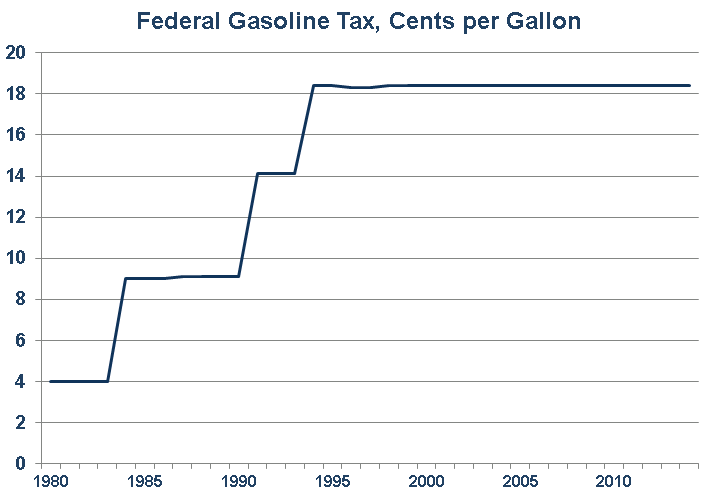
Gas tax supporters say that it is time to raise the tax because it has not been raised in two decades. What they leave out of the story is that the gas tax rate more than quadrupled between 1982 and 1994 from 4 cents per gallon to 18.4 cents, as shown in the chart [above]. Thus, looking at the whole period since 1982, federal gas tax revenues have risen at a robust annual average rate of 6.1 percent (based on Tax Foundation data). So, again, we have a spending crisis, not a funding crisis.

But, just last week, Krauthammer once again supported raising the tax:

A tax is the best way to improve fuel efficiency. Today we do it through rigid regulations, the so-called CAFE standards imposed on carmakers. They are forced to manufacture acres of unsellable cars in order to meet an arbitrary, bureaucratic “fleet” gas-consumption average.

This is nuts. If you simply set a higher price point for gasoline, buyers will do the sorting on their own, choosing fuel efficiency just as they do when the world price is high. The beauty of the tax — as a substitute for a high world price — is that the incentive for fuel efficiency remains, but the extra money collected at the pump goes right back into the U.S. economy (and to the citizenry through the revenue-neutral FICA rebate) instead of being shipped overseas to Russia, Venezuela, Iran and other unsavories.

The Plan To Make Community College Free, Ctd

A reader isn’t a fan of this plan:

I sure wish people would stop using the word “free” regarding these kinds of plans. They aren’t free.  I’ll be paying for them.  You’ll be paying for them.

I think that more concentrated “trade school/technical” type of high schools are better than sending everyone to college.  My guess is that for most people the years spent on college would be better spent on preparing to have a trade. It is a cruel trick to play on the working classes to make them think that EVERYONE is going to profit by merely going to college, as if you can’t better yourself without it.  Only the Left will benefit from everyone going to college, since Leftist/Marxist indoctrination is rife amongst Academicians.

Less people should be going to college.  I’ve been to college.  I have my degree. Want to buy it for $100?  I’ll sell it to you. There is very little that college gave me that I couldn’t have obtained on my own, simply by continuing my life-long love of reading (I was reading by age of five, thanks to my mother’s own love of reading).

As a taxpayer, I don’t want to pay for the education of people when it won’t enhance their life.  I would rather pay for more trade schools and technical skills for people.  And by the way, you can get damn rich by being a carpenter or a plumber or an electrician.

More readers sound off:

I can’t help thinking that, regarding this plan from Obama, he’s getting the issue all wrong.

From my perspective, the problem with higher education in America is that too many people need it more than that too few people get it. As it is already, too many college students either don’t want or don’t need what, at its core, a college education actually (and should) offer: a chance to pursue knowledge for its own sake and engage with thought and ideas simply for the sake of doing so. Few people actually enjoy this or can benefit from it, and yet it is really this experience, not job training or acquisition of marketable skills, that college is meant to provide.

Conversely, colleges are comparatively ill-equipped to provide job skills training, since most faculty members’ primary goal is pursuit of new knowledge (research) rather than teaching. Vocational and trade schools, not colleges, are the proper forum to provide Americans who are looking to get ahead with the skills they need to improve their lives, and yet the president is doubling down on the absurd misuse of colleges and universities that is already so pervasive.

As a student at a prestigious (if I may say so myself) university, I can tell you that most students are not there to engage with ideas and acquire knowledge, but to “check the box” on their way to a lucrative career. Academia is simply not meant to be no-cost employee training for corporations, and it is to the detriment of everyone when it gets used this way. The president ought to be focusing on expanding opportunity for those who either choose not to go to college or cannot afford to do so.

Another skeptical reader:

I have given a lot of thought about this based on my own experience. In my smallish hometown back in the late ’90s, when NAFTA was picking off manufacturing right and left, several of the largest factories closed in a short period of time.  Lots of people took advantage of Trade Adjustment Assistance, which basically allows you to receive unemployment benefits for two years as long as you are in a degree program. The tuition wasn’t included (as I recall), but virtually everyone was eligible for full Pell Grants.

Two years later though, the jobs of the future had not arrived. You just had a glut of people with Associate Degrees competing for jobs that paid less than the ones they lost.  Now the president’s new plan would be aimed at young people who have the option of moving to where the better jobs are. So this is definitely not apples to apples. But it’s still going to be many more Associate Degrees, which will make Bachelor Degrees more sought-after.

And how are these folks who needed the free community college tuition going to pay for that? Student loans. Throw in wage stagnation and a larger share of people with these degrees, and round and round we go.

Don’t get me wrong. I’m all for more education. For cheaper education. I applaud this as a great start. But we need cheaper higher education and higher wages to really make a difference.

Update: Many readers here correct and counter the ones above.

Prison For Petraeus?

CIA Director David Petraeus, testifies b

It’s looking likely that the general will face felony charges for leaking classified information to his mistress. Trevor Timm reviews the relevant law:

By all accounts, Petraeus’s leak caused no damage to US national security. “So why is he being charged,” his powerful friends will surely ask. Well, that does not matter under the Espionage Act. Even if your leak caused no national security damage at all, you can still be charged, and you can’t argue otherwise as a defense at trial. If that sounds like it can’t be true, ask former State Department official Stephen Kim, who is now serving a prison sentence for leaking to Fox News reporter James Rosen. The judge in his case ruled that prosecutors did not have to prove his leak harmed national security in order to be found guilty.

Eli Lake notes how unusual this is:

Senior officials such as Petraeus, who serve at the highest levels of the national security state, are almost never punished as harshly as low- and midlevel analysts who are charged with leaking.

When former CIA director John Deutch was found to have classified documents on his unsecure home computer, he was stripped of his security clearance and charged with a misdemeanor. President Bill Clinton pardoned him. Sandy Berger, who was Clinton’s national security adviser, absconded with sensitive documents relating to al-Qaeda from the National Archives. In 2005, he was fined $10,000 and stripped of his security clearance for three years.

The fate for lower-level leakers is rarely so kind.

Martin Longman remarks that “one of the most dispiriting recent trends in Washington has been the way that high officials have skated despite the worst kind of malfeasance and incompetence”:

Holding anyone to the same standards we hold regular folks to would have to be considered a turn in the right direction. If you want to restore some faith in government, you have to demonstrate that we’re capable, at least occasionally, of acting like there is one set of rules that applies to everyone equally. Tossing Petraeus in prison would definitely send that message.

Having said that, I think his crime is significant but ultimately not that serious. His punishment should be commensurate with his offense.

Joyner joins the conversation:

My instinct is that people in the highest positions of public trust ought indeed to be prosecuted when they violate that trust. Putting the sainted David Petraeus on trial would send a powerful signal that no one is above the law and that we take safeguarding our secrets seriously. This wasn’t, after all, a situation where he skirted the law in misguided pursuit of the nation’s security; he did so for the most selfish reasons. To the extent that his long history of service to the nation counterbalances his transgressions here, it can be weighed at sentencing.

And Marcy Wheeler is sick of Washington elites defending one of their own:

McCain (and his sidekick Lindsey) are not the only ones rending their garments over the injustice of a top Obama official being investigated for leaking classified details to make himself look good. Jason Chaffetz keeps complaining about it. And Dianne Feinstein took to the Sunday shows to declare that Petraeus has suffered enough. Richard Burr apparently made false claims about how the Espionage Act has been wielded, of late, even against those whose leaks caused no harm.

Golly, you’d think all these legislators might figure out they have the authority, as legislators, to fix the overly broad application of the Espionage Act.

(Photo: by Karen Bleier/AFP/Getty Images)

Romney 3.0

Mitt Romney Holds Florida Primary Night Event

Romney is apparently considering yet another run at the White House:

“Everybody in here can go tell your friends that I’m considering a run,” the former candidate told the gathering in midtown Manhattan, according to Politico. But insiders who spoke to BuzzFeed News about Romney’s evolution on the 2016 question said he only began to entertain the possibility recently, and that he still needs to weigh a number of factors — including Jeb Bush’s electability — before he decides to take the plunge.

Enten tries to understand Mitt’s logic:

In March, I wrote that this was the most split Republican presidential field in the modern era (since 1976). And that still holds today. Jeb Bush’s 23 percent support in a recent CNN survey was the highest for any non-Romney candidate over the past year. Most polls show every candidate (besides Romney) south of 20 percent.

But he keeps in mind that “general election losers that have run for their party’s nomination again have a terrible record.” Ben Jacobs cracks open the history books:

The last [general election loser] to even mount a campaign was George McGovern, the Democratic nominee in 1972, who mounted a quixotic comeback attempt in 1984. In fact, with the exception of Richard Nixon’s win in 1968, the only time a former major party nominee has since been elected to the presidency since the Civil War was when former President Grover Cleveland won his 1892 rematch for the White House against Benjamin Harrison.

Rather than signing on with Jeb in the next weeks or months, many of those money men and women will wait to see what Romney does before doing anything. So, Romney is really buying himself — and, whether intentionally or not, the rest of the potential field — some time. He’s taking the Bush pot off of boil and turning it down to simmer.

Lisa Lerer and Annie Linskey note that, while “Bush and Romney have always been cordial, they’ve never been close”

Some Romney advisers are still grumbling about Bush’s role in the 2012 campaign. Despite calls, e-mails, and private meetings with Romney before the hard-fought Florida primary, Bush endorsed Romney in March—nearly two months after the state’s contest and when the nomination was already within the former governor’s grasp. A few months later, in the midst of the general election, Bush criticized Romney’s approach to the immigration issue, saying at a Bloomberg View event that he needed to “change the tone.” “He got off message,” said Bush of Romney’s campaign in an interview last month with a Miami television station. “He got sucked into other people’s agenda.”

In private conversations, Romney has questioned Bush’s ability to beat Clinton, arguing that voters would recall her husband’s administration in a far more positive light than that of former President George W. Bush. He’s also warned that Bush, who spent his post-office years working on a range of business ventures, could be open to the same type of private equity attacks that Democrats successfully leveraged against Romney in the 2012 race.

Zeke Miller and Alex Altman aren’t sure how seriously to take Romney:

One Republican consultant suggests that posturing over a possible campaign was a way to signal that he wouldn’t cede automatically donors or staff to Bush. … This is why veteran operatives of the Romney campaigns consider the revived rumors of a 2016 campaign overblown. They have long scoffed at the notion he’d run again. They believe their former boss would be an excellent president. They say Romney agrees. At the same time, they don’t expect a campaign to materialize.

Jennifer Rubin hears much the same:

In my informal survey of about a 15 GOP insiders, some with other candidates and some unaffiliated, I did not find a single person convinced Romney was actually running. One person gave the back of the hand to the idea Romney was poised to enter the race: “I don’t think he is [serious]. I think his advisers are and they aren’t letting him kill the rumors.” Another remarked, “I think people who think Romney can still be president are living in a fantasy world. Great guy. Would have been super president. Should have won, but it’s over.” A third said, “It’s unclear if it is intended to start a ‘draft’ movement or if he wants to try and hold the field or if he wants to be in the wings in case the field implodes.” A fourth told me, “He has little to no natural constituency in the party.”

Larison rolls his eyes:

Given that success is very unlikely, and since it can only harm Romney’s reputation to embark on a third losing effort, it raises the question: what could Romney and his backers be thinking? Maybe his former staffers and advisers just want to get paid, but why would Romney want to go through the process all over again? There is every chance that he would be thoroughly humiliated along the way. That might be amusing to watch at first, but it would mostly just be sad.

Outside of a small band of loyalists, I can’t imagine who in the GOP would want to go through another failed presidential campaign.

(Photo by Alex Wong/Getty Images)

Busted With An Eggcorn, Ctd

Screen Shot 2015-01-08 at 10.49.30 AM

This is probably the last of the mega popular thread. A reader sends the above image:

Am I too late for eggcorns? One of Boston’s historic burying grounds is Copp’s Hill Burying Ground, named for the family of William Copp, who once owned the land. Several maps, including this one from 1776, label it “Corpse Hill” instead. Perfectly reasonable, especially considering locals’ relationship with the letter R.

An eggcorn fitting for the week:

Years ago, in winter, my Italian boyfriend called the “wind chill” factor the “windshield” factor, as he thought it meant how cold the temperature was going over a car’s windshield. He had been in Canada his whole life and nobody had corrected him (before me). He laughed.

Another:

What do you call it when you and your buddies go to the beach and build a big driftwood fire, cluster around it, and become even closer friends? This morning I saw the following on a gold prospecting forum I visit: “I have had many similar finds on beaches where people have at one time had a bond fire.”

A dozen more after the jump:

You guys are probably sick of these by now, but I’ll throw one in:

I remember calling my brother and getting my 4-year-old niece.  When I asked her if my brother was at home, she told me that he had gone to “his ami,” having clearly heard that her father was on his way to that city in Florida.

Another:

I’ve got a companion to the “Seattle” eggcorn! (“Who is Attle, and why are we going to see her?”) A young friend on her first airplane trip was paying close attention to all the pilot’s announcements in preparation for takeoff. At one point the pilot announced that they were just waiting for clearance and then would be taking off. The kid turned to her older companion and asked, “Who is Clarence, and why are we waiting for him?”

Another:

A neighbor once told me that the second of two related unwelcome events was “like addin’ salt to an injury.” (Insult to injury)

Another:

I worked with a marketing director of a Texas bank in the ’70s. When something went wrong he was afraid that he was likely to be the “escaped goat”.

Another:

OK, I’ll bite. In law school, one of my best friends, had two eggcorns that he used (until someone pointed out the error): “all intensive purposes” for “all intents and purposes;” and “the straightened arrow” for “the straight and narrow.”

Another:

After reading the latest update to this thread, I just received a letter from a fellow attorney in which he endorses a judicial candidate on the grounds that she is “imminently qualified” for the appointment.  Perhaps, by the time she takes the bench, she will be all the way there!

Another:

One of my partners in business sometimes tells me that he’s “flusterated” by one thing or another. The first few times I thought he might’ve misspoken. It wasn’t until recently that I realized he thought the word was flusterated instead of frustrated – and you know what, sometimes I get pretty flusterated too.

Another:

I grew up near Boston, and therefore I believed that Arthur was someone who wrote books.

Another:

I am a long-time reader and subscriber, but I this is the first time I am writing in. Reviewing all the eggcorns that have been shared, I thought your readers would enjoy this one. When I was about 10, I first encountered the hymn “All Hail the Power of Jesus’ Name.”  The opening line stated, quite dramatically, “All hail the power of Jesus’s name, let angels PROSTRATE fall.” By this time in my life I had heard of PROSTATE cancer and knew where it was located on the male body. For the life of me, I did not understand what was going on with those angels.

Another:

My aunt used to say that you had to heat water in a pot until it came to a roaring boil.

One more:

Teaching 8th grade English, I’ve circled more than a few eggcorns in red ink over the last 18 years. The one I see with astonishing frequency: some variation or other on “It’s important not to take things for granite.” I’ll cut them some slack; they are, after all, fourteen. Wy wife, however, is fair game for good-natured ribbing for telling our sons recently “Don’t lick a gift horse in the mouth”.

This Is Your Brain On Baby

UCL-neurology-maternal-vs-romantic-love

Adrienne LaFrance researches the neurological changes that women undergo when they become mothers. Yes, it’s like a drug:

“We see changes at both the hormonal and brain levels,” brain researcher Ruth Feldman told me in an email. “Maternal oxytocin levels—the system responsible for maternal-infant bonding across all mammalian species—dramatically increase during pregnancy and the postpartum [period] and the more mother is involved in childcare, the greater the increase in oxytocin.” Oxytocin also increases as women look at their babies, or hear their babies’ coos and cries, or snuggle with their babies. An increase in oxytocin during breastfeeding may help explain why researchers have found that breastfeeding mothers are more sensitive to the sound of their babies’ cries than non-breastfeeding mothers. … What scientists do know, Feldman says, is that becoming a parent looks—at least in the brain—a lot like falling in love.

Dads get doped up too, but in a different way:

Oxytocin does not seem to drive nurturing behavior in men the way it does in women, Feldman and other researchers found in a study last year. Instead, a man’s parental brain is supported by a socio-cognitive network that develops in the brain of both sexes later in life, whereas women appear to have evolved to have a “brain-hormone-behavior constellation” that’s automatically primed for mothering. Another way to look at it: the blueprint for mothering behavior exists in the brain even before a woman has children.