“Take Your Medicine” Taken To An Extreme, Ctd

That 17-year-old in Connecticut trying to refuse chemo lost her court battle on Thursday:

The state argued that the teen lacked competency extended to maturity and that they did not believe she understood the severity of her prognosis. Her mother and her mother’s lawyer said they expect to go back to trial court to more fully explore the mature minor argument.

Her words are pretty heartbreaking:

The day of the ruling, Cassandra published a personal essay in the Hartford Courant about her experience. In the article, she describes crying and hiding from the police in her closet, running away from home after two days of chemotherapy, and being strapped to a hospital bed to undergo treatment against her will. She also refutes any claims that her mother was neglectful during her illness. “This experience has been a continuous nightmare,” Cassandra wrote in her essay.

“I want the right to make my medical decisions. It’s disgusting that I’m fighting for a right that I and anyone in my situation should already have. This is my life and my body, not [the Department of Children and Families]’s and not the state’s. I am a human — I should be able to decide if I do or don’t want chemotherapy. Whether I live 17 years or 100 years should not be anyone’s choice but mine.”

The Courant also published an unpersuasive counterpoint from a local man who got the same kind of cancer at 19 and chose to undergo chemotherapy. Key word: chose. But as Brandy Zadrozny notes:

A guard is manning the door [of Cassandra’s hospital room], which is always kept ajar so she can be monitored. Contact with her mother and the outside world—beyond nurses and her temporary guardian appointed by the state’s Department of Children and Families—is limited.

In the words of her public defender, Joshua Michtom:

[17-year-olds] can consent to sex with someone who’s near an age to them. They can get contraception. They can get addiction treatment. They can donate blood. They can be tried as adults for certain crimes. So there’s recognition overall that maturity doesn’t happen overnight. You don’t go to sleep a 17-year-old knucklehead and wake up an 18-year-old sage.

A cancer doctor who goes by the blog name of Orac has “written time and time again about children with cancer who refuse chemotherapy in favor of quackery”:

The difference between Cassandra’s case and these other cases, interestingly, is that, from what I can tell, she refused chemotherapy before having received a single dose. Even odder, her mother backed up her decision. This is very unusual, in my experience, which, fortunately, is limited to small numbers.

But the doctor doesn’t quite know where to come down on this one:

Regular readers should also know that I’ve always said that competent adults should be able to choose whatever treatment they want or no treatment at all, even if it will result in their death. That’s why I’m very much torn about this case. The reason is simple. Cassandra is 17 and will be 18 in September. She is very close to being an adult legally. I have no problem—and never have had a problem—accepting that children are too immature to make such momentous decisions and that parents who refuse to treat children with cancer with appropriate therapy are guilty of medical neglect. Such certainty is easy for 10, 11, 12, 13, and even 14 year olds. Heck it’s easy for 15 and even 16 year olds. But as a child hits 17 and gets closer to being a legal adult, it becomes harder for me to be quite so certain.

“Overlook Their Annoying Talk”

Harris Zafar reminds us that, whether dealing with specific insults or with the freedom of speech more generally, Muhammad’s teachings fly in the face of what modern-day Islamists purport to believe:

Islam does not support people who violently censor free speech. Freedom of speech is guaranteed in the MuhammadQur’an both through direct instruction as well as recalling how Muhammad was insulted to his face and never retaliated. The Qur’an records that he was called crazy, a victim of deception, a liar, and a fraud. Through this all, the Prophet Muhammad never retaliated or called for these people to be attacked, seized, or executed. This is because the Qur’an says to “overlook their annoying talk” and to “bear patiently what they say.” It instructs us to avoid the company of those who continue their derogatory attacks against Islam. There simply is no room in Islam for responding to mockery or blasphemy with violence.

But perhaps most pointedly, the Qur’an tells believers not to be provoked by those who seem to attack Islam, stating very clearly “let not a people’s enmity incite you to act otherwise than with justice.” This is supported by the actions of the Prophet Muhammad himself. When he was once returning from an expedition, an antagonist used insulting words against him. Although a companion suggested that the culprit be killed, the Prophet Muhammad did not permit anyone to do so and, instead, instructed they leave him alone.

Readers on Friday underscored that incident and the same overall point – which can’t be reiterated enough. So where did the practice of not depicting Muhammad come from? Amanda Taub voxplains:

According to [scholar Reza] Aslan, the Koran does not explicitly prohibit depicting the Prophet Mohammed, and there have been images of Mohammed, his family, and other prophets throughout history. “The history of Islam teems with images of the Prophet Mohammed. You see this in the 7th, 8th, 9th, 10th, 11th, 12th, 13th, 14th, 15th, 16th, 17th, 18th, 19th, and 20th centuries.”

Still, the idea that depictions of Mohammed are disallowed didn’t come out of nowhere. Islam, Aslan explained, like Judaism, is an iconoclastic religion that does not permit God to be anthropomorphized — that is, portrayed as a human being — and prizes textual scripture instead.

Over time, Islamic scholars extended that tradition to cover Mohammed and the other major prophets as well, and discouraged artists from depicting them in images. That has created a strong cultural norm against images of Mohammed, even in the absence of a religious law against them.

Back in 2010, Omid Safi passed along the above image, “one of the classic images of the Prophet Muhammad’s Heavenly Ascension”:

In my recent biography of the Prophet, I have taken care to produce about 20 of the pietistic and sacred images produced by Muslim artists over the centuries. These are as far from the Danish cartoon images as one can get: they are works of devotion, illuminated by faith, and imbued with a deep sense of love. There are other options available to Muslims than either accepting the Danish Cartoonist caricatures of the Prophet or responding in pure anger and hatred. One such answer is a return to the rich pietistic Islamic tradition of depicting the Prophet who was sent, according to the Qur’an, as a mercy to all the Universe.

Quote For The Day II

“You ask yourself the question every time you open a newspaper or switch on the TV or walk the streets… You know the question. It reads: Just what the hell is going on around here?

The world looks worse every day. Is it worse, or does it just look it? The world gets older. The world has seen and done it all. Boy, is it beat. It’s suicidal…the world has done too many things too many times with too many people, done it this way, that way, with him, with him. The world has been to so many parties, been in so many fights, lost its keys, had its handbag stolen, drunk too much. It all adds up. A tab is presented. Our ironic destiny. Look at the modern infamies, the twentieth-century sins. Some are strange, some banal, but they all offend the eye, covered in their newborn vernix. Gratuitous or recreational crimes of violence, the ever-less-tacit totalitarianism of money (money—what is this shit anyway?), the pornographic proliferation, the nuclear collapse of the family (with the breeders all going critical, and now the children running too), the sappings and distortions of a mediated reality, the sexual abuse of the very old and the very young (of the weak, the weak): what is the hidden denominator here, and what could explain it all?

To paraphrase Bujak, as I understood him. We live in a shameful shadowland. Quietly, our idea of human life has changed, thinned out. We can’t help but think less of it now. The human race has declassed itself. It does not live anymore; it just survives, like an animal. We endure the suicide’s shame, the shame of the murderer, the shame of the victim. Death is all we have in common. And what does that do to life?” – Martin Amis, “Bujak and the Strong Force, or God’s Dice” in Einstein’s Monsters.

(Hat tip: John Benjamin)

Face Of The Day

dish_tentcity2

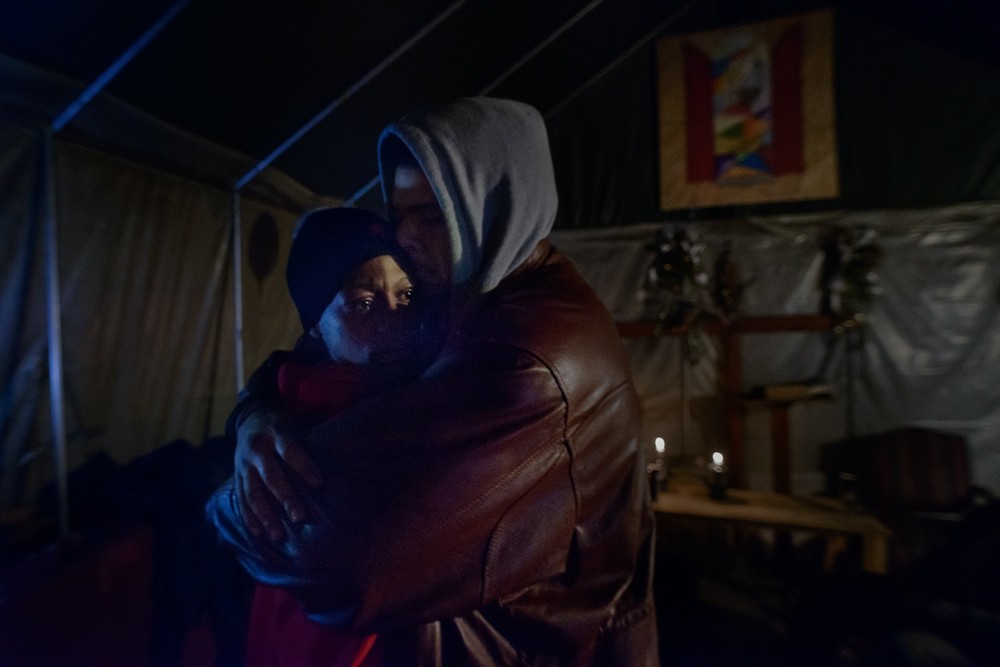
Christopher Occhicone photographed the residents of Tent City in Lakewood, New Jersey:

Tent City … has been home to up to 100 residents for the past 7 years. Local residents have been calling for the closure of the camp since it began. The town succeeded in forcing out most of the residents by August 2014. Some were offered one year of rent-free housing in neighboring towns. Others were given $3,000 in cash to agree to leave town. The remainder were unable to accept either offer because of outstanding arrest warrants.

The aim of my work was to provide an honest look at life inside the camp and thus better inform policy (being decided outside the camp). I wanted to make a document that can be used as a reference for people wanting to address the issue of homelessness.

The project was screened at Visa Pour L’image. See more of Occhicone’s work here.

“Let He Who Is Without Sin Cast The First Outraged Tweet”

800px-Guercino_-_Jesus_and_the_Samaritan_Woman_at_the_Well_-_WGA10946

Pascal Emmanuel-Gobry turns to an unlikely source as he implores us to avoid another year of online outrage – the French philosopher René Girard. He examines his work on scapegoating, which Gobry believes resonates with the way we interact online. The way to defuse our tendency toward scapegoating:

The only ancient text Girard could find that contained a denunciation, rather than an endorsement, of scapegoating, is the Bible. The Bible also has its narrative of founding murder. But while Rome’s myth states that Remus was guilty and needed to die, the Bible says that “Abel the Just” was innocent, and has its god character protect his murderer Cain from scapegoating vengeance.

The Bible also contains one of the most striking stories in all of human literature: the story of Jesus and the woman taken in adultery. The reason why the phrase “let he who is without sin cast the first stone” has resonated so deeply in every age and culture is precisely because it strikes at the core of the scapegoat mechanism. It really didn’t matter to anyone whether the woman actually committed adultery, and the lynch mob was just as guilty, or just as innocent, as her. Once the reality of the scapegoat mechanism was exposed, the men could only realize the futility of what they were about to do.

The only way to defeat the scapegoat mechanism is to expose it. … Let he who is without sin cast the first outraged tweet.

(Image of Guercino’s “Jesus and the Samaritan Woman at the Well,” 1641, via Wikimedia Commons)

A Poem For Sunday

8331816773_f2ae45ac15_k

“The Stags” by Kathleen Jamie:

This is the multitude, the beasts
you wanted to show me, drawing me
upstream, all morning up through wind-
scoured heather to the hillcrest.
Below us, in the next glen, is the grave
calm brotherhood, descended
out of winter, out of hunger, kneeling
like the signatories of a covenant;
their weighty, antique-polished antlers
rising above the vegetation
like masts in a harbor, or city spires.
We lie close together, and though the wind
whips away our man-and-woman smell,
every stag-face seems to look toward us, toward,
but not to us: we’re held, and hold them,
in civil regard. I suspect you’d
hoped to impress me, to lift to my sight
our shared country, lead me deeper
into what you know, but loath
to cause fear you’re already moving
quietly away, sure I’ll go with you,
as I would now, anywhere.

(From The Overhaul © 2012 by Kathleen Jamie. Used by permission of Graywolf Press. Photo by Richard Fisher)

Poseur Alert

William Giraldi, the novelist, teaches at Boston University and was given paternity leave after his wife delivered their first child. He shares how those nine months of relative leisure transformed him into a near-alcoholic:

When Pascal suggested that humanity’s strife stems from our inability to sit quietly in a room by ourselves, he neglected to specify what happens when one rolls a few barrels of alcohol in for company. I cannot say precisely why my “workload reduction” coincided with my “drinking problem,” except suddenly I had so much time. Okay, the university made me sign a document that swore I’d be incurring more than 50 percent of parental duties. But let’s be honest: even in self-consciously progressive households, it’s a rare new father who does as much baby work as a new mother. …

There came, of course, the medieval hangovers that vanquished entire days. Sleep interrupted by migraines and dehydration that felt downright malarial. Iffy decisions involving the diaperless infant on an antique couch. Puffy face and puffier physique. Aches in the liver region, nights in the living room. A first-name basis with the Visigoth at the liquor store. A propensity to click “send” without reading what I’d written. Friends just itching for an intervention. I kept waiting for a knock on the door from the university officials who had so generously granted me a workload reduction. But they never came for me.

This isn’t his first time Giraldi has written about his hard-knock life. Back in October, he lamented the way his fiction was favorably compared to Pulitzer Prize-winning novelist Cormac McCarthy:

If most of the McCarthy comparisons have been favorable, all of them have been facile. This is testament to the McCarthy hegemony, to how wholly he dominates an entire sector of American fiction, and to how he has usurped our understanding of a certain literary pedigree. Write a novel with a specific poetical register adequate to the task of addressing nature and redemption, one which includes the sanguinary madness of men, and McCarthy is the artist languidly at hand for every reader itching to make a connection.

But McCarthy’s prominence is such that another novelist interested in the primitive flux and flex of violence, and in that crossroad where this world grinds against the other, would have to be outright masochistic to attempt to emulate him. Neither the novelist nor the novel could ever get away with it. Every page would carry its own proof of transgression, and thus its own guarantee of detection. ‪Let’s remember, too, Walker Percy’s perfect warning to writers who attempt to channel Faulkner: “There is nothing more feckless than imitating an eccentric.”‬

On “Species Guilt”

Robert Pogue Harrison ponders humanity’s relationship with animalkind:

We like to think of ourselves as the stewards or even saviors of nature, yet the fact of the matter is, for the animal world at large, the human race represents nothing less than a natural disaster. This applies to all creatures, from those we allow to roam “wild” in designated nature preserves to those we cram together on our chicken farms; from the dancing bears of Anatolia to the bald eagles of Alaska, with their collar monitors; from the laboratory animals we test our cosmetic products’ chemicals on to the sharks whose fins leave the oceans to swim around in our nuptial soups. All creatures are under our yoke; and all, including our beloved horses, dogs, cats, and canaries, are subject to human persecution in one way or another.

From a quantitative point of view our species guilt is more aggravated today than it ever was in the past, when Plutarch or Pythagoras cried out against animal murder and the consumption of animal flesh. As the French philosopher and biologist Jean Rostand put it, “Science has made us gods even before we are worthy of being men.” While the scale of animal death has increased exponentially, the main issue today is no longer death but the coercive reproduction and perpetuation of animal life under infernal conditions of organic exploitation. Industrialized farming today, in its manipulation of the biological processes of genesis, growth, and multiplication, forces animals like cows, calves, turkeys, pigs, ducks, and geese into artificial, barely endurable forms of existence. Far more demonic than the slaughters and animal sacrifices of the past, our relegation of these creatures to a standing reserve of consumable stock reduces their “lives” to a worldless, merely mechanical process of flesh production. In his Letter to the Romans, Saint Paul wrote of the malaise of the earth: “the whole creation has been groaning as in the pains of childbirth right up to the present time.” That creaturely groaning has gotten a lot louder of late, and if God indeed loves his creatures enough to open heaven to them, it is highly likely that, when our pets get there, they will find themselves on their own.