A festival-goer is covered in mud during the 17th Boryeong mud festival at Daecheon beach in Boryeong, 150 kilometers southwest of Seoul, on July 18, 2014. The annual festival aims to promote the use of the mineral-rich mud for cosmetic skin-care and to promote tourism in the region. By Ed Jones/AFP/Getty Images.
28 Strangers vs 600,000 DCers, Ctd
It looks like – for now, at least – Washingtonians have won, with weed decriminalization going into effect yesterday. German Lopez has details:
The law authorizes a $25 civil fine for possessing one ounce or less of marijuana and allows cops to seize the drug. It also prohibits public pot use with the threat of a 60-day jail penalty. Harsher penalties kick in for someone possessing larger amounts of pot. The goal, according to advocates, is to reduce massive racial disparities in DC’s arrest rates. Although black and white Americans tend to smoke pot at similar rates, an ACLU report found that black DC residents were eight times more likely to be arrested than white residents in 2010. DC’s overall arrest rate for pot possession was also among the highest in the nation at 846 arrests per 100,000 residents, compared to an average of about 241 per 100,000 around the country.
But as Alex Rogers notes, some Republican lawmakers are putting up a fight:
The law may still encounter some pushback from Congress, as the Republican-controlled House passed a bill Wednesday that includes an amendment to stop D.C. from using federal or local funds to implement the law. The bill was passed largely along party lines; only six Democrats supported the bill. Rep. Andy Harris (R-Md.), who sponsored the D.C. provision, told the Washington Post that pot is “poison to a teenager’s brain” and that the new law would treat teenagers in a dramatically different way to young people right across the Maryland border, where violators younger than 21-years-old are required to appear in court.
Francis Clines adds, “This is a hardy political tactic in Washington, whereby out-of-town Congressmen play top dog over elected city lawmakers, as the constitution permits”:
Congressional conservatives often can’t resist moralizing and scoring points back home by interfering with city laws. Meanwhile the city’s heavily black constituency understandably complains of “plantation” tyranny. Mr. Harris, a physician and former state legislator known for opposing late-term abortions and X-rated movies at the University of Maryland, said the city’s decriminalization law does not protect minors adequately from the addictive dangers of pot. District politicians called for a retaliatory summer boycott of the Eastern Shore beach resorts of Mr. Harris’s district.
Waldman slams Harris and his ilk:
On a whole range of issues, congressional Republicans would love to turn a city made up of mostly Democrats (and mostly black Democrats at that) into a kind of right-wing Epcot Center, where you can step out and imagine that, legally speaking, you’re in Texas or Alabama. This is just one of a number of cases in which conservatives claim to have a firmly held abstract principle that guides their thinking about specific issues, but in practice are almost always concerned about outcomes. They say they value states’ rights – but not if a state wants to do something progressive like legalize marijuana or same-sex marriage.
Recent Dish on decriminalization in DC here.
Migrant Children Get Their Day In Court
The going conspiracy theory on the right regarding the border crisis, trumpeted by Allahpundit last week, is that Democrats arguing for child migrant due process are secretly hoping that the kids skip out on their court dates and disappear into the general population. Dara Lind debunks that theory, pointing to new data that shows that most of the Central American refugee kids are appearing in immigration court as instructed:
Previous data had shown that about 20 to 30 percent of children didn’t show up for their court hearings. The [Transactional Records Access Clearinghouse] data shows that that’s still holding true. Of all the kids with cases filed over the last decade whose cases have been closed, 31 percent were “in absentia.” That percentage is a little higher for cases filed over the last few years, possibly because there are more cases that are still pending from that time.
But the important question is: are Central American kids more likely to skip out on their immigration court hearings than other children? And the answer to that might be surprising.
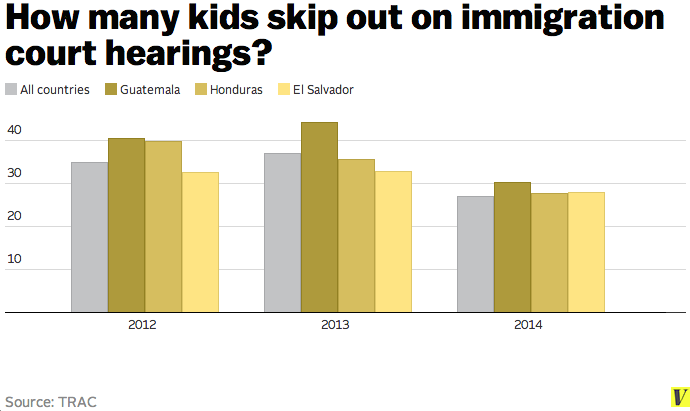
This chart looks at children whose cases were filed in 2012, 2013, and 2014 — i.e. those who have arrived during the current surge — and whose cases have been completed as of June 30, 2014. (Many children whose cases have been filed since 2012 are still in the court process, so they theoretically have another chance to show up.) That means that it’s a good reflection of how many children who have come from Central America during the current surge end up skipping out on their hearings.
The data shows that Guatemalan children, at least, really do skip out on court hearings slightly more often than other children. But children from Honduras and particularly El Salvador are slightly more likely to show up for court hearings than children from other countries.
A Breakthrough In Kabul, Ctd
An inside look at John Kerry’s brokering of a deal to resolve Afghanistan’s election crisis illuminates how high the stakes really were:
It was a dangerous moment, and not just for the Afghanis. Without an agreement between second place finisher Abdullah Abdullah and the election’s declared winner, Ashraf Ghani, Afghanistan was at risk of an implosion like the one that enabled the Taliban to take power in 1996—creating a safe haven for Osama bin Laden to plot the 9/11 attacks. And Kerry’s visit defied the advice of other Obama officials who warned any diplomatic intervention on the U.S. part held “the risk of complete failure,” in the words of a senior official. …
By mid-July, Abdullah’s supporters had threatened to create a kind of protest government. Rumors swirled of an armed rebellion, with the potential to ignite dormant ethnic and tribal rivalries. “We will accept death but not defeat,” Ghani’s running mate, the notorious ex-warlord Abdul Rashid Dostum, had recently vowed. “It was pretty frightening. People were preparing for civil war,” says one official.
“Still,” Steve Coll cautions, “the pressures over the next several weeks will be great”:
The loser of the vote audit is sure to doubt the result’s authenticity. That suspicion will create fresh pressure on the part of Kerry’s plan that is designed to empower the second-place finisher—and that part of the deal seems worryingly vague and incomplete.
Karzai is scheduled to leave office on August 3rd, but it is not likely that the vote audit will be finished by then. On Afghan social media and in the streets, feelings are running high between Pashtuns and non-Pashtuns, and along other historical fault lines. The country still looks uncomfortably close to the brink. The question facing what used to be known as the Shura Nizar, or the Northern Alliance, is whether, if Abdullah loses the final count, the alliance can achieve more by compromise than by coup-making. The objective answer is yes, but there will be those of senior rank who will argue otherwise.
Criminally Bad Parenting, Ctd
A backlash to the latest parenting panic is in full swing. German Lopez highlights the above map, which brings perspective to the question of kids dying when left alone in cars. But just today, another father in Georgia was arrested for leaving his two young children and infant in his car while shopping. This of course on the heels of the 22-month-old Georgia toddler who died recently after his father left him strapped in a hot car for hours.
Meanwhile, as Deborah L. Rhode observes, many pregnant women who take drugs don’t need to wait until giving birth to be charged with bad parenting. And laws against prenatal drug use risk unfair enforcement:
Government statistics indicate that about 5 percent of pregnant women use illicit drugs, 11 percent use alcohol, and 16 percent use tobacco. Although cocaine was once considered to be the most harmful form of substance abuse, many of its supposed symptoms have since been linked to poor nutrition, inadequate prenatal care, and other drugs. Considerable recent evidence indicates that cocaine’s effects are less severe than those of alcohol and are comparable to those of tobacco.
Yet cocaine use is far more likely than alcohol or tobacco use to be a basis for prosecution.
In [Lynn] Paltrow and [Jeanne] Flavin’s study, 84 percent of cases of prosecution or other intervention involved illicit drugs, mainly cocaine. Such selective prosecution reflects class and racial biases that are also evident in reporting practices. In one study, black women were ten times more likely than white women to be reported to governmental authorities for substance use, despite similar rates of addiction. In another survey of New York hospitals, those serving low-income women were much more likely than those serving wealthier patients to test new mothers for drugs, and to turn positive results over to child protection authorities.
Jessica Valenti sounds off:
Obviously, doing drugs while pregnant is a horrible idea. But criminalizing addicted pregnant women who need treatment is bad for babies and their mothers. It’s a short-term, punitive measure with no positive lasting impact to simply ensure that pregnant women who need drug treatment and pre-natal care won’t seek either of those options, for fear of having their children taken away from them.
The Heavy Cost Of Iranian Sanctions
Extends to the US:
A new study published this week by the National Iranian American Council argues that the various trade sanctions the United States has maintained on Iran for more than a decade actually hurts the American economy. The NIAC, a U.S.-based organization that pushes for a peaceful resolution of differences between Washington and Tehran, calculated that between 1995 and 2012, the United States has forfeited between $135 billion and $175 billion in export revenue as a consequence of not doing business with the Islamic Republic. …
In the United States alone, write researcher Jonathan Leslie, NIAC director of research Reza Marashi, and NIAC president Trita Parsi, “this lost export revenue translates into between 51,043 and 66,436 job opportunities lost per year on average. In 2008 alone, as many as 214,657 to 279,389 job opportunities were relinquished.”
Natasha Schmidt talks with Trita Parsi about the study. Schmidt asserts that lifting sanctions will leave the international community “with very little leverage when dealing with Iran on a range of issues, from the nuclear program to human rights.” Parsi disputes this:
On the contrary, the West has very little leverage precisely because there is so little interaction. If the U.S. had not eliminated its trade with Iran in 1995 and if in 2009 there actually was a significant American presence in Iran, do you think the Iranian government would have had a harder or easier time to cheat in the elections? Would the US have had more or less leverage? Part of the reason the US had so little leverage in 2009 is because it had nothing in Iran. No embassy, no diplomats, no companies—no Americans. That’s no guarantee that it would have used its leverage constructively, but it is very difficult to argue that America’s complete absence from Iran has given it more leverage.
Mental Health Break
Airbnb’s new logo looks a little … familiar:
Update from a reader:
Maybe it’s because I’m straight, but I don’t see balls. I see a vagina.
Separate Rules For Sexual Assault
Kat Stoeffel explains why colleges have such a poor track record when it comes to handling rape cases:
Title IX requires administrators to exercise their power to remove sexual offenders from the environment – temporarily, permanently, until the accuser graduates — even if the accused wouldn’t be found guilty in a criminal court. That’s explicit: In a 2011 open letter, the Department of Education reminded colleges that these civil cases have a much lower burden of proof than criminal cases. Instead of proving “beyond a reasonable doubt” that they were raped, victims need only a “preponderance of evidence.” That’s taken to mean showing that it is more likely than not that sexual assault occurred.
Granted, suspension or expulsion is a far cry from being convicted of a felony, imprisoned, and branded a rapist for life. But some experts worry that sending accused rapists off on vague leaves of absence only enables them to land safely at other campuses and victimize more students.
Meanwhile, a reader writes:
I think this story fits in well with your “The Victims Of False Rape Accusations” thread. Here’s an excerpt:
I had a really brief relationship with this girl in college; her dorm room was next to mine, and after a few evenings staying up talking all night, we made out.
We spent a few nights in each others’ rooms, but we never had sex and neither of us pressured the other into doing anything we weren’t comfortable with. After a few nights, I broke things off in the cowardly way that 19-year-old guys do, and I just stopped returning her calls and texts. I can imagine she was hurt by this, I know that I would be hurt if someone broke up with me that way.
I haven’t spoken to this girl in nearly ten years. If she felt I did something wrong in our relationship, she never confronted me about it or brought the issue to the school.
But yesterday, as near as I can tell, she saw a newspaper article about me in the Baltimore Sun, and made a Facebook post attacking me and Cards Against Humanity:
Several people that I went to school with have posted a Baltimore Sun article from 2012 about the success of Cards Against Humanity, a popular indie party game created by a Goucher alum. That is my rapist. Having his face pop up on my news feed unexpectedly in any context has the capacity to ruin my day. Seeing him praised in the press is giving me a panic attack. He should not be held as a good example of the excellence that Goucher grads have, can and will continue to achieve.
Her more recent posts have called for a boycott of my work, and she (or her friends) started a Twitter account to tweet at celebrities and organizations that I work with calling me a rapist.
The Dish’s extensive coverage of sexual assault on college campuses is here.
Kurdistan, Then And Now
https://twitter.com/Kurdistan_612/statuses/487633429048332288
Comparing the Iraqi Kurdistan of today with what she saw when she last visited in 2002, Robin Wright views the Kurdish push for independence as the culmination of a longstanding effort:
[E]ven in 2002 the Kurds were drifting into an autonomous statelet. The Kurdish language was making a comeback in government offices and workplaces, displacing Arabic. The school curriculum was Kurdicized; the younger generation barely identified with Iraq. Levies from smuggling and illicit trade produced revenues of a million dollars a day; even trucks exporting goods from Saddam-land to Turkey had to pay bribes to win passage. The Kurds had their own flag, too—a big sun emblazoned over red, white, and green stripes.
So, a dozen years later, it isn’t surprising that the Kurds now increasingly appear to be decoupling from Iraq, whether formally or de facto. When I returned, four months ago, this time on a direct flight from Istanbul to Sulaymaniyah, Kurdistan had evolved from the least developed part of Iraq to its most stable and prosperous region. I stayed at a new five-star hotel and attended a conference at the new American University of Sulaymaniyah, which brought together panellists from around the world. The Kurds also have a new pipeline for transporting oil to Turkey, which could result in exports of up to four hundred thousand barrels a year, with an estimated forty-five billion barrels of crude in reserve.
Luke Harding also observes how oil has transformed Kurdistan’s fortunes over the past decade. All is not rosy, however:
Some worry that this oil-fuelled boom is pushing Kurdistan in the wrong direction.
Kamaran Subhan, a writer based in Sulaimaniyah, wonders if it is becoming not Norway but a rentier Gulf state. A friendly Bangladeshi waiter – there were no Bangladeshis here in 2003 – brings my coffee. “We are becoming lazy,” he says. Subhan worries that culture in Kurdistan has scarcely improved, despite the consumer splurge visible in the shiny new Land Cruisers on the roads.
The town still has only one art gallery, founded in the 1990s, with a mulberry tree in the courtyard and works by Kurdish artists hanging in a bright upstairs floor. “The government has little interest in art,” owner Dilshad Bahadin says. Nearby is a small cafe where Kurdish men discuss ideas and play backgammon. Subhan’s books enjoy a print run of 500-1,000 copies, he adds – not much in a country, or near-country, of 4.5 million people.
Meanwhile, Kurdistan’s two tribal families, the Barzanis and the Talibanis, continue to dominate politics – as well as the economy and employment. The Barzanis run Irbil, while the Patriotic Union of Kurdistan (PUK), headed by Iraq’s former president Jalal Talibani, controls Sulaimaniyah. Critics accuse both of corruption, nepotism and patronage politics, keeping thousands of party workers on the public payroll. In 2007, a breakaway faction of the PUK formed a new, pro-transparency party, the Change Movement or Gorran.
Previous Dish on the prospect of an independent Kurdistan here.
92 Percent? 99 Percent?
Josh Barro has a useful piece drilling down on quite how effective Truvada is in preventing HIV-
infection. It’s a dense statistical article and worth reading in full. The basic gist is that while a big study found zero HIV infections among those taking Truvada as prescribed, the sample size is too small to declare it 100 percent effective. So they use statistics to come up with the 99 percent figure. One reason to qualify it: there may have been other factors preventing HIV infection in those taking the pill regularly (like having fewer sex partners) than those who didn’t adhere closely to the regimen. If you add in those not taking the medication every day, but almost every day, you can get a statistic of 92 percent effectiveness.
Does this matter? Psychologically, there is a difference between a one percent chance and an eight percent chance of getting infected. But in reality: not so much. Anything well above 90 percent (and indeed, so far as we have actually measured, 100 percent) is a huge deal, especially since regular condom use only seems to lower the chance of HIV transmission by 70 percent. But it’s worth reminding ourselves of the statistical nuances here.