The Perry-Paul Debates

Picking up on the ongoing foreign policy feud between Rand Paul and Rick Perry, which the Dish alluded to yesterday, Larison excoriates Perry:

Perry’s argument is the usual hawkish combination of threat inflation, fear-mongering, lazy references to “isolationism,” and stale Reagan nostalgia. He talks about a “profound” threat to the U.S. and the entire world from a jihadist group when it is no such thing, and hopes that his readers will be so alarmed by this that they won’t pay attention to how shoddy his argument is. Perry is engaging in the same behavior that the former head of MI6 recently criticized: he is helping to give groups like the Islamic State the attention they crave, and he is grossly exaggerating the danger they pose to the U.S. and its allies. The governor’s analysis relies on blurring the differences between competing jihadist groups and their goals to frighten the public into assuming that any similar group that emerges represents a major security threat to the U.S.

Paul, on the other hand, could radically change the GOP’s foreign policy thinking, or so Cillizza believes:

What Paul is proposing is that he is the Republican candidate willing (and able) to handle the party’s long-delayed reckoning with the war in Iraq.

That conflict, premised on the false idea that Saddam Hussein possessed weapons of mass destruction, has never been fully litigated within the GOP. … The back-and-forth op-eds between Paul and Perry make clear that the debate about Iraq, the mistakes made there and what it means for Republican foreign policy going forward will be a prominent feature of the 2016 Republican primary race. And, there is reason to believe that Paul’s position on Iraq is one shared by a relatively large number of Republicans. In a June New York Times/CBS News poll, 63 percent of self-identified Republicans said that the war in Iraq was not worth it.

But Kilgore expects the “isolationist” label to sink Paul in the end:

Paul’s gotten pretty good at turning what would seem to be “isolationist” positions into emblems of truculence, viz. his makeover of a long-time proposal to cut off assistance to the Palestinian Authority into a “Stand With Israel” posture. But for eons Republicans have ultimately measured their presidential candidates’ acceptability on foreign policy and national security in terms of their willingness either to kill foreigners or spend more money, if not both. No matter how much he dresses up his old man’s non-interventionism in camo patterns and how loudly he plays martial music, so long as Rand Paul opposes every opportunity to kill foreigners while calling for lower defense spending, the “isolationist” label will be a problem for him, as the ghosts of both the Cold War and the War On Terror haunt him. I suspect opponents more skillful than Rick Perry will at some point make that plain.

Noting that both of the dueling op-eds referenced Reagan extensively, Beinart asks, “So what would a Reaganite strategy against ‘radical Islam’ look like?”:

Based on Reagan’s record, particularly in his first term, it would be expensive, indiscriminate, rhetorically aggressive, hostile to congressional oversight, and cautious about deploying U.S. troops. It would, in other words, be a mess. Reagan was lucky enough to take office after Richard Nixon had exploited the Sino-Soviet rift and stopped treating communism as a unified menace. Even so, Reagan turned nearly every third-world civil war into a showdown between East and West, dramatically escalating the brutality of these conflicts even though struggles in places like Angola and Nicaragua were ultimately irrelevant to the course of the Cold War.

In today’s Middle East, by contrast, the U.S. has not yet found its Nixon. Neither the Bush nor Obama administration has developed a strategy for exploiting the widening Sunni-Shiite divide, and hawks like Perry talk about “Islamic extremism” like pre-Nixon hawks talked about communism: as a unified threat. In this context, Reagan’s strategy of indiscriminate pressure against communism across the globe offers no guide at all. What would it mean in Iraq—the topic of Paul and Perry’s columns—where an Islamist, pro-Iranian Shiite regime is battling Sunni salafists?

The Impeachment Minority

Impeachment

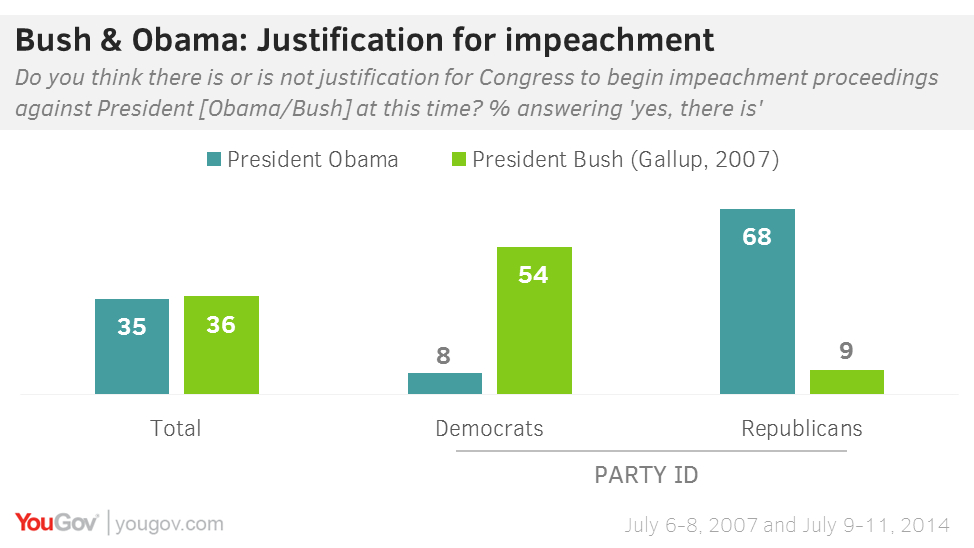
About one third of Americans want to impeach Obama, which is “similar to attitudes towards the potential impeachment of President Bush in 2007”:

In 2007, 36% of Americans said that Bush had not abused his powers, while 39% say that same about Obama. Similarly, 32% say that Obama should be impeached and removed from office, while 34% said the same about Bush in 2007.

Perhaps predictably, these attitudes towards the impeachment of Bush and Obama differ significantly according to partisan affiliation. Most Democrats (54%) supported impeaching Bush in 2007, while 68% of Republicans today think that it would be justified to impeach Obama. Overall, 35% of Americans say that impeaching Obama would be justified, while 36% said the same in a 2007 USA Today/Gallup poll.

Allahpundit puts the poll in context:

See now why there’s so little appetite among pols, including and especially among Republican candidates for Senate, to back Palin up? Even among Republican voters, 36 percent oppose impeachment. How do you build political momentum for removing him when you’re starting in a hole that deep? The silver lining is that a near-majority of the public does think Obama’s exceeded the limits of his authority as president, 49/34, including an eye-popping split among indies of 52/25.

The Lives Saved By Tobacco Control

Kenneth Warner tallies them. He defines tobacco control as “all of the efforts of the private, voluntary, and public sectors to reduce the toll of smoking: trying to prevent kids from starting to smoke, helping smokers to quit, avoiding exposure to second-hand smoke, all of that combined”:

This January, some colleagues and I published a paper in JAMA that estimated the cumulative health effects of tobacco control. We found that between 1964 and 2012, eight million premature deaths were avoided as a result of tobacco control. We did not include second-hand smoke deaths, nor the years 2013 and 2014, so probably the best figure today would be about 10 million premature deaths avoided.

Tobacco control, broadly construed, accounts for fully 30 percent of the gain in adult life expectancy since 1964. Nothing—no medical intervention or any other public health development – has contributed anything close to that.

The Future Mega-Cities

Mega Cities

You’ll find them in the developing world, according to a new UN report:

[B]y 2030, New York, Osaka, and Sao Paulo will no longer make the top 10, and Mexico City will barely hang on as the sole representative outside of Asia and Africa. This reflects the major shift driven by the urbanization in Asia and Africa, particularly in India (404 million projected new city dwellers by 2030), China (292 million), and Nigeria (212 million).

Reid Standish provides more details and the above GIF:

North America, Latin America, and Europe will remain the world’s most heavily urbanized regions but Africa and Asia will catch up in the decades beyond 2030. Africa and Asia are home to 90 percent of the world’s rural population. However, as more people urbanize, that figure will shrink dramatically. By 2050, 56 percent of Africans and 64 percent of Asians will live in cities. Asia will account for the largest growth in the sheer number of city dwellers, but Africa will urbanize at a faster rate.

In total, urbanization in Africa and Asia will add 2.5 billion people to the world’s cities.

Dissent Of The Day, Ctd

In response to this reader, another snarks:

Andrew, I must take issue with your persistent, deplorable habit of using terms like “American”, “English”, and “Chinese.” Each “nationality” is wildly diverse and contains tens of millions of individuals, saints, sinners, and everyone in between. Yet certain people seem to think – wrongly – that they “know all about” others because they know what country these people live in! Moreover, each “nationality” contains tens of millions of individuals with unique biographies.

No wait. How about: Andrew, I must take issue with your persistent, deplorable habit of using terms like “Catholic,” “Protestant,” and “Sunni.” Each “religion” is …

Or, Andrew, I must take issue with your persistent, deplorable habit of using terms like “men,” “women,” and “transgender.” Each “gender” is …

In all seriousness, any attempt to group people in any way will oversimplify. We can examine categories, question them, add nuance to them, but it will make life a lot harder than it needs to be if we throw out all categorization of people.

Furthermore, the year you were born DOES matter. My dad was born in the 1950s. He knows what it’s like to live your life assuming the world will end, sooner rather than later, because somebody’s going to nuke somebody else. That’s formative. That’s an important shared experience with people his age. People who are just now starting college do not know what it’s like to have their entire outlook on the world changed by September 11th. That’s an important shared experience they do not share with me, because they were born later.

I actually agree that many people over-rely on the concept of generations, and those generations having specific, all-embracing traits. But it’s ludicrous to claim the events a person has and has not lived through don’t matter at all.

Another is harsher on the dissenter:

Hmm … quick to offend, almost comically haughty, insufferably condescending, prone to “humble bragging” (“(minor) historian…”), think they still “get” the younger generation, love the sound of their own voice (or prose), take shallow personal stands using their pocketbooks … yep, sounds like a Baby Boomer to me. But hey, what do I know … I’m a cynical Gen-Xer ;)

On the other hand:

I totally agree with the dissenter. I am a retired attorney, Ivy League educated, AfricanAmerican, Vietnam vet, born in 1948 in Phoenix and still live there. I am a whole lot more than a “Boomer”. Unlike the dissenter, I will continue to subscribe, but constant assumptions about demographic groups really isn’t very helpful.

Another agrees:

I do hope you take the content of the dissent seriously. This is something that has needed saying for quite some time now. Out of so many strengths in your writing, this is one of your most unfortunate weaknesses.

Another makes the same basic argument as the first reader but with sources:

As a doctoral candidate in history who has found generational theory reasonably helpful in understanding U.S. history, I have three brief points to make about the dissent against generation labels:

First, of course these generational descriptors are over-generalizations misused by the authors of op-eds. So are groupings of people based on race, class, and/or gender. The art of history is the art of generalizing without messing up the overall picture too badly. The core question is whether the big picture can tell us anything useful, not whether it’s a perfect description of every individual in the group.

Second, much of generational theory these days comes from the work of Bill Strauss and Neil Howe (who are mentioned in this Dish post from 2008 on Obama as an Xer). Their main argument is that despite the diversity of individual experience and core traits, generations and cohort subsets within them develop general characteristics for their interactions with other generations. Furthermore,  these interactions with other generations help make the whole thing roughly cyclical as the generation coming of age rushes to fill the public role they see as absent. (The Wikipedia page has a pretty good overview.)

Finally, historians discover over and over again how much formative experiences from a person’s youth shapes their later attitudes. As Howe put it, history is not “a seamless row of 55-year-old leaders who always tend to think and behave the same way.” While it would be a little silly to make a big fuss over whether someone was born in 1946 vs. 1947, an American born to white, middle-class parents in 1946 is much more likely to be (or have been) socially liberal than someone born to similar parents in 1955. In the same vein, coming of age during the Red Scare of 1919-1920 (when government officials were targeted by mail bombs) makes the ambitious and zealous in the group more likely to use fear of Communism as a path to national notoriety once they’re of an age to do so. See Nixon, Richard and McCarthy, Joe.

Something that I find striking is that when Strauss and Howe first started writing in the 1990s, many saw their prediction of a “crisis mentality” starting somewhere between 2005 and 2008 as being “overly grim.” Also, the dissenter focusing their dissent on each person having a “unique biography”: classic Boomer. A core Millennial is likely to think “yeah, we’re all on the same team.” An Xer “but does it work?” And chances are, like the Silents before them, today’s Homeland children will grow up to (largely) think, “how do we take care of the individuals in the team?” Each generation has their strengths and their weaknesses.

Granted, I’m an early-wave Millennial (1983) who has now given up on the dogmatic religious faith of my teens, along with any trust I had in Wall Street to manage my money, or any desire to support a leader promising a “quick and easy” war that had to be fought “because”, so what do I know?

Update from the original dissenter, who gets the last word:

In response to the first critic you cited, I would say that “generational” descriptors are perhaps the least coherent and most ill-defined ones commonly used. Being an American, for example, is associated with a set of generally recognized symbols. It also carries a legally-defined status. No such generally recognized symbols or statuses are associated with so-called “generations”. (If there are, I must have missed the meetings.)

In a religious group, there are definable sets of beliefs that its adherents presumably have. There are no such definable sets of beliefs in regard to “generations”. “Generational” descriptors are the least accurate ones that exist, in my view.

And no, I don’t want the examination of other humans to be easier, and I don’t mind if I have to work at knowing other people. It shouldn’t be easy to know other humans. The desire to make it easy is part of the problem. We always need to go deeper than these broad categorical definitions. The trouble with such terms as “Baby Boomer”, “Gen-Xer”, and “Millennial” is that too often it isn’t where people begin their examination of others – it’s where they end it.

Finally, I know this will be a shock to my critic here, but after the invention of nuclear weapons, almost everyone felt some level of threat because of them. In many ways it was more jarring, I think, to be in the middle of one’s life and realize that humanity could now be wiped out in a single day, and that our enemies had the capacity to destroy us. Why does this critic think Cold War hysteria in the U.S. reached such berserk levels in the 1950s?

In response to the second critic, I’ve been angered by this “Baby Boomer” nonsense for years. Yes, I do take offense at being called locust. Yes, I do take offense at being blamed for every problem by people who don’t know me. What normal person wouldn’t be? As far as understanding younger people, I taught school for several decades and I have hundreds of friends in their 20s and 30s. We seem to understand each other pretty well. I am a minor historian, and am currently working on a five-volume deep history of the world. (Volume One is finished.) Since the critic is a “Gen-Xer”, does that mean that he or she is not only cynical but shallow, underachieving, lazy, and prone to blame others for his or her problems? Just wanted to know, inasmuch as this person has decided to use stereotypes to describe me.

Finally, in my opinion the work of Strauss and Howe is deeply misleading. Only sophisticated polling and surveying done by qualified social scientists can reveal the full complexity of social attitudes. And what do we find when we do such surveying? We find that people have a great deal in common with each other. We find that people tend to respond in very similar ways to the outside world, and that everyone filters reality through an individual mindset. Of course it matters when people are born, but it is not determinative to the degree many think it is. How does the author who cites Strauss and Howe KNOW what a “classic Boomer” is? What survey data is this view based on? How does he/she KNOW what a “core Millennial” thinks? Again, what is the evidence here?

Human history unfolds for a multitude of reasons. There are countless variables that affect it. Ascribing huge changes to the attitudes of so called “typical” generation members can only lead us down a dead end of incomprehension and mistaken conclusions. History is not only the story of change; it is also the story of continuities, and the things all of us share – regardless of how old we are.
A Crash Course In Perversity

Zadie Smith revisits J.G. Ballard’s controversial 1973 novel Crash, which, like the David Cronenberg movie it inspired, features characters who get off on car crashes. She writes that the “real shock of Crash is not that people have sex in or near cars, but that technology has entered into even our most intimate human relations”:

When Ballard called Crash “the first pornographic novel based on technology,” he referred not only to a certain kind of content but to pornography as an organizing principle, perhaps the purest example of humans “asking for the use.” In Crash, though, the distinction between humans and things has become too small to be meaningful. In effect things are using things. … Crash is an existential book about how everybody uses everything. How everything uses everybody. And yet it is not a hopeless vision:

The silence continued. Here and there a driver shifted behind his steering wheel, trapped uncomfortably in the hot sunlight, and I had the sudden impression that the world had stopped. The wounds on my knees and chest were beacons tuned to a series of beckoning transmitters, carrying the signals, unknown to myself, which would unlock this immense stasis and free these drivers for the real destinations set for their vehicles, the paradises of the electric highway.

In Ballard’s work there is always this mix of futuristic dread and excitement, a sweet spot where dystopia and utopia converge. For we cannot say we haven’t got precisely what we dreamed of, what we always wanted, so badly. The dreams have arrived, all of them: instantaneous, global communication, virtual immersion, biotechnology. These were the dreams. And calm and curious, pointing out every new convergence, Ballard reminds us that dreams are often perverse.

Great Good Job, Kids!

Carlin Flora delves into the complicated world of praise studies, which investigate how children react to adult feedback. She cites a study published earlier this year that shows that “overpraise (That’s incredibly beautiful! versus That’s nice!) can be harmful for children with low-esteem, but be helpful for those with high self-esteem”:

First, the study confirmed the researchers’ hypothesis that parents would be more likely to overpraise children with low self-esteem than those with high self-esteem. …

[T]hey had children between the ages of eight and 12, all previously rated for self-esteem, visit an art museum. The children were asked to paint pictures, which were then critiqued by a supposed ‘professional painter’. As a final step, they were asked whether they wanted to attempt a second, more difficult drawing exercise or a relatively easy one. All children receiving inflated praise viewed that praise as sincere, regardless of their level of self-esteem. Yet as predicted, children with low self-esteem who received inflated praise were less likely to accept the difficult challenge than their counterparts who received non-inflated praise. On the other hand, children with high self-esteem who received inflated praise were more likely to choose the challenging task than their counterparts who received non-inflated praise.

It makes sense, since people with high self-esteem are generally self-promoting and seek out situations to demonstrate their abilities, while those with low self-esteem are afraid of failure and avoid situations that might reveal their worthlessness. The authors write: ‘Thus, inflated praise can cause children with low self-esteem to avoid crucial learning experiences – a process that may eventually undermine their learning and performance.’ Here’s the complicated flip-side, though: ‘Non-inflated praise may reduce fear of failure for children with low self-esteem and thus foster their challenge-seeking, but it might fail to provide sufficient impetus to seek challenges for children with high self-esteem.’

Cool Ad Watch

14617969851_fd4256b8dc_z

Scott Beale spots one in the backseat of his cab:

The Uber car we were riding in was equipped with Delta-branded USB ports attached to the top of the passenger seat, making it easy for riders to charge their USB powered devices. The ad campaign promotes the availability of USB ports on Delta’s long-haul international flights.

The World’s Largest Failed State

The answer isn’t what you’re thinking:

In June, Foreign Policy and the Fund for Peace published the annual Fragile States Index, which analyzed the social, economic, and political stability of countries across the globe. But the list may have left out one particularly unstable region: the ocean. According to former British Foreign Secretary David Miliband, co-chair of the Global Ocean Commission, the 65 percent of the ocean that lies beyond the territorial waters of nations should now be considered “a failed state.”

“Here, beyond the jurisdiction of any government, lie the high seas,” Miliband said in an email, “where governance and policing are effectively non-existent and anarchy rules the waves.” Echoing Miliband, Carl Safina, founding president of the Blue Ocean Institute (now called the Safina Center), an environmental advocacy organization, called the ocean “a pre-state apocalypse. It is like the Wild West in the Space Age.”

The report portrays an ecosystem in crisis.

Fish stocks are being rapidly depleted. Half of the world’s coral reefs have already died, victims of rising water temperatures and ocean acidity. And according to the report: “[U]p to 60% of ocean species could be extinct by 2050 if climate change is not urgently addressed.”

It is not that global standards purportedly meant to protect marine life do not exist. Rather, they are largely toothless. The United Nations Convention on the Law of the Sea (UNCLOS), which establishes generalized guidelines for the management of marine resources, lacks enforcement mechanisms. Even now, 20 years after the convention was established, the United States and several other countries have not yet ratified the treaty, which means they are not legally bound to its principles. …

In the absence of capacity or will to enforce legal standards, the ocean’s plunder has accelerated. Underage fish are being taken both in and out of season, catches are underreported, no-fish zones are violated, and quotas are routinely ignored. Indiscriminate fishing practices are laying waste to whole fish populations and even underwater ecosystems.

The Rise Of The Notorious R.B.G.

tumblr_n8f945hbWV1tgadxro1_1280

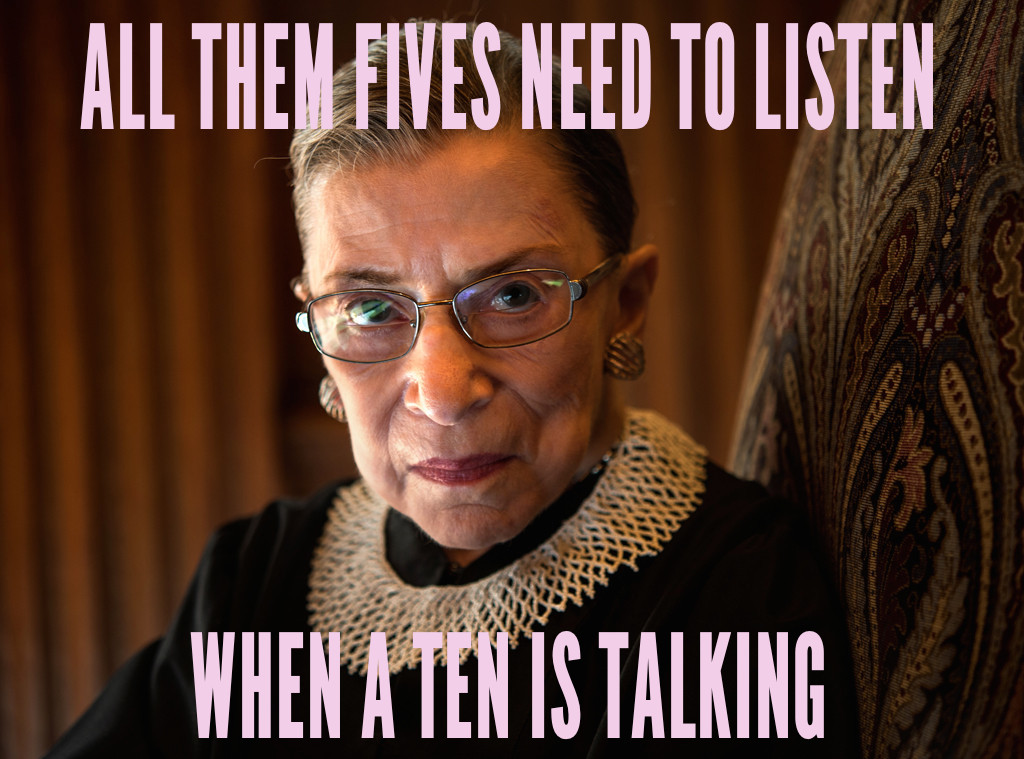
Rebecca Traister is thrilled by Ruth Bader Ginsberg’s rise to meme-hood:

Throughout history, we have acknowledged male strength, especially in its seniority, as serious and authoritative. Older women, on the other hand, have existed mostly as nanas, bubbes! Those sturdy, ambitious souls who also staked claims to public eminence were cast as problematic; tough ladies who no longer slide easily into Lycra are ball-busters, nut-crackers, and bitches.

Overriding these entrenched assumptions has been nearly impossible, even in the hundred years since women have had the vote, and in the 60 years [sic] since the feminist revolution of the ’70s. Recall that just six years ago, there was simply no popular script available to positively convey then-presidential candidate Hillary Clinton’s identity as a strong and ambitious politician. … It was in those same years that Justice Ginsburg was barbecuing the court’s decision to uphold the partial-birth abortion ban in Gonzales v. Carhart, furiously pointing out that the protection of reproductive rights is not about “some vague or generalized notion of privacy” but rather about “a woman’s autonomy to decide for herself her life’s course, and thus to enjoy equal citizenship stature.”

Back then, when Twitter was just taking off and Tumblr was being launched, and we still were relying on a largely centralized media to bring us our news, there was no one who set those words to music (though there should have been). Now, mercifully – finally – young people who are creating a new vocabulary, a library of visual and aural iconography that warmly appreciates female power in not just its nubile, but also its senior, its brainy, its furious, and its professionally brawny forms.

(Image via Shana Knizhnik’s Notorious R.B.G. tumblr)