Learning From Mindless Pleasure

For Oliver Sacks, who turned 81 this week, getting high can be a lesson in empathy. Melissa Dahl marked Sacks’ birthday with the above video, in which the neurologist talks about what he gained from his experiences with LSD and amphetamines:

So one bonus, then, of drug experiences is that it allowed me to be more empathic, and to understand from my own experiences what various patients were going through. But also, it gave me some very direct knowledge of what physiologists would call the ‘reward systems’ of the brain. It had been found, for example, with rats in the 1960s that if they had an electrode in certain nuclei of the brain, and could get a jolt of electricity, which apparently gave them great pleasure, the rats might go back to the lever again and again. They would ignore food, they would ignore sex, and they would keep pressing the lever, till they died. …

For good and for evil, I think I experienced a similar sort of thing when taking large doses of amphetamine.

It produced intense pleasure, sometimes pleasure of an almost orgasmic degree. And this sort of pleasure is one sort of wants it to go on and on even though it doesn’t really teach one anything, and it’s maybe sort of base in a way, and it almost reduces one to the level of one of these rats pressing the reward center.

Also paying tribute, Popova quoted from Sacks’ recent book Hallucinations, in which he describes the distinction between ordinary imagination and hallucinogenic experience:

When you conjure up ordinary images— of a rectangle, or a friend’s face, or the Eiffel Tower —the images stay in your head. They are not projected into external space like a hallucination, and they lack the detailed quality of a percept or a hallucination. You actively create such voluntary images and can revise them as you please. In contrast, you are passive and helpless in the face of hallucinations: they happen to you, autonomously — they appear and disappear when they please, not when you please.

Watch his TED talk on hallucinations here. Previous Dish on Sacks here, here, and here.

Writers’ Remorse

Anna Holmes reflects on her rookie mistakes as a writer (NYT):

Mostly, what I regret is the ease with which I assumed that others’ prose styles were something not just to study and learn from but to imitate. This chameleonic impulse, a talent I developed at an early age, certainly came in handy during my stints as a writer and editor for women’s service and celebrity magazines — publications that, then and now, demand a cheerful and wholly unremarkable “female” voice — but it also did a fair amount of damage to my writerly sense of self, not to mention my ability to execute stories on issues that had nothing to do with sex tips for singletons, swingy summer dresses or the assignations of Angelina Jolie. My adoption of others’ voices made it even more difficult to find mine, and it wasn’t until I was well into my 30s that I began to realize I could honor other writing styles while also asserting my own. (This development may or may not have been influenced by my entrance into the world of blogging, an environment whose freewheeling, breezy and often very personal approach to prose has inspired any number of now-established writers.)

Leslie Jamison, meanwhile, shakes her head at her early commitment to an idea of “honesty” that translated to oversharing “the parts of myself I liked least — or the situations I most regretted”:

These were my two first mistakes about honesty: I thought it meant relentless self-flagellation, and I thought it could redeem everything. I believed there was nothing self-awareness couldn’t save. My readers taught me otherwise: They often read my self-awareness as meanness or self-indulgence or delusion. It didn’t endear me to them at all. It didn’t dissolve the flaws it confessed.

I’d always believed I was being unfair to my fictional characters if I didn’t grant them the chance to redeem themselves with desire or effort, with earnest attempts to transcend their flaws and limitations. It felt unfair to be their God and then refuse them certain saving nuances. But in my essays I was doing just this — refusing myself access to anything but my own worst tendencies. So I had to consent to making myself something more than a brat or a binger — to treat myself to the rigorous grace of complication instead.

A Short Story For Saturday

This week’s story is Amy Bloom’s “Silver Water,” in which a woman movingly describes her older sister’s descent in mental illness. How it begins:

My sister’s voice was like mountain water in a silver pitcher; the clear blue beauty of it cools you and lifts you up beyond your heat, beyond your body. After we went to see La Traviata, when she was fourteen and I was twelve, she elbowed me in the parking lot and said, “Check this out” And she opened her mouth unnaturally wide and her voice came out, so crystalline and bright that all the departing operagoers stood frozen by their cars, unable to take out their keys or open their doors until she had finished, and then they cheered like hell.

That’s what I like to remember and that’s the story I told to all of her therapists. I wanted them to know her, to know that who they saw was not all there was to see. That before her constant tinkling of commercials and fast-food jingles there had been Puccini and Mozart and hymns so sweet and mighty you expected Jesus to come down off his cross and clap. That before there was a mountain of Thorazined fat, swaying down the halls in nylon maternity tops and sweatpants, there had been the prettiest girl in Arrandale Elementary School, the belle of Landmark Junior High. Maybe there were other pretty girls, but I didn’t see them. To me, Rose, my beautiful blond defender, my guide to Tampax and my mother’s moods, was perfect.

She had her first psychotic break when she was fifteen. She had been coming home moody and tearful, then quietly beaming, then she stopped coming home. She would go out into the woods behind our house and not come in until my mother went after her at dusk, and stepped gently into the briars and saplings and pulled her out, blank-faced, her pale blue sweater covered with crumbled leaves, her white jeans smeared with dirt. After three weeks of this, my mother who is a musician and widely regarded as eccentric, said to my father, who is psychiatrist and a kind, sad man, “She’s going off.”

Read the rest here. The story also can be found in Bloom’s collection, Come to Me. Previous SSFSs here.

Faces Of The Day

dish_CYJOfotd

CYJO’s series “Mixed Blood” portrays mixed-race families:

CYJO identifies herself as a Westerner of Korean ethnicity (she was born in South Korea and raised in the United States) and photographed the series “Mixed Blood” from 2010–13 in both New York and Beijing. … CYJO said one of the reasons she began the series was a curiosity about exactly what “mixed ethnicity” currently represents, noting that as countries such as China continue to modernize, how the mix of new culture will blend with longstanding traditions will be interesting to follow. While there are people who fear cultural blending, CYJO said the idea of a global identity and our definition of self, culture and race is rooted in life experiences and personal choices.

“But the bigger question is how will cultures and people maintain their individuality?” she asked. “What will be those cultural differences aside from language and food that will make a culture unique? There’s so much more we can learn from each other, especially from our differences.”

Mixed Blood” is traveling to multiple cities in China. The exhibition, which launched at Today Art Museum in Beijing, is sponsored by the US Embassy, Beijing, curated by Nik Apostolides, and designed by Timothy Archambault. Check out the book here. See more of CYJO’s work here.

(Photo: Doyle Family, 2010. Citizenship: American. Ancestries: African, American Indian, Creole, Cuban, French, Irish. Languages: English, Spanish, French. Live in New York. © CYJO)

Time Enough At Last

Still haven’t gotten around to reading Ulysses or In Search of Lost Time? For the literary-minded Daniel Genis, a 10-year stint on Riker’s Island helped:

Aside from consuming The New YorkerHarper’s, and The Atlantic (“not the easiest magazines to give away in prison”) nose to tail, Genis lavished the bulk of his attention on serious fiction, especially the long, difficult novels that require ample motivation and time under the best of circumstances. He read Mann, James, Melville, Musil, Naipaul. He vanquished “Vanity Fair” and “Infinite Jest.” He read, and reread, the Russians, in Russian. He kept up with Chabon, Lethem, and Houellebecq. At first, Genis resisted “Ulysses,” but his father kept bringing it. “I argued that he wouldn’t have the willpower to get through it once he became a free man,” [his father] Alexander Genis told me. …

The seven volumes of Proust took Genis a year to finish. Much of it was spent in solitary confinement—he had been charged with “unauthorized exchange” after several prisoners “sold [him] their souls” for cups of coffee (“some Christian guards didn’t care for my sense of humor”). He read “In Search of Lost Time” alongside two academic guidebooks, full of notations in French, and a dictionary. He said that no other novel gave him as much appreciation for his time in prison. … In prison, time was both an enemy and a resource, and Genis said that Proust convinced him that the only way to exist outside of it, however briefly, was to become a writer himself. He finished a novel, a piece of speculative fiction about a society where drugs have never been criminalized, titled “Narcotica.” Later, when he came across a character in a Murakami novel who says that one really has to be in jail to read Proust, Genis said that he laughed louder than he had in ten years.

A reader, responding to this post on financial literacy, adds something relevant to this post as well:

Funny coincidence: Catey Hill published a piece this morning about a young murderer who’s become a self-taught investment expert, and an advisor to his fellow inmates and even prison staff. One guard dubbed him the “The Oracle of San Quentin”. Here’s a fun bit:

Carroll also stresses the importance of reading beyond financial publications. His magazine list includes some highly unlikely fare for a men’s prison, including Teen Vogue (great for insight into things that teens adopt first, like social media); PopStar! (to keep up with the entertainment industry) and Shape (for fitness innovations and products). 

A Short Film For Saturday: A Little Chaos

Paul Gallagher recommends Rainer Werner Fassbinder’s short film Das kleine Chaos (A Little Chaos), above. He sees the influence of Godard and Bertolt Brecht:

The story concerns three young wannabe criminals, who take their lead from the b&w gangster films of 1940’s and ‘50’s Hollywood. Made in 1966, it’s an assured and highly stylish nine minutes of celluloid that proves Fassbinder’s ability to adapt his influences, better them and make them his own.

Godard’s influence also struck Jordan Hoffman, who found the movie “one of those films you watch in complete rapture because you have no idea what is coming next”:

A group of youngsters (lead by young R.W. replete with John Lennon-style hair) can’t get anywhere in life selling magazine subscriptions, so they turn to a life of crime … only a life of meta-crime. The look and character dynamic is stolen wholesale from Godard, but the dialogue and action is, again, dirty and bordering-on-too-violent. Imagine if the three from Bande a Part not only ran through the Louvre but also stole some paintings. A facinating short.

The Male Gaze On The Page

Laurie Penny calls out a literary double-standard, arguing that “when men write about their experiences in a political context, it’s never called ‘confessional’it’s just ‘literature’, or a ‘memoir'”:

[M]ale political experience is never coded as maleit’s just universal truth. In five years as a columnist and com­mentator who also happens to be young and female, I have lost count of the times I have been encouraged by editors to write about being a woman, in a way that is “provocative” without really challenging sexism. I have been encouraged to be a “voice” for young womento draw attention away from how most newspapers’ political pages are still dominated by men’s words, men’s agendas.

Now that I’m lucky enough to be able to pick and choose, I often hear the same thing from younger women writers: that they can pay their rent, or have their pitches listened to, only if they write about fashion or diets or dating in a way that is modestly feminist but still fluffy enough to sit within the “women’s pages,” which are usually part of a paper’s lifestyle section by virtue of not being considered serious politics.

Along the same lines, Katie Roiphe speculates that critics raving about My Struggle, Karl Ove Knausgaard’s extensively detailed autobiographical novel, would hold their tongues if the author were instead a “Carla Olivia Krauss”:

I don’t think we would be able to tolerate, let alone celebrate, this sort of domestic diarylike profusion from a woman.

A 30-page riff on going to a party with children, and trying to balance your food while watching your child, and what exactly happens to her shoes, would appear, if a woman wrote it, both banal and egoistic. (Knausgaard writes, “I felt a surge of warmth in my breast. Leaned over and picked up a diaper and a pack of wipes while Heidi clung to me like a little koala bear. There was no changing table in the bathroom, so I laid her on the floor tiles, took off her stockings, tore off the two adhesive tabs on the diaper and threw it into the bin under the sink while Heidi watched me with a serious expression. ‘Just wee-wee!’ she said. Then she turned her head to the side and stared at the wall, apparently unmoved by my putting on a clean diaper, the way she had done ever since she was a baby.”) Reviewers and readers alike would think it was narcissistic, well-traveled, self-indulgent. …

I am not trying to make the point that male readers and critics would dismiss Carla, which they would, but that female readers and critics would as well. … The particular variety of rage aimed at women who document their daily lives, especially if they don’t involve a childhood of poverty or abuse or illness, is deeply entrenched and irrational. It’s not just that we don’t think of what they are doing as art, but that it annoys us, riles us. It feels presumptuous, vain, narrow, feminine, clichéd. It is not chic the way Knausgaard’s stormy ruminations on the minor oppressions of family life are chic.

Meanwhile, Sheila Heiti applauds Adelle Waldman for narrating her novel The Love Affairs of Nathaniel P. from a male perspective. She argues that “formally, not just factually, it’s important that the author is female”:

This is hardly the first book in which a woman inhabits the mind of a man, but here it seems we’re never meant to forget that a woman is behind the writing. Just as we later see Nate outsourcing his conscience to the women around him, it’s as if the novel’s subject – the dissection of the male psyche in the context of dating – has been outsourced to Waldman, a writer who has the talent to write about anything but was given this subject because she is a woman; because the men in her milieu who have written about Nates haven’t looked so closely at the pain these men cause: her book is less an apologia than the case for the prosecution. It is methodical; Waldman has done the work of imagining so we can all understand this sort of guy’s behaviour and mentality. It’s almost a public service.

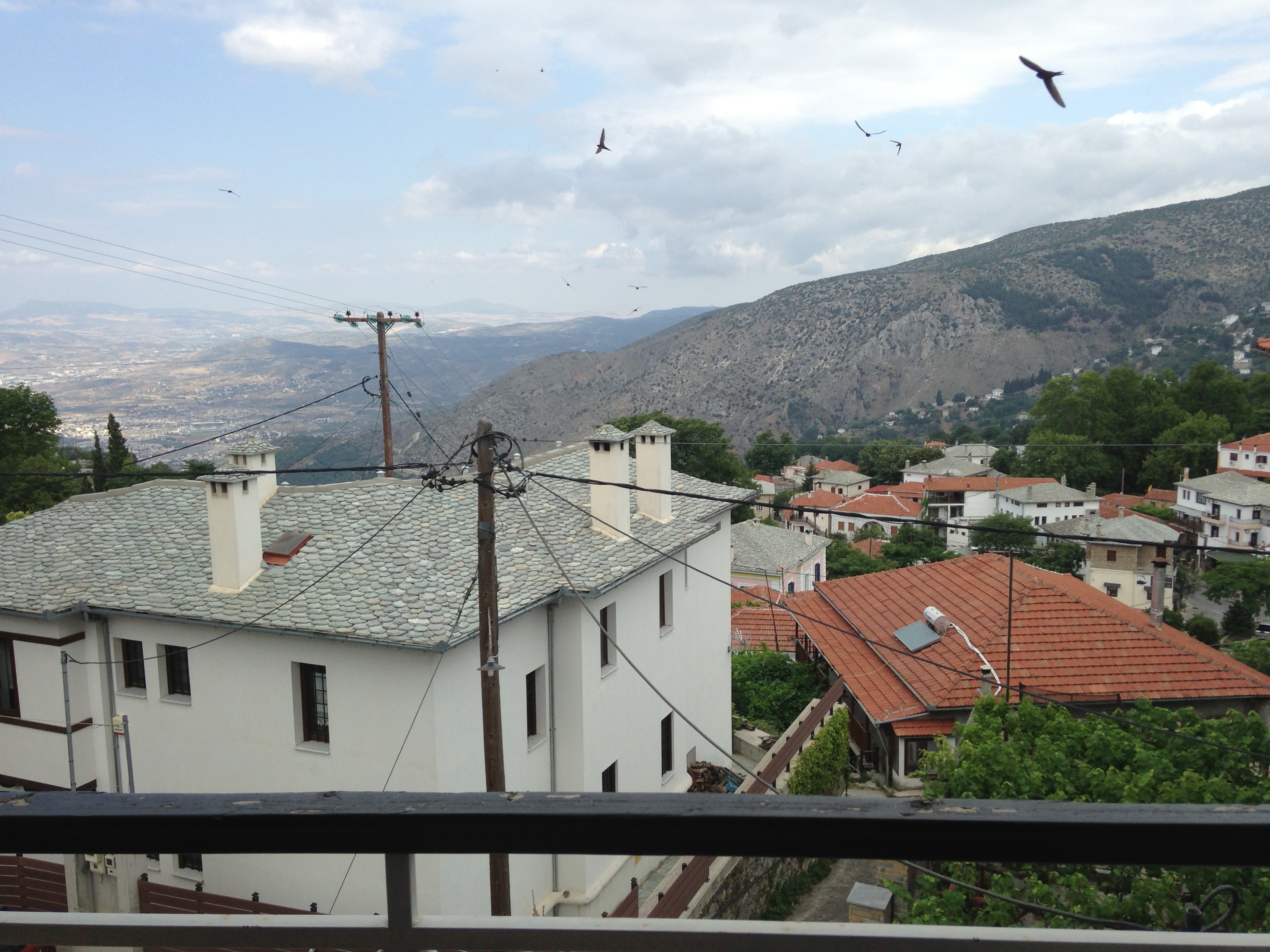
The View From Your Window Contest

VFYWC-213

You have until noon on Tuesday to guess it. City and/or state first, then country. Please put the location in the subject heading, along with any description within the email. If no one guesses the exact location, proximity counts.  Be sure to email entries to contest@andrewsullivan.com. Winner gets a free The View From Your Window book or two free gift subscriptions to the Dish. Have at it.

When The Net Was New

Leon Neyfakh singles out 1994 as a turning point for the Internet: “The number of websites grew from 623 at the beginning of the year, according to one study, to more than 10,000 at the end.” He presents an oral history of the period when just “clicking around on things was wildly entertaining, because it was so novel”:

[Michelle] Johnson [first editorial manager of boston.com, website of the Boston Globe]: When we launched boston.com [in the fall of ’95] … [o]ne of the first responses that we got was from some guy in India who was like, “Oh my God, I can get the Red Sox scores in real time!” Of all the stuff we were doing we weren’t expecting people to get that excited about getting sports scores—it hadn’t crossed our minds. We were also focused on a local audience, and here was this guy from halfway around the world who was jumping up and down about getting to read our sports stories.

She continues:

The thing that shocked me the most was how quickly young people moved away from print. I would not have bet anybody that [it would happen] as fast as it did…. I felt a little blindsided…. The term “cannibalize” did come up. I remember people saying we’d cannibalize the print product by giving away stories online. And at the time I was squarely in the camp of, “the Web wants to be free.” It was just the culture back then: You can’t charge people for stuff online. Had I taken the longer view, I would have seen that we were training a generation to expect great stuff for free and that that was going to hurt us. But back then I would have thrown my body on the tracks and said we’d be crazy to charge for this.