The Web’s Heart Of Darkness

Last summer, Andrew O’Hagan undertook the peculiar experiment of borrowing “a dead young man’s name and see[ing] how far I could go in animating a fake life for him.” In the resulting meditation on identity and “the ghostliness of the internet and the way we live with it,” O’Hagan describes how he plunged his fictionalized “Ronald Pinn” into the dark web, “where one can be anybody one wants to be”:

There were areas I wouldn’t allow him to go into – porn, for instance – but the Ronnie who existed last summer was alive both to drugs and to the idea of weaponry.

It’s one of the contradictions of the dark web, that its love of throwing off constraints doesn’t always sit well with its live-and-let-live philosophy. There are people in those illicit marketplaces who sell ‘suicide tablets’ and bomb-making kits. ‘Crowd-sourced hitmen’ were on offer beside assault weapons, bullets and grenades. One of the odd things I discovered during my time with cyber-purists – and Ronnie found it too – was how right-wing they are at the heart of their revolutionary programmes. The internet is libertarian in spirit, as well as cultish, paranoid, rabble-rousing and demagogic, given to emptying other people’s trash cans while hiding their own, devoted not to persuasion but to trolling, obsessed with making a religion of democracy while broadly mistrusting people. Far down in the dark web, there exists an anti-authoritarian madness, a love of disorder as long as one’s own possessions aren’t threatened. The peaceniks come holding grenades. The Manson Family would feel at home.

When Ronnie Pinn went to see this world he found it welcoming and vile. He saw Uzis and assault rifles, bomb-making kits, grenades, machetes and pistols. As a man with cyber-currency, he was welcome in every room and was never checked. He was anybody as well as nobody. He could have been a teenager, a warrior, a terrorist or a psychopath. So long as he had currency he was okay.

The View From Your Window Contest

VFYWC_-238

You have until noon on Tuesday to guess it. City and/or state first, then country. Please put the location in the subject heading, along with any description within the email. If no one guesses the exact location, proximity counts.  Be sure to email entries to contest@andrewsullivan.com. Winner gets a free The View From Your Window book, a new Dish mug, or two free gift subscriptions to the Dish. Have at it.

Last week’s contest results are here. Browse a gallery of all our previous contests here.


Memoirs Of A Compulsive Moviegoer

In his new memoir Silver Screen Fiend, Patton Oswalt recounts his multi-year “addiction to film.” Elbert Ventura appreciates that the comedian is “unsparing in evoking the condition of on-the-spectrum obsessiveness”:

Oswalt has a good angle—a portrait of the artist as a young film buff—and the book underscores a point often lost in talking about movie love: the sheer work of being a real cinephile. Oswalt’s immersion in movies really did deliver a thorough education: He trusted authorities like [New Beverly Cinema proprieter Sherman] Torgan and [Cult Movies author Danny] Peary and saw everything they suggested; he went to rep screenings instead of settling for video; he sought out hard-to-find entries in forgotten directors’ filmographies. At once confessional and curatorial, the book portrays Oswalt as not just a celluloid sybarite, but someone dead serious about the art.

Linda Holmes remarks that “one of the best things about Silver Screen Fiend is that Oswalt doesn’t always seem very likable in it”:

The easiest way to enjoy a memoir, at times, is when it makes a famous person seem like an awesome best friend you’d love to have. Patton Oswalt, on the other hand, in his own stories, can seem not just prickly, but full of explanations of things he’s learned to rise above:

hack comedy by people who are successful but untalented, inferior art, boring people, uncool venues (“giggle-shack” is his most devastating putdown). The book is not an argument for his personable nature, as books by famous people often are. …

It is, however, an interestingly aggressive, restless attempt – sometimes successful and sometimes less so – to get to the bottom of his own fascination with dark theaters and old movies, and how it dovetailed with his developing comedy career. The farther he gets from the theaters, and from the attempt to convey their grandeur and the grandeur of film itself, the better the book is.

David Brusie finds that the book “has its faults”:

The book’s structure isn’t always clear, which sometimes makes for an unwieldy read, and a 33-page appendix listing every movie he saw over four years, while interesting at a glance, ultimately feels like padding. But Oswalt’s ample writing talents push the narrative past these shortcomings (a section with no punctuation depicting Oswalt’s thoughts while bombing onstage is particularly vivid). His decision to write almost entirely in the present tense makes the memoir feel immediate and vital. …

The book’s resolution, which includes the birth of Oswalt’s daughter, makes clear that the story is a kind of fable about the dangers of immersion in any cultural interest. By the end, when Oswalt stumbles out of the dark and squints in the light of his new life, it’s enough to make any reader seek out the many films that made him hibernate in the first place.

In a recent interview about the book, Oswalt elaborated on one of the events that finally led him out of addiction – the release of Star Wars Episode I: Phantom Menace:

It’s not that it killed the addiction; it made me look at the addiction from such a different angle that it didn’t hold any power over me anymore. I’ll put it this way — I was the worst kind of movie fan. I’m the kind of guy who saw 6 movies a day, didn’t write any movies, didn’t make any movies, but then could be armchair quarterbacking on a movie that I had no hand in making.

Yes, I thought [Phantom Menace] was a failure, but the dude took a shot at it. It hit me that I was spending days and days and nights and nights with my friends, arguing back and forth about this film but this guy made a movie. Good or bad, he made a movie. He’s on a different relam than you.

Map Of The Day

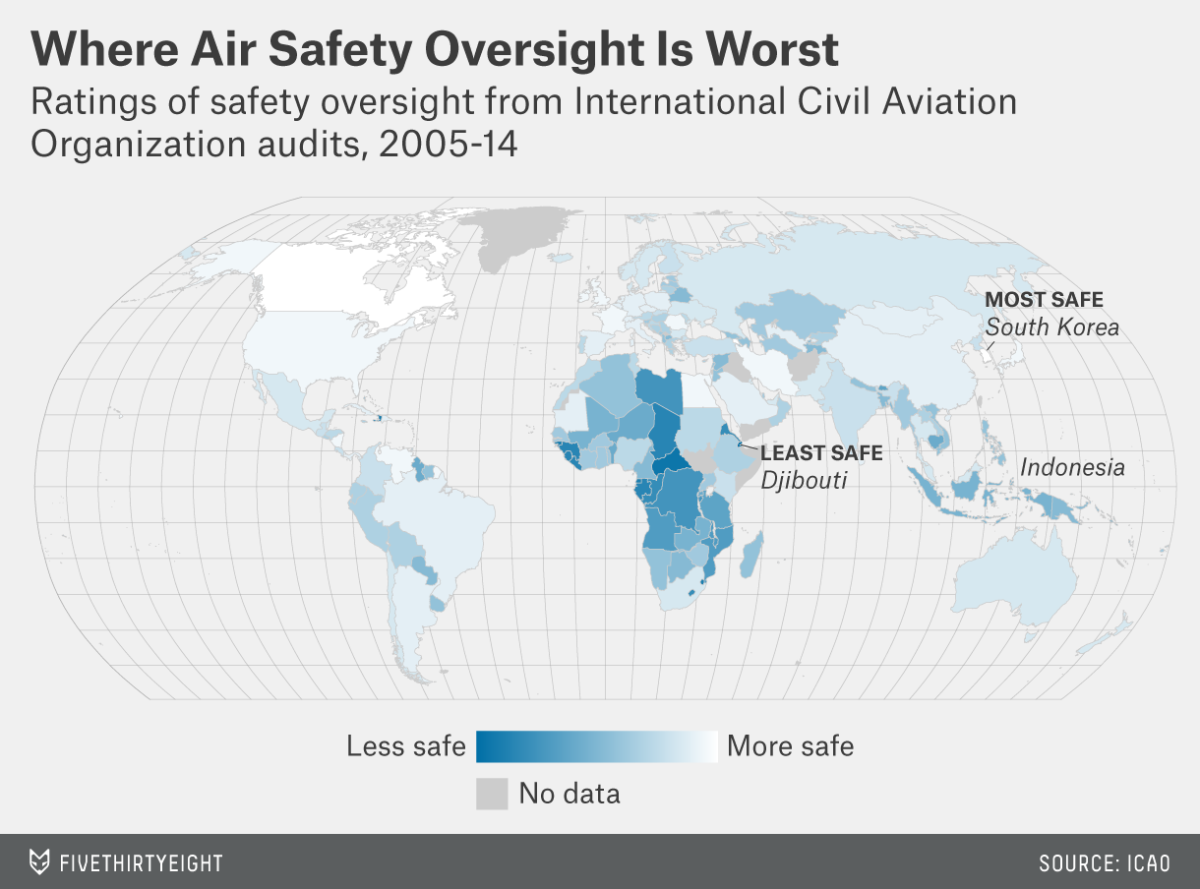
bialik-datalab-indonesia-map1

Carl Bialik shakes his head at Indonesia:

A year ago, [it] rated above average. Then, last May, the ICAO audited the country. The results were abysmal. Indonesia rated below average in all eight categories, including legislation, operations and airworthiness. The organizational structure of its civil aviation rated well below average, scoring 18 percent compared to a global average of 65 percent.

He adds that “it’s too soon to link Indonesia’s poor audit scores with the [AirAsia] disaster that is presumed to have killed all 162 people on board”:

There are, nonetheless, already indications that lax oversight played a part in AirAsia flight QZ8501. The flight took off without the necessary clearances from regulators, the acting head of Indonesia’s transportation ministry said, according to the Associated Press.

A Poem For Saturday

13224671993_a47e7c7259_k

Dish poetry editor Alice Quinn writes:

The Scottish poet Kathleen Jamie, born in 1962, is the author of seven collections, including The Overhaul, just published here by Graywolf Press and shortlisted for the T.S.Eliot Prize when it was published in 2012 in Great Britain. Too few poets from England, Scotland, Ireland, and Wales are published here. She’s one to follow along with the Irish poet Michael Longley, who also has a new volume. We’ll feature Jamie this week and Longley next.

“Hawk and Shadow” by Kathleen Jamie:

I watched a hawk
glide low across the hill,
her own dark shape
in her talons like a kill.

She tilted her wings,
fell into the air—
the shadow coursed on
without her, like a hare.

Being out of sorts
with my so-called soul,
part unhooked hawk,
part shadow on parole,

I played fast and loose:
keeping one in sight
while forsaking the other.
The hawk gained height:

Her mate on the ground
began to fade,
till hill and sky were empty
and I was afraid.

(From The Overhaul © 2012 by Kathleen Jamie. Used by permission of Graywolf Press. Photo by Peter Massas)

Is The “Creative Class” Dying?

Scott Timberg, an arts reporter for the LA Times who was laid off in 2008, has now written a book, Culture Crash, investigating “the killing of the creative class.” He names anti-intellectualism, celebrity culture, and the decline of print as culprits:

Probably the boldest claim that Timberg advances is his indictment of postmodernism as a destructive attack on culture with broadly deleterious consequences. This attack has emanated from the academy, not our profession—most journalists wouldn’t know postmodernism from a doorpost—but Timberg argues that we are all its victims. He offers a whirlwind tour of various critical schools—structuralism, “deconstruction,” feminist criticism, cultural studies—and says that they have leached the joy out of reading and other cultural pursuits.

Even the avowedly populist Pauline Kael comes in for some bashing, for allegedly “championing the kind of work that did not really need a critic’s advocacy or interpretation.” In fact, Timberg’s crankiness is reminiscent of the reaction by earlier critics of modernism, who also lamented that the cultural world as they knew it was coming to an end. Thanks largely to postmodernism, Timberg writes, we are graduating fewer (novel-reading, theatergoing) humanities majors. One could argue, of course, that practical considerations—including a spate of recessions and the sexiness of high-paying Wall Street, consulting, and tech jobs—have been more decisive in this decline.

Evan Kindley finds that “there is, ultimately, an unnerving sense of entitlement to Culture Crash, well-intentioned as it is, and that entitlement is largely generational”:

The real sting in the tail of Timberg’s polemic is not, as he would have us believe, that things are worse for creative people than they’ve ever been before. It’s that things are considerably worse than they were 20 years ago.

Throughout Culture Crash, the 1990s function as a go-to belle époque: “the peak years of journalistic employment, especially for newspapers,” the height of architectural innovation, the heyday of indie rock. His choice of interview subjects (David Lowery, Dean Wareham, David Byrne) betrays an obvious bias toward aging Gen X icons. Timberg makes clear that he’s “not particularly interested in James Cameron … or Kanye West: Celebrity and corporate entertainment—good and bad—hardly needs defenders.” Yet he’s not very interested in the genuinely marginal, obscure, or underprivileged, either—or in anyone under 40: Timberg’s interviews are all with white men who did extraordinarily well in the 1990s (or occasionally the 1980s or early 2000s), and are doing worse (but still reasonably OK) now.

One can hardly blame folks like Lowery or Byrne for complaining about the relative decline of their industries: They have firsthand experience of an age d’or to share and probably (even correctly) view themselves as spokesmen for the many suffering artists who don’t have a comparable platform. But Timberg certainly could have tried harder to talk to a wider swath of the creative class beyond his personal social circle and those he comes into contact with on his promotional rounds.

The Sinking Ship Of Chivalry

Tyler Cowen points out the abstract of a new paper that upends notions of “women and children first”:

Since the sinking of the Titanic, there has been a widespread belief that the social norm of “women and children first” (WCF) gives women a survival advantage over men in maritime disasters, and that captains and crew members give priority to passengers. We analyze a database of 18 maritime disasters spanning three centuries, covering the fate of over 15,000 individuals of more than 30 nationalities.

Our results provide a unique picture of maritime disasters. Women have a distinct survival disadvantage compared with men. Captains and crew survive at a significantly higher rate than passengers. We also find that: the captain has the power to enforce normative behavior; there seems to be no association between duration of a disaster and the impact of social norms; women fare no better when they constitute a small share of the ship’s complement; the length of the voyage before the disaster appears to have no impact on women’s relative survival rate; the sex gap in survival rates has declined since World War I; and women have a larger disadvantage in British shipwrecks. Taken together, our findings show that human behavior in life-and-death situations is best captured by the expression “every man for himself.”

The Best Of The Dish This Week

'Paris Est Charlie - Paris Is Charlie' -  Projected Onto The Arc De Triomphe

Dish editor Chris here. Andrew usually writes the BOTD feature, but, as he noted yesterday, he’s been out sick this week with a wicked flu. His message to readers:

Just a note to apologize for my absence from the blog since a little after Christmas. I got the flu pretty bad (yes, like most HIVers, I got the shot) and haven’t been mobile now for ten days. I’m waiting on blood-work results to make sure nothing else is going on, and feel a little better today. So with any luck, I should be back blogging very soon. My deepest thanks, as always, to the Dish team for making my absence so worryingly hard to discern. And my deepest condolences to the people of Paris and France. Nous sommes Charlie aussi.

Andrew was still feeling shitty today with a fever, but hopefully he’ll be back to blogging on Monday. You can email your well-wishes here.

Our three most popular posts this week were the final results of the 2014 Dish Awards, one of the first posts titled Slaughtered For Satire, Ctd, and Andrew’s year-end evaluation of President Obama’s performance (spoiler alert: he still likes him). All of our coverage of the Charlie Hebdo attack and resulting debates over free speech can be found here (to read in chronological order, go here). That round-the-clock coverage was carried out by Chas, Jonah, Patrick and myself. Some props from a reader after an exhausting week:

Just a note to say that your coverage of the events in Paris has, so far, really been at your highest level. We are getting perspectives on every intelligent side of the issues, which is exactly what we need, as opposed to, say, Nicholas Kristof-type pieties. I am thinking of teaching a course sometime in the near future on blasphemy, and your posts are really helping me to appreciate the complexity of the issue.

We also added reader updates to many of our Charlie posts – review all of them here. The most important updates you might have missed: readers provided context here and here to Charlie cartoons that some people believe to be racist caricatures of black people; that didn’t seem to be the cartoonists’ intention at all. Another reader tore apart the false equivalence of an offensive Holocaust-Muhammed cartoon created by the anti-Semitic artist Carlos LaTuff. And another pointed out that, while the WaPo scrubbed some controversial cartoons from its coverage, the paper did in fact republish one of Charlie‘s Muhammed covers, in the opinion section.

Two reader threads kept us sane this week – the one on bathroom graffiti and the other on eggcorns. All of our official mental health breaks can be watched here, capped by a beautiful one from Paris. Alice offered a poetic escape here. We also compiled many of your window views from this week’s cold snap. This new one from Clyde, North Carolina looks a bit phallic:

clyde-NC-4pm

You can always leave your unfiltered comments at our Facebook page and @dishfeed. 22 more readers became subscribers today. You can join them here – and get access to all the readons and Deep Dish – for a little as $1.99 month. Gift subscriptions are available here. Dish t-shirts are for sale here and our coffee mugs here. One new subscriber writes:

Well, you’ve done it. Months of clicking “Read On” only to not read on has drawn me into your political and cultural vortex. After discussing the high price of $19.99 with my wife, noting it couldn’t come from the budget but from Christmas Cash, I finally signed up … and then a new post confirmed that decision: “Following Jesus in an Age of Violence“. This is the reason I want to click more and ultimately support the work you do: honest engagement with various views, unfearful critique, and the evident value of holding faith, politics, economics, and personal relationships in tension. So, thank you and have a great New Year!

See you in the morning for our weekend coverage, edited and curated by Jessie and Matt, with more poems from Alice. Those three were also responsible for most of the Dish coverage over the holidays, with help from Phoebe and Tracy. A Founding Member noticed:

I’ve been an avid reader for many years and was a charter subscriber. It’s just amazing to me how informative and interesting your site always is. Even this week (between Christmas and New Years), when it’s nearly impossible to find anything decent to read on the web, you have more than your quota of fascinating and stimulating articles. Thank you so much. When I think of my greatest fears, it’s not getting old but that Andrew is getting old and might someday retire. Love you guys.

(Photo: The words “Paris Est Charlie” are projected onto the Arc de Triomphe on January 9, 2015. By Richard Bord/Getty Images)

Never Forget The Muslim Victims Of Islamic Terrorism

Wednesday’s attack on Charlie Hebdo has already inspired a backlash against France’s Muslim community, with several incidents targeting mosques, businesses, and even individuals:

Three grenades hit a mosque in Le Mans, in the early hours of Thursday while in Aude, southern France, two gunshots were fired at an empty prayer room. A Muslim family in their car in Vaucluse came briefly under fire but escaped unharmed, and a mosque in Poitiers was daubed with graffitti saying “Death to Arabs”. In Villefranche-sur-Saône, an explosion blew out the windows of a kebab shop next door to the town mosque. …

Nourredine, a taxi driver, said the cold-blooded attack on Wednesday at Charlie Hebdo had left him very saddened and angry. It had reminded him of his home country, Algeria, in the 60s and 70s, he said, where “journalists were often the first to be targeted” by extremists. “But you know, we will become victims of this atrocity,” he said. “There is real stigmatisation in France. I love this country, really I do, but this stigmatisation, this amalgamation, this tarring all Muslims with the same brush – all it does is feed the extremists. It helps the Front National, the people who hate and fear Islam.”

This tweet says it better than anything else:

https://twitter.com/misshibhop/statuses/553603082425475072

H.A. Hellyer is dismayed that French Muslims are being called upon to condemn an act that, in the long run, stands to hurt them as much as anyone else:

While the attackers may claim to have killed in the name of the Prophet’s honor, they killed someone with the Prophet’s name in the process: a French policeman called Ahmed Merabet.

As a Frenchman, he was targeted by extremists; as a Muslim, his community is targeted by extremists worldwide; and as a French Muslim, his local community stands at risk of an anti-Muslim backlash. Muslim terrorists kill far more Muslims than non-Muslims, and far more Muslims than non-Muslims are fighting these extremists. The day of the Charlie Hebdo attack, several dozen Muslims were killed by radical extremists in Yemen. Many others die every day in Iraq and Syria. …

The disgraceful attacks on Charlie Hebdo may have further consequences, such as entrenching the false notion that Muslims and non-Muslims simply cannot coexist, or that civil liberties need to be rethought, with yet more powers given to the state, diminishing the commitment to human rights. That is merely giving the attackers a further victory, rather than honoring the loss of life that took place.

Merabet is being held up as a hero on Twitter with the hashtag #JeSuisAhmed:

“The story of Merabet’s confrontation with the Paris terrorists,” Jim Edwards writes, ” is turning out to be one of the most poignant in the whole affair”:

And it’s proof, if further proof were needed, that Muslims are much more frequently the victims of Islamic terrorism than Westerners are. According to the Global Terrorism Index, 80% of all the deaths from terrorism in 2013 were in Muslim-majority countries Iraq, Afghanistan, Pakistan, Nigeria, and Syria. Since 2000, only 5% of all deaths from terrorism have been in developed countries — although they have been among the deadliest. …

Merabet is the officer seen in the heartbreaking video of the shooters’ attack on the Charlie Hebdo office, as seen through a mobile phone from across the street. The worst part of the video — aside from the moment in which the gunmen finish him off with a shot to the head — is where Merabet, lying injured on the pavement, tries to raise his arms in surrender. He is clearly no threat to the gunmen. And they kill him anyway.

This is why, in John Cassidy’s opinion, the “clash of civilizations” narrative that some are trying to superimpose on this tragedy misses the point entirely:

But to interpret things in such black-and-white terms is to distort reality. Although Islam largely missed out on the Reformation and the Enlightenment, a point frequently made by its critics, it is far from a monolithic religion. And many ordinary Muslims, rather than being on the side of the jihadis, are taking up arms against them, and sometimes paying with their lives. In Iraq, the Iraqi, Kurdish, and Iranian soldiers battling ISIS are mostly Muslims. In Pakistan and Afghanistan, the government forces fighting jihadis are also almost all Muslims.

On top of this, most of the victims of jihadi atrocities are Muslims. In Iraq last month, more than eleven hundred people were killed in acts of terrorism and violence, including nearly seven hundred civilians. It’s fair to assume that almost all of them belonged to the Islamic faith.