As often, Shafer's best lines come next to his by-line:
When will Slate die? I give it until 2032, when it will be replaced with a neural feed from Christopher Beam's brainstem.
As often, Shafer's best lines come next to his by-line:
When will Slate die? I give it until 2032, when it will be replaced with a neural feed from Christopher Beam's brainstem.
Exhibit A from a WaPo online chat:
Boston, Mass.: Here is my question for the Tea Party. What are your solutions to today's problems? For example, I hear the word socialism used alot and government getting too big. But then what would you cut? Or what would the Tea Party members have done about the financial crisis from 2008? I assume that they would not vote to bailout the banks, but what would they do if the biggest banks in the world go under?
Judson Phillips: First, cut taxes to increase economic growth. That works everytime. Second, let's go through the entire federal budget and eliminate programs that are consumed by waste, fraud or abuse. Start eliminating them.
Seriously? I mean: seriously? We're talking about a debt larger than we've ever contemplated outside of the Second World War and he's talking about eliminating "waste"? And I thought Glenn Reynolds was dishonest … Of course, we later find out that defense is off the table. But he does mention entitlements, when challenged further:
Judson Phillips: Let's start with entitlement programs. They are the biggest source of out of control spending. Then let's go to congressional pork programs.
Pork is a teensy part of the problem. He does later argue that social security disability checks are the source of the spending problem. Yep: seriously, that's his one actual specific recommendation, apart from cutting taxes further! Yes, this tea-partier is still drinking the Laffer curve Kool-Aid. What does he specifically propose for entitlement cuts that come close to the scale of the problem? Nada. And he doesn't even have the excuse of being a pathetic politician trying to get elected. He's not running for office; he's heading up a protest movement against government spending – and he yet he can't offer any serious specifics on what he'd cut that would solve the problem. In fact, he barely seems to have thought about the actual fiscal choices before us for a split second.
Taxes? Pure denial of reality:
Washington, D.C.: Judson — Are you willing to admit that taxes have actually gone down for the vast majority of Americans under President Obama?
Judson Phillips: No
Of course not. And the past has to be airbrushed as well:
Alexandria, Va.: Are you willing to admit that marginal tax rates went up for the majority of Americans during the Reagan administration? Do you know the difference between average and marginal tax rates? Could you answer a simple econ 101 questions regarding the impact of progressive taxation on the labor-leisure choice?
Judson Phillips: No.
If I have contempt for these non-arguments, it is because I retain some smidgen of a belief in honest politics and small government. These people are thoroughgoing frauds – a bunch of right-wing victim-mongers whining about something they have no actual ideas about confronting. They are not something new. They are the decaying stench of the Republican corpse. If they get into power somehow, it will be Weekend At Bernie's for conservatism.
From the NYT yesterday:
“You cannot really engage in that conversation,” said Phillip Moore, a teacher in this Detroit suburb who has embraced strong opinions on many topics in his life — on politics, education, even religion — but avoids the subject of Israel at gatherings of his Jewish relatives.
“You raise a question about the security forces or the settlements and you are suddenly being compared to a Holocaust denier,” said Mr. Moore, 62. “It’s just not a rational discussion, so I keep quiet.”
I share his pain. But the hysterics are not representative:
In a survey taken after the diplomatic skirmish of March, the American Jewish Committee — the heart of the traditional mainstream — found little change in the level of Jewish support for Mr. Obama’s handling of relations with Israel. The survey found that 55 percent approved of his handling of Israeli relations, compared with 54 percent last year.
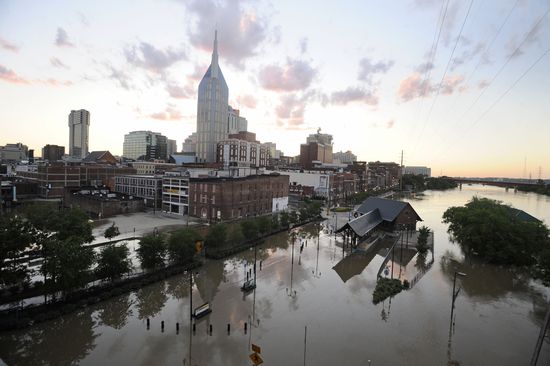
Sportswriter Patten Fuqua pauses to reflect on the unprecedented devastation to his city:
But let’s look at the other side of the coin for a moment. A large part of the reason that we are being ignored is because of who we are. Think about that for just a second. Did you hear about looting? Did you hear about crime sprees? No…you didn’t. You heard about people pulling their neighbors off of rooftops. You saw a group of people trying to move two horses to higher ground. No…we didn’t loot. Our biggest warning was, “Don’t play in the floodwater.” When you think about it…that speaks a lot for our city. A large portion of why we were being ignored was that we weren’t doing anything to draw attention to ourselves. We were handling it on our own.
Photo by Jeff Gentner/Getty Images. The Big Picture has many more. Musical slideshows here and here.
Information Is Beautiful joins the party.
Christine Rosen sounds a little uptight:
Today, what used to cause embarrassment now elicits little more than a collective shrug. In our eagerness to broadcast our authentic experiences and have our individuality endorsed, we reject embarrassment as if it were some fusty trapping of a bygone age. But we haven't eliminated embarrassment; we have only upped the ante. "Your slip is showing" used to be the most embarrassing sartorial faux pas a lady could commit. Now we regularly witness "nip slip" from female celebrities whose shirts mysteriously migrate south during public appearances – or during Super Bowl halftime shows. As the boundary between public and private has dissolved, so too has our ability to distinguish between embarrassing and appropriate public behavior. The result is a society often bewildered by attempts to impose any standards at all.
If embarrassment is over, why is The Office such a huge hit? Why has the last decade seen a surge in embarrassment humor? The objects of embarrassment may have shifted, and no doubt the level of embarrassment in a far looser, less fastidious society has, as Rosen argues, sunk. But the beast with red cheeks will always blush. And living in a society terrified of the faux pas is a pain in the ass.
Jeremy Jackson’s newly released talk on our relationship with the ocean seems appropriate given the oil spill in the gulf:
Bruce Schneier's answer:
There are actually several answers to this question. One, terrorist attacks are harder to pull off than popular imagination — and the movies — lead everyone to believe. Two, there are far fewer terrorists than the political rhetoric of the past eight years leads everyone to believe. And three, random minor terrorist attacks don't serve Islamic terrorists' interests right now.
Today on the Dish we rounded up commentary on the eve of the election. The Tories continued to surge, Johann Hari harangued Cameron, the WSJ illustrated Labour's big-government record, Chris Bertram endorsed the party out of class sympathy, Larison distinguished the British left from the American left, Bernstein kept up talk over electoral reform, and Chris Brooke prepped us for a hung parliament.
In terror talk, Goldblog sized up the perception of the Times Square bomber, Andrew marveled at the madness of McCain and Lieberman, David Brooks gave props to the president's poise, and Steve Coll talked sense. We also learned that a Muslim immigrant had alerted authorities about the bomb.
Palin antics here. More scrutiny of the Arizona law revisions here and here. Even the Phoenix Suns sounded off. DC passed a medical marijuana bill. A horrific video from the drug war here. A forerunner of reparative therapy unloaded some gay baggage. Anna Lappé countered Robert Paarlberg on organic farming in Africa, Tom Laskawy tore into superweeds, and readers contributed to the race debate.
A letter from Nashville here. Epistemic closure watch here. Hewitt award here and creepy ad here. Bear-blogging here and here. Conan expletives here, tea with Tyson here, and kick-ass couch forts here.
— C.B.
Dan Bull has created an eve of election British debate rap battle (above). The second half is better than the first. Mark Tran reflects on the campaign:
Sometimes you can get to the end of an election campaign and feel that nothing very much has changed. That hasn't happened this time. The leaders' debates really did put a rocket under the Lib Dem campaign and in the polls Nick Clegg's party has enjoyed a lasting boost. On the stump David Cameron turned out to be even better at retail politics than people predicted. And (at least until this week) Gordon Brown turned out to be even worse. But the day-to-day campaigning did not seem to make much difference to the figures. We've reached the eve of polling day with the Tories still ahead, seat projections varying wildly (depending on what swing model you use…), a hung parliament on the cards – and polls showing that a huge chunk of the electorate still hasn't made up its mind…Election nights are always interesting. But tomorrow will be exceptional.
George McCoy gives voting instructions to those interested in more relaxed sex laws. In other sex news, the Sun's page 3 girls endorse the Tories (link NSFW):
Page 3 Girls in all their glory represent the very image of freedom in this country. But if Labour or the Lib Dems win the election, this could be the last time they are allowed to pose together. MPs Harriet Harman and Lynne Featherstone will move swiftly to change the law and ban Page 3 forever. Our national treasures – who even enjoy the Royal seal of approval from our future King Prince Charles – will be no more.
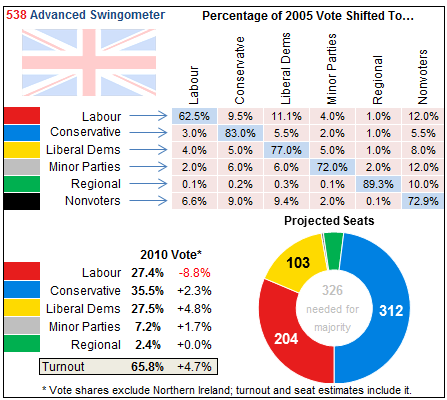
Nate Silver's final projection:
Polling during the past 48 hours has tended to show very slight gains for the Conservatives and Labour at the expense of the Liberal Democrats. Our projection model now forecasts that Conservatives will have 312 seats in the House of Commons (up from 308 in our previous forecast), Labour 204 (up from 198) and Liberal Democrats, 103 (down from 113).
Mark Blyth and Jonathan Hopkin have a Foreign Affairs piece on the election:
[T]hree issues press the next government's agenda — force projection and great-power status, Britain's "special relationship" with the United States, and its relationship with the European Union.
Britain ceased to be a credible world power during the Suez Canal crisis of 1956, yet it still seeks to punch above its weight. With a weak economy for the foreseeable future, however, the new fiscal reality may curtail such ambitions, no matter who wins the election. The IMF has estimated that to bring the U.K. debt level back to around 60 percent of GDP, Britain will need to cut the equivalent of 12 percent of GDP from its budget over ten years. Big-ticket force-projection items, such as the Joint Strike Fighter and the modernization of Trident, the United Kingdom's missile-based nuclear weapons program, will necessarily come under intense scrutiny. International commitments, such as Britain's continuing presence in Afghanistan — which is already deeply unpopular with the British public — may also be called into question.
Anatole Kaletsky is hoping for a Tory-Lib Dem deal:
Suppose that the Tories emerge as the leading party, but require Lib Dem support. This would produce a far stronger government, provided the two parties could agree on terms. These terms would probably not entail a formal coalition, since their policy differences are profound and many, but on a temporary pact for peaceful coexistence, in which the Liberal Democrats would agree not to vote against the government on motions of confidence and budgetary issues, in exchange for a Tory promise of a referendum on electoral reform.
Such an agreement might last for two years or so. It would not commit the Lib Dems to positively supporting Tory economic policies, but it would require them to acknowledge the overriding national interest of economic stability and to abstain from parliamentary obstruction. The Tories would not need to support PR or any other electoral reform but merely to put these issues to a referendum in which the governing party would be free to campaign for a “no” vote.
Simon Hix and Nick Vivyan's final prediction:
Basically, this model predicts that the Conservatives will secure between 271 and 315 seats, that Labour will secure between 197 and 241 seats and that the Liberal Democrats will secure between 93 and 121 seats.
Bagehot's view of the campaign:
In campaigning terms, it had been dominated by the television debates. Bigotgate was the only other moment that got much of a look-in. The debates overshadowed much of the rest of the national campaigns. Meanwhile, apart from the early embarrassment over Labour's choice of blogger to introduce Gordon Brown at the launch of the manifesto, and a couple of candidates de-selected for online indiscretions, new media have been much less important than their excitable boosters predicted. I am a fan of the debates, but they have made the campaign feel like long bouts of pointlessness punctuated by brief periods of excitement.
It hasn't been pointless for the bookies. The British are betting like mad:
British voters have wagered more money on the uncertain outcome of tomorrow's vote than on any other election, with recent surges of betting on David Cameron and the Liberal Democrats seeing bookmakers revise forecasts of total election betting from £20m to up to £40m. During the 2005 general election campaign only £10m was gambled.
Daniel Finkelstein recalls the first time he voted Tory:
You may remember those posters: “I’ve never voted Tory before, but.” The Conservatives put those up because they realised that, among undecided voters, an extraordinary number said that while they were thoroughly disillusioned with Labour, they had never voted Conservative before. Now, they said, they were on the brink of backing David Cameron. And then, again and again, they added this: “My grandad would roll in his grave.”
Many pollsters assume — and adjust their polls accordingly — that a disproportionate number of these undecided voters will return to their past voting behaviour rather than following the trend. This has helped to make polls more accurate in the past. The result largely depends on whether that assumption holds good this time.
So, annoyingly, this election will be determined by people fighting a tribal urge that I’ve never felt and can’t completely relate to.
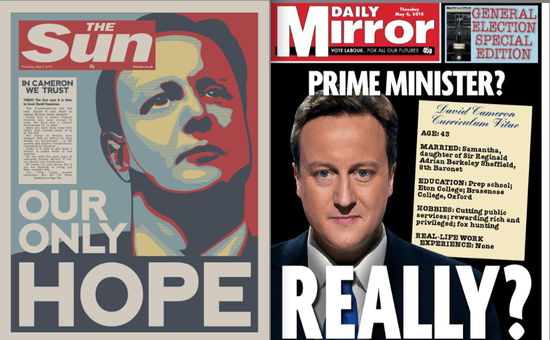
Thursday's front pages here. Here are The Sun's and the Mirror's covers:
Anthony Well's prediction:
[M]y guess is we are going to see the Conservatives between 300-310, Labour between 220-230, the Liberal Democrats between 80-90 (though I warn you, I may be a pollster, but my personal powers of election prediction are notoriously poor!) For other pollster predictions, TNS have made a seat prediction of CON 292, LAB 204, LDEM 114; Peter Kellner’s personal prediction is CON 300-310, LAB 230-240, LDEM 75-85; Angus Reid have a prediction of CON 320-340, LAB 165-185, LDEM 105-120.
Alastair Campbell carries water for Brown:
I do not pretend to be as close to [Brown] as I am to [Blair]. Nor can I claim we have not had major disagreements down the years. We have. Nor can I say there have not been moments when I have willed him to do things he is not doing, or not do things that he does. And yes, there have been moments in the past few months when I have wished I could escape the political bubble for good instead of being drawn back in to the point where the campaign has been close to a full-time occupation again. All that is true. But the pull of Labour is strong, and this I know: if I had to choose between [Gordon Brown], David Cameron and Nick Clegg for PM, then it has to be Gordon every time. Heaven knows he has his faults – everyone does. But my God you have to admire the resilience and the depth of a man who just will not stop fighting for what he believes in.
From the Telegraph's endorsement of the Tories:
This newspaper was never convinced by the New Labour experiment. We believe that the past 13 years rank as a wasted opportunity of historic proportions. Elected on a wave of near-euphoria at the start of a decade-long economic boom, Labour was better placed than any post-war government to change this country for the better. Yet Tony Blair's "project" was undermined from the start by two fundamental flaws. The first was the conviction that only big-government solutions can bring about lasting change; the second was the belief that to throw money at a problem is to solve it. The consequence was a spending binge of unparalleled profligacy conducted by an ever-expanding state machine – almost a million people have been added to the government payroll since 1997. When Labour came to power, public spending accounted for 40 per cent of GDP. Last year, the figure was 52 per cent. Following the worst downturn in 70 years, and burdened as we are with a deficit of gargantuan proportions, the unbalanced nature of our economy will hamper British recovery.
Rachman lists promises Cameron is likely to break first:
1. The tax-break for married couples: the new government is going to need every penny of tax revenue it can get.
2. Raising the inheritance tax-threshold – a totemic policy for the Tories, who think it helped to turn their fortunes around. But can you really justify a tax-break for the middle-classes and the rich, when everybody else’s taxes are going up?
3. Re-negotiating the European treaties to repatriate powers over areas like work-place legislation. The Tory rank-and-file would love this. But it would involve the expenditure of a huge amount of time and political capital, for not that much gain.
Paul Mitchell looks at Northern Ireland and the DUP's possible deal with Cameron:
For Cameron, it may mean that with 318 seats he has a working majority.
Peter Hoskin worries:
The question hanging over the dying stages of the campaign is this: will the negativity cut through? Strategists on both sides, for Labour and for the Tories, think that Brown's disingenuous warnings about "Tory cuts" to child tax credits, for instance, are having some effect. Whether it's enough to move the polls tomorrow remains to be seen – although I can't imagine, or perhaps can't bring myself to imagine, that Brown's exclusively gloomy and misleading rhetoric will achieve much beyond alienating the electorate.
And Hamish Macdonell rounds up newspaper endorsements:
Daily Mail: “Why we must vote DECISIVELY to stop Britain walking into disaster … and give the Tories their chance.”
Sun: Alongside a picture of topless page-three girls: “Sixteen Page 3 girls in all their glory represent the very image of freedom in this country. But if Labour or the Lib Dems win the election, this could be the last time they are allowed to pose together.”
Independent: “There is a strong case for progressively minded voters to lend their support to the Liberal Democrats wherever there is a clear opportunity for that party to win.”
Daily Telegraph – Conservatives
Sunday Telegraph – Conservatives
Daily Express – Conservatives
News of the World – Conservatives
Guardian – Liberal Democrats
Times – Conservatives
Sunday Times – Conservative
Economist – Conservatives
Independent on Sunday – Liberal Democrats
Observer – Liberal Democrats
Mail on Sunday – Conservatives
Financial Times – Conservatives
Mirror – Labour, but urging tactical voting for Lib Dems
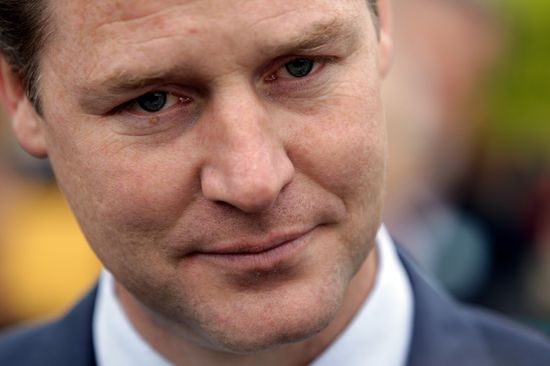
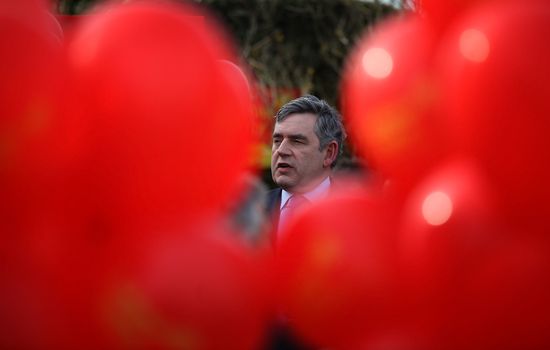
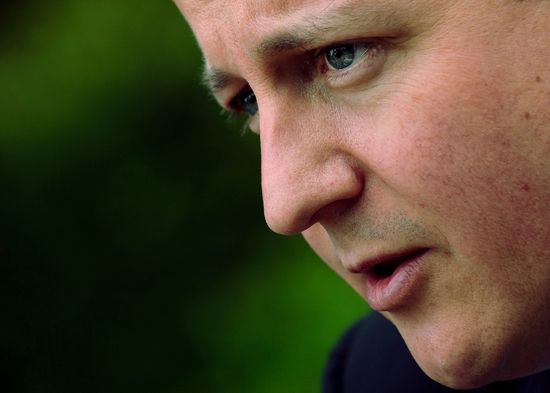
(Images: (1) Conservative Party Leader David Cameron listens to a question during a breakfast meeting with servicemen and women on April 22, 2010 in Exeter, in south-west England. By Adrian Dennis Getty Images (2) British Prime Minister Gordon Brown addresses party supporters at a private residence on April 21, 2010 in Cardiff, United Kingdom. By Christopher Furlong/Getty Images (3) Leader of the Liberal Democrats Nick Clegg speaks to party supporters during the last day of campaigning before polling day on May 5, 2010 in Eastbourne, United Kingdom. by Dan Kitwood/Getty Images)
 The Dish