Convicting Terrorists, Ctd

Steve Coll's bottom line:

Whatever the narrative behind Shahzad’s case turns out to be, we can take solace that we will hear it in a court of law. Amidst the country’s often self-defeating search for a justice system to address terrorism, his is not a particularly hard case—a U.S. citizen arrested on U.S. soil for a crime against Americans carried out in New York. We can nonetheless look forward to “The Daily Show” clips showing cable television anchors railing about the Obama Administration’s failure to recognize him as a warrior. Fortunately, like one of those Eleven O’clock News bank robbers who tries to rob an A.T.M., only to topple it over on himself, Shahzad’s case may help to illuminate a truth larger than himself: Terrorists are criminals, and the great majority of criminals are prosaic.
Face Of The Day

98861206

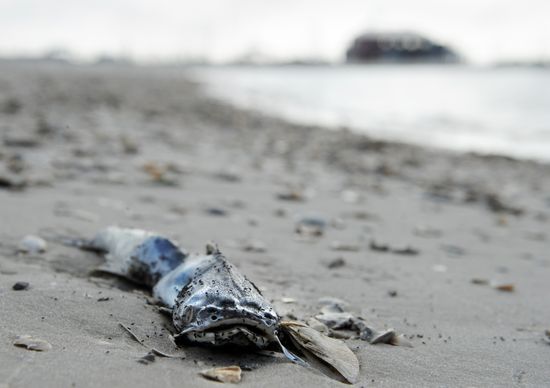
A dead fish is seen on the beach May 5, 2010 in Pass Christian, Mississippi as the gulf coast is still threatened by the oil spill from the BP Deepwater Horizon platform disaster. Emergency crews rushed to protect fragile shorelines and islands as the Gulf of Mexico oil slick expanded, prompting a mobilization of more national guard troops and alerts as far as the Florida Keys. With oil still gushing Wednesday from the ruptured offshore well, volunteers and others descended on the region to help stave off a looming environmental crisis from the huge oil patch. By Stan Honda//AFP/Getty Images.

“Darwinian Evolution In Fast-Forward”

The NYT reports on a growing threat to US agriculture:

Just as the heavy use of antibiotics contributed to the rise of drug-resistant supergerms, American farmers’ near-ubiquitous use of the weedkiller Roundup has led to the rapid growth of tenacious new superweeds. To fight them, [Charlie] Anderson and farmers throughout the East, Midwest and South are being forced to spray fields with more toxic herbicides, pull weeds by hand and return to more labor-intensive methods like regular plowing. “We’re back to where we were 20 years ago,” said Mr. Anderson …

Grist's Tom Laskawy has been tracking the superweed threat for a while now (and recently warned us of superbugs). James McWilliams, on the other hand, reads through the National Research Council's "most extensive (and unbiased) report to date on the performance" of genetically engineered crops, a report that "[e]ven GE's most ardent detractors should give due consideration."

Nashville: Still There

A reader writes:

Just want to say thanks so much for mentioning Nashville yesterday. I know there's a lot of other stuff going on right now that news outlets are choosing to cover but we really do need the attention, support and prayers of everyone to get through this.

There are so many stories. The Grand Ole Opry stage (which has a cutout circle of wood from the original Opry where Hank Williams once stood and played) is under water. The massive hotel and convention center known as the Opryland Hotel is sitting in ten feet of river water, diesel fuel and sewage. The city takes in something like 12.5% of its hotel tax from this one 2,880-room establishment, which will be closed for months for repairs. A restaurant with aquariums lining the walls at the mall across from the hotel has broken tanks and piranha are swimming around the mall in five feet of water. People are still being rescued. The football stadium, hockey arena, symphony center, and many other historic businesses and buildings in Nashville are flooded and have untold millions in damage. Worst of all, this flooding happened outside of high-risk areas so most people are without flood insurance. The entire city stinks of wet. We're conserving water, so we're calling today Stinko de Mayo – be stinky for Nashville's sake & don't shower.

Choosing Between Abuse And Deportation

Laura Tillman fears that the Arizona law will keep battered women from getting the help they need:

The law requires police officers to question those they suspect of being in the country illegally about their immigration status. A change to the law made late Friday specifies that these questions be asked only when an officer is stopping, detaining or arresting a person while enforcing another law or civil ordinance. This provision makes it unclear whether the perpetrator of the crime or both criminal and victim would be asked in the process of, say, responding to a complaint of domestic violence.