Race And Intelligence, Again, Ctd

Thoreau defends the student but not the email. He takes on the substance of the e-mail in a follow-up post. He fairly reiterates the various defenses used by race and IQ theorists. Then he pounces:

The problem with these theories is that for most of the past several thousand years most people in this world were growing crops, herding animals, catching fish, or maybe working some sort of skilled trade making things for (and hence living among and marrying the offspring of) farmers, herders, and fishermen.  Yes, there have been great urban civilizations here and there, and these civilizations produced great works of creativity and intellect (some more than others).  However, the vast majority of the people in those civilizations were NOT living in the big city and working as poets or philosophers.  They were in the country growing crops, or in the city working as tradesmen or manual laborers.  And who said that farming isn’t or wasn’t cognitively demanding?  I certainly can’t imagine having to juggle all those different tasks!  The highly educated classes were a small fraction of the society (and probably not having more kids than their farming counterparts), so you can’t point to a few philosophers in the gene pool to argue for some sort of difference between descendants of Greek wheat growers and the descendants of Mexican corn growers, or descendants of fishermen on Crete and descendants of fishermen from the coast of Africa.

Also, genes spread.  A lot.

 Conquests spread genes.  Large migrations spread genes.  Migrations of individuals who moved for one reason or another spread genes.  Genes can diffuse from one village to another as people move around and marry.  They move across social classes–one needn’t postulate a huge degree of class mobility to recognize that over the span of centuries genes will move between classes as bastards and black sheep are disowned, or maids are seduced (or raped), or the lady of the manor sleeps with the gardener, or the nobleman has a girlfriend on the side, or whatever else.  The bottom line is that people like to mate, and they do it while traveling, they do it across class lines, they do it across ethnic lines (even in violation of cultural taboos), and so over time genes can move around the globe.

So, genes spread, and they spread in a world where for several millenia most ancestors of most people alive today were doing similar jobs (farming, herding, fishing) and hence facing similar cognitive tasks.  All of this makes it very unlikely that you’ll find big differences between racial groups (however we define those groups).

Now, maybe there are small groups, isolated over millenia by geography and/or social custom, who only bred amongst themselves and (for whatever reasons) faced unique cognitive demands (and hence unique cognitive selection pressures).  However, these groups are much smaller than an entire racial group (as racial groups are usually defined).  Maybe the people of the isolated valley named Lower Whatsitstan have religious traditions that emphasize study and economic practices that involves elaborate contracts.  Maybe the people of the isolated valley of Upper Whatsitstan are dumbasses who live in a lush climate where survival is easy and the geography has kept outsiders from coming in and taking their stuff, so they’ve never had to outwit anybody.  These groups are so small that they will have next to no impact on the average IQ of folks from Central Asia.

He goes further into the weeds in another post:

I’m trying to argue that if/when the first “intelligence gene” is discovered, whether that gene happens to be more common in one group or another is largely irrelevant for predictions about those groups.  The first “intelligence gene” discovery will not tell you about any other “intelligence genes.”  So we find Intelligence Gene #1 and it has whatever distribution among groups.  That won’t tell us whether Intelligence Gene  #2 (yet to be discovered) has a different pattern among groups.

By analogy, suppose that you studied the shark genome, and identified the genes that are responsible for it having fins.  Suppose that you found that dolphins are genetically different from sharks.  Would it follow that dolphins cannot possibly have fins?  No, because dolphins found their own ways to evolve fins.  So, if two groups of people faced similar selection pressures (because most of their ancestors performed similar tasks) and you find that Group #1 is somewhat more likely to possess a particular gene, it doesn’t mean that Group #2 didn’t evolve something that performed the same task.

The Family Values Paradox

Jonathan Rauch reviews Naomi Cahn and June Carbone's new book, Red Families v. Blue Families. Rauch writes that "if you want to find two-parent families with stable marriages and coddled kids, your best bet is to bypass Sarah Palin country and go to Nancy Pelosi territory." His larger thought:

Blue norms are well adapted to the Information Age. They encourage late family formation and advanced education. They produce prosperous parents with graduate degrees, low divorce rates, and one or two over-protected children.

Red norms, on the other hand, create a quandary. They shun abortion (which is blue America's ultimate weapon against premature parenthood) and emphasize abstinence over contraception. But deferring sex in today's cultural environment, with its wide acceptance of premarital sex, is hard. Deferring sex and marriage until you get a college or graduate degree — until age 23 or 25 or beyond — is harder still. "Even the most devout overwhelmingly do not abstain until marriage," Cahn and Carbone write…

The result of this red quandary, Cahn and Carbone argue, is a self-defeating backlash. Moral traditionalism fails to prevent premarital sex and early childbirth. Births precipitate more early marriages and unwed parenthood. That, in turn, increases family breakdown while reducing education and earnings.

Lexington muddies the waters:

It may be that preaching about family values forces people into premature or shotgun weddings which then fall apart. But it seems equally plausible that this story could be, in large measure, about class. Americans in poor red states are surrounded by family breakdown, so they fear it more, and make it into a political issue. The college-educated classes, who trend blue, have low rates of divorce and single parenthood. They are also better equipped, financially at least, to cope with the consequences of family breakdown should it occur. So they don't worry about it as much, and are repelled by politicians who wax sanctimonious about it.

When Do Presidents Care About the Deficit?

George Hager argues:

There’s a short list of big, successful deficit-reduction efforts, and they all had at least two of these three elements in common: 1) The deficit situation had become dire or embarrassing, or both. 2) The president committed to the effort and/or signaled he’d give up a key pledge to get a deal. 3) The opposing party was willing to negotiate away a piece of its bedrock position to get a deal.

Bernstein takes issue with the second point:

What the three episodes [Hager] cites (1982, 1990, 1993) have in common was that in each case, the president's economic team told him that the problem was likely to have real, immediate effects on the economy, effects that would show up before the next election.  In each case, that seems to have been both necessary and sufficient.  Hager does include presidential involvement as one of his three conditions, but I'm making a slightly different claim: presidents will care about deficit reduction when they have an electoral incentive to care about it, and once they are on board, Congress gives it them to them.

The Daily Wrap

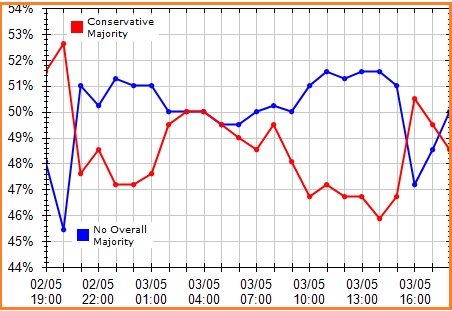
Today on the Dish we compiled extensive commentary from the fourth-to-last day of the British election. Latest electoral projections here. Cameron considered full equality for gays, the Corner chimed in on Cameron, and some British Muslims supported the Tories. Niall Ferguson assessed the UK's finances.

Times Square bomb commentary here, here, and here. We also rounded up perspectives on the politics of the oil spill. Andrew chewed over Mearsheimer's latest take on Israel/Palestine (and addressed Goldblog's take), checked in on the Vatican sex scandal, and compared the GOP's anti-gay posture to its attitude toward Latinos. Reader reaction to Mearsheimer here. More Palin lies here.

Bill Maher stood up for South Park and free speech, TNC challenged Frum over profiling, and a Harvard Law student resurrected the Bell Curve debates. Yglesias award here, Malkin here, and more ugly rhetoric here. Creepy ad here.

— C.B.

Is The UK Worse Than Greece?

Niall Ferguson's view of Britain's finances:

The situation of the United Kingdom in fiscal terms is in fact worse than the situation of Greece. That may come as a surprise to you, but if you look at the most recent paper on the subject published by the Bank for International Settlements, it is very clear. The trajectory of U.K. public debt over the next 30 years, absent a major change of policy, will take it to a mind-blowing 500% of GDP, which is about 100 percentage points worse than Greece. If Britain had done what many right-thinking people thought it should do and joined the euro, the situation of Britain would be worse than that of Greece today. The only reason that Britain isn’t an honourary member of the PIIGS club, along with Portugal, Ireland, Italy and Spain, is that it stayed outside the eurozone and therefore reserves the right to debase the currency as an exit strategy. I don’t know about you, but I don’t find that very cheery as a prospect

So, Britain has a massive fiscal crisis that is just about to break. Whoever wins this election … they are going to have a ghastly task on their hands to try to reform a system of entitlements and welfare and state subsidy that has hugely expanded under Gordon Brown since 1997.

(Hat tip: Dreher)

Cameron’s Cool; Clegg’s Inner Hippie; Brown’s Final Peroration: Countdown To 5/6

The final Tory PEB (public election broadcast) above. Contrary to earlier reports, Cameron says marriage equality isn't in the cards:

Mr Cameron said that he was not planning to rename civil partnerships as civil marriage, as some papers had been speculating.

"We are not planning that. I think that civil partnerships are excellent thing because they give
gay people the opportunity to form a partnership and have some of the advantages of marriage. I think that is right. I am very happy to have a look at how we can take policy forward… but I think where we are at the moment, I think has dealt with one of the great unfairnesses. So we should look to the future cautious about whether we can build on that."

Mehdi Hasan blames Cameron for letting a "a 28-point poll lead more or less disappear":

Cameron is the longest-serving of the three party leaders – and, if a week is a long time in politics, then four and a half years is an eternity. That he is still struggling to stay ahead – against an unpopular and unelected prime minister, at the helm of a party in office for the past 13 years – is a damning indictment of his poor leadership. As one cabinet minister pointed out to me a few days ago: "Cleggmania is a distraction. The real, unreported story of this election campaign is how David Cameron failed to pull away – even before the debates."

Alex Massie and John O'Sullivan are debating why the Tories aren't doing better. Here's John O'Sullivan:

I think that the Tory leadership as a group forgot how to manage its "broad Church" coalition. They went from realizing that the base was insufficient for victory to believing that it was an obstacle to victory. In pursuing centrist voters they were insouciant about losing voters to their right. Their desire to demonstrate Tory support for public services led them to embrace Labour's budgetary strategy until shortly after the roof fell in. And they tried only fitfully to integrate their new ideas into the party's tradition and sense of itself. Not only did this approach drive some traditional conservatives into UKIP, but it also gave an impression of inauthenticity and even cynicism. It prevented the Tories from deriving any political benefit from Labour's budgetary implosion. And it may even have prepared the ground for the Lib-Dem surge by validating their brand of politics in advance-but I concede that's a stretch. Mr. Massie thinks that the problem is that the leadership did not pursue the strategy of alienating the base consistently and vigorously enough to convince centrist doubters. We will have to differ.

Massie's reply:

[Y]es, it is a worry (from a Conservative perspective) that the party may not win much more than 35% or 36% of the vote on Thursday. If it does worse than this then, yes, Cameron's critics will consider themselves vindicated and they may have a point. Nevertheless even if we end up considering Project Dave a failure that doesn't mean an alternative strategy – one that might win support from Peter Hitchens and Simon Heffer for instance – would have prevailed or done any better. I suspect it might have done very much worse and that the Conservatives could have been fortunate to win even 30% of the vote in such circumstances.

Julian Glover praises Cameron:

Life is often incremental. In each age, many things get better and some worse, and it is rarely clear whose ideas are right at the time.

I think David Cameron, at his best, thinks like this. If he wins the election this week – as his confident body language on television today certainly suggested he expects to – he will avoid grand promises and schemes. Rhetoric falls badly from his lips because it implies a certainty he cannot share. The Big Society and – worse – the Great Ignored are phrases of his that failed in this election because they pretended to offer some all-encompassing Conservative theory of progress. No such thing exists. Cameron used a better and modest line today in his BBC interview to describe his intentions: "quiet effectiveness". That is what he would want a Tory government to offer; a series of rolling judgments, often small, sometimes contradictory when compared ideologically, which might amount to a modest but sustained improvement in the condition of the country.

Mick Brown had a largely flattering profile of Cameron over the weekend:

When I suggest to Cameron that he intended to 'detoxify’ the Tories, he visibly winces. 'I don’t use the phrase because it’s not just as simple as let’s put a lick of fresh paint on an existing car; it’s more a case of taking all the good bits of the old car and building a modern car.’ He talks about 'lighting the touch paper’ to a vision of 'compassionate conservatism’ that is actually part of a deep-seated Conservative tradition of social reform that goes back to Peel and Disraeli.

'I’ve always found it very condescending, this idea that you have to be left-wing in order to be compassionate. I think the Conservatives are deeply compassionate because we understand that the things that actually deliver a more compassionate society are things like families and good schools. The party has modernised and is more in connection with the country it seeks to govern, but the core beliefs that the good society is the responsible society, that government can’t do everything, that communities need to do more together, that is as old as the hills.’

An inspiring video in support of the Lib Dems above. Renard Sexton looks at Clegg's options:

[If] the Liberal Democrats want to govern at some point – and it seems that Nick Clegg sees it this way – a simple reform to the electoral system that will bring modest returns to the party at best may not be they way to go. Perhaps they should set their sights on knocking Labour out as much as they can this election — effectively conceding 2010 to the Tories, but building their chances for long term success in the next decades.

Fraser Nelson argues against a Tory-Lib Dem coalition:

Nick Clegg will not bring down the government: he has more to lose from a second election than Cameron. I suspect there is enough gas left in the LibDem bubble to last until Thursday – Clegg may raise his tally of MPs from 62 to 80 or even 100. He still enjoys the novelty factor: he is not well enough known to be disliked. This will change. You can bet that, in a second election, he would kiss goodbye to his new recruits. It is Cameron that would have a gun against Clegg’s head, not vice versa.

Hippy-clegg
Guido posts this image of Clegg and complains:

Clegg is hampered by the democratic structure of his party, the manifesto is written partly by the activist membership, many of whom are radical left-wingers – the infamous weirdie beardies.  Clegg emphasises all the vote winning right-of-centre policies on television; cutting personal taxes, putting more police on the streets, cutting back the health and educational bureaucracies.  His party has also saddled him with a manifesto that is soft on sentencing criminals, backs banning-the-bomb and joining the euro policies.

Iain Martin:

The wider Lib Dem campaign has not been very effective. It is as though party strategists were as much taken by surprise as everyone else by their man’s success in the first debate. Clegg has continued to be relaxed and generally strong on the trail, but back in London the party should have flooded the gaps left by their enemy (the two old parties) with initiatives and practical populist policy pronouncements to emphasize there was more to this than a post-debate bubble. They didn’t.

James Macintyre calls Brown's speech today (clip above) his best of the campaign:

Brown, speaking as I type, is genuinely moved. He looks angry about poverty, determined and serious. As he talks through his values, imbued in him by his church of Scotland father, "bigot-gate" seems a very long way away. As he talks of the minimum wage, the audience are going wild for him, even more so than they did for Nick Clegg.

This is Brown at his best. Labour strategists will wish he could be like this all the time, and certainly in the next couple of days.

Norm Geras explains why he is voting for Labour:

Labour's record on poverty unmatched – and social justice trumps other considerations unless these are of an exceptional and urgent kind.

Labour's final PEB:

Labour strategist Alastair Campbell isn't giving up:

[If] you live in one of the 100-plus Tory/Labour marginals, just remember that if you go to bed with Nick next Thursday, you wake up with silken-skinned Dave on Friday morning, and that voice will be slipping through our brains for a few years, announcing change that will damage the economy, public services, and generally take our country backwards to the kind of Britain [David Cameron] really believes in.

And the betting markets are all over the place:

Bettinguk

What To Do About Iran?

Patrick Berry advocates a light touch:

The overall picture is one of an Iranian economy that is heavily straight jacketed already. The current government is largely to blame. Based on the regime's track record of incompetence and the consequences of that incompetence for the Iranian economy, the U.S. would be wise to take a step back, allowing Iran to continue on its present course. As its position grows weaker, the U.S. position would grow stronger, shoring up American diplomatic leverage or at least making Iran easier to contain or deter. The U.S. would also sidestep accusations that its policies had contributed further hardship to the Iranian people. Congress is searching for the most effective means to weaken the Iranian economy; the best approach may be for it to do nothing at all.

The Times Square Bomb, Ctd

Steve Coll thinks this is a teachable moment:

Anyone who tries to set a vehicle on fire in Times Square on a warm Saturday night is going to make news in a big way. Presumably that was the primary goal of the perpetrators—to attract attention, to spawn fear. The very amateurishness of the attack—unlike the Christmas Day attack, for example, it does not immediately call into question the competence of the government’s defenses—offers President Obama the opportunity to start talking back to terrorists everywhere in a more resilient, sustainable language than he has yet discovered. By which I mean: They intend to frighten us; we are not frightened. They intend to kill and maim; we will bring them to justice. They intend to attract attention for their extremist views; the indiscriminate nature of their violence only discredits and isolates them. They intend to disrupt us and throw us into fits of media-saturated hysteria; we will remain vigilant, but we will also keep their unsuccessful attempted murder in perspective. Something like that.