The Daily Wrap

Today on the Dish, Andrew live-blogged the last election debate. Both he and the viewers gave it to Cameron. Reax here. We also rounded up the fallout over Bigot-gate, Cameron sniped Brown, a reader took a shot at Gillian Duffy, another dissented over Andrew's take on US vs British immigration, the Economist editorialized against Lib-Dem, and Andrew took a long look to the post-election environment. More Scottish profanity here and here.

In immigration coverage, Cowen combed through the Democrats' new reform plan, Bill Clinton made the case that immigrants will cut the deficit, Duncan Hunter got pwned for wanting to deport American kids, Shikha Dalmia called out right-wing hypocrisy over capitalism, and readers responded to the immigration debate at length. Another agreed with Andrew about the Tea Party's cultural crux, William Frey illustrated its demographic loss to young immigrants, and Andrew mulled over that struggle. Friedersdorf put forth his immigration plan, Leviticus came to the illegals' defense, and Limbaugh pulled a Hewitt. You should vote for this kid if you can.

"Will she or won't she run?" continued here, here, and here. Meanwhile, reporters continued to chicken out.

In other coverage, Ackerman relayed news that a Gitmo torturer may testify, the defendant neglected to show, Larison and Reihan assessed the Crist apostasy, Hank Cardello put forth a plan to cut America's fat, and Edward Tenner delved into the dead chimp studies. Our South Park bleg didn't get any major revelations, computer geeks gushed about their first loves, the Dish stalked Goldblog in the woods, and anti-fart blankets tried to save your marriage. This window and this MHB were particularly lovely.

— C.B.

The Grief Of Animals, Ctd

Edward Tenner digs deeper into the implications of the chimp studies:

[Can grief] extend to consciousness of one's own mortality? The Oxford mathematician Marcus du Sautoy cites the mirror-recognition research of Gordon Gallup, who first showed elegantly — by surreptitiously applying a temporary red dot to the forehead and observing the reaction — that only a few species realize they are seeing themselves in a mirror (even brainy parrots chatter with a perceived playmate) rather than another creature:

It is striking that chimpanzees start to fail the test once they reach 30 years old despite having some 10 or 15 years left to live. The reason is that self-awareness comes at a cost. Consciousness allows the brain to take part in mental time travel. You can think of yourself in the past and even project yourself into the future. And that is why Gallup believes that in later life chimpanzees prefer to lose their ability to conceive of themselves. "The price you pay for being aware of your own existence is having to confront the inevitability of your own individual demise.

"Death awareness is the price we pay for self awareness."

Reading The Plan

Cowen doesn't understand the amnesty component of the Democratic immigration reform plan (pdf) released today. Gabriel Arana gives an overview of the entire plan. Most of the plan centers on illegal immigration, but there is also a section on high-skilled legal immigration:

This proposal will reform America’s high-skilled immigration system to permanently attract the world’s best and brightest while preventing the loss of American jobs to temporary foreign labor contractors. At the moment, high-skilled workers are prevented from emigrating to the Unites States due to restrictive caps on their entry. In order to accomplish this goal, a green card will be immediately available to foreign students with an advanced degree from a United States institution of higher education in a field of science, technology, engineering, or mathematics, and who possess an offer of employment from a United States employer in a field related to their degree. Foreign students will be permitted to enter the United States with immigrant intent if they are a bona fide student so long as they pursue a full course of study at an institution of higher education in a field of science, technology, engineering or mathematics. To address the fact that workers from some countries face unreasonably long backlogs that have no responsiveness to America’s economic needs, this proposal eliminates the per-country employment immigration caps.

Face Of The Day

DriftClareKendallEnglishHeritageGetty

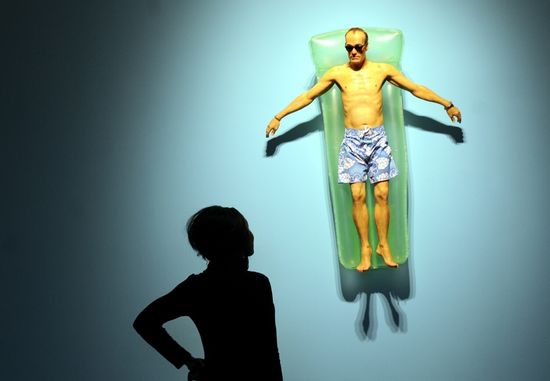
Ron Mueck's 'Drift' installation is pictured at Belsay Hall, on April 29, 2010 in Belsay, United Kingdom. The work forms part of English Heritage's 'Extraordinary Measures' exhibition which explores the concept of scale with surreal and fantastical installations. It opens to the public on May 1, 2010. By Clare Kendall/English Heritage via Getty Images.

Obamacare And Arizona

Shikha Dalmia calls the right hypocritical:

If universal health coverage was part of the longstanding liberal agenda to implement a European-style welfare state in America, Arizona's tough new anti-immigrant law represents the conservative agenda to install a European-style surveillance state. Indeed, the very same conservatives who could not find words strong enough to condemn the Europeanization of America under ObamaCare are now greeting the Arizona law–which will require residents to prove their lawful status to authorities on demand–with a cheerful smile and a shrug.

And Alex Tabarrok calls out.

For Cameron

The Economist backs the Tories. Here's their case against Clegg:

[L]ook at the policies, rather than the man, and the Lib Dems seem less appealing. In the event of another European treaty, they would hold a referendum not on that treaty but on whether to stay in or leave the EU; odd, given that they also (wrongly) want to take Britain into the euro. They are flirting with giving up Britain’s nuclear deterrent. They would abolish tuition fees for universities, which would mean either letting the quality of British higher education slide still further or raising the subsidy to mostly well-off students by increasing state funding. They are worried about climate change but oppose the expansion of nuclear power, which is the most plausible way of cutting emissions. Their policies towards business are arguably to the left of Labour’s. A 50% capital-gains tax, getting rid of higher-rate relief on pensions and a toff-bashing mansion tax are not going to induce the entrepreneurial vim Britain needs.

Palin’s Press Pass Won’t Last, Ctd

A reader writes:

Two words for Josh Green: Ross Perot.

In 1992, Perot skated through the presidential election season with the press at arm's length. He launched his campaign in a softball interview with Larry King (and ended his political career there, too, in a debate with Al Gore.) Despite his bizarre withdrawal in the middle of the campaign – sound familiar? – he re-entered the campaign in the last month and managed to get almost 1 out of 5 Americans to vote for him. While Perot pitched himself as a can-do guy – a bit different from Palin – he had a similar populist appeal as an outsider, speaking truth to the establishment. While Perot self-financed his '92 campaign, Palin certainly has the juice to raise money for a campaign waged through ads, speeches, and patsy interviews. I don't think she'll win, but I think she can make a show of it, and make things crazy.

Another writes:

I'm guessing you don't have a lot of time to listen to random podcasts, but if you check out the most recent Double X podcast from Slate, there was a long discussion between Hanna Rosin, Jack Shafer and Jessica Grose about Palin and how the left should deal with her when she runs for president. Shafer posited that refuting her points (which don't really make any sense) is like refuting the points of a five year old: you look like a jerk and you wind up, weirdly, strengthening her arguments.

The only people who can really take someone like Sarah Palin down are comedians. He suggested that, if she runs for president and becomes the subject of concise mockery, she cannot last. "So," Rosin said, "what we need is more Tina Fey." Shafer's point is already born out a little bit. I watched the Katie Couric interview, but what I remember better is Tina Fey (as Palin) saying, "I can see Russia from my house!" And in my head, that statement is completely associated with Palin, not with Fey — it is only after I think about it for a few seconds that I remember which woman actually said those words.

Too much more of that, and it will only be a very small group of zealots left who still love her.

Final Debate Reax

StudentsChristopherFurlongGetty

Live-blogging here. Verdict here. Fallows:

Gordon Brown is really, really terrible as a public figure. Every time he wags his head scoldingly “No, No” when the opponents are speaking, he must lose another 500 votes. No policy judgment here. Just saying that — based on this sample, plus these past few days’ “bigot” disaster — this is someone with neither aptitude nor (apparently) training as a TV-era public figure. The more that the general election becomes “presidential,” the harder it is to imagine that people will choose to have him around for a few more years as the main figure to listen to in the news.

The Economist’s political correspondent:

I thought Clegg edged the first half, but then faded a bit as he was interrogated on immigration. The smugness of the Tory aides milling around the place seems authentic; they’re sure their man won won (though as Bagehot notes, that is not the same as winning by enough to pull away from the Lib Dems in the polls). I will sign off with a bit of unEconomist-like gossip: Alastair Campbell overheard saying “We’ve had it now” as he left the spin room.

Martin Kettle’s verdict:

The central character in the three-man drama that has so energised British politics this month is neither Brown nor Clegg but David Cameron. It is Cameron who, after a bad debut two weeks ago came back with a stronger performance last week and who, in Jeremy Hunt’s phrase, faced the most important job interview of his life. You may not want to know this, but my impression is that most viewers will judge that he passed. Better start getting used to it.

Andrew Sparrow:

Earlier today Alastair Campbell said Brown had to show he was “better placed to secure the economic recovery than Cameron or Clegg” and that he had to “press this home like his life depended on it”. I thought that he was better than he was in either of the first two debates. But he needed to upturn national opinion. He didn’t. It was probably an impossible task for anyone. We are where we were.

Michael Tomasky:

I think Cameron did pretty badly, but of course that could just be because I find less to like in his platform than in the others’. Although I do note that he was the first to say he agrees with President Obama’s ideas about financial regulation. Which just goes to prove that your right in the UK and our right in US are two rather dramatically different beasts.

Iain Dale:

That was the David Cameron I wanted to see. Passionate, full of conviction, positive, more combative. It wasn’t a slam dunk victory, but it was never going to be. But it was a clearcut victory – more so than last week. It was his best performance of the three, whereas I felt that Brown and Clegg put in their weakest performances of the three, although I am not diminishing Clegg’s appeal. His was still a comparatively good performance, but I thought he was in danger of overgoing the “two old parties” line in the first twenty minutes. He became irritating. Well, I found it irritating, at least. On two questions he floundered badly – immigration and housing. At the end he was reading notes during his final statement.

Gordon Brown tanked badly. Anyone who thinks he didn’t wasn’t watching the same debate as me.

Scott Lucas:

The Conservatives did not secure their Parliamentary majority tonight, and Brown recovered enough from recent setbacks to ensure that there will not be a humiliation of Labour, although it is doubtful he did enough to bring in the largest number of seats next week. Unless a major Fear Factor of coalition government scares away voters from the Liberal Democrats, Britain will have its first “hung Parliament” in almost 40 years.

Peter Hoskin:

So that’s the second time that immigration has had a major impact upon proceedings this week.  Until we came to the question on that topic, I thought Clegg was bossing the TV debate.  He was clear, personable and managed to hover elegantly above Brown and Cameron’s dusty brawl over spending cuts.  But as soon as it came to clarifying Lib Dem policy on an amnesty for illegal immigrants, the wings rapidly fell off the yellow bird of liberty.  All of a sudden, Clegg sounded rattled and unpersuasive.  From then on in, it was Cameron’s game.

Labour list:

Nick Clegg gave his weakest performance of the three debates tonight. On housing, he had no real policies, just complaints. On immigration, his attacks on Cameron were effective, but his amnesty too easily torn apart by Brown. His attempts to show himself as different to the other two men were over-rehearsed and over-repeated, and grating.

Massie:

If Clegg was weaker this week Cameron was stronger. This was, by some distance, his best performance and he did enough to finish the winner on my scorecard. This had less to do with his advocacy of Conservative policies – by now we all know what their plans are – but because, at last, he offered an effective rebuttal to Gordon Brown’s near-endless supply of half-truths, absurdities and outright falsehoods.

James Macintyre:

Brown, if we are honest, was solid, especially given the circumstances; but he was not electrifying. He appeared to do his best. But it may not have been the electrifying performance he needed. Surprisingly to some, Brown almost exclusively “went negative” in his final statement, adding to the — perhaps unfair — impression that he has a less positive, more desperate message to convey. It is a shame, some Labour activists must believe, that Brown didn’t have more to say about his vision for an exciting, progressive next term.

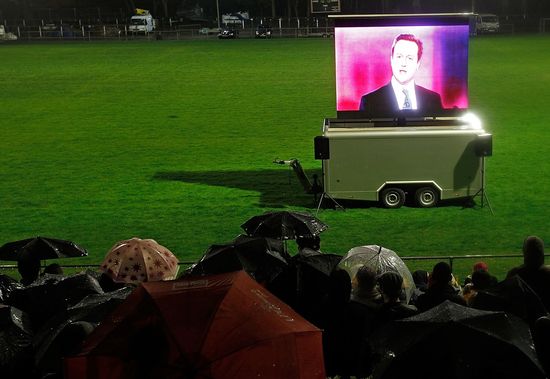
(Image: Students at Birmingham University brave the rain to watch an outdoor screening of the leaders third and final televised debate on April 29, 2010 in Birmingham, England. By Christopher Furlong/Getty Images)
Polling The Brit Debate

Well, I wasn't so off on this one:

A post-debate Guardian/ICM poll showed David Cameron on 35%, Gordon Brown on 29% and Nick Clegg on 27%. Other polls following the debate suggested Cameron pulling away from his rivals. ComRes had the Tory leader on 35%, Nick Clegg on 33% and Gordon Brown trailing on 26%, YouGov for the Sun had Cameron on 41%, Clegg on 32% and Brown on 25%, and AngusReed had Cameron on 36%, Clegg on 31% and Brown on 23%.

The Next Skinny Kid With A Funny Name?

Mike Lillis reports:

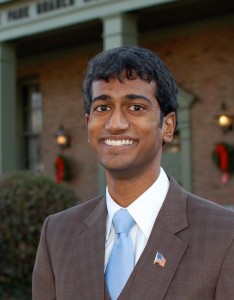
With the Democratic primary just days away, state and local party leaders are ripping into David ChiliKrikorian, one of the hopefuls to challenge GOP Rep. Jean Schmidt in November, for disparaging remarks he’s made recently about his chief primary opponent, Surya Yalamanchili. According to accounts given to local politicians, Krikorian has appeared at campaign events to ridicule Yalamanchili, an American of Indian descent, by dramatically pronouncing his name to emphasize its foreign nature.

“Now do you really think that a guy with a name like that has a chance of ever being elected?” Krikorian allegedly said to members of Veterans of Foreign Wars in Clermont County.

The comments —  which Krikorian denies – drew a quick response from local Democratic leaders, who shot off a letter to Krikorian Wednesday calling his behavior “deeply disturbing.”