"I can understand Obama being touchy on the subject of producing your papers. Maybe he’s afraid somebody is going to ask him for his," – Rush Limbaugh.
The Defense Of Marriage Blanket
This does appear to be legit:
Letters From The Frontlines
Servicemembers Legal Defense Network is printing letters from gay and lesbian soldiers. From a military chaplain:
It is easy for those who do not live in fear of being ‘outed’ to say: ‘We must wait and examine this law further.’ But when you have to watch what you say, where you go, and who you talk to, this erodes the human person. When you live in fear that the wrong pronoun slips through your lips, or a co-worker see you in public with your life long partner and you respond ‘this is just a friend’, this degrades your human self worth.
Cameron’s Triumph; Brown’s Bitter Bye Bye
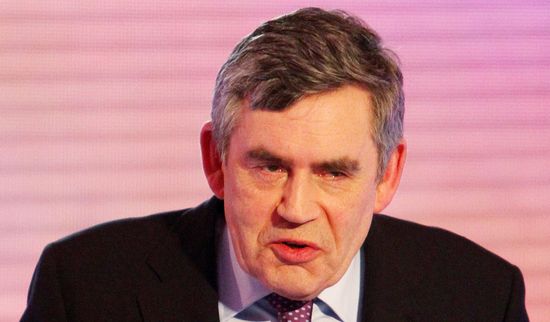
My live-blog of today's British election debate (just concluded) can be read here. My take is that Cameron had his strongest performance yet and Clegg did well, but not so well as to surge. But Brown was forceful and dreadful in equal measure. He seemed completely deflated and suddenly much older.
Cameron wins in a hung parliament on current trends. But if Labour collapses in marginal seats, as seems to be the case, anything could happen. I'd place a side-bet on a small Tory majority today. Cameron was on top form. But the system favors a Lib-Tory pact. We could, however, see a Labour collapse of historic proportions and maybe that will be the real impact of this election, before an austerity government takes over.
A Carrot Approach To Lowering Obesity
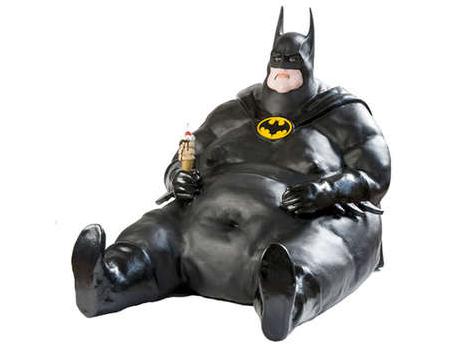
Hank Cardello is critical of anti-obesity strategies that target demand – namely the soda tax – and instead wants to curb supply:
One initiative I am advancing is the "20 by '20" program, designed to reduce the supply of calories 20 percent by the year 2020. It would offer all packaged food marketers and restaurant chains a straightforward quid pro quo: keep your tax deductions for advertising in exchange for lowering the number of calories per serving you sell. Specifically, food manufacturers and restaurant chains must lower their calories sold by 2 percent each year for 10 years in order to retain their deductions for advertising. […]
From a corporate perspective, having the flexibility to determine which products to change or promote offers a huge advantage over a government imposed one-size-fits-all tax mandate. And progress would be easily tracked, since every company knows how much of each individual product it sells and the calorie content (one of the side benefits of those bar codes on the label). This approach bridges the divide between the altruistic motives of those trying to improve the public's well-being and the profit motive intrinsic to corporate success.
Ambinder is open to the idea:
Cardello's industry-centric approach recognizes the role that industry is playing in the crisis itself, which is a step in the right direction. When it comes to making food better, the question is how we train people's brains to respond to a set amount of calories as if it were a greater amount of calories. We become addicted to a certain level of energy; the push and pull of homeostasis make it extremely difficult to voluntarily reduce consumption. So I wonder whether reducing the supply of food will matter in a country that already produces excess food and distributes it inefficiently.
Ambers also flags a stick approach adopted in Santa Clara County, California: banning toys from fast food meals.
(Sculpture by Franceso de Molfetta)
Dissent Of The Day
A reader writes:
I’ve been fascinated with your vigorous defense of Obama and your disdain for the Labour Party. Within the span of several posts you dismiss the likelihood of a GOP sweep in November because they have awakened Hispanics with all their bigoted blundering around the immigration issue. Simultaneously you seem to be relishing in Brown’s demise because he’s caught calling a women a bigot for saying “You can’t say anything about the immigrants.” Are you sympathetic with the issues of Hispanics here in America, or are you simply pleased that they are going to help hold back the bigoted waves of white rural America? Is this woman a bigot, as Brown asserts, or is she, unlike her Tea Party counterparts, expressing legitimate political anxiety?
I have not dismissed the likelihood of a GOP sweep in November. The anti-incumbent mood and the depressed job market suggests a robust swing to the GOP. What I have said is that the long-term branding of the party with the Arizona law is a terrible development for the GOP in the future, when minorities will become a larger and larger part of American society and politics. I do believe we should have a more honest debate about illegal and legal immigration.
More, I favor tougher measures to secure the border. I also favor easier ways for talented immigrants to come here legally. As an immigrant myself, I do sympathize with legal Hispanics who have gone through the legal channels for immigration and will now have to carry around extensive documentation to prove they are not criminals. This bill will thereby punish “suspicious”-looking legal immigrants as well, because they will all feel under surveillance. A society where one minority feels under surveillance is not a truly free society. This is beneath America, in my view.
As for Mrs Duffy, she was not speaking of illegal immigrants. East Europeans have every right to work and live in other EU countries. As for Labour, I find their fiscal record as damning – almost as damning as George Bush’s. They really are socialists. And I’m not one. I hope Brown destroys that party and allows a liberal response to conservatism to be the two-party system.
Mental Health Break
Jamie MacDonald’s Greatest #@*&s
A reader writes:
If you are going to keep linking to The Thick of It/In the Loop during this U.K. Election Cycle, could you PLEEZE include this compilation of the far more vulgar, deranged, and Scottish Jamie MacDonald (played by Paul Higgins)?
Oh, all right.
Live-Blogging The Third British Debate
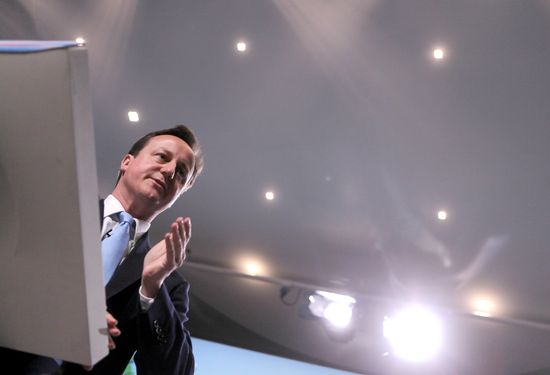
5.00 pm Brown's final statement is all but a resignation speech. And it is entirely a negative speech – sad, hostile, and reliant on the other parties' being "not ready for government." He was feisty earlier but seemed defeated at the end. I sense the bottom falling out of the Labour campaign, and a new energy from the Tories. I misjudged the first debate, so I may be wrong here, and without being in the country it's hard to judge the mood and context.
But I wonder if this isn't a seismic election, in which the two main parties emerge as the Tories and the Liberal Democrats. The only reason Brown gave for voting Labour was fear of the new. Since they're truly sick of the old, his fear-mongering needs to be much more persuasive.
This was Cameron's night to my mind. And he timed it well.
4.59 pm Clegg: "Don't let anyone tell you it cannot happen. It can."
4.57 pm Cameron says a society should be judged by how it treats the most vulnerable, the poorest. This is a Disraelian one-nation repositioning for the Tories – and, in many ways, Cameron's gentle aristocracy makes him a classic Tory PM – a good butcher with great manners.
4.56 pm It's always good to listen to a political debate where the following words can be said with a straight face: "That's a very silly thing to do."
4.45 pm. Cameron wakes me up. He's looking directly at the viewing audience and being very effective. And the big difference in this debate has been Cameron's willingness to bring up and attack Labour's record. If you are deciding between the devil you now or the one you don't. Cameron keeps reminding people of the devil they know.
4.41 pm. Now we're on welfare abuse. I have to say this gets technical very fast and I find my mind wandering.
4.27 pm Clegg gets rattled on immigration. Cameron says the Lib-Dems are threatening 1.2 million new citizens who could go on welfare. Clegg says that because 80 percent of immigrants are from the EU, Cameron's proposed cap on immigrants is trivial. But if all the EU immigration is legal, then there cannot be any cap on them, can there? without a new relationship with the EU? Maybe I'm missing something.
This was by far the most snippy and biting part of the debate – showing how immigration really does have salience as an issue in Britain as well as the US.
4.18 pm. A minority questioner asks why political leaders don't "get it" on immigration. Brown completely dodges this question. Cameron comes in hard demanding a big new cap on non-EU immigrants. He wants 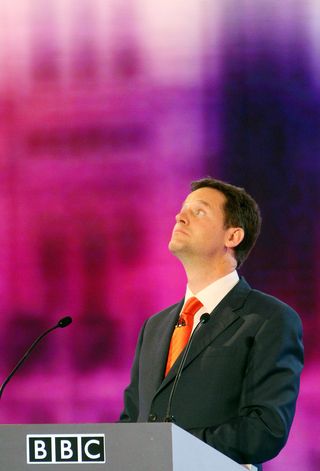 the numbers of annual immigrants to return to the tens of thousands rather than the hundreds of thousands. The question obviously relates to Bigotgate – and Brown decides to answer it by a rehearsed tirade on how many jobs he will bring back. Sad, and devastating for the prime minister. Cameron and Clegg haven't exploited the "bigoted woman" remark. Good for them. Smart too.
Now Cameron skewers the LIb-Dems on amnesty for illegals. Clegg seems very defensive on this – until he gets to the link between illegal immigrants working in the shadows to criminal gangs. Total home-run for Cameron.
4.16 pm. A classic Tory-Labour fight over business and Cameron is endorsing an emphasis on business and away from government.
4.04 pm Clegg is getting more aggressive. And yet aggressively defensive on the euro. He now says he wouldn't take Britain into the euro unless the conditions were right, and he wouldn't without a national referendum. Neutralizes the euro as an issue, but not much more.
Brown goes back to "the same old Conservative Party" line, and is reduced to playing class war. Cameron's responses have been articulate, passionate and yet sane. Over three debates, he has handled himself well, I'd say. He established his low-key calm and affability and allowed Clegg to steal the show, but with each subsequent debate, he has slowly upped the ante and gone on the offensive. Maybe my deep Tory sympathies are blinding me, but Cameron seems like a future prime minister to me tonight, Brown feels like an angry and arrogant old man, and Clegg seems like a worthy, fresh-faced "Here they go again" protest vote against the established political order.
4.01 pm Cameron is kicking Gordon's butt – he's truly on a different level tonight. Now I see more of how he seized the leadership of the Tories five years' ago. I'd seen his sincerity and decency before now – but not the necessary steel for politics. Now I see the glints of steel. I have a feeling he has just won this election.
3.57 pm. The Conservative leader, repeat, the Conservative leader, says the bankers bonuses have been "appalling". He endorses Barack Obama's financial re-regulation bill. He's very strong on the banks, actually – sounding like a Democrat in the US. There's very little in Cameron's manifesto that Barack Obama couldn't endorse in full.
3.50 pm. Brown is making this much more pugilistic and much more of a classic right-left debate, attacking Cameron for defending the rich. Brown keeps shaking his head – Al Gore-like – whenever Cameron speaks. My view is that this has been the Tory's best debate so far by far. Clegg is now getting far more animated, backing Tory themes on lower taxes. I suspect Clegg senses he is no longer the center of attention.
Brown is saying that Cameron wants tax cuts for the very rich while cutting tax credits for children. Brown calls this "immoral". Cameron pushes back saying the tax credits would remain for the poor – not for those above certain incomes. Clegg backs him on that.
3.46 pm. Small point: the first two questioners are minorities – South Asian and West Indian. Both are about fiscal matters. The first wants more candor about deficits; the second wants lower taxes. And what Cameron is doing is trying to pitch a conservatism to this diverse population that appeals to their self-reliance.
3.44 pm This is becoming a real fight between Cameron and Blair, and Cameron is winning. Suddenly, Clegg is receding. Then Brown talks over Clegg for several seconds. Brown is on the offensive. I guess he feels he cannot please anyone so he might as well growl at them.
3.40 pm. Brown's sole point – again – is that there can be no cuts in spending now, which the Tories are proposing. Cameron says he only wants to cut 1 percent of government spending … and now he's saying he could get some savings by abuse of welfare. A soft blow from the right. Brown actually says that David Cameron reminds him of the Conservative Party of the 1930s! Finally, there does seem some kind of choice here.
3.36 pm. There's something about this huge faux-studio that has rendered the leaders more statesmanlike in demeanor, more like public speakers than TV hosts. To my subjective mind, this has made Clegg seem a little smaller and Cameron more commanding.
The first audience question is a superbly blunt one about dishonesty in spelling out future spending cuts. Cameron is stronger than previously on this, but still dishonest. He pledges to protect spending on police, education and health. But how do you deal with the huge debt with so many items off budget?
3.33 pm. Brown looks dreadful – he looks like he's aged a few years in one day.
Again, his entire opener is about the past, his alleged brilliance in saving the economy from a depression.
3.32 pm. Terrific opener from Cameron: he really does seem to have grown into the role in this campaign, just from the debates. It's striking to hear a conservative make a clarion call for a new "tax on banks." A very timely pledge at the end that he would never support joining the euro, given the Grecian jitters, and Clegg's euro-enthusiasm.
3.30 pm Fantastic venue: the Great Hall at the University of Birmingham. A studio is created inside a vast cavernous Gothic cathedral-style. I guess we don't have many buildings like that in the US.
Palin’s Press Pass Won’t Last, Ctd
A reader writes:
Re the reporter who said, in regards to the question of Palin’s alleged bootlegger grandpas:
“I would have loved to ask her. But, as the media covering Palin’s visit reported at the time, we were kept at a distance, not allowed any questions and were strictly forbidden from recording her speech.”
The onus is on the reporter. It’s on all of them. Because any story written about Palin and her puppet show that passes for a political event should read along these lines:
“Went to see Palin speak. Weren’t allowed to ask questions. So there’s nothing to report. Oh she looked nice.”
“Were invited to report on Palin’s speaking engagement. We’re not allowed to ask questions so there was no point in going. We’re told she looked nice.”
“Palin spoke. She said “Down Syndrome Baby”, “Ronald Reagan”, “Obama is bad”, “Republicans are good”. “Moose”. Oh and she looked nice.”
If they refuse to be her flunkies and glorified stenographers, then she can’t use them that way. But of course their news outlets won’t allow that – money and all – but that’s what they should do. Or stop calling themselves reporters.
Amen. But they’d lose ratings and pageviews so they cave in. One more thing that’s been bugging me a little, my colleague and friend (and fantastic reporter) Josh Green wrote:
For all its faults the media is doing a perfectly fine job of covering Palin and her sundry shortcomings, and has been since the day she flubbed her first interview. No, we haven’t uncovered the Trig stuff (we’re leaving that for Andrew).
But I’m not a reporter; I’m a blogger, columnist, essayist, hack. Why is it left for me to go there?
Why is this story beneath Josh’s professional interest? Why is the only actual accredited reporter who has asked for clarification on the weirdest, most surreal event in Palin’s so-called life working for the Anchorage Daily News? Why is this riveting human interest story not even brought up by Oprah? Why has no reporter or TV interviewer ever asked her to repeat the story she has already publicly told to the Anchorage Daily News (before she hit the big time) and in her novel? How many women in America give a speech while experiencing contractions and get on two trans-continental planes twelve hours after she told us her water broke with a Down Syndrome infant? Why is this not an askable question of someone who was nearly an Arizonan heartbeat away from being president? This would indeed be a grotesque invasion of privacy for a private person who maintained her family’s dignity and privacy. But when the person brandishes a newborn as a campaign and book tour prop, why does no one ask the question?
I know why. These reporters have told me very directly off the record. As one senior Washington reporter told me: there’s no point in asking a question when you know you will get no answer. As another put it, it may well be true, but we have our reputations to think about.
In private they all ask themselves. But they will never ever ask her. Ask yourself: why? When such a question could easily be answered by Palin in a second with a scintilla of evidence, we still have no questions and no answers a year and a half later. And people wonder why I suspect the press is part of the problem here. In fact, this story or non-story is now not really about Palin. It’s about the system that allows what has occurred to have occurred.
 The Dish