Iraq: A Work In Progress

Musings on Iraq reads the 2009 State Department report on human rights in Iraq, which was released last month:

Iraq has held six elections since it regained its sovereignty in 2005. That makes it an exceptional country in a region that is known for autocracies and monarchies. Allowing people to pick their own government, and replace politicians they don’t like is an important step towards democracy, but it is only a piece of the puzzle. Iraq needs a government that protects its own people from itself, and enforces the law. That is sorely lacking in Iraq right now since the authorities are still weak, divided, corrupt, and there is no transparency or oversight. That means the Prime Minister can use the security forces against his political rivals, suspects can be tortured and held incommunicado for years sometimes, and the media can be intimidated by officials with little to no consequences.
Volcanic Economics

Avent points to various economic forecasts and posits:

The airlines will feel significant pain from this event, though the impact will differ from that after September 11 in that fear of terrorism continued to reduce traffic volumes after the flight disruptions ended. Should flights resume this week or next, the hit to output probably won't be that significant, especially since there are some offsetting effects to lost airline activity (hotels, train operators, and car rental firms are all having banner weeks). But if most flights are still grounded by mid-May, the fallout could be significant. Mother Nature does love to throw economic curveballs.

The Lib-Dem Surge

Renard Sexton asks if it's for real:

If the bounce simply manifests in a massive burst of support in seats that the Lib Dems already hold, along with a few nearby marginals, the end result could be a pickup of a modest 10 to 20 seats. Similarly, if it comes from alienated opposition voters in safe Labour or Tory seats (tactical/protest voters who would not vote Lib Dem over their own party), again the Lib Dem share of MPs will not budge very much.

All told, Nick Clegg and his cadre will have to play very calculated offense with the rise in support they have gotten. If they can start to turn more races into three-way affairs, and pull disaffected voters from both the Conservatives and Labour, this could get quite interesting.

The Daily Wrap

Today on the Dish, Andrew continued to seize upon new improprieties within the Catholic hierarchy. He also turned the klieg lights on John Paul II and featured a scene from Benedict's visit to Malta. Commentary from Hertzberg and Savage.

In election coverage, polls put Labour in third, Clegg continued to glow in the media, and an eccentric candidate challenged Cameron. Dominic Lawson explained the class factor, we heard from a disgruntled Tory, and a reader in Scotland dissented.

While the world liked us more and more, Americans hated on Americans. Eyjafjallajökull coverage here. Get your Palin fix here, here, and here. Greenwald and Balko tag-teamed the administration over whistle blowers, Ryan Avent concentrated on financial reform, and Drum pushed back against Andrew's swipe at "well-meaning liberals." And we spotlighted a depressing story of gay persecution.

In assorted commentary, Juan Cole talked terrorist HR, Adam Serwer pushed for inmate suffrage, Scott Adams sized up sex addiction, and Alex Tabarrok illustrated how freakishly fat we've become. The latest Dish coverage of circumcision here. Malkin award here, Hewitt here, and Moore here. Cool ad here and cool face here.

— C.B.

“Public Opinion”

Healthcareblumenthal

Blumenthal studies the likely voter models and asks:

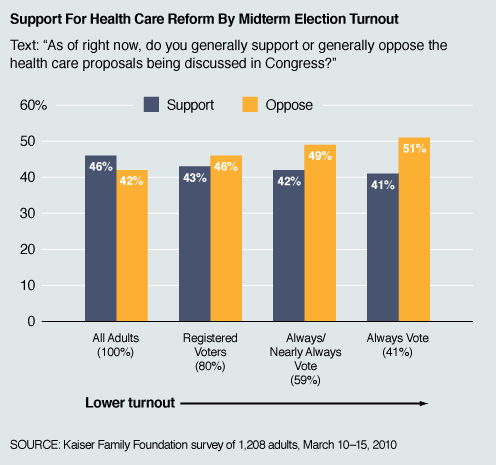
Which "public opinion" should elected officials watch most closely, that of all Americans or just those most likely to vote in the next election? That debate is far bigger than this column, but I can offer one observation: Judged by their rhetoric, politicians from both parties pay far more lip service to the needs of all Americans than those most likely to vote.

Americans Hate Everyone

This Pew release is worth reading:

The public’s hostility toward government seems likely to be an important election issue favoring the Republicans this fall. However, the Democrats can take some solace in the fact that neither party can be confident that they have the advantage among such a disillusioned electorate. Favorable ratings for both major parties, as well as for Congress, have reached record lows while opposition to congressional incumbents, already approaching an all-time high, continues to climb.   

It's not just Washington:

Just 25% say the federal government has a positive effect on the way things are going in the country and about as many (24%) say the same about Congress. Yet the ratings are just as low for the impact of large corporations (25% positive) and banks and other financial institutions (22%). And the marks are only slightly more positive for the national news media (31%) labor unions (32%) and the entertainment industry (33%).

Reax here.

Dissent Of The Day

A Scottish reader writes:

You do realise that "Clegg" is a Scots word for a horse-fly, which does indeed have all of the characteristics suggested by Annabel Goldie. If I'm anything to go by, Scots also have trouble resisting cheap puns. I'd put her comments down to this failing rather than any real fear of the Lib Dems. Oh, and by the way, you should also know that – Ms Goldie notwithstanding – the Tories are almost extinct in most of Scotland, where the real political battle is a three-way between Labour, the Scottish National Party and – a respectable but distant third – the Liberal Democrats. As such, Alex Salmond, the leader of the SNP, was rightly annoyed at the TV debates being between the Tories, Labour and the Lib Dems, when the SNP is a far bigger force in Scottish politics than the Tories.

“Your Holiness, what must we do?”

A fascinating nugget from Pope Benedict XVI's trip to Malta:

One of four young people to address the pope said he spoke for those who feel marginalized because “we are of a different sexual orientation,” or because they came from “broken or dysfunctional families,” were immigrants or had trouble with drugs.

“It seems almost as if we are less readily accepted and treated with dignity by the Christian community than we are by all other members of society,” said the young man, who was not identified and appeared to be of college age. “Your Holiness, what must we do?”