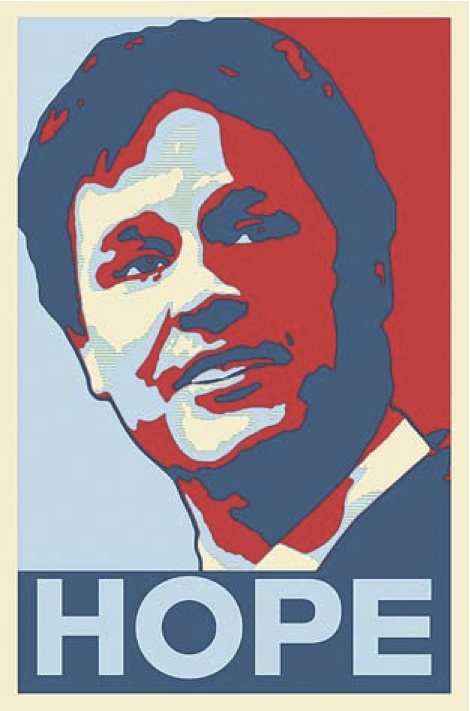
The Fierce Urgency Of Nick

30183809-Nick-Clegg-Barack-Obama-election-2010-poster

So he's a liberaltarian from nowhere who represents for many people the most positive force for change. Do we have Britain's Barack Obama in Nick Clegg? The Guardian has some fun:

Obama promised to transcend America's troubled racial past and the culture wars of the 1960s. Clegg promises to make the drivers of night buses let you get off between stops, and to refund VAT to mountain rescue services. (Oh, and cut taxes on low earners, break up the banks, and scrap the Trident replacement.) From Yeovil to Cornwall, from northern Bristol to certain areas of Surrey, there is a frisson, a whisper of possibility: Yes, we can. Well, maybe. And probably not, actually, because of the first-past-the-post voting system. And yet you can feel it in the air: the fierce urgency of Nick; the audacity of Clegg.

Cameron just junked his scheduled TV ad for last night attacking Labour to turn his sights on Clegg.
Learning To Love The Secularists

Rick Hertzberg comments on the sex-abuse scandal:

To the extent that the Church manages to purge itself of its shame—its sins, its crimes—it will owe a debt of gratitude to the lawyers, the journalists, and, above all, the victims and families who have had the courage to persevere, against formidable resistance, in holding it to account. Without their efforts, the suffering of tens of thousands of children would still be a secret. Our largely democratic, secularist, liberal, pluralist modern world, against which the Church has so often set its face, turns out to be its best teacher—and the savior, you might say, of its most vulnerable, most trusting communicants.

The Convergence Of War And Video Games

In the wake of the WikiLeaks controversy, Clive Thompson talks to NPR about the "moral and ethical aspect to the way you design weapon systems."

Predator drone strikes, they're highly virtualized situations, right? I mean, you have someone sitting on American soil or in a nearby country, you know, piloting a drone able to shoot and kill. And so, everything is done through an interface in the same way that everything on a video game is done through an interface. It’s going to be a constant question for us as a society and for the military whether or not, as they become more game-like, that creates an effect that makes it easier to kill people in a way that you might not want to make it easier to kill people.

Above footage from Call of Duty 4: Modern Warfare.

Softening The Edges Of Rock And Rap, Ctd

A reader writes:

How about this staple of college life over the past decade: The Gourds bluegrass cover of Snoop Dogg’s "Gin and Juice." Nothing like splicing Compton and Appalachia. Or there’s always the Carolina Chocolate Drops cover of Blu Cantrell’s "Hit Em Up Style."

Previous recommendations here, here, and here.

Obama And The Gays, Ctd

Drum thinks I am being touchy:

"Well meaning liberals" have almost unanimously been fighting in favor of gay marriage for years. We aren't balking at anything. But in the meantime, surely incremental change is better than nothing? Seriously: Does Andrew really think that those of us who support progress short of complete victory are merely interested in "perpetuating the victimology that sustains the Democrats and their interest groups"? For God's sake.

No. That's why I included the phrase "well-meaning." I want full civil equality, robust gay self-government, minimal government interference and integration of gay people in society. What I'm against is gay people being pitied into being wards of the state and recipients of compassion and pity. I don't want anyone's compassion or pity. I want equality.

The Web Ecosystem Evolves

Futureofreading

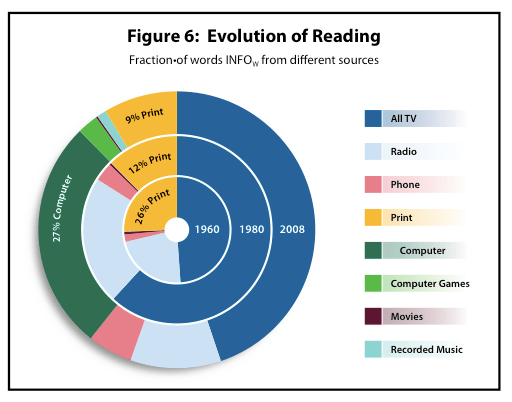
Manisha Verma ponders the "Splinternet":

The golden age of the Web – a unified aggregation of sites people accessed using standard or similarly formatted PCs and browsers, is being replaced slowly by new-age iPhones, Androids, Kindles, Tablets, and TVs connecting to the Web.

Derek Thompson follows up:

The splintering of the Internet provides challenges and opportunities (those fraternal twins of corporate ambiguity) for ad-based companies. The evolution is important because the "golden age of the Web" was golden for free content, but not for paid content. In the Splinternet, users are more willing to pay for content. Consider: one estimate put the Apple app economy at $2.4 billion per year in 2009. If Web advertising is failing to cover overhead on site accessed via laptop, then perhaps paid apps with revenue shared between the proprietary platform and the content-maker could offer a way out of the morass. On the other hand, the splintering incurs additional development costs. Rather than run the same portfolio of banner ads across your Web pages, developers have to build custom applications for each platform.

(Image via Thompson)

How To Not Think About Death

Joseph Epstein ponders the advice of Greek philosopher Epicurus (341-270 B.C.):

To summarize, then: forget about God, death, pain and acquisition, and your worries are over. There you have it, Epicurus’ Four-Step Program to eliminate anxiety and attain serenity. I’ve not kitchen-tested it myself, but my guess is that, if one could bring it off, this program really would work. But the real question is, even if it did work, would such utter detachment from life, from its large questions and daily dramas, constitute a life rich and complex enough to be worth living? Many people would say yes. I am myself not among them.

Today, Epicurus would advise us all to get an Internet addiction. Pushes everything else out of your mind until you are dead and miserable.

Incentives, Not Tools

Ryan Avent has a long, smart post on financial reform:

[S]everal of the conference's speakers made the point that regulators had about 90% of the tools they needed to prevent a serious crisis before the crisis hit. They just didn't use them. A lack of needed tools is a convenient excuse for everyone who failed to do their job before the crash, which is everyone, and so you see the reform debate focusing on which new rules or institutions or regulators or authorities are needed that weren't previously around. In some cases, the new tools argument makes sense, but most of the time the real problem was that the people in charge were unwilling to do their jobs.

To generate different results moving forward, what's needed isn't new councils or abilities, but new incentives and better oversight. Incentives and oversight could be changed via legislation, but they don't have to be. Cultural shifts, or a press given less to financial cheerleading could make a meaningful difference.

Yglesias is more upbeat. I think the cultural shift is here for a while, but tighter rules are essential.