Whole Foods Vampires

Emily Colette Wilkinson notes the rise of ethical blood suckers:

Our vegetarian vampires, I think, are afflicted with the same crises of conscience that we are as first-world twenty-first century humans. We eat too much, we shop too much, we use too much fuel, water, land; we mistreat the animals on which we depend for food and the other peoples whose labor produces for us the cheap abundant goods we have all grown so used to. The vampire’s insatiable hunger for blood mirrors our insatiable hungers for food, wealth, property, and possessions. Contemporary vampire fiction mirrors our collective anxiety about our need for self-discipline and a return to a more humane approach to our fellow beings: Now, the vampire, the most appetitive and unrepentantly murderous of our culture’s mythic archetypes, restrains himself in our popular fiction. He has become a “vegetarian” of sorts, the vampire version of a Whole Foods shopper, who prefers humanely raised meat, free range eggs, sustainably farmed produce. From the shimmering pâleur of the vampire radiates something new and hardly otherworldly: an aura of white liberal guilt.


Movements vs Organizations

Juan Cole explains why certain terrorist groups are able to survive assassinations:

I would argue that social movements (as opposed to organizations) are particularly difficult to decapitate. Organizations are characterized by a high degree of integration and are tight systems. Movements are more informally arranged than are organizations, and their flexibility and vagueness can help them withstand attacks on leaders…The Greens in Iran since last summer have been a movement, and it seems obvious that Mir Hosain Mousavi and Mehdi Karroubi as leaders are not all that central to it. The Sadrists in Iraq are a movement, and after a campaign of arrests and assassinations waged against them by the U.S. and British militaries and then the government of Prime Minister Nuri al-Maliki over years, they continue to survive and reemerged to take some 12 percent of seats in the Iraqi parliament on March 7.

Bursting The Liberal-Democrat Balloon

Matthew Parris is underwhelmed by Nick Clegg's allegedly apolitical stance:

Extraordinary, the potency of cheap politics. Mr Clegg is personally a good, public-spirited and capable man, of sound small “l” liberal economic and social instincts; but he’s a party leader, just like the other two, and prey to the same constraints, the same small dishonesties, the same necessary accommodations with the truth.

It simply isn’t the case that he or his party are in a different league of straight-talking, no-nonsense politics. But the plague-on-both-your-houses Lib Dem pitch looks capable this weekend of suckering itself on to popular alienation like a leech. Mr Clegg swelled visibly as the debate drew on, and, as I write, he is swelling further in the polls. Very slightly in love with his own probity, he may have some way yet to swell.

In time the sanctimony will sour. A week? A month? A year? Could the Liberal Democrats, engorging themselves on popular alienation and feeding on their own Outsider narrative, lift themselves into coalition government? What can David Cameron do to stop this?

Why Gay Parents Chose A Catholic School For Their Kids

This essay is one to read, re-read and savor. It begins:

To be honest, we never expected a welcome. We certainly never expected an invitation. But there we were, five years ago, two women in our pastor’s office, letting him know that we were a couple (in case he hadn’t picked up on that) and that we would in a few weeks be showing up at church not to sit in our separate spots (she in the choir, I in the middle-back) but to sit as a family with our two newly adopted sons in tow.

We didn’t want that reality just sprung on him, a thoughtful and decent man who, we expected, might get an earful from a few parishioners in the ensuing days and weeks. We asked if our coming to church like that was OK with him. Our priest said he appreciated the heads-up. “Just come, just come,” he insisted, expressing considerable relief that we had nothing else to discuss (“When I saw your names in my appointment book, I was afraid you might be asking me to bless your union”). He then inquired as to the boys’ names and ages and, hearing that the eldest would be almost six, asked, “Will you send him here, then, for school?” My partner and I shot a glance at each other. We said we hadn’t figured that was a possibility. We’d been struggling with the school question a bit. Sending the kids to the village public school in the very rural district where we lived was out of the question. We wanted a more demanding education for them. Sending them to our parish school in the small city in which we worked was, we had thought, equally out of the question. The priest raised both eyebrows. “No, not out of the question. Not at all. Send them here. In fact, I don’t even think you’d be the first same-sex couple to do so.” We’d had no idea. He thought a bit, came up with the family’s name, and said he thought all three of the girls were still enrolled and doing fine. We were stunned. Of course we’d want to send our kids there, then. Of course.

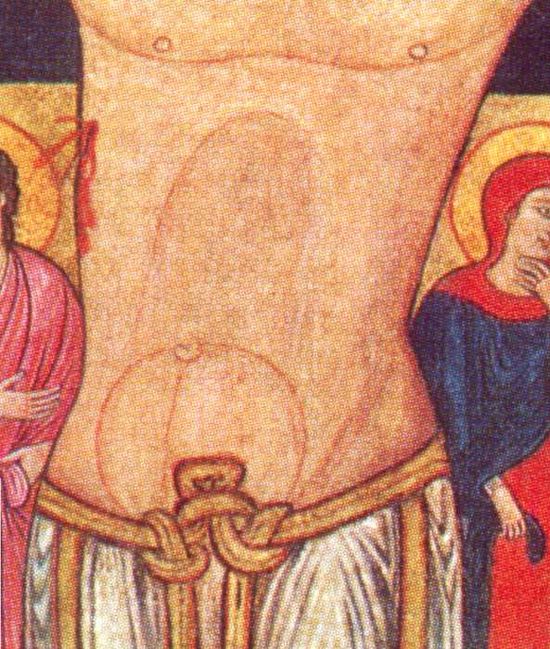
Religious Art Fail, Ctd

Slide0040_image081.sized

A reader writes:

Dish readers might also enjoy, in English, the great art historian Leo Steinberg’s major (definitive?) 1983/1996 study on the subject: The Sexuality of Christ in Renaissance Art and in Modern Oblivion. From the publisher’s gloss:

Steinberg’s evidence resides in the imagery of the overtly sexed Christ, in Infancy and again after death. Steinberg argues that the artists regarded the deliberate exposure of Christ’s genitalia as an affirmation of kinship with the human condition. Christ’s lifelong virginity, understood as potency under check, and the first offer of blood in the circumcision, both required acknowledgment of the genital organ. More than exercises in realism, these unabashed images underscore the crucial theological import of the Incarnation.

Money quote from the book:

“The longer one dwells on the theological grounds for genital shame, the more imperative that Christ be therefrom exempted.”