Yes, Clegg Won

Graphic---poll-TV-debate--001

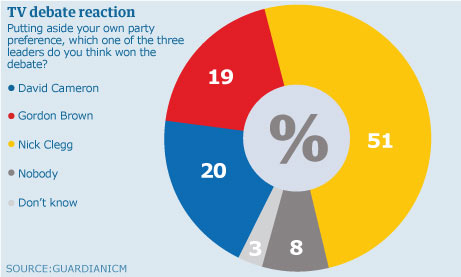
The insta-polls in Britain remove any doubt as to who won last night's debate:

• A Times Populus poll conducted last night indicated that 61% of voters believed Clegg had won the night, compared with 22% for David Cameron and 17% for Gordon Brown.

• Research by YouGov for Tory-supporting Sun newspaper in the immediate aftermath of the programme put Clegg on an impressive 51%, David Cameron on 29% and Gordon Brown on 19%.

• A ComRes poll for ITV News showed Clegg was seen as the winner of the debate by 43% of the 4,032 viewers polled – nearly double Cameron's score of 26% and Brown's 20%.

Tim Russo thinks this could be a game-changer:

If the Lib Dems are actually seen by the electorate, for the long term, as a reasonable alternative governing party, after and because of this debate, it will be at the long term expense of the Tories.  British voters are tired of Labour, true, but big pluralities literally despise the Tories, and see them as nothing more than a hereditarily necessary political party.  If that necessity disappears, because the Liberal Democrats have become a legitimate alternative, the Tories could be knocked into oblivion for a very long time.

The studio audience shifted dramatically to the Liberal Democrats. And yet … when you sift it to represent a broader swathe of the public, Cameron wins:

ComRes' research indeed puts a rather different complexion on the impact of Clegg's performance on the Liberal Democrat's ratings. The more representative sample puts the Liberal Democrats on 24% – a very gentle rise – Labour on 28% and the Tories leading with seven points on 35%.

Clegg himself has been smart enough to downplay any breakthrough. But it will be magnified by the impact of the first-ever televised debates in British political history. Which means the second one will be all the more critical.
Holes In The Echo Chamber

Tyler Cowen calls this paper on ideological segregation online "one of the best papers on on-line media." Cowen highlights this tidbit:

A consumer who got news exclusively from nytimes.com would have a more liberal news diet than 95 percent of Internet news users, and a consumer who got news exclusively from foxnews.com would have a more conservative news diet than 99 percent of Internet news users….Visitors of extreme conservative sites such as rushlimbaugh.com and glennbeck.com are more likely than a typical online news reader to have visited nytimes.com.

Another paragraph:

The Internet makes it easy to consume news from multiple sources. Of course many people do get news from only one source, but these tend to be light users, and their sole source tends to be one of the large relatively centrist outlets. Most of the people who visit sites like drudgereport.com or huf?ngtonpost.com, by contrast, are heavy Internet users, likely with a strong interest in politics. Although their political views are relatively extreme, they also tend to consume more of everything, including centrist sites and occasionally sites with con?icting ideology. Their omnivorousness outweighs their ideological extremity, preventing their overall news diet from becoming too skewed.

Counting Bodies

Musings On Iraq studies March's casualty figures:

The numbers show two important trends in violence in Iraq. First, the insurgents are weakened to the point that they can only carry out a large number of attacks every other month. They then have to take a month to recover and re-supply, which accounts for the previous up and down pattern. Second, casualties are at their lowest rate since the 2003 invasion. The Iraqi security forces are stronger, many groups are trying to partake in politics rather than use violence, most of the insurgency has switched sides since 2005 with the Anbar Awakening and the Sons of Iraq program, and the Special Groups have been largely inactive since the 2008 government offensives in Basra, Baghdad, and Maysan. That has resulted in what some U.S. commanders have called the “irreducible minimum,” meaning violence will not see any more reductions without some change in the status quo. Even with this new security environment, Iraq is still number one in the world in terrorist attacks, and 200-400 people die each month as a result, an unacceptable amount for any country.

Obama And The Gays

You'd have to have a heart of stone not to applaud the president's attempt to ensure that gay spouses have access to one another in hospital settings. Equally, the dynamic leaves me queasy. There is something about the well-meaning liberal mind that is often admirably eager to help the needy, but balks at offering the recipients what we really want: simple equality. The latest move – giving Obama an easy win, the gay lobby a role in mediating the transaction – perpetuates the victimology that sustains the Democrats and their interest groups.

If we had marriage equality, we'd need no-one's compassion. We'd just be able to live our lives. Why won't the president help us do that?

The GOP And The Banks

I found McConnell's attempt to create an alternative reality – let's say an end to bailouts is another bailout! – Palinesque in its post-modern reality. It's also bad politics, of course. Continetti warns:

Memo to Republicans: you are about to step into a political trap! The GOP has focused so much on the downsides of the Dodd proposal, it hasn't made it clear that it supports sensible reforms to correct the imbalances that led to the 2008 financial crisis … Now, maybe the Senate Republicans don't support reform at all. Maybe they just want to deny Obama a victory and wait until they have more power in the next Congress. That would be a shame, because tacitly backing Wall Street on this issue erodes the GOP brand as the People's Party.