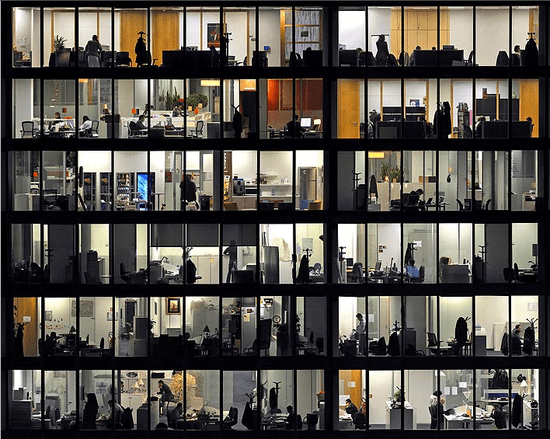
French photographer Jean-Pierre Attal takes portraits of office facades. More images here and here.
Daphne Merkin has a theory as to why we care about them:
The intimate lives of writers have always had a special attraction for readers, perhaps because we imagine that people who can shape ideas and arrange scenes on the page should be able to offer us some special insight into how to order our messy off-the-page lives. This has rarely been proven the case—writers often seem less, rather than more, gifted at the mechanics of everyday existence; all the same it has not stemmed our interest in finding out what Sylvia said to Ted or why Simone pimped for Jean-Paul. This interest speaks, I think, to a dream of coherence—a matching-up of intellect and emotion, of romance and reason—that continues to inspire us even as it eludes our grasp.
Of course some writers read literary biography for other reasons. Nick Mamatas confesses:
I get most excited when reading about rejection slips and advances and late royalty checks and underfunded publishers with the can't-fail idea to print a lot of quickly written short books and those novels written in a feverish six weeks to pay off a tax bill and the shocking disappointment that comes with only selling a few thousand copies of a novel that ends up widely read only posthumously. Since my own career is mostly indie press stuff that doesn't sell at all, I don't even bother to mentally adjust for inflation. Did Nathanael West only make $780 in royalties? Gee, me too. And if Lovecraft got a penny and a half per word out of Weird Tales, I managed five cents a word from that same magazine only 77 years later.
How much do musicians get paid in the digital world? The answer is long, so it's after the jump:

Yglesias responds to Amber's article on obesity:
One reason for America’s expanding waistline has to be our extraordinary success in getting fewer people to smoke. Certainly I gained about 25 pounds in the three years after I quit smoking, a process I’m currently making progress on reversing by drawing on the kind of resources that, as Ambinder observes, working class and poor Americans generally don’t have access to. Smoking is an appetite suppressant. It’s also a substitute for snacking just in terms of having something to do. I found looking into it that nearly any realistic combination of mealtime options would be consistent with me losing at least some weight, but that the problem was snacking between meals (which would be easier to avoid if I just smoked a cigarette every time I thought I wanted to mucn) and then our second factor. Public health professionals don’t like to emphasize this point because they want to encourage people to quit smoking. But to an extent making progress on one public health problem has contributed to a second, albeit less serious, one.
A disturbing report on NPR finds little evidence within the Catholic church over the years to prevent "treated" child-rapists from returning to work with kids. But what struck me was a psychiatrist's analysis of what's really going on:
One of the biggest challenges in treating priests, Lothstein says, is that they don't have the same kind of sexual experiences — or history of talking about such experiences — that an ordinary adult may have. "Many of the priests tend to be psychosexually immature," he says. "They've never taken a course in healthy sexuality."
He says some of them have gone into minor seminary at age 14 and developed "a sense of self without having appropriate lines of dating, meeting other people, experimenting with touch, kissing, ordinary sexuality."
If celibacy is a mature choice, it can be a wonderful act of self-giving. But when mandatory for all, it prevents many healthy men from entering the priesthood, offers a cover for those terrified of their own sexuality and thereby creates a priesthood dominated by the emotionally immature. The hierarchy cannot grapple with these obvious facts of life and human nature. Because it would require re-thinking the dogma in their bunker. And thinking is not allowed in Benedict's church – at least thinking not done by the Pope.
Today on the Dish we were all over the first debate of the British election. Andrew live-blogged the event and summed up his reaction. Reax here and here. We also highlighted the Tories' approach to marriage.
Bloggers discussed the intellectual state of conservatism (we spotted another depressing sign) and Friedersdorf went another round with Thiessen. Andrew reasserted his fear of a Palin nomination while Brooks and Dickerson wanted everyone to focus their attention elsewhere. A Christian singer came out.
In other coverage, Niraj Chokshi told us about people are killing their TVs, McWhorter talked cussing, and Milbank got pareened. More women confessed their love of weed and Bolivia took it up a notch. Ta-Nehisi examined the horrors of slavery.
Beard blogging here. Crowdsourced art here, speed art here, and phallic Jesus art here. Urinating dildos here and porn for the blind here. Hewitt nod here, FNC hijinks here, and a frightening face of the day here. Also, we explained how we're trying to improve the Dish a bit.
— C.B.
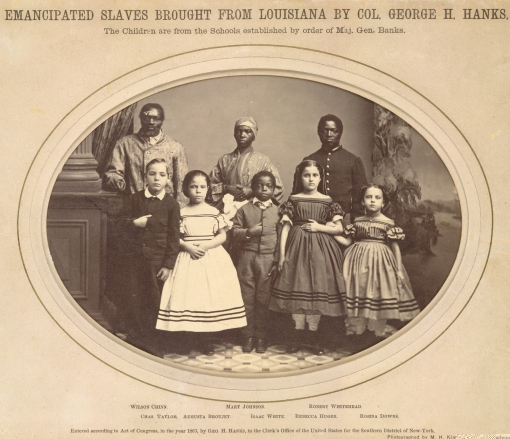
TNC posts the above picture of emancipated slaves and prints an accompanying letter that includes passages such as this:
Rebecca Huger is eleven years old, and was a slave in her father's house, the special attendant of a girl a little older than herself. To all appearance she is perfectly white. Her complexion, hair, and features show not the slightest trace of negro blood.
And this:
Wilson Chinn is about 60 years old, he was "raised" by Isaac Howard of Woodford County, Kentucky. When 21 years old he was taken down the river and sold to Volsey B. Marmillion, a sugar planter about 45 miles above New Orleans. This man was accustomed to brand his negroes, and Wilson has on his forehead the letters "V. B. M." Of the 210 slaves on this plantation 105 left at one time and came into the Union camp. Thirty of them had been branded like cattle with a hot iron, four of them on the forehead, and the others on the breast or arm.
There is a spirited debate in the comments. From TNC's replies:
I thought the point was–"this could be you."…This is one of the saddest thing to me about the whole ordeal. You're really talking about feuding cousins–almost literally. We think of this some kind of collision between Africans and the West, and it is that, but not in the way we think it is.
Whenever I travel down South, it's instantly apparent to me. The whites and the black there–even where my folks are from on the Eastern Shore of Maryland–feel like cousins. Even as a New Yorker, I can feel it when I'm talking to white people there.
Earlier analysis here and here. Live-blogging here. Peter Hoskin:
Nick Clegg certainly gained most from the evening…But Cameron won in a different sense, in that he far outperformed Gordon Brown. In other words: I can't see Labour closing the gap on the Tories because of tonight's debate, and, if anything, the gap might increase. The difference between the two men was chiefly one of personality. Cameron humanised many of the issues, whereas Brown tried to use them as clubs against his Tory oppone. Cameron brought energy to the stage. Brown brought scowls, frowns and jibes about Lord Ashcroft.
For Cameron to win, he must be the change candidate. So his most serious mistake was letting Clegg gallop off with this particular banner, portraying the bigger parties as more of the "same old, same old" and the Lib Dems as the cleanskins who somehow have nothing to do with tarnished Westminster politics. He needs to pin Clegg down, as he did over party funding.
It's the anti-politics vote, combined with novelty, that probably gave it to Clegg in both ITV's instant reaction poll and its "dial test" panel.
As for Brown, he was on top of the detail, and solid. But he looked tired and rumpled, often glowering. Above all, his answers were too packed with indigestible policy detail. He failed to understood what Clegg intuited perfectly – that TV debates are aimed not at the logical, but at the emotional part of the voter's brain. A long line of losing presidential candidates could have taught him that lesson.
Mr. Clegg was highly polished, looking directly at the camera at the right moments to reach viewers at home and interacting most effectively with the audience in the studio. Both other leaders said several times “I agree with Nick”, which must have been music to his ears. Here he was being wooed in public with a hung parliament a strong possibility.
Following these debates, it won’t be long before British party leaders are chosen by primary elections, not just party members (no more unopposed non-elections like the one that brought Gordon to the top job in the first place) — and having been so chosen, will not easily be ousted by their colleagues. The significance of the debates is that they invite you to meet your new boss. And it’s you.
I think Nick Clegg won the day, if only by a short head. He put in a very confident performance and I can't think of an error that he made. Whenever I watch these debates I try to do it at least in part through the eyes of normal voters. And I have to be honest, I think they would have been impressed by Clegg. What he said may have been utter bollocks at times – and it was – but it was the way he said it. He also dictated the terms of the debate at times. As Vince Cable just said on the BBC, the constant repeating of "We agree with Nick" justifies that assertion.
Clegg is on a high – but it might not last. The Lib Dem leader was the clear winner of the debate tonight. This may change the dynamic of the election and he has every right to feel pleased with his performance. But let's keep this in proportion. He's not Barack Obama.
David Cameron was by far the most surprising of the three. Pinned in the middle, he often seemed under attack and subdued. Mr Brown put him under pressure and he didn’t manage to push back well; when he tried to change the subject it seemed contrived. He also seemed intentionally to be avoiding the aggressive style of the prime minister even eschewing one open-goal on under-equipped troops. A former Tory spin doctor who was watching with me said he was being deliberately “statesmanlike”. This, I think, was overly rose-tinted but as the evening progressed it did seem a calculated strategy to seem calm under fire and to avoid the most extreme yah-boo politics.
I was once given a George W. Bush doll which, if you pressed a button on his lapel, would recite one of his soundbites. At times, this is what this debate felt like. At every given topic, the leaders recited their given answers. People have heard Brown’s repertoire, they’ve heard Cameron’s. But not Clegg’s. He enjoyed the novelty factor. I hope he enjoys it: tonight may very well be the high point of his political career.
Can Clegg keep it up? If he does, the Lib Dems might even force Labour into third place, which would be extraordinary. In the next debate, the Lib Dem leader will lack the element of surprise and freshness that he took advantage of so effectively tonight. Cameron and Brown will also see him as a much more dangerous opponent – and will definitely go for him. On the other hand, Clegg now has some momentum and excitement behind him, and he can build on that. And the next debate will be about foreign affairs. As a multi-lingual, former Euro-MP that should be Clegg’s strong suit – although in Eurosceptic Britain, he will probably try to disguise the extent of his Europhilia.
Suddenly, this election looks interesting.
A reader writes:
One of your readers says that evangelicals "don't produce "voter guides" because they don't bother with that kind of centralized messaging. " Um…
I spent years in high school and college attending evangelical churches, and fairly small/midsize, not megachurches, and so did many of my friends. And come elections, Christian Coalition representatives would be standing outside the sanctuary handing out their surveys scoring all the candidates, down to local stuff, on essential Christian issues like school redistricting (Jesus was opposed) and of course the death penalty (Jesus was in favor big time). My many, many, many evangelical friends at other churches had the same experience.

Khong Island, Laos, 6 pm
 The Dish