Mental Health Break

MoMA for the ADD-addled:

Kelsey Keith captions:

This video shot by YouTube user chrspck is pretty self-explanatory: it documents every single painting on display in the Museum of Modern Art’s painting galleries on April 10, 2010 (last Saturday, for the curious). We spotted Bacon, Pollock, Braques, Monet, Rothko, Kahlo, Dubuffet, Picabia, Leger, Klimt, Mondrian, Warhol, Chagall, Wyeth, Johns, Gauguin, Newman, Van Gogh, Twombly, Lichtenstein, and many, many others.

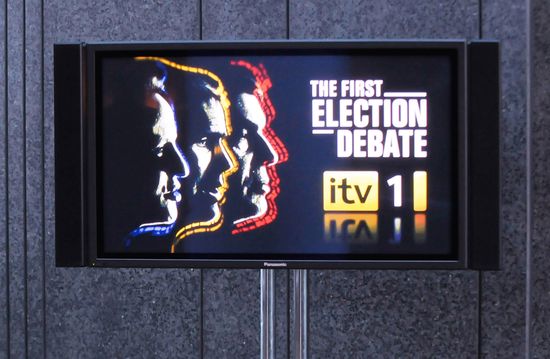
Live-Blogging The Brit Debate

BRITDEBATE1RobEvans:Getty

5.01 pm Brown's final pitch is entirely about fear that spending cuts will hurt the recovery and damage public services. Brown's and Blair's record has barely been raised. If the Tories want to turf them out, the record should surely be more central. Cameron's closing remarks were, however, the best moment of the night: hope versus fear. Yes, that is the conservative message in Britain: hope versus fear.

4.55 pm. On healthcare: unbelievable pabulum and tedium. They're all vying to help old people, sick people, all people – by spending money and directing government employees. The British policy debate really has shifted leftward in the past decade.

4.50 pm Clegg seems far more critical of Cameron than of Brown. Both Brown and Clegg take aim at inheritance tax cuts for the wealthy.

4.46 pm. Each candidate is vying to spend more money on the socialized medicine system. Only Clegg seems even faintly fiscally responsible: "We're going to need savings in the NHS." Cameron has quarantined the health service as the only government program that won't be cut in the attempt to control the debt.

4.40 pm. Cameron blames Brown for too few helicopters in Afghanistan. He scores a small point.

4.32 pm. The defense debate centers around the pay and equipment of the military. The unpopularity of the Afghanistan war seems simply assumed. Clegg seems to have the most pertinent and concrete proposals. Brown defends the war as a vital means to prevent terrorism that starts in that region. Cameron rather lamely wants a comprehensive defense review. Not that this is wrong; it's just a little banal. Clegg wins this round – especially in the nuclear capacity question.

4.31 pm. An audience questioner: "Good evening, guys." This is a new Britain.

4.29 pm. This election is about six billion pounds – one percent of total UK government spending. The Tories want to cut that. Labour doesn't. And Labour wants a small FICA tax hike. That's it.

4.28 pm. Cameron says that Brown wants to keep on "wasting your money now." Cameron makes a One Nation pitch: "We're going to have to come together on the deficit."

4.26 pm. Brown fear-mongers: the Tories are "a risk to the recovery."

4.23 pm. Brown says any reduction of government spending now will create a double-dip recession. Cameron keeps providing anecdotes of government waste: "cut the waste; drop the tax." Clegg is so right that this is a dishonest debate. Neither side is being honest about the hard fiscal choices. Sound familiar?

4.20 pm. Finally, a real issue. Cameron is saying no to new taxes and yes to ending government "waste" as a way to cut the deficit without stalling the recovery. Clegg details some actual cuts – and then wants to get rid of Britain's nuclear weapon capacity.

4.17 pm. Cameron turns the education topic to taxes and accuses Brown of pioneering a jobs tax, i.e. the proposed FICA tax increase. Brown keeps challenging Cameron on why he isn't spending more. Yes, they're all debating who is going to spend more as Britain faces its biggest deficit in memory.

4.15 pm. Education. As usual, almost impossible to talk about without blather. Cameron's insistence on removing truants seems to go down well but he then digresses into anecdotes about government waste. Yes, they had a massage room for teachers in some government agency. Very American.

4.08 pm Just an anthropological point: Cameron just tried to sum up what they all agree on. It was a classic Alpha Male move. I give him a Beta-plus. Brown so far is combative and smiling his grisly smile constantly. Clegg comes across as a bit of a whiner – which is always the trap for the third party. But he's very effective and telegenic. No question that Clegg and Cameron seem of a different and younger generation. But you can see why nervous voters might find the older bloke a little more reassuring in a pinch.

But if Cameron is trying to prove he is of prime ministerial caliber, he's succeeding. The policy differences are, so far, numbingly small.

4.06 pm Brown's raising the question of hereditary peers in the House of Lords is classic class-baiting Cameron.

4.02 pm. Cameron wants to streamline government – and cut the number of MPs – to reduce the fiddling of parliamentary expense accounts? Shurely shome mishtake. Meanwhile, Brown keeps sucking up to the Lib Dems. A hint of the possibility of a Lib-Lab pact? Cameron fights back with a quite effective parry on the tardiness of Labour's interest in constitutional reform. If they wanted to get rid of hereditary peers, they could have done so in the last 13 years.

4.00 pm. Brown says he was "shocked and sickened" by the expenses scandal among members of parliament. He wants recalls of dodgy MPs. He wants an elected House of Lords.

3.58 pm. Brown is getting very aggressive. He keeps interrupting Cameron. Now there's a jibe about air-brushing. It doesn't seem that fitting for a prime minister. It seems a little insidery. But without imbibing the current atmosphere in Britain lately, it's hard for me to judge how this strategy will go down with the viewers.

3.55 pm. Brown tries to get a rehearsed joke about Tory posters. But he's the first to start bickering and talking about the meta-issues. Another Brown rehearsed line: "This is not Question Time, David. This is Answer Time." Good line. Badly delivered. But Cameron ducks the question on funding of the police.

3.54 pm. Brown offers legal injunctions against the police if a case lags. He's implying that Tory budget cuts could reduce the number of cops on the street. Clegg just keeps repeating that nothing seems to change as the two parties alternate in power.

3.50 pm On crime, more police on the streets seems a common refrain. Cameron wants to get drug addicts off the streets and into rehab. Rehab as an anti-crime measure is unimaginable in an American context. And from the right?

3.48 pm. Cameron touts welfare reform as a cure for immigration excesses. Now he's talking about tougher sentences for burglars and murderers. Not exactly hugging hoodies, is it?

3.44 pm They're all vying to get immigration "under control". Brown rather awkwardly says it already is under control. But he suffers the plight of incumbency. If they've been in office for the past 13 years, it's a little late to get tough. Clegg keeps banging on about regional caps for immigrants – not a national one.

3.39 pm Cameron's hair is much more presidential. And his first immigration answer – a clear vow to reduce immigration levels – seems clearer than Brown's obviously scripted description of his meeting with chefs. Yes, chefs.
Women Who Get High, Ctd

A reader writes:

I am a 32 year old professional woman.  I work as a paralegal at a law firm in a major city and have been in the legal field since I was 19.  I smoke pot every night and have smoked pot regularly since high school.  I smoke far more than my male partner at home (I often call him a lightweight and tell him I can "smoke him under the table").  I do 90% of the buying in our house, mainly because I smoke so much more than him.  I also work out every day.  Why?  Because I smoke pot, get the munchies, and chow down on something sugary and sweet every night.  

My best friend of 12 years is also in the legal field, also smokes every night, also smokes far more than her husband and does 100% of the buying for their house. I guess we are not normal but I see nothing wrong with my habits and have never felt guilty about it.

Another writes:

I heard an interview with Linda Ronstadt in which she said she never got into drugs in the '60s and '70s because marijuana made her want to "crawl under the bed with a bag of Oreos and NOT SHARE."

Another:

Your reader who touched on the Sativa/Indica distinction made a good point.  Sativa gives an energetic, psychedelic, thought-a-minute experience — a "head high".  Classic clean-the-house-high stuff.  An Indica-dominant strain, on the other hand, will produce much more of a body high and that "couch lock" sensation.  Because of its growth characteristics — short, bushy, dense with buds — Indica is a more efficient choice for indoor growers, and as such has come to dominate the market.  A legal market that places less of a prime on covert guerrilla grows could see a huge resurgence for sativa strains.

Also, I noticed that the "10 Rules for Dealing with Police" video stars one of Baltimore's lead defense attorneys (and guest star on The Wire), Billy Murphy. It's real worthwhile stuff, thanks for pointing it out.  And I love your "cannabis closet" and "women who get high" series, please keep them coming!

The Dish, Not As Jumpy

A reader writes:

I have been noticing fewer page jumps to read full posts recently. As a multi-daily reader I must give a hearty "Thank You" for that.

Another writes:

This is over a year old, but still: are y'all hip to Slow Blogging? I'm noticing a general slowing down, or conscious pausing, across multiple blogs recently. Interesting.

I'm trying to find a way to keep this blog alive without burning out completely.

It's hard to explain the experience of blogging every day (more or less) for ten years straight. And blogging like you mean it. I can't phone in this blog; it's just not in my nature. So cutting myself off on weekends has been a way to avoid crashing and burning (for Chris and Patrick too), and regaining some semblance of a life outside the web. But we've still failed to do "slow-blogging". In our first week of weekends-off, we racked up 260 posts, which is really no different than our previous pace. We've just concentrated them into five days rather than seven.

We have decided to cut down on the truncated posts, to please our most dedicated readers. More scrolling, less clicking. Fewer pageviews, but it's the reader experience that matters most. We realize at the Dish that our most precious resource is you.

Coming Out To The Evangelical Community

Grammy-nominated Christian singer Jennifer Knapp talks to Christianity Today about her homosexuality:

It never occurred to me that I was in something that should be labeled as a "struggle." The struggle I've had has been with the church, acknowledging me as a human being, trying to live the spiritual life that I've been called to, in whatever ramshackled, broken, frustrated way that I've always approached my faith. I still consider my hope to be a whole human being, to be a person of love and grace. So it's difficult for me to say that I've struggled within myself, because I haven't. I've struggled with other people. I've struggled with what that means in my own faith. I have struggled with how that perception of me will affect the way I feel about myself.

The Tories’ Marriage Nudge

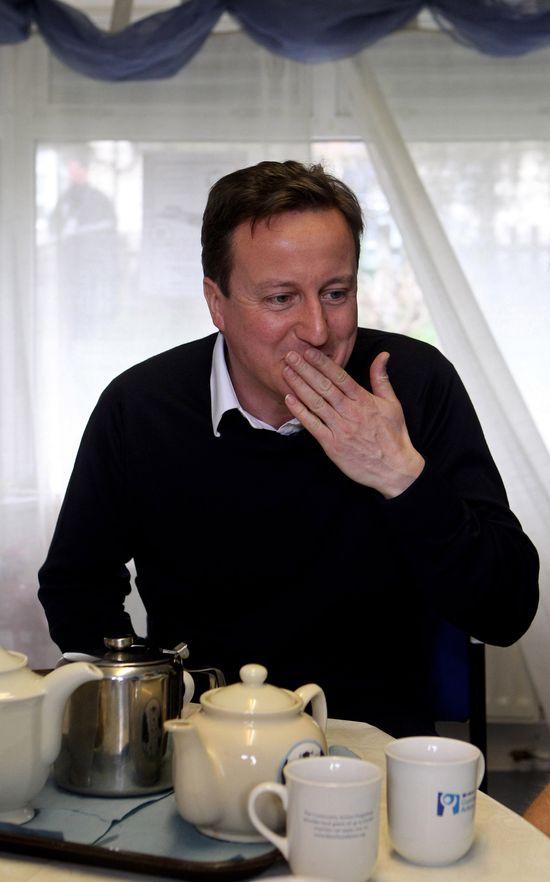
CAMERONOliScarf:Getty

Mark Vernon lets loose on Cameron's proposed tax breaks for married couples:

The policy shows that the party which unleashed neo-liberalism upon us is still tied to the money-as-morality nexus. And it surely also reveals a kind of displaced guilt. Iain Duncan Smith has convinced his party that family breakdown is linked to social injustice. What the Tories can't admit is how that injustice is linked to the values of Thatcher's free-market, subsequently adopted by new Labour: individualism, short-termism, the choice doctrine, fantasies of self-sufficient freedom.

Burke's Corner begs to differ on the first point:

Cameron clearly indicat[ed] that the policy is not about money – it is, rather, a nudge:

We aren't saying people will get married because of money. But we think that sending a signal that families are at the heart of a strong society is a good thing to do.

The Conservative manifesto's promise to create the most family-friendly society in Europe is – at least partially – a rejection of neo-liberalism. The pledge represents a reassertion of conservatism's older communitarian vision over and against the neo-liberal values proclaimed on the centre-right during recent decades. It is a proclamation that neither the Individual nor the Market is sovereign. To create the most family friendly society in Europe will require the market to be checked and – yes – regulated, precisely because it rejects what Vernon describes as the "money-as-morality-nexus". And it declares that individualism is no longer the centre-right's governing credo.

I'm with Burke's Corner, of course. And I find Cameron's explicit inclusion of gay couples and embrace of the merits of commitment and responsibility with respect to everyone – gay and straight – to be admirably sensible. The government, it seems to me, should stay out of social engineering. But it should make sure it doesn't discourage critical social institutions like the family – and, so far as possible, create policies that favor the virtues that make liberal democracies work: thrift, education, marriage.

PS I'll be live-blogging the first ever election debate between party leaders in Britain at 3.30 pm today.

(Photo: : British leader of the opposition Conservative party, David Cameron, reacts during his visit to a parenting rescource centre in Halifax, northern England on April 15, 2010. British politics bursts into a new era Thursday when the three main party leaders square up for the country's first ever televised general election debates. By Oli Scarff/AFP/Getty/Pool.)