Why Do Africa’s Wars Last So Long?

Jeffrey Gettleman answers:

There is a very simple reason why some of Africa's bloodiest, most brutal wars never seem to end: They are not really wars. Not in the traditional sense, at least. The combatants don't have much of an ideology; they don't have clear goals. They couldn't care less about taking over capitals or major cities — in fact, they prefer the deep bush, where it is far easier to commit crimes. Today's rebels seem especially uninterested in winning converts, content instead to steal other people's children, stick Kalashnikovs or axes in their hands, and make them do the killing. Look closely at some of the continent's most intractable conflicts, from the rebel-laden creeks of the Niger Delta to the inferno in the Democratic Republic of the Congo, and this is what you will find.

America’s Style

Stefany Anne Golberg relishes it:

There is an aspect of the American aesthetic that approaches design like a child. There’s a giddy lack of propriety, a joyful dismissal of taste, a love of big colors and sparkle. It’s connected to our attitude toward wealth, which often equates beauty with prosperity. In other words, if it looks rich, it must be beautiful. The shinier the better. This aesthetic of bling, though, is not simply about playacting at wealth; it’s about becoming lost in a fantasy of layers upon layers of artificiality and imitation.

Making Murder Normal

Gerald Dworkin and Justin E. H. Smith debate the death penalty. Smith is against it:

I think some people almost certainly do deserve to die, but for better or for worse there simply is no person or body that can be entrusted with the grave responsibility of killing them. For me, one of the strongest arguments against [capital punishment] has not to do with what it does to the criminal who is punished, but what it does to those involved in the application of the punishment. It makes it possible for killing to be the normal carrying out of a bureaucratic procedure, rather than a transgression or a suspension of our ordinary commitments. That to me is more terrifying than the murder to which the punishment is a response: the murder was plainly a transgression, whereas the compensatory execution is allowed for in our books of law. This means that to uphold [capital punishment] is to make killing normal, something that it is not even for the great majority of murderers.

A Butte Story

Lady

A reader writes:

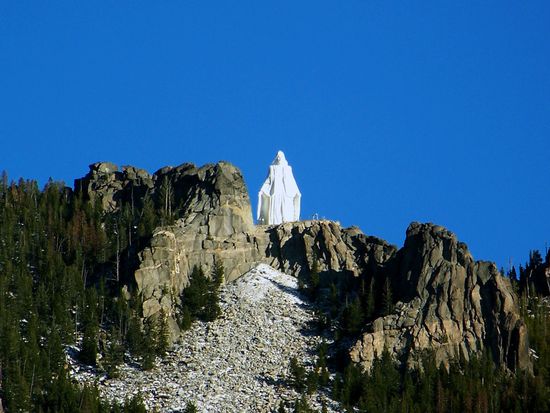
Seeing that window view from Butte, Montana, where I grew up near, I immediately thought of "Our Lady of the Rockies."  On top of one of the peaks overlooking the city is a 90 foot tall, pure white statue of the Virgin Mary.  Rumor has it, Our Lady originated from an answered prayer.  A man, whose wife was sick from cancer, prayed to God and promised to build a giant statue of the Virgin Mary if his wife ever recovered from her illness. When she became well, the man stayed true to his promise and constructed the statue. During the night, it's lit up and can be seen from 100 miles away.

The statue is the second largest in the US.

The Divinity Of Sex

Rich Heffern laments both the liberal and the fundamentalist approach to sex:

To say that sexuality is just an animal instinct, an obstacle to holiness, is to say that sexuality has nothing to do with our humanity. But in fact our sexuality is an integral part of our personal and interpersonal identities. From childhood it looms large in our lives, and we must deal with it one way or the other. Thomas Moore, in his best-selling book The Soul of Sex, writes:

“We have a habit of talking about sexuality as merely physical, yet nothing has more soul. Sex takes us into the world of intense passions, sensual touch, exciting fantasies, many levels of meaning and subtle emotions. It makes the imagination come alive with fantasy, reverie and memory. Even if the sex is loveless, empty or manipulative, still it has strong repercussions in the soul, and even bad sexual experiences leave lasting, haunting impressions.”

There is an ancient wisdom, even within the Judeo-Christian tradition, that maintains that sexuality is primarily spiritual, possibly the single greatest source of spiritual vitality in the human psyche. Sexuality is a mode of interaction with divinity. The Old Testament’s Song of Songs describes the relationship between Yahweh and humans in the most gloriously sensual and erotic images and poetry. Catholic mystic St. John of the Cross used sexual intimacy as the effective analogy for understanding intimacy with God. St. Augustine referred to the cross of Christ as a marriage bed, intimating that our sexuality has infinite redemptive dimensions.

Quote For The Day

"[T]he usual manner of presenting philosophical work puzzles me. Works of philosophy are written as though their authors believe them to be the absolutely final word on their subject. But it’s not, surely, that each philosopher thinks that he finally, thank God, has found the truth and built an impregnable fortress around it. We are all actually much more modest than that. For good reason. Having thought long and hard about the view he proposes, a philosopher has a reasonably good idea about its weak points; the places where great intellectual weight is placed upon something perhaps too fragile to bear it, the places where the unravelling of the view might begin, the unprobed assumptions he feels uneasy about…

No philosopher says: There’s where I started, here’s where I ended up; the major weakness in my work is that I went from there to here; in particular, here are the most notable distortions, pushings, shovings, maulings, gougings, stretchings, and chippings that I committed during the trip; not to mention the things thrown away and ignored, and all those avertings of the gaze.

The reticence of philosophers about the weaknesses they perceive in their own views is not, I think, simply a question of philosophical honesty and integrity, though it is that or at least becomes that when brought to consciousness. The reticence is connected with philosophers’ purposes in formulating views. Why do they strive to force everything into that one fixed perimeter? Why not another perimeter, or, more radically, why not leave things where they are? What does having everything within a perimeter do for us? Why do we want it so? (What does it shield us from?) From these deep (and frightening) questions, I hope not to be able to manage to avert my gaze in future work." – Robert Nozick, Anarchy State and Utopia

.

Quote For The Day

"People with self-respect have the courage of their mistakes. They know the price of things. If they choose to commit adultery, they do not then go running, in an excess of bad conscience, to receive absolution from the wronged parties; nor do they complain unduly of the unfairness, the undeserved embarrassment, of being named co-respondent. In brief, people with self-respect exhibit a certain toughness, a kind of mortal nerve; they display what was once called character, a quality which, although approved in the abstract, sometimes loses ground to other, more instantly negotiable virtues.

The measure of its slipping prestige is that one tends to think of it only in connection with homely children and United States senators who have been defeated, preferably in the primary, for reelection. Nonetheless, character – the willingness to accept responsibility for one’s own life – is the source from which self-respect springs.

Self-respect is something that our grandparents, whether or not they had it, knew all about. They had instilled in them, young, a certain discipline, the sense that one lives by doing things one does not particularly want to do, by putting fears and doubts to one side, by weighing immediate comforts against the possibility of larger, even intangible, comforts. It seemed to the nineteenth century admirable, but not remarkable, that Chinese Gordon put on a clean white suit and held Khartoum against the Mahdi; it did not seem unjust that the way to free land in California involved death and difficulty and dirt.

In a diary kept during the winter of 1846, an emigrating twelve-yaer-old named Narcissa Cornwall noted coolly: “Father was busy reading and did not notice that the house was being filled with strange Indians until Mother spoke out about it.” Even lacking any clue as to what Mother said, one can scarcely fail to be impressed by the entire incident: the father reading, the Indians filing in, the mother choosing the words that would not alarm, the child duly recording the event and noting further that those particular Indians were not, “fortunately for us,” hostile. Indians were simply part of the donnee.

In one guise or another, Indians always are. Again, it is a question of recognizing that anything worth having has its price. People who respect themselves are willing to accept the risk that the Indians will be hostile, that the venture will go bankrupt, that the liaison may not turn out to be one in which every day is a holiday because you’re married to me. They are willing to invest something of themselves; they may not play at all, but when they do play, they know the odds," – Joan Didion.