The Vatican Spins; The NYT Wins

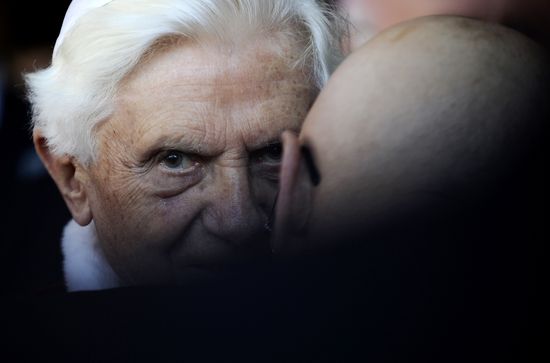
BENEDICTFilippoMonteforte:AFP:Getty

The Vatican came out swinging yesterday against the New York Times. And whiffed bad. The Vatican accused the Times of reporting “deficient by any reasonable standards of fairness,” and insisting that then-Cardinal Ratzinger had nothing to do with the decision by his deputy to suspend a canonical trial against Father Lawrence Murphy, an unrepentant multiple rapist of deaf children, because he was nearing death.

The only way this can be the case is, again, if control-queen Ratzinger knew nothing of the final decisions of his number two in a meeting in Rome on a case where hundreds of defenseless deaf children had been raped and molested by an unrepentant priest for decades. That's the agit-prop being pushed out by some Vatican-sympathizers. They argue that because Ratzinger's CDF only got responsibility for child abuse cases in 2001, he cannot have been responsible for the 1998 decision. But Ratzinger was in charge of the case in 1996 to 1998 because

Father Murphy was suspected of using the confessional to commit his crimes — a crime that is considered particularly serious under the church’s canon law because confession is a sacrament.

This is why Ratzinger is so connected to the Murphy case. And he was handling it for two years. What are the odds he knew nothing about it? Or that he had no sign-off on the final decision not to proceed with a trial?

But the NYT's coup de grace against the Vatican comes with the theocon chief witness, Father Brundage. Brundage had claimed he had been misquoted in the NYT, and that the trial was indeed ongoing at the time of Murphy's death. Brundage, now seeing documents he had not seen before, reverses himself:

Father Brundage, who is now working in the Archdiocese of Anchorage, posted an essay this week saying he was never informed that the trial of Father Murphy had been halted.

He also said that he had been misquoted in both The New York Times and The Associated Press. In an interview on Wednesday, Father Brundage acknowledged that he had never been quoted in any Times articles about the Murphy case — and the paper did not misquote him. He said he was misquoted in an Associated Press article that was posted temporarily on the Times Web site, and he mistakenly attributed that to The Times.

He said the documents show that the Vatican had encouraged the Milwaukee Archdiocese to halt the trial, but they did not use strong language and actually order a halt. He said that he never saw the letter from Archbishop Weakland abating the trial until it appeared on the Times Web site last week.

So it seems perfectly clear that the Vatican did indeed make the final decision – against Weakland's wishes – not to proceed with a canonical trial, and Murphy was buried in full vestments, and his victims never got justice and the church had more sympathy with an elderly and dying priest than with the raped souls and bodies of countless children. The indefatigable Carolyn Disco, a commenter at America, and NCR and a Dish-reader, notes the critical meeting when the decision was made:

 Snip: The May 30, 1998 meeting with Weakland, Fliss, Sklba, Bertone, his deputy Girotti, and staff is critical. The translated minutes from Italian specify Weakland pleaded for a canonical trial to proceed. He specified six points, including Murphy has no remorse, many victims, fear of scandal, etc. Some of the translation wording can be awkward but the meaning is clear.

ETTALMiguel Villagran:Getty Then Bertone lists the problems of continuing a trial: difficulty in furnishing proofs, testimonies without increasing scandal, need for secrecy, long period of time, no other accusations from Superior diocese; that “there are not enough elements to instruct a canonical trial.”

Bertone lists what should be done by way of “penal remedies”  like restricting where Murphy can celebrate Eucharist (only Superior, not Milwaukee), and requiring permission in writing. Also that Murphy must give clear signs of repentance, “OTHERWISE he must be applied to a trial.” Clear signs of repentance mean NO TRIAL.
 
Bertone even “restates the two central points TO BE FOLLOWED” and lists them: (no discretion allowed) “1) the territorial restriction of the celebration (of the) Eucharist and 2) the needed remorse and reform of the priest.” That’s it, period.
 
The meeting concludes with Weakland’s pained “difficulty he will have explaining this to the community of the deaf.” Weakland would have no difficulty at all explaining the continuation of a trial but great difficulty in explaining the cancellation of one.

Notice that one factor in Bertone's decision – my italics – was avoiding more scandal for the church and needing more secrecy. Moreover, Disco notes how the Vatican bureaucracy, like most bureaucracies, finds a way to avoid full responsibility by anyone :

There is no separate written order by Bertone to stop a canonical trial (with or without his superior’s  agreement or understanding, ie Ratzinger) but there are minutes that specify what measures are “to be followed.”

There is no written order to Brundage to stop a trial, instead there are those same minutes he read, and a report of a status conference on the Murphy case with no mention of a trial in progress – just administrative measures related to “precepts.”

For clarifying details of what went on at those meetings at the Vatican and compelling case that Weakland was pushing strongly at the end for a trial and the Vatican was pushing against can be read in Disco's responses (7,8 and 9) here.

(Photo: Filippo Monteforte/AFP/Getty.)
Don’t Blame Unemployment On Obama

Tyler Cowen rebuts a conservative critique:

[T]he slow aspects of the recovery do not, contrary to some accounts, seem

to stem from uncertainty about the plans of the Obama administration.  I see at least two reasons for this doubting this account:

1. Output has recovered much more rapidly than the labor market; last quarter GDP growth exceeded five percent yet employment is essentially flat.  The labor market is one of the least regulated sectors of the American economy, so it would be odd if regulation were causing the slow aspects of the bounceback.  Many of the extant government-blaming hypotheses predict slow output growth, not rapid output growth and slow labor market participation.

2. Arguably health care and finance have been subject to the most regulatory uncertainty.  Yet the health care sector has held up OK and banks have made a very strong comeback in terms of profits.

I believe the causes of the jobless nature of the recovery are unique to the labor market.

Ratzinger, Micro-Manager

A reader writes:

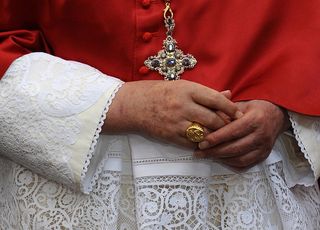
It's important, and entirely relevant, to remember what Ratzinger was up to in the mid-eighties. In 1986, I worked in the Academic Vice-President's (i.e., provost) Office at Catholic University. I have a personal recollection of a fellow secretary from another office running down the hall in McMahon, where the high-ranking academic offices were, BENEDICTHANDSJoeKlamar:AFP:Getty screaming, "I've got Cardinal Ratzinger on the phone!"

That person's rank was somewhere between the Academic VP and dissident Charlie Curran, and Ratzinger was calling about Curran.

Ratzinger wasn't going through the American bishops who make up Catholic's Board of Trustees, nor was he going through the university president, who worked in a different building, let alone office. Nor did he delegate. This wasn't a head-of-state to head-of-state, foreign-minister to foreign-minister correlating status in the chain of command. This was Ratzinger himself, on the phone, making sure that the persons directly responsible for terminating Charlie Curran did the paperwork to get it done. I doubt he called the payroll office, but he didn't let himself trust the people at the top to inform him of progress or carry out his instructions.

Contrast this deep personal, almost kibbitzing interference with his professed ignorance of the canonical, albeit not strictly doctrinal, errors of his gross, unimaginably cruel and criminal priests and their hapless bishops.

I think malicious, willful neglect is his only defense to actively, knowingly harboring felons of the worst sort.

Why Work Such Long Hours?

In her recent article on happiness, Elizabeth Kolbert quotes former Harvard president Derek Bok:

If rising incomes have failed to make Americans happier over the last fifty years, what is the point of working such long hours and risking environmental disaster in order to keep on doubling and redoubling our Gross Domestic Product?

Wilkinson replies:

There are many, many other benefits of economic growth. People live longer and a greater proportion of the population is likely to get a good education. Growth promotes tolerance and inclusiveness, and a history of ongoing growth tends to produce cultures that cares less about the material side of life and more about justice and the less tangible aspects of  a good life. And then there’s the fact that the United States is a notable exception to the general rule that increasing wealth is paired with increasing average levels of national happiness.

Drill, Barack, Drill: The Lesson From Healthcare Reform

As I've noted it's pure long-term, strategic Obama, something the GOP will understand only when it's way too late. So far, they have played directly into the president's hands. A reader concurs:

The question is: why agree to this before getting an agreement from the GOP on other things, like cap and trade? That's where you get it, Andrew, and others don't. This move, which Obama longed telegraphed, is about perception as a way to increase bargaining power with the public against the GOP's sure-fire opposition.

The lesson of health care is this: Obama knows that even if he goes to the table like Dems want, saying no to oil, no to nukes, and then compromises (what pundits want) to try and get what he wants (a cap and trade system), that he still won't get GOP support and will lose the public in the process of negotiating. it happened with health care. That's the GOPs ploy, make demands, claim the demands will get your overall support, and then walk away and talk about how ugly the process is.  In private conversations GOP senators have admitted they liked the health bill but couldn't vote

for it alone.

Obama is now going at it from a different angle.

Knowing he has no GOP support, he gives his conservative Dems cover by backing oil and nukes and coal and he paints the GOP in a corner, like he did after the HCR summit, as the party of No. By preemptively saying he'll drill baby drill and do nuclear power, the GOP looks obstructionist.

This is good for Dems politically on the campaign trail, and it actually increases the chances that Dems can move in unison on an energy bill by themselves. Then they'll face the prospect of getting that 60th vote on stronger grounds than had they mucked up the message with a long drawn out process, where Ben Nelson cuts deals, talks poorly about the bill etc. By preemptively saying yes to oil, yes to nukes, this cuts the process in half. It's a comprehensive bill designed by Dems that they can run on.

That's the theory anyway.

More and more, you realize: he's got this.

Hewitt Award Nominee

"[If] it was argued during his two terms in office that Bill Clinton was “our first black President” because of his supposed liberal policies that would benefit African-Americans …[S]houldn’t Barack Obama already be our 'first gay President' due to his liberal policies pushing the homosexual agenda?" -  Tom McClusky, Family Research Council.

(Hat tip: BTB)

The Daily Wrap

Today on the Dish we watched Obama adopt "Drill Baby, Drill!" Follow-up here. In Vatican coverage, Andrew dug up previous praise for Ratzinger but took him to task for his failings. Hitch was a bit harsher. A Kentucky lawsuit took aim at the Church, June Thomas brought up the abused girls, an Italian bishop spewed some bigotry, and Bill Donohue followed suit.

Palin backed Bibi, tried to hide Willow, peeved her "guests," and got some competition in the reality-show arena.

In other coverage, Suzy Khimm noted some strides in ending DADT, Friedersdorf sounded off on gender pay, readers pounced on the "misogynist asshole," and PZ Myers challenged Andrew on Christianity. More Romney commentary here and here. Animal-suicide blogging turned into parasite blogging. Marcotte got a Moore Award. And a real-life Cartman crashed Chatroulette.

— C.B.

“A Different Kind Of Hell Every Day”

Jonah Lehrer argues that home buyers usually underestimate the value of a short commute:

Why is traffic so unpleasant? One reason is that it's a painful ritual we never get used to – the flow of traffic is inherently unpredictable. As a result, we don't habituate to the suffering of rush hour. (Ironically, if traffic was always bad, and not just usually bad, it would be easier to deal with. So the commutes that really kill us are those rare days when the highways are clear.) As the Harvard psychologist Daniel Gilbert notes, "Driving in traffic is a different kind of hell every day."

I am so lucky to have my ridiculous little bike.