Stuck In The Middle Without You

James Surowiecki checks in on middle-market companies:

While the high and low ends are thriving, the middle of the market is in trouble. Previously, successful companies tended to gravitate toward what historians of retail have called the Big Middle, because that’s where most of the customers were. These days, the Big Middle is looking more like “the mushy middle” (in the formulation of the consultants Al and Laura Ries). The companies there—Sony, Dell, General Motors, and the like—find themselves squeezed from both sides (just as, in a way, middle-class workers do in a time of growing income inequality). The products made by midrange companies are neither exceptional enough to justify premium prices nor cheap enough to win over value-conscious consumers.

On Passion Sunday

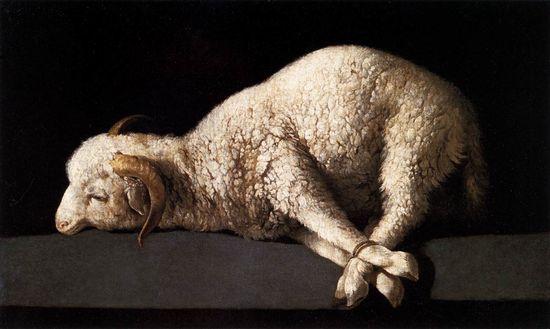
Lambofgod

"Memory is the sense of loss, and loss pulls us after it. God Himself was pulled after us into the vortex we made when we fell, or so the story goes. And while He was on earth He mended families. He gave Lazarus back to his mother, and to the centurion he gave his daughter again. He even restored the severed ear of the soldier who came to arrest him — a fact that allows us to hope the resurrection will reflect a considerable attention to detail. Yet this was no more than tinkering.

Being man He felt the pull of death, and being God He must have wondered more than we do what it would be like. He is known to have walked upon water, but He was not born to drown.

And when He did die it was sad — such a young man, so full of promise, and His mother wept and His friends could not believe the loss, and the story spread everywhere and the mourning would not be comforted, until He was so sharply lacked and so powerfully remembered that his friends felt Him beside them as they walked along the road, and saw someone cooking fish on the shore and knew it to be Him, and sat down to supper with Him, all wounded as He was.

There is so little to remember of anyone — an anecdote, a conversation at table. But every memory is turned over and over again, every word, however chance, written in the heart in the hope that memory will fulfill itself, and become flesh, and that the wanderers will find a way home, and the perished, whose lack we always feel, will step through the door finally and stroke our hair with dreaming, habitual fondness, not having meant to keep us waiting long," -  Marilynne Robinson, Housekeeping.

Recent Keepers

The Dish is so fast and furious these days that my regular attempts to write mini-essays get about thirty minutes' worth of prominence on the blog. Here are the more recent longer posts: The Death of Conservatism, my response to TNC's amazing readership, Under The Microscope, Obama's Victory Of Persistence, and my attempt to understand the psyche of child-molesting priests, Sin or Crime? Ash Wednesday reflections on Marc Thiessen's allegedly Catholic defense of torture here: May The Judgment Not be Too Heavy Upon Us.

Dying With Dignitas

In the March issue of The Atlantic, Bruce Falconer investigates a controversial company:

Dignitas’s slogan is “To live with dignity, to die with dignity,” and for 12 years the group has been serving cocktails of sodium pentobarbital, a highly lethal barbiturate, to clients from around the world. During that time, Ludwig Minelli has helped more than a thousand people kill themselves, and he has cornered the market in what has come to be called “suicide tourism,” transforming his native Zurich into the undisputed world capital of assisted suicide.

Assisted suicide is also legal in the Netherlands, Belgium, and Luxembourg, as well as in the American states of Oregon, Washington, and Montana. But in all those places, the practice is restricted to people with incurable diseases, involves extensive medical testing and consultation with physicians, and requires that applicants be permanent residents. By contrast, Switzerland’s penal code was designed such that, without fear of prosecution, you can hand someone a loaded pistol and watch as he blows his brains out in your living room.

"The Suicide Tourist," directed by John Zaritsky and aired on Frontline, focuses entirely on the human side of Dignitas – namely, a poignant profile of Craig Ewert's final days with his wife and Lou Gehrig's Disease.

Remember Me

Jessa Crispin reviews Ben Yagoda’s history of the memoir:

The memoir is a weird gig. Yagoda barely scratches the surface of that weirdness. When one person is simultaneously the artist, the muse, and the model, you can get a fierce, genius Frida Kahlo. But for every one Frida, you get a couple hundred 22-year-old girls who plaster their Facebook page with faux-arty pictures of themselves and feed off the anonymous male commenters who tell her she’s hot. It’s the 22-year-olds that interest me.

I wonder what happens to them when they finally get sick of living their lives in full view of the public.

Maybe it’s an addiction of sorts: celebrity.

Science And The Meaning Of Life, Ctd

Freddie DeBoer responds to Sam Harris:

[I]f we are indeed a cosmic accident, the result of the directionless and random process of evolution, then it makes little sense to imagine that we are capable of ordering the world around us, beyond the limited perspective of our individual, subjective selves. This has always been to me the simplest step in the world, from the first two beliefs to the third, from the collapse of geocentrism and creationism to the collapse of objective knowing. Yet I find that it is one many people not only refuse to make, but one that they react against violently. This is the skepticism that is refused, and this refusal is the last dogma.

Reading Newspapers

Nige doesn't miss it:

I seem to have given up reading newspapers again. This was less a conscious decision than a combination of circumstances somehow squeezing the newspaper-reading option out of my day-to-day life. I can't say that I feel any lack. In the days when I did read the papers diligently, I soon realised that almost nothing of what I'd read remained in my head the following day (or indeed hour) – it just briefly cluttered up my brain, then disappeared.