What Should The Pope Do?

Dreher's advice:

Explain these decisions in context of the times and the culture, but overall don't be defensive, but rather be humble. Confess all, and be publicly penitent. Many people will scream condemnation at the pope and the Church, and much of that will have been deserved. But I think men and women of goodwill will appreciate a genuine attempt to come to terms with this evil situation, not by denying and stonewalling, but by admitting and asking forgiveness. The pope already has uttered some extraordinary words of regret, but I think people are looking for something more.

Even K-Lo, while blaming everyone else and the 1960s, wants the Pope to explain himself. I don't think he is capable of it: the defenses he has built up, and the cult of total authority cannot allow him to own his personal complicity in child-rape and abuse. I think we will continue to have "non-responsibility" and denial – a bit like the US government and its authorization of war crimes. Dreher can't imagine resignation:

People who say the pope should resign are way off base. Popes don't do that, and besides, are you really going to find another potential pope who didn't participate in what was apparently a widespread practice re: shuffling around predator priests? Of course, as I said, if Benedict reassigns bad bishops, or accepts many resignations, it raises the question: if he did the same thing, why is he sending them down but not himself? It's a hard question to answer.

You're telling me. There is no way out for him. He cannot discipline others without disciplining himself and he cannot save the church if he does not defrock many others. It's obvious he should resign. It's also obvious he cannot. That's why this crisis is so grave. It could go on for a long time, stripping the hierarchy of whatever authority they have left (and look how well they enforced their own extremist understanding of being pro-life in the healthcare debate).

It may get darker before the light gets in. But this is Passion Sunday. As Christians we are taught to hope.
Can An Animal Commit Suicide?

The intro of a paper on animal suicide:

It is commonly assumed that suicide is a distinctly human act. Lacking the capacity to visualise and enact their own deaths, animals are seen to be driven by an instinct of self-preservation. However, discussion over the existence of the self-destructive animal has been long been central to debates over the nature of suicide. By granting animals the capacity to take their own lives, they were granted emotion, intelligence, consciousness.

By transgressing boundaries between animal and man, scientists and activists in the 19th century were united by a determination to ensure the welfare of both. For their critics, these boundaries were to be maintained– animal acts of self-destruction were not intentional, but accidental and instinctual responses to stimuli. Nevertheless, reflections on the suicidal animal have continued, less a means of granting consciousness to the non-human, but as symbols and analogies for human acts of self-destruction devoid of thought or intention.

(Hat tip: Mind Hacks)

The Role Of The Confessional

A reader writes:

One thing that I haven’t seen you mention is the issue of the Seal of Confessional. If someone confesses something during the Sacrament of Reconciliation – anything, no matter how vile, evil, or illegal – the priest hearing the confession is not supposed to repeat it to anyone. Ever. Period. Breaking that confidentiality means automatic excommunication. The priest can set the penance as confessing to the legal authority, but can’t enforce it.

There’s a very good reason that rule is there. God’s mercy is infinite, and people shouldn’t be afraid that the priest is going to inform on them to the civil authority. But it’s equally obvious to me that this presents a gigantic loophole for abusers. If a pedophile priest confesses to his direct superior, what’s that superior going to do?

The confessional is different, but none of the cases we have been discussing came from there. They came, it appears, from the parents of raped children. The admissions of guilt were made in non-confessional forums. The Pope presided over a meeting at which a man deemed a clear and present “danger” to children was merely shunted from one parish to another, and ended up raping several.

In other words, this is a red herring.

A Walking Bar Graph

SameHeight

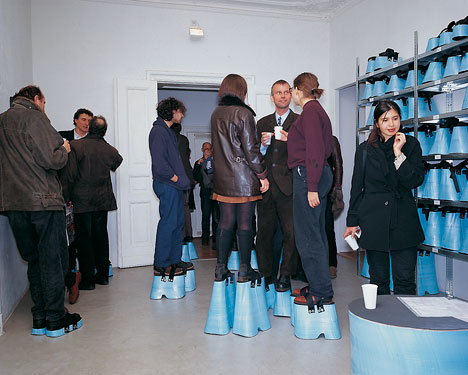
An art project from 1997 used shoes of various heights to make everyone the same height:

Berlin-based artist Hans Hemmert (famous for his work with balloons) threw a party where guests wore shoe-extenders to make them all the same height of 2 meters. Aside from bringing the partygoers all to a common eye level (and eliminating the awkward postures of party talk between the tall and the short), the gathering is lent an infographic nature by the shoes: all made from blue foam, the person's real height is read in the visual uniformity of the sole instead of at the head—like a walking bar graph.

Putting Nuns In Their Place, Ctd

A reader writes:

In the later of section of Bishop Morlino's letter that you didn't include in your quote, he explains — correctly, I believe — that Roman Catholicism is based on a theory of apostolic succession, in which only members of the Church hierarchy have "authority" to define Catholic positions because only they have been called by Jesus Christ: "That’s what we mean when we say that the Church is Apostolic. The bishop is a true Apostle insofar as he teaches with the Holy Father, and the priest is a true Apostle insofar as he teaches with the bishop — that’s how it works." As a Lutheran, I don't accept this theory, myself, but it strikes me as a fairly complete, even airtight, answer to your many criticisms of the Pope and the Church.

You've been suggesting that bishops have to be "accountable," that they have "moral authority" only to the extent that they satisfy the rest of us (at least, satisfy ordinary Catholics) that they're conducting themselves morally. In other words, you're assuming that the source of their authority lies in common values, the wider community, or some other human agency. This, however, is not Church teaching. To the Church, authority comes not from humans but from Jesus Christ — who, conveniently enough, speaks to humankind through the Church (NOT the Bible — that's a Protestant view — but only the Bible as the Church interprets it), which means that as a practical matter, the Church hierarchy is not, and does not propose to be, accountable to anyone but itself.

I understand why you reject this view. Modern people in general reject it. But that's because modern people are heirs of the Protestant Reformation. What you've essentially been saying is that the Catholic Church, too, needs to act and think in Protestant terms. If it doesn't, you say, you wonder how it will "survive." OK, but if it follows your wishes, it will survive only as another denomination of Protestantism. So, really, it faces a choice between two kinds of non-survival: further shrinkage into a tiny rump of pre-modernists who accept unaccountable authority (that's what you seem to be warning against), and the disappearance of what makes it distinctively Catholic in favor of a surrender to Protestant modernity (that's what the bishops seem to be resisting — and understandably so, I think).

Three words: Second Vatican Council. It mattered. It means that the faithful also have a role to play in our church, because we are the church.

Why Does No One Listen To Political Scientists?

Ryan Sager's guess:

[M]y theory of why no one in politics likes to think about political science: because it renders them powerless. How do you do your job as a political consultant when the truth is that 90% of the success or failure of what you do will be determined by the unemployment rate? If you’re a political journalist, how do you write a story every day for a year (or three years, given our current presidential election system) saying, essentially, “Well, the fundamentals still make it exceedingly likely the president will be reelected.” If you’re a politician… well, then you’re a sociopath anyway, so perhaps it’s not worth getting into this scenario too deeply.

And then there's the fact that so many political scientists are quant-wonks you'd run from if you met them in a Starbucks. And, yes, I have a PhD in political "science".

Yglesias Award Nominee

"This hasn't been a great week in terms of, I think, the Constitution and where it says that you're supposed to, you know, everybody is, has a mandate to have insurance. But I think the way some Republicans are handling this is nothing more than purely despicable. The names that are next to and being highlighted by those crosshairs — I think it's an abuse of the Second Amendment. I also feel as though every single person on here is a mother, a father, a friend, a brother, a sister, and to take it to this level is — it's disappointing to see this come from the Party, and I would hope that leaders like Sarah Palin would end this" – Elizabeth Hasselbeck, who campaigned with Palin.

What’s For Dinner?

MeatConsumption 

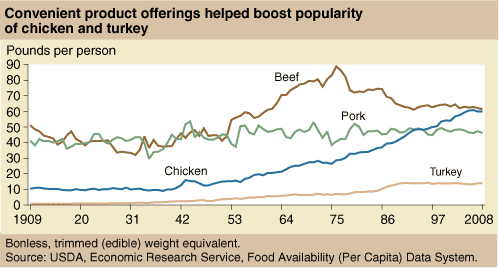
The USDA and the Economic Research Service look at 100 years of American eating. Graph above on meat eating habits. Another point of interest:

Increasing availability of fats and oils and cheese reflects their use in processed foods and the growing eating-out market in the second half of the century. The availability of fats and oils grew from 36 pounds per person in 1909 to 87 pounds in 2008. Much of this increase was in salad and cooking oils used to cook french fries, a mainstay of fast food and other restaurant menus. Cheese availability also skyrocketed—growing from 11.4 pounds per person in 1970 to 31.4 pounds in 2008. Cheese owes much of its growth to the spread of Italian and Mexican eateries in the United States and to innovative, convenient packaging, such as string cheese for lunch boxes.

(Hat tip: Kottke)