Chait reads a Clive Crook column all the way through.
Israel and The US: Interests Diverging
Hard Truths From George Friedman:
Israel sees the American preoccupation in these other regions [Iran and IraAf-Pak and India], along with the current favorable alignment of forces in its region, as an opportunity both to consolidate and expand its power and to create new realities on the ground. One of these is building in East Jerusalem, or more precisely, using the moment to reshape the demographics and geography of its immediate region. The Israeli position is that it has rights in East Jerusalem that the United States cannot intrude on. The U.S. position is that it has interests in the broader region that are potentially weakened by this construction at this time.
Israel’s desire to do so is understandable, but it runs counter to American interests. The United States, given its overwhelming challenges, is neither interested in Israel’s desire to reshape its region, nor can it tolerate any more risk deriving from Israel’s actions. However small the risks might be, the United States is maxed out on risk. Therefore, Israel’s interests and that of the United States diverge. Israel sees an opportunity; the United States sees more risk.
The problem Israel has is that, in the long run, its relationship to the United States is its insurance policy. Netanyahu appears to be calculating that given the U.S. need for a western balance of power, whatever Israel does now will be allowed because in the end the United States needs Israel to maintain that balance of power. Therefore, he is probing aggressively. Netanyahu also has domestic political reasons for proceeding with this construction. For him, this construction is a prudent and necessary step.
Obama’s task is to convince Netanyahu that Israel has strategic value for the United States, but only in the context of broader U.S. interests in the region. If Israel becomes part of the American problem rather than the solution, the United States will seek other solutions. That is a hard case to make but not an impossible one. The balance of power is in the eastern Mediterranean, and there is another democracy the United States could turn to: Turkey — which is more than eager to fulfill that role and exploit Israeli tensions with the United States.
Obama Interviewed By An Indonesian
No wonder he’s popular abroad:
Shales vs Amanpour
What a load of hooey. I think Amanpour is a brilliant idea for hosting This Week, calm, authoritative, not caught up in Beltway process, able to say what she thinks – on torture and Israel, for example – while remaining careful to include other views. Genius. A vast improvement on the charisma-free insider, Stephanopoulos.
Approval Climbs
A new Gallup poll shows a bounce for the health care bill.
How Health Care Reform Could Affect You, Ctd
The WaPo has a calculator. The NYT tries to explain the requirements for small businesses. They are taking questions on the subject here. I think this is when the bill gets more popular. But we'll see.
Washington Isn’t Broken
Massie admires the American system:
[S]ure, you could look at a year of grinding health-care debate, some of it tedious and some of it ridiculous, and complain that this shows how broken American politics is. But I think it may actually be the other way round: the system is neither irretrievably nor fundamentally broken and the United States, by dint of history and diversity, remains the great experimental, democratic melting pot.
The sad day – the day when we'll know something really has changed – is when big stuff happens in Congress and no-one cares. Happily that prospect still seems some way off.
Netanyahu Throws Some Elbows
Netanyahu gave a defiant speech yesterday, but Haaretz suggests it's accompanied with quiet concessions. Indeed, there's a theory (one of many) that Netanyahu's chest-thumping is in inverse proportion to private concessions.
Ackerman also writes up the speech.
Viacom’s Hidden Addiction – And Hypocrisy
YouTube defends itself against Viacom's persistent legal action over copyright:
For years, Viacom continuously and secretly uploaded its content to YouTube, even while publicly complaining about its presence there. It hired no fewer than 18 different marketing agencies to upload its content to the site. It deliberately "roughed up" the videos to make them look stolen or leaked. It opened YouTube accounts using phony email addresses. It even sent employees to Kinko's to upload clips from computers that couldn't be traced to Viacom. And in an effort to promote its own shows, as a matter of company policy Viacom routinely left up clips from shows that had been uploaded to YouTube by ordinary users.
Viacom's efforts to disguise its promotional use of YouTube worked so well that even its own employees could not keep track of everything it was posting or leaving up on the site. As a result, on countless occasions Viacom demanded the removal of clips that it had uploaded to YouTube, only to return later to sheepishly ask for their reinstatement. In fact, some of the very clips that Viacom is suing us over were actually uploaded by Viacom itself.
(Hat tip: Kottke)
Face Of The Day
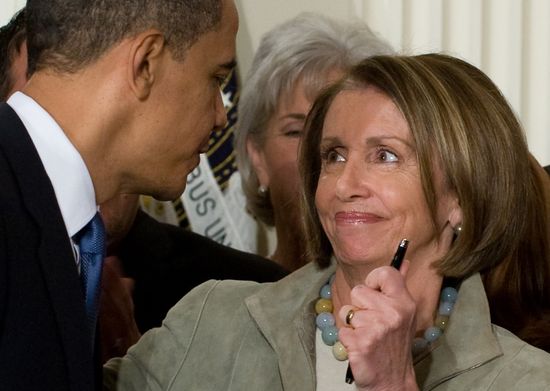
Speaker of the House Nancy Pelosi (R) holds a pen given to her by US President Barack Obama after signing the healthcare insurance reform legislation during a ceremony in the East Room of the White House in Washington on March 23, 2010. By Saul Loeb/AFP/Getty Images.
 The Dish