"This is a big fucking deal," – vice president Joe Biden, on HCR.
How The GOP Can Fix The Bill
Frum has ideas. Reihan is working on this as well. By far the better approach to railing about it all year-long. Run on conservative reform within universal healthcare, not repeal. Not that they'll listen.
The Scandal Has Just Begun Outside America
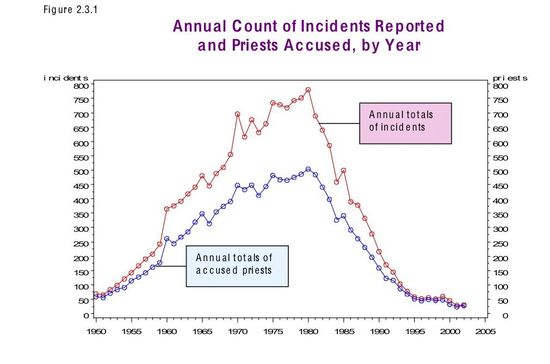
Andrew Brown worries about the ways in which abuse cases were silenced and covered up at low levels of the church – especially between 1970 and 1985.
There was no Vatican cover-up. Instead of one centrally ordered cover-up, there were hundreds of little local ones. They didn't require special regulations. They grew quite naturally out of the clerical culture. They worked by silence and omission rather than anything more obviously sinister. The scandal is going to be much worse as a result…
But the crucial line in Vatican investigator Mgr Charles Scicluna's evidence comes much earlier. He says that between 1975 and 1983, there was not a single case referred to his office from anywhere in the world. This is astonishing.
I'm sure he's telling the truth. But this should be scaring him out of his wits …
because the period when nothing at all was reported to Rome was also when the abuse was most frequent and widespread and from which the worst stories have since emerged. Look at the graph [above], which admittedly only covers America. There were never fewer than 350 priests reported in any of the years between 1975 and 1983. None of those cases reached Rome for judgement. All of them were covered up spontaneously, almost unconsciously, by the local bishops.
What this means, of course, is that in every country where there was abuse there were also cover-ups, and these will come to light all round the world.
Obama’s Moderate Bill
Chait sorts through the spin.
A Risky Prediction
My own view is that healthcare reform will play a minor role in November's elections – because of amnesia, and other events. But in so far as it does play a role, my hunch is that it will help Democrats. My belief is that when people absorb the details that people with pre-existing conditions will soon be able to get insurance, that no-one can get priced out of their current insurance plan by massive sudden premium hikes, and that lifetime limits on insurance are now over … well, people will like it. Why would they not? And if Obama seizes the initiative on debt reduction and calls the GOP bluff on debt this summer and fall, he can outflank them on the right as well. Meanwhile people like him far more than they do the GOP.
More to the point: Obama can campaign on these things. And he and the Democrats can point plainly to all the GOP and say: they wanted no change; they tried to kill it all. If you still believe in change, vote for us. We delivered, we'll deliver again. The more determined the GOP is to argue that this will kill the Democrat vote in the fall, the less I believe them. If the economy is reviving by then, their obstructionism will fall even flatter.
Meep, meep.
Obama's favorable since November after the jump, compared with Romney's – and Palin's. Brutal:
Quote For The Day III
"If the GOP takes the legislative innovations of the Democrats and decides to use them, please don't complain that it's not fair. Someone could get seriously hurt, laughing that hard.
But I hope they don't. What I hope is that the Democrats take a beating at the ballot box and rethink their contempt for those mouth-breathing illiterates in the electorate. I hope Obama gets his wish to be a one-term president who passed health care.
Not because I think I will like his opponent–I very much doubt that I will support much of anything Obama's opponent says. But because politicians shouldn't feel that the best route to electoral success is to lie to the voters, and then ignore them.
We're not a parliamentary democracy, and we don't have the mechanisms, like votes of no confidence, that parliamentary democracies use to provide a check on their politicians. The check that we have is that politicians care what the voters think. If that slips away, America's already quite toxic politics will become poisonous," – Megan McArdle.
Science And The Meaning Of Life
Sam Harris sees science as a way to determine what is right and wrong. He is basically attacking the post-Nietzsche fact-value distinction:
The Exposure Of Thiessen As A Lying Hack
The line I am getting from Thiessen’s defenders is that, Well, he criticized her, too, in his book. Let’s see: One person is a reporter who worked alongside me the Wall Street Journal. The other was a flack for Jesse Helms and Rumsfeld. Who am I more likely to trust? It puzzles me that my old newspaper, The Washington Post, would hire Thiessen to write for its op-ed page. How many former Bush speechwriters does one newspaper need?
One nugget Tom dug out of Mayer’s must-read demolition job:
Thiessen’s account of the foiled Heathrow plot, for example, is “completely and utterly wrong,” according to Peter Clarke, who was the head of Scotland Yard’s anti-terrorism branch in 2006.
“The deduction that what was being planned was an attack against airliners was entirely based upon intelligence gathered in the U.K.,” Clarke said, adding that Thiessen’s “version of events is simply not recognized by those who were intimately involved in the airlines investigation in 2006.” Nor did Scotland Yard need to be told about the perils of terrorists using liquid explosives. The bombers who attacked London’s public-transportation system in 2005, Clarke pointed out, “used exactly the same materials.”
Btw, congrats, Tom, on winning the National Magazine Award for Best Blog. We still love you at the Dish.
Cool Ad Watch
AXA_EVOLUTION from TronicStudio on Vimeo.
(Hat tip: LikeCool)
Home Win
Contra my column this week, Walt is confident that Obama's HCR victory will not boost his clout abroad:
To begin with, Obama’s No. 1 concern still has to be the U.S. economy. The Democrats are going to lose seats in the midterm elections, which will make pushing domestic reform efforts much harder. It might be tempting to focus on foreign policy, therefore, except that everyone knows Obama’s re-election hinges largely on getting Americans back to work. If the economy and especially employment turn around by 2011 he’s golden; if it doesn’t, he’s in trouble.
More importantly, there isn’t a lot of low-hanging fruit in foreign policy.
He might get an arms-control agreement with Russia, but there aren’t a lot of votes in that and there’s no way he’ll get a comprehensive test-ban treaty through the post-2010 Senate. Passing health care at home won’t make Iran more cooperative, make sanctions more effective, or make preventive war more appealing, so that issue will continue to fester. Yesterday’s vote doesn’t change anything in Iraq; it is their domestic politics that matters, not ours. I’d say much the same thing about Afghanistan, though Obama will face another hard choice when the 18-month deadline for his “surge” is up in the summer of 2011.
 The Dish