How New Is Bloggery?

Robert Darnton reads old papers:

To appreciate the importance of a pre-modern blog, consult a database such as Eighteenth Century Collections Online and download a newspaper from eighteenth-century London. It will have no headlines, no bylines, no clear distinction between news and ads, and no spatial articulation in the dense columns of type, aside from one crucial ingredient: the paragraph. Paragraphs were self-sufficient units of news. They had no connection with one another, because writers and readers had no concept of a news "story" as a narrative that would run for more than a few dozen words.

If Cable Dies

Max Fisher looks ahead:

It's not hard to foresee a day when Americans come home and, using an Internet TV system that would probably look a lot like your DVR menu, queue up the latest situation comedy or key in to a live news broadcast. Maybe shows will have traditional ads, maybe they'll be ad free but cost a dollar each, or maybe viewers will get to choose. But payment model would be just the beginning of the changes. Networks, no longer forced to fill exactly 24 hours of daily programming, would act more like movie studios, releasing as many or as few titles as they wished. High-quality shows would prosper as networks dropped the unneeded filler. The market would open up to anyone with a camera and a server host, inviting a flood of independent TV shows produced on a shoestring by directors with broad creative license.

Failed Foods

Meg Favreau remembers some of the worst:

In 1994, Prepared Foods (“the industry's leading ingredient-oriented, food, beverage and nutritional product development publication”) came out with a piece in its Annual highlighting failed product launches from the previous 10 years. The article started with 1983, the Year That Everybody Decided to Make a Cheese-Filled Hot Dog. It's little wonder that none of these lasted; one of these hot dogs was called Frank 'n' Stuff, and I can unequivocally say that here's nothing that makes me less excited to eat a food than giving it a name that hearkens to sticking together cadavers (which I guess is kind of what hot dogs are already). Then, Prepared Foods points out, in 1990 there was Betty Crocker's microwavable bread, six-ounce loaves that were purchased partially baked and finished with two-to-three minutes in the microwave. Oh, and what about when Clorox was making microwavable meals? Because nothing says “good food” like a company primarily associated with bleach.

The Daily Wrap

Today on the Dish, as the HCR process reaches a climax, Clive Crook questioned the CBO estimate, Keith Hennessey held his ground against the bill, Nate Silver was very optimistic about its passage, and Ron Brownstein heightened the drama.

In Israel coverage, Netanyahu cozied up with Hagee, Abe Foxman redoubled his rhetoric against Petraeus, Andy Bacevich said enough was enough, Obama polled well among non-right-wing Israelis, and Ackerman wondered what Clinton will say to AIPAC next week.

In pope coverage, a Dish reader erupted over Benedict's excuse, another saw a way to remove him, another criticized Catholic reporter John Allen, another scrutinized the Church's culture of silence, and another cheered Andrew on. RFD writers called for secular oversight while Johann Hari took a shot at religion.

Elsewhere, McWhorter and TNC tackled Tavis Smiley and Frum started to track some serious allegations against Hannity. Our NCLB debate continued here and here. In a powerful piece of footage, Neda's mother mourned her daughter's death.

— C.B.

Obama Goes All In

Brownstein:

Win or lose, Obama has pursued health care reform as tenaciously as any president has pursued any domestic initiative in decades. Health care has now been his presidency's central domestic focus for a full year. That's about as long as it took to pass the Civil Rights Act of 1964, originally introduced by John F. Kennedy and driven home by Lyndon Johnson. Rarely since World War II has a president devoted so much time, at so much political cost, to shouldering a single priority through Congress. It's reasonable to debate whether Obama should have invested so heavily in health care. But it's difficult to quibble with Emanuel's assessment that once the president placed that bet, "He has shown fortitude, stamina, and strength."

Ambers nods.

How We Judge Bills

Ezra Klein observes:

[W]e really judge the extremism of legislation based on the positioning of Republicans and Democrats. If I'd told you that the Obama administration was going to release a health-care bill that would attract every Senate Democrat — from Bernie Sanders and Barbara Boxer to Ben Nelson and Joe Lieberman — and either endorsements or neutrality from the American Medical Association, the hospital industry, the pharmaceutical industry, AARP, labor, and much of the insurance industry (though their press releases have become more oppositional recently), you'd have thought that was a pretty moderate, consensus-oriented bill. Which it is! But most Americans don't think that because the Republicans decided to treat it as the second coming of fascism.

And the MSM is too wussy to call them on their crap.

There Are Two Sides To This Conflict

A reader writes:

Something is seriously wrong with the debate over Israel and the Palestinians. Not only does one side of the Jewish community vilify anyone for criticizing Israel, they reject the very basis of negotiation: it takes two sides. AIPAC advises the Administration to lay off any public disagreement or rebuke of the Israeli government's policies. Why? The Israeli government stepped over the line and put both the Obama and Fayyad administration in untenable positions. Yes, this is the argument.

Of course, in the cross-blog debate over the last few days no one (except the vilified Juan Cole) has brought the Palestinians into the picture. Is this the view of Israel?

That how the settlement announcement is seen by Palestinians and how it undermines the Fayyad administration is of no concern in the controversy, is of no concern to the Netayahu government?

By criticizing Israel, the Obama administration tried, rightfully, to balance Palestinian concerns. That's what really irks the Israelis and their Israel 'right or wrong' American backers. An intentionally provocative question: why is their refusal, on the eve of proximity talks, to consider the interests of their negotiating partner not called out as anti-Arab, or anti-Palestinian?

Or doesn't it matter?

Leave NCLB Behind? Ctd

A reader writes:

If there is one issue on your blog I was ever qualified to write to you about, this is the one. I'm turning in my dissertation this afternoon, in fact, on the effects of NCLB on teachers' instruction. I think a lot of your readers' points are way, way off the mark.  Here are the facts as I understand them, from my work and the literature.

First, the effects of standards-based reform on student achievement (measured by test scores) are decent–as good or better than your typical whole-school-reform movement. They are about the same magnitude for white, black, rich, and poor students. In my opinion, these effects are mainly operating through the content of teachers' instruction–WHAT they are teaching, not necessarily how they are teaching. Teachers are responding to the assessments and standards by aligning their instruction, especially in mathematics and science. Some might call it teaching to the test, but I actually found that instruction moved more toward standards than it did tests.

Teachers' responses to the standards and assessments are, not surprisingly, strongest when the standards and assessments target the same content. That was, in my view, the #1 goal of standards-based reform, and yet I've found that state assessments often measure wildly different content than is specified in standards. In other words, the tests were supposed to be fair representations of the content specified in the standards, but that's simply not the case right now, and teachers don't know what to teach as a result.

Even more interestingly, I analyzed teachers' responses to standards and assessments and found that, in grades where the standards and assessments emphasized higher-level thinking, like the high school grades in English, teachers responded by increasing their focus on those skills. When the standards and tests emphasized procedural thinking, like all grades in mathematics, teachers responded by emphasizing those skills. Thus, if the standards and assessments were better targets (right now, they almost all stink), teachers would almost certainly respond by teaching in ways that are more desirable. Constructing high quality tests is only a measurement and, possibly, cost problem, but I am very confident we can overcome those obstacles.

As for the accountability measures, I agree that they are overly draconian. However, I did find that teachers paid more attention to the standards and assessments and aligned their instruction more in states with higher levels of accountability. Some degree of accountability is good, but the current system needs to be retooled.

Given these conclusions, I think it would be a massive mistake to abandon standards-based reform altogether. The fact is that the way we've done NCLB is not what the original "inventors" of standards-based reform had in mind. If we did it better, I am very confident that the results would be better and the negative externalities would be minimized. I am hopeful that that's where we're heading, but we'll see.

As for charter schools and urban flight, neither of which are my areas of expertise, I am neutral on charter schools–on average they do the same, but some clearly do better (again, I think, because they have more instructional time and teach more content). And people have been avoiding urban public schools for decades, so that argument is nonsense.

Anyway, I hope you find this information useful. None of my research is published yet, but I got a professor job at USC in this dreadful market based on this job talk, so I'm pretty confident that my results are legit and an important contribution to the field.
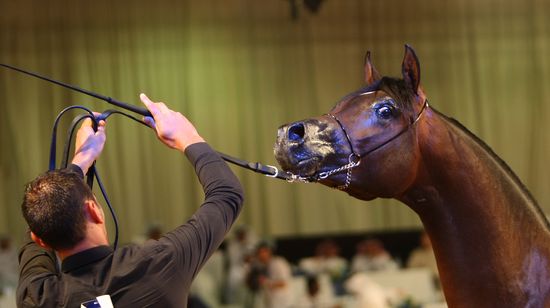
Face Of The Day

COLTKarimSahib:AFP:Getty

A two-year old Arabian Class 8 Colts, owned by Saudi Prince Abdul Aziz bin Ahmed bin Abdul Aziz, is paraded during the Dubai International Arabian Horse Championship in the Gulf emirate on March 19, 2010. The championship is a competition for purebred Arabian horses which parade during the three-day event to showcase their beauty and talents. By Karim Sahib/AFP/Getty Images.

Can The Pope Be Removed? Ctd

A reader writes:

All of this is true. But it does not imply that the answer is that a pope cannot be fired. The fact that the laws on the books provide no avenue for the removal of a pope doesn’t mean that the laws couldn’t be changed to make it possible.

There is an authority in the Catholic church that possesses power at least equal to that of the pope: the Ecumenical Council. The decrees of an Ecumenical Council have a force like that of Papal dicta, and they constitute the canon law by which the Pope governs. The Councils write the laws. So the Pope is supreme within the law, but the Council is supreme over the law. As a result, a Council can remove a pope. In fact, it’s happened several times.

The Councils of Pisa, Constance, and Basel all fired one pope or another. At the Council of Pisa in 1409, the bishops dethroned the two rival schismatic popes, Benedict XIII and Gregory XII, and elected a third, Alexander V. At the Council of Constance (1414-1418), the Council accepted the resignations of Benedict XIII and Alexander’s successor John XXIII and deposed the third papal claimant, Benedict XIII. Of course, this Council also settled matters by retroactively declaring some of the schismatic popes as “anti-popes,” so they weren’t popes to be deposed in the first place, and repudiating the Council of Pisa as a mere meeting of bishops, and not a Council at all. At Basel, Pope Eugene IV (who has no rival claimant!) was deposed in 1439, but the Council itself was declared illegitimate by the rival Council at Ferrara and Florence. So, on the books, it looks like no popes were fired. But that’s only because the Councils wrote the books.

It is still an open question as to whether Councils are supreme over the pope, and whether a Council can be convoked without papal authority. Right now, the consensus is perhaps in favor of the pope. But these are questions of doctrine and canon law, and questions of doctrine and canon law are ultimately decided by Council. There’s nothing preventing someone, if they can get sufficient support, to convene a Council that declares itself legitimate and then deposes the pope.

There’s an addendum to this. At the height of the Thirty Years War in 1632, the representatives of Spanish (i.e., Hapsburg) interests in Rome accused Pope Urban VIII of insufficiently supporting the Catholic cause in the conflict. Following a famously fractious consistory meeting, allies of the Spanish party privately threatened to convene a Council and remove the pope. Urban, for his part, took the threat seriously.