Face Of The Day

CarlSublerJohnMooreGettyImages

U.S. Army chaplain Carl Subler reads under the glow of his red-filtered head lamp early on March 5, 2010 at a a combat outpost in Sha-Wali-Kot in Kandahar province in southern Afghanistan. Soldiers in combat zones are often forbidden from using 'white' light at night, in order to avoid detection by enemy insurgents. The Catholic priest was reading I Am America (And So Can You) by Stephen Colbert. Military chaplains, who travel the battlefield across Afghanistan, provide a backbone of support for thousands of soldiers struggling with the difficulties of war and year-long deployments away from home. By John Moore/Getty Images.

Plucky Little Iceland

by Alex Massie

Early voting has begun in Iceland's referendum on whether it will honour the terms of an agreement its  government made with the British and Dutch authorities to repay £3.5bn those governments paid out to investors in Icleand's broken, bankrupt banks.

The Icelanders feel as though they've been bullied (especially by the British) and it's hard not to agree with them. Quite why the Icelandic government should be held responsible for the British government's entirely voluntary decision to bail out savers and investors is a mystery.

Worse still was the manner in which her Majesty's Government treated Iceland – seizing all Icelandic assets in the UK and using anti-terrorism legislation to do so. This was a) disgraceful and b) a reminder of how dangerous such laws are and how subject and open to abuse they really are.

This being the case, I'm with the plucky Icelanders. Vote No!

Do Debates Matter, Ctd

by Jonathan Bernstein

I enjoyed Alex Massie's response to my response to his comments on the upcoming Brit debates.  I hope he doesn't mind if I go one more round.  

I'm not sure that we do disagree (and if if I mischaracterized his views, I definitely apologize).  I too think that American presidential debates are overhyped silliness even less appropriate for the British system.  As he says:

Consider the 1992 Presidential debates. About the only thing that anyone remembers is George HW Bush looking at his watch. An awful lot of guff and pop-psychology was extrapolated from that single second. Did it help the electorate make an informed choice? Not really. At least not in any substantive fashion.

And that's fine. What I object to is the pretence that these contests are actually debates in which rival candidates demonstrate their prowess or moxy or whatever. They're nothing of the sort.

I agree!  But I also don't really think there's much at stake in calling these things "debates."  I remember that Dan Rather used to be really cranky about that, refusing to let that word pass his lips.  I never understood why he cared.  As for debates revealing character of the participants…well, I agree with that too, but it's not as if press coverage of elections (at least in the USA) focused narrowly on "prowess or moxy" are restricted to the debates; that sort of stuff dominates political coverage, regardless.  Alas, but again: what does it have to do with debates?

At any rate, I think we both agree that presidential debates have been useless at doing any of the things that the people who hype them say that they can do, and that as useless they are at those things in America, they're likely to be even worse at them in Britain. 

I do want to add something about promises, however, because I think this is pretty important.  Politicians make lots of promises when they campaign — some are on matters of public policy, some on process, and some on style.  Whatever voters may think, the evidence is pretty good that pols themselves take these things pretty seriously.  There is evidence (yup, from political scientists, but I'm afraid I don't have a citation handy) that pols tend to keep their promises…if you look at the data compiled by the folks at PolitiFact, Barack Obama has either kept, tried to keep, or is working on keeping almost all of his issue promises.  The style promises matter, too.  Let's see if I can find a good way to put this…remember the Beer Summit?  I'd say that Obama got in trouble with his initial remarks about that episode because he was perceived as having made a promise to be a certain type of president — a certain type of black politician as president, and his remarks verged on breaking that  promise.  I'm not sure whether, in that instance, the press correctly interpreted Obama's promise (and this stuff does get tricky, because unlike issue promises candidates are rarely explicit about this type of promise).  But the idea is that all promises candidates make place constraints on them, even if voters don't actually believe those promises.  And so I do think that one benefit of debates is that, by focusing the attention of the political world on the candidates, the promises (issues and style) that that case about the most get the most attention, which in turn places the most severe constraints on them should they want to break those promises.  Which, of course, they may do, as we've seen with Obama in cases such as the Armenian genocide or the business of conducting health care negotiations on CSPAN.

I do think that centralizing the campaign for a few hours is probably less important in nations that are smaller than the US, nations that have shorter election campaigns, and nations that have a closer connection between formal, written party platforms and actual promises by the top candidate. 

Quote For The Day

by Chris Bodenner

"That those in question would have their patriotism, loyalty and values attacked by reputable public figures such as Elizabeth Cheney and journalists such as Kristol is as depressing a public episode as I have witnessed in many years. What has become of our civic life in America? The only word that can do justice to the personal attacks on these fine lawyers — and on the integrity of our legal system — is shameful. Shameful," Walter Dellinger, former head of the OLC and senior partner of a firm that represented a Gitmo detainee pro bono at the behest of Bush DOD lawyers.

Chart Of The Day

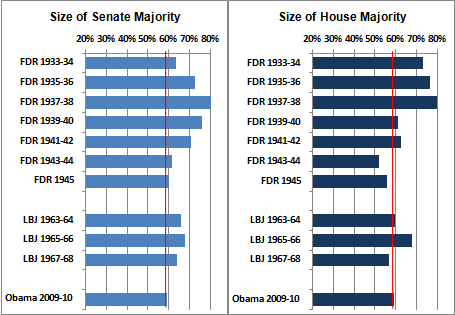
Majorities

by Patrick Appel

I somehow missed this Nate Silver post from earlier in the week:

When F.D.R. took over the Presidency in 1933, the Democrats controlled 64 percent of the Senate seats and 73 percent (!) of the House seats, counting independents who were sympathetic to the party. And those numbers only increased over the next couple of midterms — during their peak during 1937-38, the Demorats actually controlled about 80 percent (!) of the seats in both chambers. Obama, by contrast, came into his term with 59 percent majorities in both chambers. That's not much to complain about by the standards of recent Presidencies, but is nevertheless a long way from where F.D.R. stood during his first two terms, or for that matter where L.B.J.'s numbers were during the 1965-66 period, when the bulk of the Great Society programs were implemented.

Against Excessive Vetting

by Jonathan Bernstein

I tend to be pretty generous in my grades for President Obama, thirteen months in.  I think that he's handled a lot of things well, and those that haven't gone the way he originally wanted, I think, have often been cases in which he just lost.  That happens sometimes, even with large Congressional majorities.

Where I do think that Obama has done a poor job, really inexcusably, is on nominations, both executive and judicial.  Yes, he's had to deal with a rejectionist Republican Party ready to filibuster everything, but that's no excuse for not even nominating people.

There is one structural change that I would recommend, especially for executive branch nominations: just stop vetting them, already.  The White House can't tell Congressional committees what to do, but by all accounts the initial vetting for these jobs is far, far, more than necessary.  That is, if presidents scaled way back on vetting, the occasional dud would get through, and…what?  Would it ruin the presidency?  No, it wouldn't.  For example, the White House shouldn't have nominated Van Jones.  Whatever his other strengths or weaknesses, and whatever his actual beliefs about the September 11 attacks, his support of the "truther" add made him toxic.  And in fact, that weakness was exposed, and he resigned.  And…no damage was done.  Is it really better to have no one at all in a large number of positions, with all the damage and wasted opportunity involved, then to take a slightly larger risk that something will go wrong?  No, it isn't.  This kind of surface risk-aversion is a real mistake.

Here's what I've recommended. 

Appoint a commission.  Put on it a couple of former chiefs of staff, a couple of former Senate committee chairs, and a couple of corporate executives with experience in hiring people, and a couple of people who have had to be vetted for mid-level jobs in a executive branch department or agency.  Tell them that you want them to report back in three months with a streamlined vetting process.  For executive branch positions other than those in sensitive national security areas, it should be no more intrusive, expensive, or difficult than whatever major corporations do when they're hiring someone.  And then, implement the new process immediately, and get some nominees sent up to the Senate.

Meanwhile, nominate judges!  There's just no excuse for leaving so many positions open.

Of course, that still leaves the broken confirmation process, but that's mostly beyond Obama's control, although I agree with those who say he could be fighting a lot harder for his nominees (threatening recess appointments shouldn't have taken thirteen months, for example).  One thing at a time, especially when it's something that Obama can do on his own.  The nominations process is broken, and if Obama cares about governing, he should fix it.

The Hurt Locker and the Oscars, Ctd

by Graeme Wood

People tend to dislike movies about events they experienced, for the same reasons they tend to dislike movies based on books they've read.  If the movie's accurate, it bores them, because it's just an abbreviated version of a more vivid past.  And if it's inaccurate, well, it's inaccurate.

My old colleague Brian Mockenhaupt faults Hurt Locker for the latter reason, and he is right: there is much that feels bogus.  The movie's first sour note is its epigraph — "War is a drug" — from Chris Hedges, whose book taught me more about the psychological trauma of Chris Hedges than about the psychological trauma of war. (Hedges, a former NYT correspondent, describes brutally beating a KLM agent in Costa Rica, an act of psychopathy other war reporters somehow resist.)  The drug in question in the film appears to be some kind of horrible speed-plus-angel-dust twofer, which simultaneously revs up reality, robs you of judgment, and makes you strong.  I have never popped open the trunk of a car to reveal a huge bomb meant for me, so I can't promise that bomb-disposal technicians don't experience these effects.  But the needless risks and hijinks in Hurt Locker seem laughably far-fetched.

I spent two years in Iraq, never as a soldier and usually away from fighting.  Most of the bomb-disposal work I saw was controlled detonation, from a great distance.  It looks like this:

The aspect of Hurt Locker I found truest was the return home from Iraq to a world whose colors felt dulled, and whose blessedly banal choices — Window or aisle? With or without ice? — felt meaningless.  (Which, of course, they were.)  Ironically, the effect of the homecoming scenes in Hurt Locker reminded me not only of my returns from Iraq, but also of the withdrawal symptoms experienced by Avatar viewers.  It's the feeling of entering a world less vivid and dramatic than the one you've left.  That these movies both manage to induce such highs and lows suggests they both deserve their Oscar nominations, accurate or not.

The Defense’s Opening Statement

by Patrick Appel

Matthew Alexander has a must-read review of Marc Thiessen's new book:

My gut reaction on reading Marc Thiessen's new book, Courting Disaster, was: "Why is a speechwriter who's never served in the military or intelligence community acting as an expert on interrogation and national security?" Certainly, everyone is entitled to a voice in the debate over the lawfulness and efficacy of President Bush's abusive interrogation program, regardless of qualifications. But if you're not an expert on a subject, shouldn't you interview experts before expressing an opinion?

Instead, Thiessen relies solely on the opinions of the CIA interrogators who used torture and abuse and are thus most vulnerable to prosecution for war crimes. That makes his book less a serious discussion of interrogation policy than a literary defense of war criminals. Nowhere in this book will you find the opinions of experienced military interrogators who successfully interrogated Islamic extremists. Not once does he cite Army Doctrine—which warns of the negative consequences of torture and abuse. Courting Disaster is nothing more than the defense's opening statement in a war crimes trial.

A British Tea Party?

by Alex Massie

Rod Dreher has a good post riffing on today's David Brooks column which is in turn well worth reading. Brooks argues, astutely in my view, that the Tea Party movement is in many ways the flipside of the 1960s New Left:

Members of both movements believe in what you might call mass innocence. Both movements are built on the assumption that the people are pure and virtuous and that evil is introduced into society by corrupt elites and rotten authority structures. “Man is born free, but he is everywhere in chains,” is how Rousseau put it.

Indeed. And, as we've discussed before, since many American political trends end up crossing the Atlantic it's probably not a great surprise that there are British Tea Partiers too. Here's Daniel Hannan explaining it all:

[T]he idea, in 1773, that Britain was a foreign country would have struck most Americans, patriot or loyalist, as ridiculous. A large majority of the British population sympathised with the arguments of the colonists. So, indeed, did the greatest British parliamentarians of the age.

“I rejoice that America has resisted,” proclaimed William Pitt the Elder setting out the case against the Stamp Act in 1766. “Three million people so dead to all feelings of liberty as voluntarily to submit to be slaves would have been fit instruments to make slaves of the rest [of us]”

“Let us get an American revenue as we have got an American Empire,” said Edmund Burke in 1775, taking up the cause of no taxation without representation. “English privileges have made it all that it is; English privileges alone will make it all it can be.”

Those British Lefties who now sneer at what they regard as the Americanisation of the British Right would do well to remember their own history. They are the political heirs of Charles James Fox, of John Wilkes, or Tom Paine. I have no doubt that if the heroes of that age – Burke or Fox or Pitt or Johnson or Swift – could be transported to our own time, they would recoil with horror at the level of taxation and state intervention.

To remind you, Labour has introduced 111 tax rises since 1997. It has taken a trillion pounds in additional taxation. And it has still left us with a deficit of 12.6 per cent of GDP.

Enough is enough.

Well, I'm not a fan of the intruding state, nor of high taxation but this is hardly a serious political manifesto. We may all admite the giants of the 18th century (and their rhetoric and principles) while appreciating that, you know, we don't actually live in the 18th century.

If Fox and Burke and Pitt and Dundas and all the others were to be transported to our time they might indeed be astonished by the levels of taxation and state intrusion (and their horror would not be baseless) but they'd also be astonished by stuff such as, I dunno, universal education, universal health care, universal pensions and much, much more. Unfashionable as it may be to say this, all these things need to be paid for.

Noting that hardly makes one an apologist for Big Government or punitive taxation but, entertaining though it is to dream of an era of Georgian political giants and contrast them with our own dessicated pygmies, it's not really terribly useful.

Lower taxes and a smaller, more limited idea of govenrment would both be very good things and, as an outlet for pent-up frustration, there's not too much wrong with the idea of British Tea Parties. I sense, however, that this will not become a mass movement. There's something of a Monty Python sketch about it all and, however well-intentioned they may be, the Tea Partiers will simultaneously be too silly and too earnest to be taken too seriously.