by Chris Bodenner
This beauty's been bouncing around the blogs all week:
by Chris Bodenner
This beauty's been bouncing around the blogs all week:
by Jonathan Bernstein
Ezra Klein complains that Republicans are much better at manipulating the media, referring to the fact that reconciliation wasn't considered controversial when Bush and the GOP employed it for tax cuts in 2003:
Because Democrats weren't complaining. The tax cuts might have been controversial, but they weren't creative enough to polarize the procedure the Bush administration was using to pass them.
But some of the credit for that has to go to the Bush administration, which took seriously the need to institutionalize reconciliation when they were strong and popular rather than weakened…[B]y using it for his popular first round of tax cuts, Bush normalized it such that Democrats couldn't really complain when he used it for his much more controversial second round of tax cuts.
Wrong! The Democrats certainly could have attacked the procedures under which the Bush tax bill was passed, even the second one. Had they made a stink about it, they could even have forced lots of media attention on the idea. But…look, maybe I'm just cranky today, but I'd say that they didn't, because it would have been incredibly stupid to do so. In fact, what the Democrats did was attack the tax cuts as being giveaways to the rich, which gave them an issue to run on in 2004, 2006, and 2008, and good rhetoric to use once they won the Congress and eventually the presidency. And I don't think they had much trouble getting that message out.
Look, the minority party gets to have talking points. Those talking points are going to make it to the public via the news media, and they are going to affect coverage. About a quarter of the nation will instantly adopt those talking points (and, in most cases, think they've always believed them…I've seen this happen to both conservatives and liberals, and it's an amazing effect). That's just how it works. If a party chooses to waste those talking points by constructing an ineffective and brittle straw man, why should partisans of the other party object to that?
As Jonathan Chait and Nate SIlver point out, Republican whining about the size of the bill and the process are having no effect at all on the popularity of health care reform; if anything, opposition may have peaked right at the new year, two months ago, before Brown and reconciliation. While Republicans have the attention of the nation on this topic (more or less — of course, most people don't follow this stuff closely), they're trying to convince people of an argument that will be stale and dated the day after Obama signs the bill (should that happen), while the Democrats arguments in favor of reform will generally still be relevant to voters in November and in 2012. And a large part of that is because Democrats are using arguments based on reality, while the GOP, er…isn't. That doesn't prohibit their ideas from getting exposure in the press, but it does limit how successful they will be.
No one cares about procedure, even real procedural abuses. If the GOP wants to base its last-stand opposition to the most important piece of legislation in a generation on tall tales about procedure, the Democrats shouldn't be anxious. They should be very, very happy.
by Patrick Appel
Jay Cost counts heads.
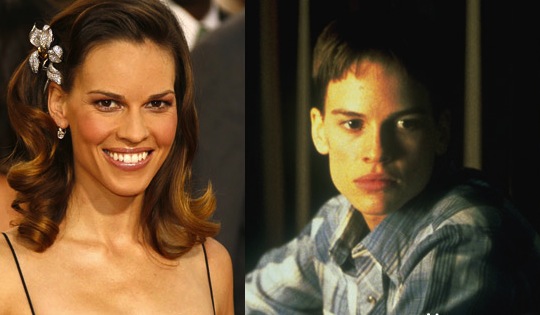
by Chris Bodenner
Kim Elsesser makes the case:
While it is certainly acceptable for sports competitions like the Olympics to have separate events for male and female athletes, the biological differences do not affect acting performances. The divided Oscar categories merely insult women, because they suggest that women would not be victorious if the categories were combined. In addition, this segregation helps perpetuate the stereotype that the differences between men and women are so great that the two sexes cannot be evaluated as equals in their professions.
(Hilary Swank won Best Actress for her portrayal of Brandon Teena in Boys Don't Cry.)
by Patrick Appel
Nate Silver gives the odds:
My head says yes — Pelosi will squeak this through — while my gut frankly says no. Either way, I'm not sure there's a lot of arbitrage against that 52 percent number at Intrade, but I'd hesitate to call the bill a favorite to pas
by Chris Bodenner
Yet another prominent Republican calls out the Cheneys:
Peter D. Keisler, who was assistant attorney general for the civil division in the Bush administration, said in an interview that it was “wrong” to attack lawyers who volunteered to help such lawsuits before joining the Justice Department. “There is a longstanding and very honorable tradition of lawyers representing unpopular or controversial clients,” Mr. Keisler said. “The fact that someone has acted within that tradition, as many lawyers, civilian and military, have done with respect to people who are accused of terrorism – that should never be a basis for suggesting that they are unfit in any way to serve in the Department of Justice.”
Jonathan H. Adler adds:
There’s perhaps some irony that Peter Keisler is defending Obama Administration nominees from such attacks, when he himself was subject to scurrilous attacks when he was nominated to the U.S. Court of Appeals for the D.C. Circuit. More evidence Keisler is more honorable than those who kept him off the bench.
Or those who now denigrate his profession.
by Jonathan Bernstein
Matt Yglesias is frustrated by the ability of the opponents of health care reform to scare up a "controversy" about reconciliation out of whole cloth. As he notes, reconciliation is over thirty years old, and has never been considered controversial in the past. That's true. He continues:
This is a reminder, first and foremost, that the nation’s prestige political journalists aren’t very good at their jobs. You always have the option of not giving in to the power of the right-wing noise machine. But time and again reporters and editors choose, as autonomous moral agents, to do so.
But of course it’s also a reminder of the continuing power of the right-wing noise machine. The ability of talking points to go through the Drudge/Limbaugh/Fox conveyor-belt means that while conservative claims may not always carry the day in the public discourse, the right basically gets to decide what the debate is about on any given day…And since we’re having the debate, it becomes true to call it a “controversial” process.
I think this is a bit more complex than that. It's true that one of the jobs of the press is to evaluate the truth of claims made by government officials, including the minority party. But a more basic job of the press is simply to let people know what political actors are saying. The New York Times and the Washington Post can't — shouldn't — ignore a party's talking points just because they're nonsense. And while I do think reporters should be straightforward about factually dubious claims, it is also is, for better or worse, important that those claims are aired.
The key for the press, it seems to me, twofold. First, there's a huge difference between the claims of, say, Republican leaders in the House and Senate on the one hand, and claims of Glenn Beck or backbenchers in the Hose on the other. This often calls for judgment — is Michele Bachmann an obscure backbencher, or is she a Republican leader in the House — and there are no hard and fast rules, but the basic idea is that major points of view should be heard. The other side of it is what to do with claims that pass that first test, but are nevertheless nonsense. Unfortunately, that situation leaves the press with few good options. On the one hand, factually wrong assertions need to be treated as factually wrong…but it's awfully hard for reporters to know, in many cases, what things are simply factually wrong, and which are in a gray area in which responsible experts disagree. Or, to put it another way, it is clearly not true that the reconciliation patch is an unusual use of that procedure, but it does appear to now be true that reconciliation is controversial, since Republican leaders say it is. I'm not a journalist, but I find the choices they have to make in dealing with this sort of thing difficult. I suspect that there are no good solutions for how to accurately report talking points of a major political party that are based on nonsense and hokum.
While this is frustrating, I'm not sure it's a grave threat to the republic. Yes, Republicans have successfully managed to convince people that there's a Serious Question of whether reconciliation should be used for health care reform. But in doing so, they've crowded out other potential points they might want to make about the bill. In other words, the media does allow them to "decide what the debate is about" to some extent (although not just Republicans — after all, this takes place within a debate over health care reform, not over tax cuts or deregulation or why Obama is soft on terrorists because he keeps killing them). That's not a Republican choice. Both parties can influence what the debate is about. And in my opinion at least, parties that use their window to elevate phony issues tend to suffer.
by Chris Bodenner
Stephen Hawking says the human race is screwed (other than that, a great MHB):
Pink Terror Hawking from mike barzman on Vimeo.
(Hat tip: Beautiful/Decay)
by Patrick Appel
A reader writes:
I love how everyone's typical reaction to breast milk cheese is disgust. Yet the majority of us will eat any product under the sun made from the breast milk of cows, goats, or sheep. Which is truly more disgusting — milk that is meant for baby human beings, or milk meant for baby ruminants? It's certainly not a trend that's going to catch on for the masses because I don't see women lining up for mass milkings any time soon — but as a mother of a child who had severe food allergies and reacted whenever I consumed dairy, eggs, soy, wheat, or nuts, I won't say that the thought of eating breast milk cheese or ice cream didn't cross my mind. Rice gets old very quickly.
by Chris Bodenner
TNC is deciding whether to enroll his son in a public or private school:
The problem with all of this is that, despite my own experience, I've always been committed to public schools, and I believe in them for many of the reasons I outlined above. Public school put me in contact with kids who were a lot different than me, and forced me to learn to relate. It taught me how to navigate other worlds, and appreciate vocabulary that wasn't particularly native to me. At my middle school, you couldn't erect a wall between yourself and the kids from the projects. You had to learn to cope.
As someone who attended six very different public schools growing up, I could not say it better.
 The Dish