The Hurt Locker And The Oscars, Ctd

by Patrick Appel A reader writes:

I’ve been reading the posts about “The Hurt Locker” and various service members’ response to the film. Trying to decide whether the movie is an accurate portrayal of life in Iraq is a fruitless task, as that assumes there is a singular experience among combat soldiers. Something tells me a Marine in Fallujah has a totally different perspective on the war than an MP in the Green Zone or a fighter pilot or a bomb diffuser in Baghdad.

I can make a similar point with an experience from my own life.

When I was in 11th grade, my English class was assigned a large project on the Vietnam War. We were to discuss the effects of the war in the context on multiple areas of American culture: music, television, literature, news media, etc. One part of the assignment was to interview a Vietnam vet. We were of the age that most of us had little trouble finding a father, uncle or neighbor who served in Vietnam.

We were allowed to take the interviews in any direction we wanted, but everyone had a list of certain questions they had to ask (a la the end of “Inside the Actors Studio”). One of questions asked which movies they thought offered the most realistic portrayal of the war and, conversely, which movie they thought was the most unrealistic. Far and away the leader in bothcategories when the votes for all interviewees were tabulated was  “Platoon.” My father, who was on the front lines during the venture into Cambodia, connected with the insanity, terror and futility portrayed in “Platoon.” However, someone in another combat situation could just has easily thought is was inaccurate compared to their experience.

The big point here: It’s F-ing stupid to try and determine whether a single film has successfully portrayed the war through the eyes of all who served. There is no universal narrative for combat soldiers, and holding a film to that standard demands the impossible (and would probably make for a crappy movie anyway).


John Adams And The “Gitmo Nine” Ctd

by Chris Bodenner

A reader writes:

I cannot agree that Mr. Potemra makes a valid point.  I do not see any legitimate policy dispute giving rise to the demand for these attorneys' names.  What they did was advocate for the due process rights of their clients, arguing against indefinite detention and trial by military tribunals which lacked basic procedural protections.  That such representation could be described as "highly controversial" by Mr. Potemra only serves to show how far afield the far right has become.  Have we really gotten to a place where it is debatable whether those we are detaining for years, possibly forever, should actually receive competent legal counsel to assert whatever modicum of rights they may have?

In essence, this quest for these attorneys' names is merely a political play by Grassley, Cheney, et al. to paint this administration as pro terrorist by claiming that they are now employing ("harboring") al-Qaeda sympathizers in the Justice Department.  There is no legitimate policy dispute to be found in all this posturing. 

If there was, then every lawyer that has ever represented a criminal defendant, that later seeks to work for the government in a role other than as a public defender, should be investigated publicly for any potential conflict of interest between their past clients and their future work for the state or federal government which incarcerated them.  This is just simply ridiculous.  The EPA has certainly hired many lawyers that used to represent polluters, because they are intimately familiar with the environmental laws that the EPA is charged with enforcing.  I actually have several law school classmates who were very concerned with environmental issues and went work for corporate firms representing polluters because they hoped to gain the necessary legal expertise to one day work for the EPA.  When is the last time that you heard a public outcry to expose such individuals?

I do not doubt that Grassley is playing a political game here.  But I still think it was a valid point because even Holder acknowledged potential conflicts of interest (though of course he could have been simply placating Grassley). Also, the reader insists that the attorneys' opposition to indefinite detention is not controversial, yet the Obama administration itself is holding nearly 50 detainees indefinitely.

Transparency is always my default preference. Having the names become public is not a smear unto itself; it is the dark insinuations that make demands for transparency deplorable. (Though of course, in the political arena, "simply asking questions" is often a smear unto itself.)

By the way, for a great reax of the controversy, see Max Fisher.

John McCain Loves California

by Jonathan Bernstein

You'll recall that at the health care summit, John McCain took a shot at California over water rights.  Now, I happen to be a native of Arizona, so I can appreciate that sentiment.  But in politics these days, what California is mostly known for is a massively dysfunctional budget process.  While most legislation in California needs only majorities in their legislature and the okay of the governor, budget bills need a supermajority.  The result is, more often than not, a train wreck.  John McCain apparently has been studying California thinks…gimme some of that.

Congress, for better or worse, has the opposite approach.  While most things are subject to supermajority requirements in the Senate, budgeting generally is exempt from that requirement.  A key part of that is the formerly obscure bill called "reconciliation,"  which as I guess all attentive readers know by now cannot be filibustered.  A little with the wonky — do you know what reconciliation is supposed to reconcile?  It's not, as you might have thought, revenues and expenditures.  Reconciliation is actually supposed to reconcile Congress's original plans for the year, as expressed in the Congressionally-passed budget resolution, with whatever Congress has actually done during the year.  The idea was to help Congress live up to its own promises to itself.  The people who came up with the budget reforms of the mid-1970s knew how hard it was to pass laws, and were concerned that this difficulty made it harder for Congress to maintain control of the budget, and so they invented a new, protected type of legislation to make it a little easier. 

That wasn't needed for appropriations bills, which must pass every year or else the government will not be able to function.  It's need for changes in entitlement spending, and it's needed for changes in revenues. 

Back to McCain: he's now introduced a bill to shield Medicare from reconciliation, saying that "entitlements should not be part of a reconciliation process."  That's nonsensical, to tell the truth: entitlements are a main reason that the reconciliation process was invented.  It's true that Social Security was exempted from reconciliation in 1985, but adding Medicare would be a major step towards turning the budget process back into a supermajority procedure. As Ezra Klein says, "The issue here isn't mere hypocrisy. It's dangerous shortsightedness."   That's right; it would be a significant step on the road to turning Congress into the California state legislature.  The next step would surely be removing tax increases from reconciliation, leaving Congress even more handcuffed when it came to deficit reduction.  

There's a reasonable argument that Congress should need a supermajority to pass ordinary bills.  But that argument is weakest when it comes to things that Congress absolutely must pass, and budgeting is at the core of must-pass legislation.  You would think that John McCain would know that, but then again he's never really been one to understand the substance of policy and procedure.  But it's very simple: supermajority requirements + budgeting = California. 

Do Debates Matter?

by Alex Massie

There's lots to be said for Jonathan Bernstein's critique of my dissatisfaction with the way set-piece political debates are organised. From this you will gather that I disagree with him.

He argues that I have a "goo-goo" view of these contests that can only be shared by political obsessives. Perhaps so, but my main point is simply that such "contests" are sold to the public as a means of evaluating the respective merits of the motley gang of candidates paraded before them for their disapproval when, in fact, little could really be further from the case since such "contests" generally demand little more than the rote recitation of talking points. When was the last time substance actually mattered?

Consider the 1992 Presidential debates. About the only thing that anyone remembers is George HW Bush looking at his watch. An awful lot of guff and pop-psychology was extrapolated from that single second. Did it help the electorate make an informed choice? Not really. At least not in any substantive fashion.

And that's fine. What I object to is the pretence that these contests are actually debates in which rival candidates demonstrate their prowess or moxy or whatever. They're nothing of the sort. I don't expect voters to evaluate candidates as a debate judge and adjust their preferences accordingly because that would be a) silly and b) stupid. 

There is at least a greater, more persuasive, case for these contests in the American system than in the British. Gordon Brown has been a national figure for 20 years; David Cameron has been leader of the Conservative party for four years. He's been on TV many times a week for several years. We don't need to learn more about these men and a glorified press conference is not likely to enlighten even low-information voters too much. 

Of course Jonathan is right to argue that voters have many different reasons for endorsing a given candidate and, frankly, a "goo-goo" (or elitist, though he's too polite to put it in such terms) idea of debate might not help them but if debates tip the balance then, crikey, we're probably in a spot of trouble.

And I fear that he's commendably if unfortunately idealistic when he writes:

Debates also force candidates to make promises, and that's an important part of representation.  Of course, because campaigns (especially in the US) are long, often the promises made by candidates at high-profile events such as debates will sound to close observers as merely repeating talking points, but that's OK; the fact of repeating those particular talking points when everyone is paying attention makes those promises more important to whichever candidate takes office.  So that's an important and proper part of high-profile debates, although it doesn't have much to do with which candidate "wins" the debate."

As a political scientist I'm sure Jonathan has evidence to support the seemingly quaint notion that voters take any promises, far less those made in the quasi-hurly-burly of a debate, terribly seriously. I suspect they're more disenchanted than that. And, in any case, I'd be reluctant to argue the case that politics suffers from a deficit of promises….

Sure, my preferred format for these freak shows wouldn't demonstrate the Prime Ministerial fitness of any presumed "victor" but nor does the existing way these things are done really help the average, absent-minded, voter. That's all!

You can tell me why I'm wrong at alexmassieATgmail.com and you can, if less probably, tell me that I'm right at the same address.

The Pentagon Shooting

by Patrick Appel

Patterico has a transcript of John Patrick Bedell's manifesto. He was a 9/11 truther:

[The US government], like so many murderous governments throughout history, would see the sacrifice of thousands of its citizens in an event such as the September 11th attacks, as a small cost in order to perpetuate its barbaric control. This collection of gangsters would find it in their interests to foment conflict and initiate wars throughout the world in order to divert attention from their misconduct and criminality. The true nature of such a regime would find its clearest expression in Satanic violence currently ongoing in Iraq.

In a rare moment of agreement, I'd like to second this part of a comment by a reader at Michelle Malkin's place:

We all know that John Patrick Bedell and Joseph Stack are basically insane, plain and simple — as are any number of similar whackjobs who periodically go loco and erupt into violence. Violent psychopaths often incorporate some seemingly random overarching theme into their mindset, and on occasion that theme involves politics. Whenever someone like Bedell or Stack goes ballistic, every pundit jumps into the fray and tries to spin the outburst as “exemplifying” the political viewpoint of those with whom the pundit disagrees. But that only rises to the level of a valid argument when a distinct pattern emerges.

In general, I find scoring political points off of tragedies distasteful. Malkin's reader continues:

[T]he truth is, paranoid people simply feel threatened by the external power structure in general, so they lash out at any symbol of authority, regardless of its political affiliation.

This is largely true but obviously partisans out of power are more likely to see the government as a malevolent force. Still, if politically motivated shootings do spike, something I've seen no hard data on, it will have more to do with the state of the economy than anything else.

Brown: Iraq Was Nothing to Do With Me

by Alex Massie

Gordon Brown has been giving evidence to the Chilcott Inquiry into the Iraq war today. And, to be honest, no-one cares. As the Prime Minister drones on it's clear* that his only real message is this: It Wasn't My Fault! This, admittedly, also has the benefit of being true though it's also the case that Brown could have, had he chosen to do so, stopped British involvement.

But, with the honorable exception of African debt relief, Brown has never been interested in foreign policy. In this sense, as in others, he is a curiously uninquisitive Prime Minister. Only half-formed really. The Iraq war was, generally speaking, an inconvenient distraction for Gordon, hoovering up funds that he'd have rather splashed elsewhere. When it came to defending government policy Gordon was, like TS Eliot's cat Macavity, simply not there. This was often the case when the Blair ministry found itself in trouble; suddenly Gordon would have gone to ground.

One way to understand the septic relationship between Brown and Blair is to think of it in American terms. Though of the same party they exemplified the old saw that the other party are merely your opponents; your enemies are much closer to home. In American terms, it was as if Blair had the White House and Brown the House of Representatives.

This division extended, in fact, to policy too: like many a President Blair became more interested in foreign policy than its domestic brethren, not least because overseas he was free of Brown's baleful influence and jealousy. for Gordon guarded his domestic privileges fiercely. Brown, by contrast, had no real interest in foreign policy and was happy to let Blair exhaust himself overseas not least because the more Blair swanned around the world the less attention he could pay to domestic policy and, consequently, the more power Gordon and his souped-up Treasury would enjoy.

No wonder their relationship, once so happy and so close, became strained and, well before the end, utterly dysfunctional to the point where, though of the same party and neighbours, they simply could not work together.

*Would Britain have backed Bush if Brown had been PM rather than Blair? I suspect so, though not as enthusiastically and Brown would, natch, have been a poorer salesman.

Christianist Watch

ZZ41A9E3B1

by Chris Bodenner

Think Progress has details:

An evangelical Christian hate group called “Repent Amarillo” is reportedly terrorizing the town of Amarillo, Texas. Repent fashions itself as a sort of militia and targets a wide range of community members they deem offensive to their theology: gays, liberal Christians, Muslims, environmentalists, breast cancer events that do not highlight abortion, Halloween, “spring break events,” and pornography shops. On its website, Repent has posted a “Warfare Map” of its enemies in town. Calling Repent an “American Taliban,” blogger Charles Johnson notes that the group’s moniker “Army of God” is a rough translation of “Hezbollah.”

Dan Savage has more. Update from a reader:

Hizbullah translates to “Party of God,” not “Army of God.”  Jundullah would translate to “Army of God.”  They’re an entirely different terrorist group.

It’s that Time of Year Again: Remembering that No-One Remembers the Armenians

by Alex Massie

Poor Armenia. Just about the only time that wee country gets a mention in Washington is when the perennial Recognise-the-Genocide issue comes up. As tradition demands, the Secretary of State lobbied Congress to avoid passing anything resembling or hinting at any such thing. Nevertheless the Foreign Affairs Committee voted 23-22 in favour of the annual motion acknowledging the ghastliness. Whether it makes it to the floor remains a moot issue.

Everyone, I think, recognises the practical and political difficulties in siding with the Armenians or, as may be the case, handing a sop to the American-Armenian community. Turkey matters more than Armenia. And Turkey is touchy and macho and quick to take offense. No surprise then that their ambassador to Washington has been called back to Ankara for "discussions".

This is, then, an annual rigmarole from which few people escape with any great measure of credit. This includes the current President who promised not so long ago that…

I also share with Armenian Americans – so many of whom are descended from genocide survivors – a principled commitment to commemorating and ending genocide. That starts with acknowledging the tragic instances of genocide in world history. As a U.S. Senator, I have stood with the Armenian American community in calling for Turkey's acknowledgement of the Armenian Genocide. Two years ago, I criticized the Secretary of State for the firing of U.S. Ambassador to Armenia, John Evans, after he properly used the term "genocide" to describe Turkey's slaughter of thousands of Armenians starting in 1915. I shared with Secretary Rice my firmly held conviction that the Armenian Genocide is not an allegation, a personal opinion, or a point of view, but rather a widely documented fact supported by an overwhelming body of historical evidence. The facts are undeniable. An official policy that calls on diplomats to distort the historical facts is an untenable policy. As a senator, I strongly support passage of the Armenian Genocide Resolution (H.Res.106 and S.Res.106), and as President I will recognize the Armenian Genocide.

Emphasis added. In a better world it might be tough to walk back from that.

To be fair to Obama he is little worse than his predecessor who also raised Armenian hopes only to pass the issue on to his successor. But this issue should also be a reminder that you cannot wholly leave the campaign behind once you assume office and that you should, perhaps, be wary of writing cheques you cannot cash. Otherwise you look like a chump at best and, more probably, a duplicitous fraud.

Sure, yes, this is, in many ways, vastly more trivial than recent improvements in Yerevan-Ankara relations. It may well be that, as was true last year, passing the resolution and gaining Presidential approval might set back the bigger, broader, better picture. But this too should be a memo to 2012 candidates: don't make cheap commitments you have few intentions of honouring. 

Previously on Armenia and by me: here. Maybe I'm wrong, of course. You tell me! Write to alexmassieATgmail.com

The Jobs Report

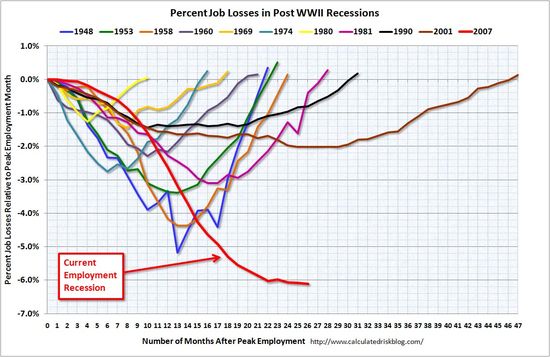
JobsChart
by Patrick Appel

Leonhardt helps decode it:

If the storms indeed had a big effect — if they cut even 100,000 jobs from payrolls — then today’s report counts as very good news. The economy lost only 36,000 jobs last month, far fewer than forecasters expected…But that’s not the only plausible reading of the report. It’s also possible that economists vastly overestimated the snow effect. It’s even possible the snow effect was close to zero.

Chart from Calculated Risk.