Obama To Flip On Civilian Trials?

by Patrick Appel

That is what the WaPo suggests. Greenwald:

Obama supporters spent months vigorously defending the decision to try KSM in a civilian court on the ground that Obama was upholding the Constitution and defending the rule of law.  What are they going to say if he reverses himself and uses military commissions instead:  that he's shredding the Constitution and trampling on the rule of law?  If they have any intellectual integrity at all, that's what they will have to say.  

Ackerman:

Every time Obama compromises on a matter of national-security and civil-liberties principle, his GOP opponents raise the pressure to get him to bend further. His compromises earn him no good will. He is being, simply, punked. And if he compromises on KSM, does he really think the Guantanamo Bay votes will roll in; or will he simply have enough to break a potential filibuster around the Afghanistan war funding request? Obama can fight and win. Or he can compromise, demoralize his base, and the GOP will continue to roll him.

David Kurtz:

Think of the worst possible scenario for what would have happened to New York City, no matter how remote, then insert that into a campaign ad. There's no way to disprove what might have been. Human nature will be to focus on the bullet that we supposedly dodged. Whereas if you actually suck it up and proceed with the trial, it takes all the wind of out that sail. People still go to work, buildings don't fall down, the ground doesn't open up and swallow Manhattan. Democrats show they're strong and resolute and the issue goes away.

Yglesias:

I’m not going to attempt to defend this. I’ll merely note that it’s hard enough to have any kind of civil liberties in this country when the opposition party is pushing for them. When what you have is an opposition that’s pressuring incumbent officials to seize more power for themselves the incentive structure is nuts and the constitution is going to be shredded.
Playing Nice With Iran, Ctd

by Patrick Appel

Joyner scores the Leverett and Ledeen debate:

I find that one rarely goes wrong taking the most pessimistic assumptions of both sides and assuming they’ll come true. Ledeen is almost certainly right that the United States and Iran are simply too far apart to come to an amicable general accord. It would be great if Iran would help us solve all our myriad problems in the region but they’ll only do so in those cases where they can’t afford to do otherwise.

But I agree with Leverett that the implosion of the Islamist regime is a neocon fantasy.

We’ve been counting on the “Iranian moderates” since Ollie North and the gang cooked up their elaborate arms for hostages deal and been continually disappointed. The Green movement that has Americans all a-Twitter is not the rise of a Jeffersonian democratic movement but the backers of a competing regime-approved Islamist candidate. Hard evidence or no, I’m pretty sure the last election was stolen. Hell, I’m pretty sure the one before that was stolen, too. But, at the end of the day, the Iranian president is a hood ornament. Iran is run by the ayatollahs, not the suits.

Tell Me What Your Story Is, Ctd

by Jonathan Bernstein

I'm making a list of ideas that reporters and political junkies pine for, but actually make no sense.  Seth Masket is on it:

Personally, I'd add to this the idea of a truly nonpartisan leader who can lead a state to greatness because he's not wedded to a party.  Also, the idea of a Unity presidential ticket that finds the least exciting ideas of both political parties and pairs up people like Lowell Weicker and Dick Lamm to advance them.

Several readers suggested variations of those ideas, which by the way are discussed in this book.   One particularly creative reader had a longer list than me…here's a taste:

1) Presidency decided by House of Representatives after no one gets an electoral majority, due to third party winning electoral votes or electoral tie
(2) Third party gets enough seats in the House to hold the balance of power in the election of the Speaker
(3) Amendment to the constitution produced by constitutional convention as described in Article V
(4) New state added to the union or State divided into two states with consent of state and Congress, as described in Constitution, article 4

Wait — I like that last one!  I don't think that would necessarily be a bad idea.  The other three, though, and the Mr. Smith scenarios that Seth discusses…yeah, they fit this category nicely.

Equality Is Equality For All

6a00d8341c730253ef01310f5895cf970c-500wi

by Chris Bodenner

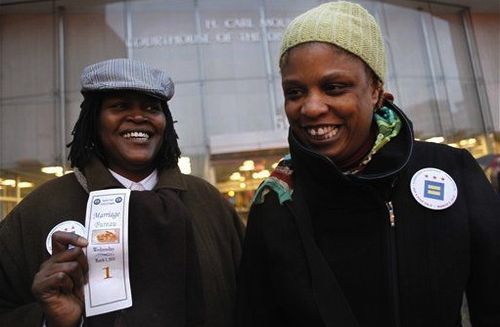
Dan Savage counters those who say that marriage equality should not be a priority for poor minorities:

Wealthy gay couples—whatever their color—can hire lawyers to draw up wills and powers of attorney and jerry-rig some of the protections of marriage. Full marriage equality will allow all gay couples—regardless of color, regardless of economic resources—to access all of the protections of marriage. Marriage equality is a social justice issue.

Towleroad on the photo:

[DC residents] Sinjoyla Townsend and Angelisa Young, partnered for 12 years, were the first couple to receive a same-sex marriage license. Young said that "It's like waking up Christmas morning."

The Iran Debate, Ctd

by Patrick Appel

I wrote:

The strongest argument against engagement with Iran is not that any individual political actor in Iran is irrational, but that the country's leadership is divided against itself and that the warring political fractions are incapable of committing to any sort of international agreement. The green movement added to this disunity.

Kevin Sulivan makes a convincing rebuttal. His whole post is worth reading, but here are the first few paragraphs:

I really think this is, in short, the biggest problem with those who took on the Green banner and championed it so unflinchingly and uncritically since last summer's protests broke out. It's worth noting that many of those who adopted the Green Movement after June 12 were the same analysts and journalists who just months prior had tried their best to put a positive face on Iranian democracy. Once that reality was shaken, and a regime most already understood to be awful actually confirmed said awfulness, many of these same analysts and journalists were left shocked and searching for an explanation.

Along came the Green Movement: a young, cosmopolitan and liberal movement rooted in justice, democracy and Islam; the kind of thing you rarely hear about when Iran hawks clamor on about Ahmadinejad and the "Mad Mullahs." Here, finally, was something even the casual Western observer could get behind.

It's a great story, and it's one that will no doubt continue to be told. But it was always a modest movement seeking electoral reparations; at best "revolutionary" only on its lesser fringes.

Sullivan writes that the "Iranian regime is always divided, and if we were to take Appel's advice, the time for engagement would be never. " I was not advising against engaging an internally divided Iran but simply acknowledging that there are various nodes of power within the government and that the divisions make diplomacy difficult. To take just one example, the uranium enrichment deal fell through, in part, because of internal Iranian squabbling.

From Phone Book To Facebook

by Chris Bodenner

Kashmir Hill observes:

Nowadays, if you’re not on Facebook, it’s possible you don’t actually exist. There was a time when we had to exchange phone numbers or email addresses to keep in touch with a new acquaintance. Now, we usually just head to Facebook and friend them.

The same holds true for business cards, which presumably have declined in use because of Facebook's omnipresent reach.  After my initial infatuation with the site, mostly as a means to track down far-flung people from the past, now I just use it as a directory.  So it has largely replaced the phone book as well. I met someone in New York last week and it simply didn't even occur to me exchange information. (And now, to friend someone, you can simply shake your iPhone.)

650% APR, Ctd

by Patrick Appel

A reader writes:

A good friend of mine got sucked into the payday loan scam a while back.  They had some medical bills and things got tight so they borrowed $600 from a payday loan place.  The terms of the loan were as follows:

  1. The loan had to be paid off in full all at once.  So in any given month you were not permitted to pay down any fraction of the principal.  You had to come up with all $600 all at once.
  2. The interest rate on the loan was 50%/month.  So to keep the loan current it mean paying $300/month.  

This of course meant that they would have to be able to scrap together $900 in any given month in order to pay off the loan.  Given that they were struggling to get $600 together in the first place, getting $900 all in one month would have been a stretch.  Paying the $300/month was painful but doable, but the problem was that they couldn't get out from under the loan because they couldn't get all of the principal together in any given month.

Von Hoffman Award Nominee, Ctd

by Chris Bodenner

Props to Cliff Stoll for owning up to his terrible prediction:

Of my many mistakes, flubs, and howlers, few have been as public as my 1995 howler. Wrong? Yep. At the time, I was trying to speak against the tide of futuristic commentary on how The Internet Will Solve Our Problems. […A]s I've laughed at others' foibles, I think back to some of my own cringeworthy contributions. Now, whenever I think I know what's happening, I temper my thoughts: Might be wrong, Cliff…

Er, a reader writes:

Cliff Stoll was actually wrong even *more* spectacularly than that: he wrote an *entire book* on why everything we have now would never come to pass: Silicon Snake Oil. He doubled down on his crappy prediction. He was just making a living by being a contrarian “expert”, is all. Now? Well, hully gee, he makes Klein Bottles . . . and sells them online.

Buy some bottles here (and you gotta love the Web 1.0 design).

The Daily Wrap

Today on the Dish, Alex Massie sized up the possibility of a hung Parliament, scrutinized the format of scheduled debates, noted the endorsement of Cameron by Mugabe, snickered at the cover of Tony Blair's new book, and guffawed at the victory of a kooky congressional candidate.

Jonathan Bernstein took a long look back at the healthcare reform process, countered Massie over the proper role of debates, mentioned the latest uproar from the fringe right, and discussed budget gimmicks. Graeme Wood pointed out "the perfect tree."

Elsewhere on the Dish, Lieberman put forth a bill to end DADT, Palin came out with a new book and docudrama, Ted Olson displayed integrity in the face of Cheneyism, Mike Potemra defended the inquiries into the detainee attorneys, Douthat defended Mitch Daniels, Noah Pollak knocked Obama's ability to influence Iran, George Friedman argued for a fundamentally different approach to the country, Frum attended a debate between Leverett and Ledeen, Tyler Cowen reviewed Diane Ravitch's new take on education reform, and a bunch of bloggers wondered if we vote too much. A satirical blogger passed away and the Dish received a powerful email from Chile. Christianist watch here and Von Hoffman nominee here. Cool ads here and here. Quintessential MHB here.

Andrew popped in to give props to the Atlantic web team for a rapid response. (He should be back on the grid by tomorrow night.)

— C.B.

A Hung Parliament? Yikes!

by Alex Massie

A new poll of 60 marginal seats Labour won by between six and 14 points in 2005 gives the Tories just a two point lead: 39%-37%. That's good, but not enough to win a majority. No wonder Allister Heath worries that Britain is heading towards the worst of all possible worlds: a hung parliament in which neither party has a majority

It is a calculation that should fill all of us with an immense sense of dread: there is now a 72.2 percent chance of a hung parliament. Or so says Michael Saunders, Citigroup's chief European economist and the one man in the City everybody listens to when it comes to the interaction between parliamentary politics and the financial markets. His model, which incorporates the standard data about the Westminster first-past-the post system, and into which he has fed all of the latest polls, also suggests that there is just a 6.2 percent chance of strong Tory majority, a 19.1 percent chance of a weak one and 2.5 percent chance of a Labour majority. Given the terrible state of our public finances, and Britain's desperate need for a strong government with a clear commitment to fiscal reform, all of this is little short of disastrous.

If no-one wins a majority, Gordon Brown, as the sitting Prime Minister remains in office and has first dibs on cobbling together a coalition with, presumably, the Liberal Democrats (this explains Brown's entirely opportunistic recent conversion to the cause of electoral reform). If that proves impossible then the party with the largest number of seats will be asked if they can form a government, whether it be a majority coalition or a minority ministry.

Suffice it to say, as Allister points out, the markets aren't likely to be enthused by any of this.

So what will the Liberals do? Their difficulty is that while the electorate seems unlikely to be enthused by the idea of their propping up Labour many of their own MPs and local councillors see the Conservatives as a bigger danger (to their own prospects if not the national interest) and are, consequently, more comfortable with a Lib-Lab pact than with sleeping with the Tories.

Relatedly I've a piece at Foreign Policy today marvelling at how Gordon Brown, despite his unpopularity, isn't dead yet.