by Chris Bodenner
The world is flat – and auto-tuned:
(Hat tip: Dino Ignacio)
by Patrick Appel
Michael Singh doesn't approve of how we do sanctions:
This incremental approach is counterproductive. The sanctions’ predictability and long lead time allows Tehran to prepare for them in advance. For example, Iran is currently expanding its oil refining capacity and reducing consumption subsidies in anticipation of the sort of gasoline sanctions moving through Congress, and could be a net gasoline exporter by 2013. Incrementalism inures the Iranian regime to sanctions altogether, stripping of credibility any threats of tougher action in the future. The result is to rob sanctions of their deterrent effect and make extreme outcomes — a nuclear-armed Iran, or war with Iran — more rather than less likely.
by Alex Massie
Bagehot of the Economist is beginning to have some doubts about the Obama administration:
I have hesitated to read drastic slights into the sometimes awkward diplomacy between Barack Obama and Gordon Brown. But this stance on the Falklands cannot be seen any other way. It really is no way for the Americans to treat their most important military ally—as some in America doubtless appreciate.
What stance? Well Hillary Clinton has been visiting Argentina and was asked about the status of the Falklands. Here's what she had to say:
And we agree [with Argentina]. We would like to see Argentina and the United Kingdom sit down and resolve the issues between them across the table in a peaceful, productive way.
And:
[W]e want very much to encourage both countries to sit down. Now, we cannot make either one do so, but we think it is the right way to proceed. So we will be saying this publicly, as I have been, and we will continue to encourage exactly the kind of discussion across the table that needs to take place.
Until now, like Bagehot, I've resisted being anything other than mildly irritated by the American stance and, yes, you can argue that Clinton was merely humouring her hosts and saying the bare minimum that they wanted to hear. On the other hand, this is, as Bagehot puts it, an unwelcome "intervention" and a public declaration of the American position, not an off-the-record "we take no position" briefing from a desk officer in the State Department or at the UN.
Perhaps it shouldn't be a great surprise. Foggy Bottom has never been too keen on taking the British side on this issue, seeing, I suspect, the Falklands as an anachronistic relic of Empire. Be that as it may, the principle of self-determination has generally been something Washington has recognised and it's blindingly obvious that absent that recognition there really isn't very much to talk about when it comes to the Falklands.
So one hopes that Clinton was merely being polite, but her words carry weight and will increase a sense of expectation in Argentina (and more broadly across Latin America) that cannot possibly be met and that is guaranteed to infuriate the British. At best this is clumsy; at worst it's rather worse than that.
If me email is anything to go by – incidentally, that's alexmassieATgmail.com if you want to get in touch – the average Briton is likely to react to this sort of American intervention by suggesting that it's time to bring our boys home from Afghanistan and leave the Americans on their own.
by Graeme Wood
Pakistan's Zardari government, apparently in need of more religious controversy, is moving to alter its blasphemy law. The law forbids insulting Islam and the Prophet Muhammad, and the penalty can include death.
Blasphemy convictions are common in Pakistan, although the death sentence has never been carried out. Most convictions are thrown out on appeal or because of lack of evidence.
[…]
Christians have long complained about the law because it offers no protection if a Muslim accuses them of violations such as tearing a page of the Quran, and many accusations are levelled to settle personal scores. Just making an accusation is usually considered sufficient evidence to register a case.
Blasphemy defendants may often get acquitted, but they are also frequently beaten to death in prison.
Qamar David, a Pakistani Christian who for some reason sent out text messages insulting Muhammad, was just sentenced to life in prison and fined $1200. The Republic of Ireland is less forgiving of its blasphemers, monetarily; the fine there is $34,000.
by Chris Bodenner
“It is absolutely outrageous for the Cheney-Grassley crowd to try to tar and feather Neal [Katyal] and Jennifer [Daskal] and insinuate they are al-Qaeda supporters. You don’t hear anyone refer to John Adams as a turncoat for representing the Brits in the Boston Massacre trial," – retired Air Force Col. Morris Davis, who served as a chief prosecutor for the military commissions under Cheney.
by Chris Bodenner
Liz Cheney ratchets up the disgusting campaign led by Senator Chuck Grassley to impugn DOJ appointees who represented Gitmo detainees. Ackerman:
You know, [the lawyers who] provided the representation that the Rehnquist and Roberts Supreme Court has repeatedly ruled those detainees are entitled? And which even the military commissions provide for? Instead, there’s this McCarthyite tactic of calling Justice Department lawyers the “Gitmo Nine,” a name that oh-so-cleverly suggests that those lawyers were themselves detained at Guantanamo.
Of course the "Gitmo Nine" isn't devious enough for Cheney, so she goes with the "Al-Qaeda Seven." Not only does she presume that all suspected terrorists are guilty before due process, but she ignores the reality that only a fraction of the detainees held at Gitmo were even accused of Al-Qaeda ties in the first place. Ackerman has more:
Grassley knows exactly what he’s doing. He’s taking one of the strengths of the American justice system — the fact that everyone is entitled to legal representation — and implying that it’s unseemly. It’s a testament to the weakness of his character that he will never forthrightly accuse these attorneys of what he’s implying — sympathy with accused terrorists — in a way that they could refute. What a pathetic excuse for a man. Those of us in the media have an obligation to call this smear campaign what it is.
Think Progress rounds up more McCarthyite smears from the far right:
– The American Spectator escalates the number of potential terrorist “abettors” in the Department of Justice from 9 to “as many as 13 to 16.”
– David Davenport, a researcher at the conservative Hoover Institution, wrote in an editorial for the San Francisco Chronicle, “The Department of Justice is supposed to be prosecuting terrorists, not coddling them.”
– The Investor’s Business Daily headlines its editorial: “DOJ: Department of Jihad?” “Just whose side are they on?” IBD asks.
– “It’s like they’re bringing al Qaeda lawyers inside the Department of Justice,” said Debra Burlingame, who lost her brother on 9/11 and a board member of Liz Cheney’s group Keep America Safe.
by Alex Massie
As a general rule, Britain's political and media classes are too fond of importing anything and everything from American politics. This election is no different as both main parties try to emulate the successes of the Obama campaign. The biggest change, however, is the agreement to have a series of three leaders' debates.
Evidence from the United States suggests that such contests tend to confirm pre-existing trends, rather than sharply change the game. However, the US electorate is accustomed to televised debates; they remain a novelty in Britain and so it is quite possible that they will, this year anyway, have a bigger impact than might become customary in the future.
Tim Montgomerie, head of the Conservative grass-roots site ConservativeHome, lays out some of the reasons for opposing the debates here. They're cogent and not simply a question of partisan politics. Yes, the Prime Minister only agreed to the debates because of his lowly standing in the polls and, yes, Brown stands to benefit from the luxury of low expectations when it comes to the actual contests (though much will doubtless depend upon the exact format of the debates).
The biggest beneficiary of the debates, however, is likely to be Nick Clegg, leader of the Liberal Democrats. Although there is no prospect of Clegg becoming Prime Minister (since his party attracts little more than 20% support) he will relish a rare opportunity of confronting Brown and Cameron on more or less equal terms. For once he won't be an afterthought.
Still, as I've suggested here and here, there's something depressing about having these contests at all. That's largely because it confirms and exacerbates the Presidentialisation of our politics, a cult of personality that sits ill with the parliamentary tradition.
A Brown vs Cameron contest is all very well and good but it turns the election into a contest between competing personality cults. That being so, far from strengthening parliament (a good idea!) it weakens it by giving the Prime Minister an even greater "mandate".
All this is perhaps inevitable and the debates are, in this sense, simply a recognition of the way the wind is blowing. Only a handful of voters will have the chance to vote for either Cameron or Brown but the debates will encourage all voters to ignore the competing claims of their local candidates and endorse instead the party, not the man (or woman). This is not the way to improve the quality of MPs.
In other words, whatever is useful (and entertaining) about the debates is countered by their drawbacks as we move towards the curious situation of electing a quasi-President via a parliamentary election. Britain will, of course and as is traditional, muddle through but the more Presidential politics becomes, so the case for rather more wide-ranging reforms becomes stronger.
But it does make one wonder what would happen if, hypothetically, Cameron or Brown were to "win" the debates but lose his seat even as their party won the election. Constitutionally, this would be of no great importance: the Queen would simply invite someone else to form a government that could command support from a majority of the House of Commons; politically, however, it might be a different matter as voters complained that they now had an "unelected" Prime Minister and a government that wouldn't quite be what any of them had voted for.
That won't happen this year but it could, as I say hypothetically, in some future election. So, even though its too late to complain about the cult of personality one should still be wary of it.
by Patrick Appel
Martin Ssempa, preacher and proponent of Uganda's kill the gays bill, is now blogging:
Ha ha ha..the homos are scared to death that we have hard evidence of WHAT they do. They are mortally ashamed of the public knowing the totally deviant sexual activities which include the most unnatural, unhealthy and disease prone sexual activities..fisting, anal licking, scat (fecal) games, brown and yellow showers, etc all these are the acts they want to keep secrets…So they now plant stories to bemoan that I am showing "gay porn" to "little children". That now my members in church are wanting to try out being homos! ha ha ha…
Ssempa's response to criticism from gay bloggers further exposes his warped perspective. Andrew posted pictures of Ssempa's gay porn presentation last Friday. A few readers thought that the pictures looked photoshopped, so I e-mailed Warren Throckmorton to see if he would forward me the the rest of the pictures from the series. A few of the photographs may look photoshopped because of how Ssempa holds the computer, but after examining them I believe that they are legitimate. The pictures are in line with news reports and Ssempa even uses one of the pictures at the start of his hateful, bigoted post, which is excerpted above. I'm posting all the pictures from his presentation below the jump to demonstrate how gays are being demonized in Uganda. Any of these fetishes could be, and are, practiced by heterosexual couples, but Ssempa uses these images to paint gays as sexual deviants. The worst homophobes are always fixated on gay intercourse rather than the reality of gay and lesbian relationships. All five photographs (NSFW):

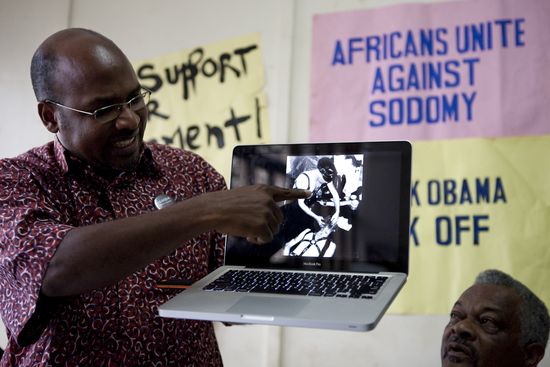

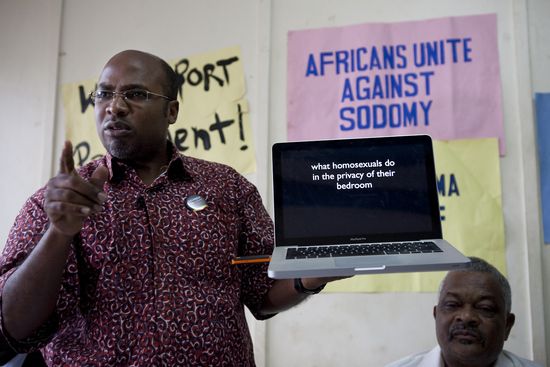
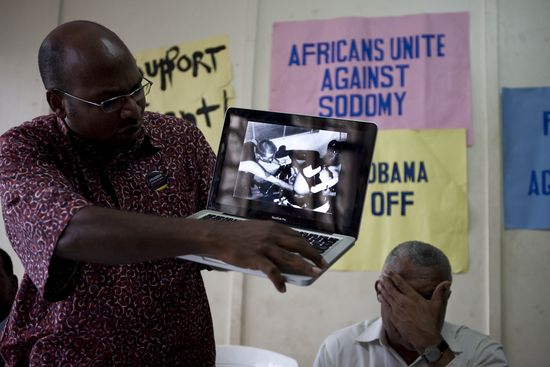
The photographs are used with Warren Throckmorton's permission. His original post is here. His blog, which has been all over this story, is here.
by Patrick Appel
Behind the scenes footage:
by Graeme Wood
Christopher Hitchens's call for pre-emptive earthquake aid to the Islamic Republic of Iran brings back a rush of numb memories. I was in Iran after the Bam earthquake of 2003, and I hitchhiked immediately to the earthquake zone, packing in food and water to avoid getting in the way of the last rescue efforts.
Even in war, I have never seen such wreckage. Most of the shops seemed to have buckled in the same way: their concrete side walls toppled together to the left or the right, and the heavy slab of the roof slammed down on whatever was inside. During the afternoon I walked around the Citadel of Bam, formerly a vast adobe labyrinth, now thoroughly pulverized. It looked as if a giant had inserted a pestle into the mortar-bowl of the Citadel, and just stirred and ground away until nothing was left.
Bam's temblor killed only 26,000 people. Hitchens points out that Tehran is built over a crisscross of faults, and that a quake as strong as the one in Haiti could kill a million. After Bam, all Iranians had a fresh reminder that the Big One would hit Tehran soon enough. Which made me wonder: why does anyone still live there? Why not consider moving to a less seismically precarious place, or at least to more durable housing? I never got a satisfactory answer, although one hotel clerk did say offhandedly that Iranians were familiar with the experience of being promised big changes — positive or negative — and that the threat of an earthquake sounded a lot like yet another vision of change that would be infinitely postponed.
 The Dish