It appears they have a "cycle of abuse" up there – of humans having sex with animals.
The Daily Wrap
Today on the Dish we rounded up reaction to Obama's spending freeze. Andrew's take here. (He also offered his early take on the SOTU address.) DiA chastised the NYT for its coverage of the announcement.
Noam Scheiber, Paul Begala, Kos, and Andy Stern kept the "pass the damn bill" beat going. Frum pointed the finger at Dems while the Dish singled out these three. Larison and Andrew ventured into the dynamics between jihadism and Israel. Max Fisher surveyed the reaction to Yoo's PR push while Andrew kept the coals burning on the Gitmo deaths. And we learned that Pope JP2 liked to beat himself.
In other coverage, Mark Thompson countered Frum over funding political parties, Jonathan Bernstein explained how politics has changed, and Rebecca Traister sat through Palin's appearance on Oprah. The latest on the Prop 8 trial here and here. Recession update here. Neil Gaiman mourned his cat while the keyboard kind struck again. And this one pwned a bear.
— C.B.
Public vs Private Jobs, Ctd
A reader writes:
I doubt I'm the first one to write in about this, but the database you posted here doesn't contain any data that would help meaningfully answer the question about whether government workers are overpaid. It's true that in nearly every county Federal, State, and Local workers ON AVERAGE make more than non-government employees, but we have no way to know whether these are
equivalent groups of workers.
It's entirely possible that government workers appear to make more because they, disproportionately, hold jobs that require high school or college degrees (or even post-graduate degrees) while the private-sector employees disproportionally work service and manual labor jobs that require little education or training. If salary isn't broken down by profession, education level, etc., then comparing public to private workers is comparing apples to oranges. It doesn't tell you anything to know (in a county where, for example, the biggest government employers are a VA and the public school system) that a pool of doctors, teachers, and clerks makes more than a pool of mostly small business owners, service workers, and agricultural laborers. What you need to know instead is whether a doctor or teacher or secretary would make more working inside the government or outside of it.
Digging Up The Hatchet
Ezra points to this Youtube and posits that "you can't look at this as anything less than a tremendous defeat for the Obama administration." Greg Sargent sees Obama's shift as a body blow to the "larger argument" of liberalism:
Obama defenders will point out that he’s always been a pragmatist. But fairly or not, liberals saw in him someone who would use his extraordinary communications skills to expand the field of what’s pragmatically possible, to move public opinion — not someone who would ever play by the other side’s rhetorical rules. Each time he falls short of this ideal, people grow less willing to give him the benefit of the doubt.
My take here. Jared Bernstein blogs the White House response:
There are two ways to do a freeze like this: (1) an across-the-board freeze on every program outside of national security; and (2) a surgical approach where overall totals are frozen but some individual programs go up and others go down. In short, a hatchet versus a scalpel.
During the campaign, you may recall that John McCain touted option 1 – the hatchet approach of an across-the-board freeze.
The President was critical of that approach then, and we would be
critical of it now. It’s not what we’re proposing.
To the contrary, the entire theory of the President’s proposed freeze is to dial up the stuff that will support job growth and innovation while dialing down the stuff that doesn’t. Under our plan, some discretionary spending will go up; some will go down. That’s a big difference from a hatchet.
I really think the tailspin of left-liberals this past week needs to end. As long as the health bill gets through and the spending freeze is supplemented by a real commission to cut spending and raise taxes, he'll be fine. If he's just putting forward a gimmick and if health reform is over, he's far from fine. But we don't know either of those facts yet. Let's wait for the SOTU, shall we?
Face Of The Day
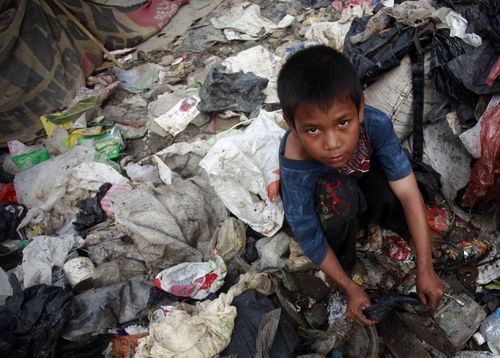
Basir, eight years old, works separating plastic he has collected from the landfill after finishing school for the day on January 26, 2010. The Bantar Gebang landfill site is one of biggest dump sites in Jakarta, Indonesia. Children who live and work at the landfill are schooled by day before going to help their parents scavenge and sell their finds after classes are over. Around 6,000 metric tons of garbage are dumped daily at the landfill. By Ulet Ifansasti/Getty.
TNC Bait
The "7th Circuit Upholds Prison Rule Forbidding Inmates to Play Dungeons and Dragons":
The prison’s rationale for the ban is that playing D&D might stimulate “gang activity” by inmates. But the government conceded that there is no evidence that Dungeons and Dragons actually had stimulated gang activity in the past, either in this prison or elsewhere. The only evidence for the supposedly harmful effects of Dungeons and Dragons were a few cases from other states where playing the game supposedly led inmates to indulge in “escapism” and become divorced from reality, one case where two non-inmates committed a crime in which they “acted out” a D&D story-line, and one where a longtime D&D player (not an inmate) committed suicide.
Quote For The Day
"We would be more American on the day we permitted same-sex marriage than the day before," – David Blankenhorn, a witness in favor of Prop 8.
Has Bin

Juan Cole deconstructs the latest tape from Osama bin Laden:
I don't know if the old monster is dead, and some clever young engineers just have a program to emulate his voice, or whether he is alive and horribly disfigured (we have not seen him in an authentic video since October 2004). But I do have the severest doubts that he issued this audio message. And the interesting thing is that even if he did, almost no one in the Muslim world seems to care.
(Image: A recent piece by Banksy, discovered outside Salt Lake City.)
Sexual Fluidity
Talbot explains why both sides in the Prop 8 case have paid so much attention to whether sexual orientation is genetic and fixed:
One of the four criteria for defining a classification such as sexual orientation as suspect—which in turn subjects laws targeting that class of people to the highest burden of proof—is that the group in question share an immutable characteristic. The immutability of sexual orientation is hardly a settled matter—just ask Anne Heche. But maybe it needn’t be always immutable—just generally a matter of deep internal promptings that would take some serious suppressing to get over. The three categories that the courts have said in the past warrant strict scrutiny are: race, national origin, and religion. The first two are clearly immutable, in the sense that most people think of the word, but religion is not. Indeed, it might well be that people convert, are born again, or lose their religion altogether as often as they switch their sexual preference.
 The Dish