So say several news outlets. But EA methodically debunks the claim, essentially calling it a misinterpretation. Masoud adds:
Lost in the quote is yet another significant tidbit, one which reveals that if anything, Karoubi was actually sharpening his rhetoric. By not addressing Khamenei as "Supreme Leader" or even "Ayatollah," but simply "Mister," Karoubi has implicitly challenged Khamenei himself.
This reader was a software developer who was weathering the recession well so far. Original post here. Our reader writes:
Everything is better than previously reported actually. My career moved up, my income followed. I was able to make extraordinary investments in wine as people were selling off cheap to raise cash. And while I didn't pay off my mortgage as I hoped, that happened because I diverted the extra cash I was making on my payments towards investments. So I'm still on track.
But the real reason I'm checking back in is because there was one thing this past year that did change for me. And it may or may not have happened regardless, but I think the recession did bring it into focus for me. And that is my discovery of urban gardening (or I should say suburban gardening). What a rush and how fulfilling. Who knew?!
I've been reading blogs about people doing the same for some time now and there are some incredible success stories out there. (You really ought to do a View From Your Urban Garden series.) People who were really hit hard by the recession taking it within their own hands to dig out, literally! It's inspiring and very, very, very humbling.
We've been growing all sorts of things in the house with some success and we're still learning. Cucumbers, tomatoes (turns out it is possible to kill tomatoes), onions and mushrooms (not shrooms, although they've been discussed). It's not enough to live off of, but we would starve very very slowly if it came to it, provided we can keep electricity and water. We've been able to give food away as well. Helping my friends get up and running and showing them how easy it is has been rewarding. It was also something my fiance and I discovered that we both loved to do and really enjoy. What till march rolls around, we're planning on tripling the size of our garden and hopefully figure out how to can and store the extra.
So as the recession seems to be waning I find myself with a really good job and really good health. But I've been there before and so were alot of people before the recession. So I plan on continuing to live well below my means and save and store as much as I reasonably can while still being happy. Being happy is the one thing I know I can control each day as I get out of bed.
Weigel points to the latest installment of Harold Ford's performance art piece Senate campaign:
The two bantered about the difference between New York and Tennessee, with [radio host Fred] Dicker poking fun at Ford for pronouncing “smear” (as in: “I’ve been the victim of a smear campaign on my position on choice”) as “schmear”, prompting this exchange:
Dicker: “I think schmear is something you put on a bagel.”
Ford: “I’m a little country. I apologize…It’s “smear”, s-m-e-a-r. Y’all talk funny.”
Weigel:
Winning over New Yorkers by 1) bungling an ethnic pander then 2) joking that they talk funny and that their food is weird! Next, expect Ford to call A-Rod a “Red Sox fan.”
TNC takes a much more sober look at the former congressman from Tennessee.
“The Rethink Scholarship is an $18,000 scholarship for aspiring art directors and designers to Langara College’s Communication and Ideation Design program. The winner will also receive a 3-month internship with Rethink.”
According to Mark Regnerus, the author of the forthcoming Premarital Sex in America, among women who made virginity pledges and are now married, only 13. 9 percent waited until their wedding night to have sex. There aren’t good data on women who make virginity pledges after they are sexually active—who try to become “secondary virgins,” as researchers put it. What we do know is that some young women—often born-again Christians, like Bristol—believe that repledging virginity can erase their sexual histories. These teens “typically reconcile their memories with their present beliefs,” according to a study called Reborn a Virgin: Adolescents’ Retracting of Virginity Pledges and Sexual Histories, published in the American Journal of Public Health in 2006.
We have some new evidence of how he understood it:
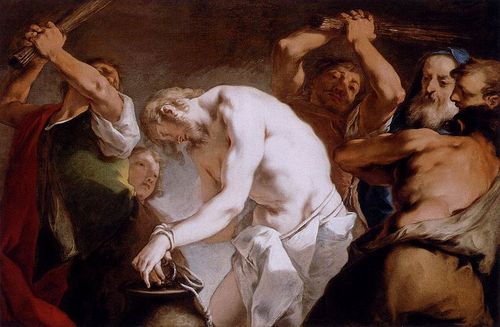
Pope John Paul II whipped himself with a belt, even on vacation, and slept on the floor as acts of penitence and to bring him closer to Christian perfection, according to a new book by the Polish prelate spearheading his sainthood case…
“It’s an instrument of Christian perfection,” Oder said, responding to questions about how such a practice could be condoned considering Catholic teaching holds that the human body is a gift from God.
“As some members of his close entourage in Poland and in the Vatican were able to hear with their own ears, John Paul flagellated himself. In his armoire, amid all the vestments and hanging on a hanger, was a belt which he used as a whip and which he always brought to Castel Gandolfo,” the papal retreat where John Paul vacationed each summer.
A reader notes:
So the practice both disrespects the body as a gift from God, but is also, according to the higher-ups, part of the asceticism of Christian perfection.
Let’s bracket for a moment whether or not this can be worked out within a revealed theology. The question is whether it can be worked out in a natural theology and, more specifically, in a natural morality such as the the “new natural law”, which purports to show that practical reason is capable of arriving at certain conclusions about human behavior irrespective of religious beliefs.
As you know in the NNL, as promulgated by, for example, Germain Grisez, John Finnis, and Robert George, there are “basic goods” that cannot be attacked for the sake of other goods, among those basic goods we find “life”–and it would seem that whipping oneself is tantamount to attacking one’s own life, which includes, as I understand it, one’s bodily integrity. But even if that could be accommodated, there is a more pressing problem: a constant theme in NNL is that one cannot use one’s own body as a mere instrument in order to create a subjective experience in a way that “disintegrates” the unity of body and self.
So, for example, masturbation is the illicit use of one’s body as a mere instrument for a subjective experience that is not unitive of the body and self. (The same applies to homosexual acts, mutatis mutandis.) Eating is morally acceptable because the act of eating is actually (in reality) conducive to body wholeness regardless of one’s subjective intentions, but gluttonous eating would not be alright because it violates the body’s good for the sake of pleasure.
It doesn’t matter whether we find these arguments convincing or not (but by the way, I think that if they are right, they prove too much: they cannot defend natural family planning because it separates intentions from acts, but that’s another email): what matters now is that our former pontiff, on this account, would seem to be using his body in a way that disintegrates his person: he inflicted pain on his physical body for the sake of another end, namely, a subjective experience of being reminded of Christ’s suffering. The other big issue is that John Paul II, in Veritatis Splendor, basically endorsed the basic goods theory of the NNL! On his own account, it would seem that he’s violating the general Catholic moral principle that one cannot do an evil (based on its proximate end) in order to promote a good, however good that ultimate end is.
It seems to me, unless I’m missing something, that something has to give: either the NNL is wrong, or JPII (along with many in our pantheon of saints) committed a moral crime. I just wonder, if I’ve represented the NNL’s position accurately, which horn of this dilemma they’ll choose. Or, they’ll just ignore this problem completely.
And I write this not as someone who hates the Church: I love the Church and I’m trying to find a way to allow for fallibility and forgiveness to enter into this crucible of certainty and hostility toward the marginalized and the outsiders that now seems to dominate discourse among the self-identified orthodox. Nor do I disagree with all the things the NNLs believe (I’m pro-life, e.g.) or think that JPII was an awful pontiff (though I do have some disagreements, obviously). But at some point, it would be dishonest for me to ignore what strikes me as very tortured (no pun intended) arguments and sheer advocacy for conclusions already desired.
I have every respect for the practice of self-mortification and self-denial. I believe that certain acts which may be harmful for the body – long periods of fasting and even self-mortification practices like the cilice – can be transformed into spiritual ends. They can evoke a reminder of our mortal selves, a way to chip away at the encroachment of pride or self-obsession, a means to emulate the suffering of Jesus. Jesus’ experience of profound pain is one way he embraced his humanity and through such pain, we also can come closer to Jesus and God. Done wrong or obsessively, self-mortification can become a kind of neurosis or even fetish. But I see the last Pope’s embrace of these things as affecting signs of his deep and genuine closeness to God.
But my reader is also onto something. Such acts do separate out the natural bodily integrity George et al. defend as something amenable to any non-believer’s reason. So why is self-abuse inherently wrong when it is done by hand and yet saintly when it is done by whip?
In an attempt to spoof College Humor’s Prank Wars Half Court Million Dollar Shot, the school told Branstrom if he made a half-court shot while blindfolded, he would win NCAA tickets. However, the school never had NCAA tickets to give him, as they never expected him to make the shot.
A Dish reader asserted that the "idea that public employees make less than those in the private sector is a myth that needs to die." Drum responds:
[Is] this actually true? In the upper reaches of management, it obviously isn't. Mid-level and executive level managers often make half as much as comparable private sector managers. (Or less.) And although rich pension deals make headlines, it's not clear how widespread they really are. More generally, though: do ordinary workers (clerks, school teachers, construction workers, etc.) make as much as their private sector counterparts? Or more? And where could we go to find out?
 We have some
  The Dish