So meta:
Pass. The. Damn. Bill.
Andy Stern of the SEIU warns the Dems:
"Take the Senate bill as it is as the foundation to find ways whether through reconciliation or other legislative processes to try and fix the things that a lot of people think need to be fixed both now in the House and the Senate. I think going through reconciliation we don't have Ben Nelson or Joe Lieberman to kick around anymore. So the 58 other senators get to decide something they maybe didn't get to decide the first time around because of the hostage-taking that is going on in the Senate."
Pass. The. Damn. Bill.
Kos proclaims that the Democrats have a base problem:
[The Democratic base doesn't] need blogs or MSNBC to tell them that Democrats can't govern. They already knew that Republicans don't want to govern, but the Democrats were supposed to be different. And they are, they want to govern, but they can't. And the voters that worked their asses off to give Democrats the White House and super majorities in Congress are now realizing that it was all for nothing. That all that talk about hope and change was cynical bullshit designed to motivate them. It worked once, but that crowd is learning the art of political cynicism, and it ain't pretty.
Which is one more reason that failure to pass the health reform bill would be fatal – both substantively and politically. In my view, a failure to pass it will end Obama's presidential coalition and destroy his political viability. Why? Because it will reflect a failure of nerve. And Obama has no chance of doing what he wants to do without nerve.
Less vague hope, Mr president. More specific audacity.
Keynes vs Hayek
It’s a mustachioed rap-off:
(Hat tip: Megan)
The Fiscal Pivot II
The devil here is in the details. The administration is proposing specific cuts in the budget. Most expect those cuts to be pretty unobjectionable. Some programs — particularly in the education and health spheres — will even see increases. But it'll be hard to evaluate the policy until we see where the savings are actually coming from. "Non-security discretionary spending" is a big category.
spending freeze, no matter how notional, is a huge ceding of rhetorical grnd by WH. will give GOP more leverage in makng anti-hcr, stim case.
I’m attempting not to freak out because (a) I don’t have details and (b) I suspect this initiative was deliberately leaked to progressive bloggers in an effort to get denounced by the left and I don’t want to give them the satisfaction.
My standard position on these things is that they’re political cowardice aimed at creating the false illusion of political courage. That was true of Gramm-Rudman and all of the freeze this, across-the-board that proposals that have come along since. Sure, they force cuts, which I generally favor. But they do so willy-nilly, without any analysis of costs and benefits. Much better, in my view, is to cut bad programs (various corporate subsidies, including farm subsidies, for example) and keep the good ones.
Republicans will scoff at it for being relatively meaningless and Democrats will undersell it because they're not enthusiastic, which somehow will send a cue to the folks between the 40 yard lines (as Chris Matthews likes to say) that this the real thing. Real risk, chance of reward: small. The big if — IF the president really fights for this…fights against his own party, and does so with conviction — if Democrats decide to embrace this (which is doubtful), then it could help both his party and himself.
Drum:
Just to be clear: $250 billion over the coming decade, even if Obama miraculously makes this work,1 is $250 billion out of a projected deficit of, oh, let's call it $10 trillion in round numbers. In other words, about 2 or 3 percent. And in return for what? The liberal base now has yet another reason to be disgusted with Obama, so the obvious hope is that independents are going to lap this up. And who knows? Maybe they will. But what I wonder is this: hasn't Obama's pivot happened too quickly to seem like anything other than what it increasingly is: a panicky and transparent attempt to recover from the Massachusetts tsunami?
I don't doubt that Obama has the Clinton-like political ability to pivot on a dime and sell it with brio. What I do doubt, after a year of watching him, is that he truly believes in his heart of governing hearts that this is a virtuous or workable path, or that he's particularly concerned with the considerable gap between what he promises and what he delivers. Presidents, including the last guy, whatshisname, always promise deficit-reduction in every State of the Union Address. We still haven't quite launched that Mission to Mars. I will be happy–and at this point, shocked–to be proven overly skeptical.
Obama’s pseudo-spending freeze is a chance for Republicans to be (refreshingly!) bipartisan, and to take advantage of Obama’s willingness to move the debate over the rest of this year to a terrain—who will constrain big government?–that is good for them, and the country.
I really want to see how the supporters of a budget commission and the deficit peacocks on Capital Hill and elsewhere react because that will be the best indication of whether the Obama proposals have a shot in hell of being enacted. Their reaction will also provide the best indication about whether they're as serious about the deficit as they have been saying or whether they've just been preening for the cameras.
[W]hatever the administration’s motive–whether it was to appease bond traders or tea-partiers–and whether the effect on the actual budget is large or small, the administration’s announcement is an admission of abject failure. Obama was, after all, a professor, as were two of his main economic advisors, Larry Summers and Christina Romer, but in the past year, they have failed utterly to explain to Americans (let alone the bond traders) how deficits function in recessions.
It’s appalling on every level.
[T]he freeze is more notable for what it excludes than what it includes. For now, it does not include the largest domestic spending programs: Medicare, Medicaid and Social Security. And all "security-releated programs" are also exempted from the freeze, which means it does not apply to military spending, the intelligence budget, the Surveillance State, or foreign military aid. As always, the notion of decreasing the deficit and national debt through reductions in military spending is one of the most absolute Washington taboos. What possible rationale is there for that?
[It] could be that the president's federal spending freeze and efforts to prop up state governments really do cohere — the stimulus represented an effort to buy time for state governments to get their fiscal houses in order, and the spending freeze represents an effort to stop the bleeding at the federal level as we devise a mix of deeper spending reductions and tax increases that will put us on a sustainable course over the longer term. Perhaps the stimulus was a feint. Rather than serving as a down payment on a wave of public investments, it was a strategic pause in a broader effort to right-size governments at all levels. Suffice it to say, I don't think that this reflects the vision of President Obama and the Democrats.
There really is no good way to interpret this turn of events. From the standpoint of the purely economical, this is a huge mistake. Even if we assume that the economy will be strong enough in 2011 to handle budget balancing, this proposal is practically worthless. The administration has said this will produce $250 billion in savings over ten years, but as The Economist noted in November, the fiscal deficit will be over $700 billion in 2014 alone, and will grow from there. Non-defence discretionary spending is nothing; those who are serious about long-term budget sustainability talk about defence, they talk about entitlements, and they talk about revenues. In other words, this will do very little about the deficit, and it will do even less to convince markets of the credibility of the American effort to trim the deficit.
Every little bit helps, but this is barely a budgetary fig leaf.
I'll let the economists talk about the wisdom of curtailing government spending in the middle of a massive consumption deficit, but what concerns me more is the politics. Specifically, the sort of cognitive dissonance that is going to be created in the mind of the average voter when the White House is promising to freeze spending on the one hand (or, more accurately, this will be the media caricature of their gambit), and on the other, trying to defend its stimulus and its health care reform package, trying to excuse the bailout package as a necessary evil, and perhaps trying to champion new programs.
One way to achieve fiscal tightening without endangering the recovery would be to enact entitlement reforms now that won't take effect for some years. Anything meaningful, such as raising the normal retirement age, will have to be phased in over many years anyway. Since entitlements have to be reformed at some point, doing so now would demonstrate resolve to get the budget under control while avoiding near-term fiscal tightening that might be premature.
There's not much to say in terms of the economic issues, the real lesson is that politics is more constrained than many people think. Berating Obama for his lack of courage or his "failure to get tough" is simply denying or postponing this fundamental realization.
For Bernanke
Bartlett makes the case.
HuffTwit
Is the Huffington Post plotting to duplicate all of Twitter?
The Fiscal Pivot
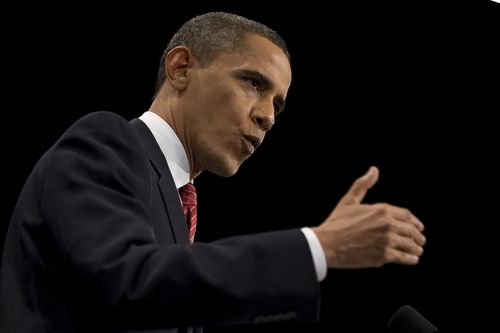
The Dish has been arguing for months now that once the worst of the recession is over, Obama should shift his attention to the deficit and the long-term debt. I find the proposed spending freeze to be a symbolic start, a way for the administration to show that it can focus on good government, that it can prune domestic discretionary spending both to hone priorities and to cut waste. It is, of course, a substantively trivial debt-reduction without a serious entitlement and defense review. It's not as trivial as the "pork" fixation. But it is an important – I'd say vital – rhetorical framing for the rest of his term in office.
Obama has his work cut out Wednesday night. He needs to frame health insurance reform as both a moral imperative and as a fiscal downpayment. He has to argue that the cuts involved in health reform will be made and that it's fiscally irresponsible not to make them. He should commit to vetoing future budgets if those Medicare cuts are not made. Then he has to embrace the spending freeze and commit to a deadly-serious entitlement and debt commission that will slash long-term entitlement spending and enact some new revenue system (my preferred option is a VAT, but I'm open to suggestions) to resolve the long term fiscal problem in his first term. This is his populist gesture: a commitment to do what is right against the status quo, regardless of the political consequences.
His theme is clear: he did not come to Washington to play the same old games. He is not interested in the old politics. He wants real reform. He will do everything he can to enact it in his first term, even if it costs him re-election. He should reprise the essential message of his campaign: change.
My view, however, is that this strategy makes no sense without an equally uncompromising effort to pass the Senate health insurance bill.
In my view, the House Dems need to just vote the Senate bill and forget about amending it in reconciliation. If the House Dems cannot do that, they're even more useless than I imagined, and will thoroughly deserve to go down in November. The point is that Obama's fiscal pivot for Independents risks losing Democrats if health reform is left for dead. And it's that coalition that elected Obama and is currently the only coalition capable of addressing this country's profound compounding crises.
The importance of Obama's fiscal pivot is two-fold. The first is that, after the spendthrift Bush years and the fiscally crippling but necessary response to the recession, it's the right thing to do. Given the precarious state of the world economy and the fragility of the dollar, it's actually an urgent thing to do. And again, the real issue is long-term entitlements and defense and the collapse of the revenue stream. If we do not fix this soon, the next generation can say goodbye to any prosperous future.
The second element is political. It is simply astonishing that the GOP is now posing as a party of fiscal responsibility. It's like Bristol Palin campaigning against teen pregnancy. They cannot be allowed to get away with this canard without a thorough accounting of their own profound responsibility for the current state of affairs. Obama was forced to spend in his first year to avoid a second Great Depression. He must be careful not to overdo it and risk a double dip. But he must make solvent government his core objective and he must pound that home day after day, even as he also focuses on jobs. Without that kind of reform, no one should have long term faith in the US economy – because its political system is failing it.
Fiscal responsibility will be for Obama what welfare reform was for Clinton: something he believes in anyway but that can reframe his administration away from the exhausted red-blue, right-left paradigm that the intellectually exhausted Republicans are grabbing onto as the only politics they understand. Obama should be brutally honest about the reasons for spending in his first year and equally blunt about the need to tackle the long-term debt now, while we still can.
Further thoughts on the SOTU later today.
(Photo: Jim Watson/Getty.)
Pass. The. Damn. Bill.
Begala is "begging":
I understand and share the frustrations of progressives. They compromised before the debate even began, giving up on Medicare for all and settling for its weak cousin, a public option. The progressive wing of the Democratic Party has been everything that the reactionary wing of the Republican Party has not: open-minded, pragmatic and respectful of the views of others. The Republicans' obstinacy has been rewarded by the voters, who sent Scott Brown to the Senate as the candidate of change who promised to defend the status quo on health care. So why do I urge further flexibility? Because failure is not an option and surrender is not a strategy.
I am convinced that Democrats lost the Congress in 1994 because we failed to pass health care. And yet today many Democrats are worried that they will lose the Congress if they pass health care. They are wrong.
The View From Your Window

Flagstaff, Arizona, 8.31 am
 The Dish