The Death Of A Cat

Neil Gaiman's real-time journal is oddly moving:

I slept in the attic bedroom again last night. Zoe seemed weak and listless when I went in, and was huddling on the floor by the heater. She smelled weird, like bile. She got out of bed a couple of times in the night, to throw up a couple of teaspoons of foam. Then I'd clean her up and bring her back to the bed, and she'd snuggle and purr.

When I woke up this morning, she was in her cat bed on the floor. I cleaned up the vomit-foam that had happened while I'd slept. Now I'm off to drive through something that appears from wunderground.com to be a full-on ice-storm to go and get Olga from the airport and bring her back to spend a last day with her cat.

And I'm wondering what it is about this small blind cat that inspires such behaviour — mine, Olga's, Lorraine's…. I've had cats in this house for 18 years, and there are cat-graves down by gazebo. Two cats died of old age last year. It wasn't like this.

I think it may be the love. Hers, once given, was yours, unconditionally and utterly.

Jihadism And The Israel Question

Larison, as often, treads where angels fear to:

When most Western anti-jihadists hear that Bin Laden has tied the Christmas bomber attack to the cause of Palestine and specifically to the treatment of Gaza, or when they learn that the bomber who killed the seven CIA operatives claimed that the Gaza operation early last year had driven him to jihadism, the conclusion they draw is not that there was and is something wrong with U.S. and Israeli policies with respect to Palestinians. There is no sudden revelation that the inexcusable blockade of Gaza is politically unwise as well as morally wrong. On the contrary, the support Bin Laden expresses for the Palestinian cause makes that cause seem to most Western anti-jihadists to be that much more indistinguishable from Al Qaeda’s goals and therefore that much more antithetical to Western interests.

This might very well be another purpose in Bin Laden’s exploitation of Palestinian grievances: to harden Western audiences against Palestinian claims even more by linking his cause to Palestine, which will make Americans in particular less interested in supporting an administration that tries to exert pressure in support of a peace settlement. Bin Laden would like to appropriate the Palestinian cause, which Palestinians definitely do not want, and most Western anti-jihadists would like nothing more than to let him have it.

Jihadism has many causes. It is, as my shrink helpfully says, multi-determined. But the idea that Israel’s occupation of the West Bank and pulverization of Gaza can be bracketed entirely out of that dynamic is loopy (see how the CIA’s double agent turned again after Gaza). It’s clear that taking the Israel-Palestine question off the table would help us tackle Jihadism immensely. If the US were to help establish a Palestinian state and could be shown to stand up to Netanyahu’s continual provocation, it would help the US advance its interests in the region and the world.

It would not remove or emasculate the more irredentist factions, the Qaeda core, the Saudi nutjobs, and the Mumbai maniacs. But it would help shift the paradigm in which they can use the daily humiliations of Arabs in the West Bank or the horror of the Gaza attack as ways to move the Muslim middle. The same goes for closing Gitmo and ending torture. And the reverse is true: those who want to brandish Gitmo, embrace torture and accelerate Israeli settlements intensify the polarization that the Jihadists relish.

Unwinding this cycle is a huge amount of what Obama is trying to do. Which is why those who want a civilizational war are so adamantly opposed to him and his policies.

Here Comes The Haggis

Haggis

A 21-year-old ban is lifted:

The "great chieftan o' the puddin-race" was one of earliest casualties of the BSE [Bovine spongiform encephalopathy] crisis of the 1980s-90s, banned on health grounds by the US authorities in 1989 because they feared its main ingredient ‑ minced sheep offal ‑ could prove lethal. […] "It was a silly ban which meant a lot of people have never tasted the real thing," said Margaret Frost, of the Scottish American Society in Ohio. "We have had to put up with the US version, which is made from beef and is bloody awful."

Massie hails the Obama administration: "At last, real change we can believe in."

Life As A Neocon

A nice little tidbit from the Newsweek piece:

Fully half of the eight featured speakers on Commentary's Alaskan cruise this summer, for example, are Podhoretzes (paterfamilias Norman; his wife, Midge Decter; his son, John; and Elliott Abrams, his son-in-law) … Sometimes it seems there are nearly as many Kagans as neocons. In fact, there are only four: Donald (the father), Robert and Frederick (Donald's sons), and Kimberly (Frederick's wife). Donald Kagan, a professor of history and the classics at Yale, is an authority on the Peloponnesian War, but his interest extends to war itself, which he has come to view, as he once put it, as "the default state of the human species."

And there are those who try and restrain that impulse and those who embrace it as a good.

The Boss Tweed-ization Of National Politics

Mark Thompson disagrees with Frum's suggestion that political contributions should flow through the parties:

Frum’s proposal is a recipe for creating machine politics on a national scale.  Strengthening parties is a guaranteed way of ensuring that everything will be a party-line vote, which may or may not be a bad thing, depending on your perspective.  But because it strengthens parties so much, it just shifts the appearance of corruption from individual politicians with only one vote or one voice who are at least nominally accountable to the electorate to national party chairmen with near-absolute control of every vote in their party and of every agenda item in their party who are not even nominally accountable to the electorate.

Chart Of The Day

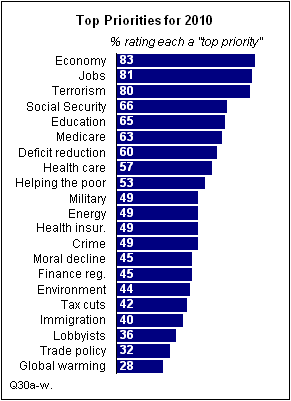
Priorities

From a recent PEW study:

[P]olicy priorities show little change from a year ago. For example, despite the ongoing debate over health care reform, about as many now call reducing health care costs a top priority (57%) as did so in early 2009 (59%). In fact, the percentage rating health care costs a top priority is lower now than it was in both 2008 (69%) and 2007 (68%).

In addition, the percentage placing top priority on providing health insurance to the uninsured stands at 49%. That is little changed from a year ago and off its high of 61% in January 2001. Notably, there is now a wider partisan gap in opinion about this issue than for any of the other 20 issues in the survey: fully 75% of Democrats rate providing health insurance to the uninsured as a top priority compared with just 26% of Republicans.

How Politics Has Changed

Jonathan Bernstein reflects:

Politics, in one respect, has really changed over the last two decades.  Both parties, but especially the Republicans, now have highly efficient ways to get their talking points out to the rank-and-file, without confusing things by also informing them of the larger context.  That's really different than things were in the 1950s, 1960s, and 1970s.

Back then, politically attentive people would watch the network news and the local news and look at the occasional newspaper, and maybe Time or Newsweek, and on top of that they would also be exposed to party talking points.  Now, to a great extent, people's only exposure to the news may consist of the party's talking points (again, especially on the Republican side).  So the old job of finding out how well those talking points are resonating by hearing whether ordinary folks use them to talk about politics is no longer a useful task.  Increasingly, the only language to which people — once again, especially Republicans — are exposed is those talking points.  For a Rush/Beck listener, there isn't another language available to discuss the health care bill.

Who Is At Fault If Healthcare Fails?

Frum pins blame on the Democrats:

There’s always one reliable way to over-ride a filibuster: mobilize public opinion. In February 1917, when isolationist senators filibustered legislation to arm merchant ships, President Wilson crushed them by direct appeal to the public: “A little group of willful men, representing no opinion but their own, have rendered the great government of the United States helpless and contemptible,” he said in a March 4 address. A month later, the U.S. had gone beyond arming merchant ships – it was at war. But you can only appeal to the public if the public supports the underlying cause. Obamacare’s problem is ultimately not the Senate, but the country.

Well, we'll see if Obama fights for this Wednesday night and takes the real case to the country. If he doesn't, if he caves, then we will know he can be rolled. And so will the nihilist right.