Kottke notes, “The unchopped tree bit in the last minute is particularly beautiful.”
Maya Lin – Unchopping a Tree from What is Missing? Foundation on Vimeo.
Kottke notes, “The unchopped tree bit in the last minute is particularly beautiful.”
Maya Lin – Unchopping a Tree from What is Missing? Foundation on Vimeo.
Alan Jacobs wonders about information addiction:
Consider an analogy to restaurant dining: Americans in the past twenty years have spent far, far more on eating out than any of their ancestors did, and that's a significant development even if you point out that huge portions of fat-laden food mean that they're not paying all that much per calorie. In fact, that analogy may work on more than one level: are we unhealthily addicted to information (of any kind, and regardless of quality) in the same way that we're addicted to fatty foods?
Kottke points to a passage in Richard Dawkins' book, "The Greatest Show on Earth: The Evidence for Evolution":
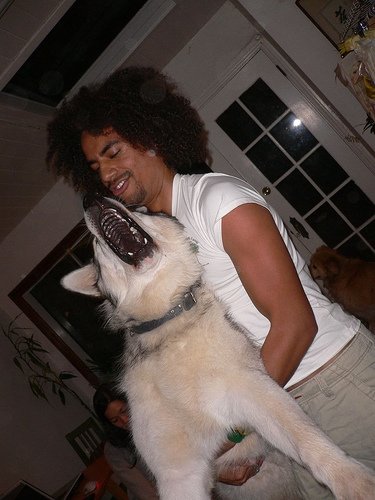
We can imagine wild wolves scavenging on a rubbish tip on the edge of a village. Most of them, fearful of men throwing stones and spears, have a very long flight distance. They sprint for the safety of the forest as soon as a human appears in the distance. But a few individuals, by genetic chance, happen to have a slightly shorter flight distance than the average. Their readiness to take slight risks — they are brave, shall we say, but not foolhardy — gains them more food than their more risk-averse rivals. As the generations go by, natural selection favours a shorter and shorter flight distance, until just before it reaches the point where the wolves really are endangered by stonethrowing humans. The optimum flight distance has shifted because of the newly available food source.
Photo taken from a new tumblr, "wolf! not wolf".
Jonah Lehrer considers chess:
Although we tend to think of experts as being weighted down by information, their intelligence dependent on a vast set of facts, experts are actually profoundly intuitive. When experts evaluate a situation, they don’t systematically compare all the available options or consciously analyze the relevant information. Carlsen, for instance, doesn’t compute the probabilities of winning if he moves his rook to the left rather than the right. Instead, experts naturally depend on the emotions generated by their experience. Their prediction errors – all those mistakes they made in the past – have been translated into useful knowledge, which allows them to tap into a set of accurate feelings they can’t begin to explain. Neils Bohr said it best: an expert is “a person who has made all the mistakes that can be made in a very narrow field.” From the perspective of the brain, Bohr was absolutely right.

Pascal-Emmanuel Gobry explores the New Testament:
The Gospels often show how, in the context of a patriarchal society, women played a very important role in the early Church. It is Mary who initiates Jesus’ miracle, and when she brings it up he dismisses her, calling her “woman”. Throughout the Gospels, whenever the men dismiss the women, it is later found out that the women were, in fact, right. After Jesus is resurrected, it is women who first find the empty tomb and, when they report this to the Apostles, they are first dismissed. In a matter of days, the Apostles, the leaders of the Church, have forgotten Jesus’ words about rebuilding the Temple, but the women remember, and accept the revelation. And it is the women, of course, who are right.
And this, of course, makes the modern Catholic church's refusal to grant women the full equality Jesus did all the more pernicious and un-Christian.
(Painting: El Greco's imagined Mother of God.)
The human race almost went extinct:
With 6.8 billion people alive today, it's hard to fathom that humans were ever imperiled. But 1.2 million years ago, only 18,500 early humans were breeding on the planet–evidence that there was a real risk of extinction for our early ancestors, according to a new study.

Coralville, Iowa, 8.35 am
Adam Kirsch reviews Walter Homolka's and Hans Küng's How to Do Good and Avoid Evil:
[A]fter listing the debts of Christianity to Judaism, [Küng] names three things that Judaism owes to Christianity. First is “universality of belief in God”: Christianity, we learn, rescued Judaism from “Pharisaism” and its “anxious and zealous fixation on the letter of the Torah,” thus making monotheism palatable to the whole Roman world. Then comes “the Jewish Enlightenment”: one might have thought that the Enlightenment was a secular movement, opposed to traditional Christianity as well as traditional Judaism, but Küng implies that somehow Christianity is responsible for “leading Jews out of their medieval ghetto … and into modern culture.” Finally comes “the Jewish Reform”: here the gift of Christianity was that “Judaism was now understood as a prophetic-ethical religion—a religion of justice, mercy, and unconditional love of humankind.”
Without Christianity, in other words, Judaism would be a pharisaical, provincial, benighted, and unmerciful faith; and classical German Reform Judaism represents the best form of Judaism because it is the least unregenerate, the least stiff-necked. In this way, it becomes clear how even well-meant ecumenicism can end up reinforcing the oldest stereotypes—and how the invitation to sign up for a global ethic can turn into pressure to disavow everything that separates a minority faith from the majority. There must be better ways to do good and avoid evil than this.
Nope:
Nobody was considered "old" at 30 in prehistory, just as 30 year-olds aren't considered "old" among modern day hunter-gatherers, or in the Old Testament, where humans were allotted 70 years (three score and ten). People who lived beyond childhood often–even typically–lived into their 60s and 70s in prehistory. The evidence for this is overwhelming, and well known to specialists in anthropology, primatology, and archaeology.
Salon interviews Susan Clancy, who has taken a lot of heat for her arguments in The Trauma Myth:
The title refers to the fact that although sexual abuse is usually portrayed by professionals and the media as a traumatic experience for the victims when it happens — meaning frightening, overwhelming, painful — it rarely is. Most victims do not understand they are being victimized, because they are too young to understand sex, the perpetrators are almost always people they know and trust, and violence or penetration rarely occurs. "Confusion" is the most frequently reported word when victims are asked to describe what the experience was like. Confusion is a far cry from trauma.
She makes clear this doesn't make crimes against children less wrong:
As I hope to have made clear in the book, sexual abuse is never OK. No matter what the circumstances are, or how it impacts the victims, sexual abuse is an atrocious, despicable crime. Just because it rarely physically or psychologically damages the child does not mean it is OK. Harmfulness is not the same thing as wrongfulness. And why is it wrong? Because children are incapable of consent.
Children do not understand the meaning or significance of sexual behavior. Adults know this, and thus they are taking advantage of innocent children — using their knowledge to manipulate children into providing sexual pleasure. Sick.
 The Dish