Or a falcon. You want a mini-head-cam? You want to know what it feels like to fly like a bird?
Next Time, Drop The Singlet
A skinny new-gay Jewy twenty-something dips into a leather party. And has some thoughts.
John McCain
Will the man whose soul is still on eBay respond to the SCOTUS decision and Obama’s bank proposal? Or can he still in any way resist the Palinites’ control?
The Dogs Who Ride Trains
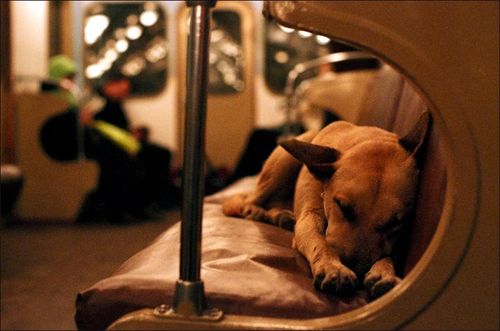
Susanne Sternthal reports from Moscow:
[Animal specialist Andrei] Neuronov says there are some 500 strays that live in the metro stations, especially during the colder months, but only about 20 have learned how to ride the trains. This happened gradually, first as a way to broaden their territory. Later, it became a way of life. “Why should they go by foot if they can move around by public transport?” he asks.
“They orient themselves in a number of ways,” Neuronov adds. “They figure out where they are by smell, by recognising the name of the station from the recorded announcer’s voice and by time intervals. If, for example, you come every Monday and feed a dog, that dog will know when it’s Monday and the hour to expect you, based on their sense of time intervals from their biological clocks.”
The blog English Russia also covered the phenomenon:
Another skill they have is to on the green traffic light. “They don’t react on color, but on the picture they see on the traffic light”, Moscow scientist tells. Also they choose often the last or the first metro car – those are less crowded usually. It’s funny but the ecologists studying Moscow stray dogs also tell the dogs don’t miss a chance to get some play while on their travel in the subway. They are fond of jumping in the train just seconds before the doors shut closed risking their tails be jammed. “They do it for fun …"
The Failure Of The Academy
Gideon Lewis-Kraus reviews Louis Menand's new book on the university:
[Menand] really does think that something is wrong. He concludes the book with a discussion of a study by two sociologists that shows how overwhelmingly center-left the politics of academics are. In the 2004 election, he notes, 95 percent of humanities and social-science professors voted for Kerry; zero percent voted for Bush. This is sure to be taken up by the few remaining culture warriors as proof of the disloyalty of the American professoriate. But Menand, in the context of a book about the trade-offs of professionalization, reads the situation differently. The fault is not with the politics themselves; academics are usually careful to keep policy out of the classroom. It is with the homogeneity. The system is simply replicating itself too smoothly.
Waiting For The Female Obama
Hanna Rosin reviews the portrayals of "superficial sexism" in Game Change and Anne Kornblut's new book, Notes From the Cracked Ceiling:
The obvious question to ask is: Are the media gossips and dolts equally stuck in two gears when it comes to insulting men? To that, I have to answer no. There are indeed more variations on the male insult, and Game Change covers most of them: Bill Clinton is petty and embarrassingly flirtatious. John Edwards is dishonest, egomaniacal, and vain. Only Barack Obama is preternaturally cool, even when everyone around him is flailing.
And that, really, is the important point. Obama was not just the result of a long steady progress of civil rights. He was a bolt from the blue, the happy result of his particular charisma married to this particular moment in history. If he hadn’t appeared, we might have waited a long time for our first African-American president. Like Kathleen Parker, I cannot at the moment think of an obvious candidate for the first female one. But I am certain that one day, soon, she will happen along and surprise us.
The Dish concurs with this blogger:
The best way to break through the glass ceiling is to not acknowledge its existence, choosing to actively pursue goals rather than let fate take over.
Losing The Plot
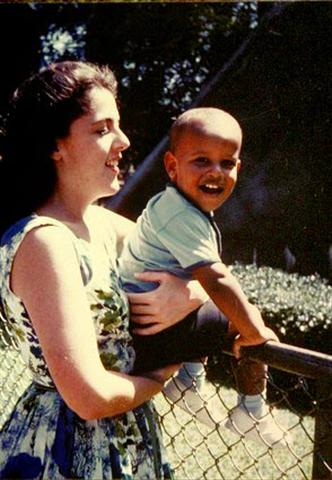
Junot Diaz scrutinizes the storyteller-in-chief:
All year I’ve been waiting for Obama to flex his narrative muscles, to tell the story of his presidency, of his Administration, to tell the story of where our country is going and why we should help deliver it there. A coherent, accessible, compelling story—one that is narrow enough to be held in our minds and hearts and that nevertheless is roomy enough for us, the audience, to weave our own predilections, dreams, fears, experiences into its fabric. It should necessarily be a story eight years in duration, a story that no matter what our personal politics are will excite us enough to go out and reëlect the teller just so we can be there for the story’s end. But from where I sit our President has not even told a bad story; he, in my opinion, has told no story at all.
I heard him talk healthcare to death but while he was elaborating ideas his opponents were telling stories. Sure they were bad ones, full of distortions and outright lies, but at least they were talking to the American people in the correct idiom: that of narrative. The President gave us a raft of information about why healthcare would be a swell idea; the Republicans gave us death panels. Ideas are wonderful things, but unless they’re couched in a good story they can do nothing
Jeez, this is unfair. From Cairo to Oslo, he has hit it out of the park. But wait for the SOTU. That is the natural moment to do exactly that.
The Cycle Of Big Government
William Eggers and John O'Leary outline five reasons why libertarians should care about government:
1. Bad government leads to bigger, badder government. Today, only 23 percent of Americans trust government to do the right thing. At first blush, this would seem to be an encouraging statistic for those opposed to “big government.” After all, the less citizens trust government, the less willing they should be to give it big new responsibilities, right? Wrong. An important recent academic study called “Regulation and Distrust” shows that, paradoxically, the worse government performs, the more citizens demand greater government intervention.
The authors’ explanation for this curious finding is that in societies where people distrust large institutions—whether government or big business—the demand for more regulation and for more government is higher, even when government is incompetent or downright corrupt.
They also list five historical examples of good governance and five examples of bad governance.
(Hat tip: Will Wilkinson)
Visual Consumption
Nicole Allen marvels at the dark side of food porn:
"[G]ross food," as Gourmet.com termed it, or "grotesque food," as I prefer, has taken hold strongly and suddenly. When thisiswhyyourefat.com, the Tumblr blog that is home to the Fat Bitch, launched in February, it went from zero to 2 million pageviews in 48 hours. Supersizedmeals.com also took off, and today the fried butter ball or deep-fried cupcake on a stick can be found on your average food, gossip, or city blog.
[…] Consider the bacon beer mug, which is pretty much what it sounds like. For whatever reasons, beer and bacon form the core of a heavily marketed vision of the American male. This is a man who goes camping in his Ford pickup, swilling Bud by the fire and flipping bacon in the morning. His masculinity is calm, assured, innate. But what kind of man downs beer from a mug made of bacon? Surely one who is mocking this he-man image. But I would guess that beneath the satire, he lacks the carefree masculinity whose symbols he regurgitates.
The World Spins Backwards
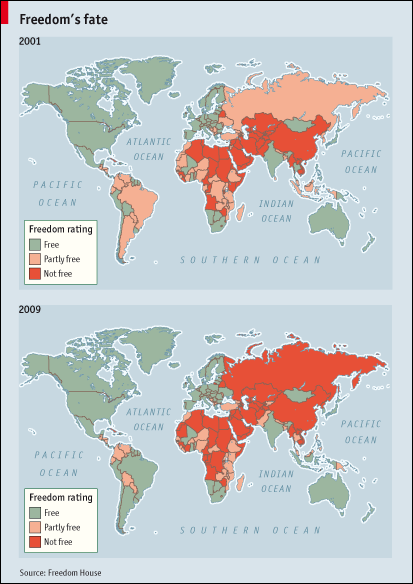
The Economist sums up a study:
In its report entitled “Freedom in the World 2010: Global Erosion of Freedom”, the American lobby group found that declines in liberty occurred last year in 40 countries (in Africa, Latin America, the Middle East and the ex-Soviet Union) while gains were recorded in 16. The number of electoral democracies went down by three, to 116, with Honduras, Madagascar, Mozambique and Niger dropping off the list while the Maldives were reinstated. This leaves the total at its lowest since 1995, although it is still comfortably above the 1990 figure of 69.
Taken as a whole, the findings suggest a huge turn for the worse since the bubbly mood of 20 years ago, when the collapse of Soviet communism, plus the fall of apartheid, convinced people that liberal democracy had prevailed for good. To thinkers like America’s Francis Fukuyama, this was the time when it became evident that political freedom, underpinned by economic freedom, marked the ultimate stage in human society’s development: the “end of history”, at least in a moral sense.
(Hat tip: Geras)
 The Dish