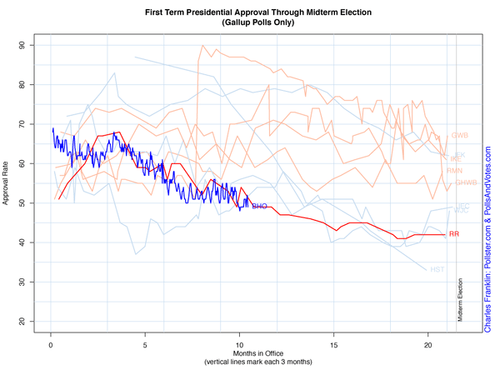
[Reagan] is remembered as the so-called "Great Communicator," but that's after the economy picked up late in his first term and he won a landslide victory over Walter Mondale. However, Reagan was not always viewed that way — he suffered through a recession early in his term that damaged his political standing (his approval trajectory was very similar to Obama's). The political scientist Jonathan Bernstein reviewed press accounts of Reagan from January 1982, and concluded that "Reagan's manner [was portrayed as moving] from amiable and clear on the big picture to clueless and oblivious to the important details of governing — and indifferent to suffering — when things were going bad." The larger point is, as Bernstein notes, that "character traits are perceived by the press in light of how the president is doing in the polls and in Washington, not the other way around." In other words, the perception that Obama isn't "connecting" is a symptom of his declining political status, not the cause.
Lou Cannon makes a similar point at the Daily Beast:
A year into his presidency, not quite halfway through what would prove a 17-month recession, Reagan was in worse standing with the public than President Barack Obama is today. In the Gallup polling of 1982, his approval rating hovered in the low forties throughout the year, bottoming at the beginning of 1983 at 35 percent. This turned out to be the lowest rating of Reagan's two-term presidency but at the time many who worked in the White House were privately betting that he wouldn't even be a candidate in 1984, let alone have a second term in the White House. His aides' gloominess was reflected in my reporting for The Washington Post, for which I was senior White House correspondent, and also in a book that year in which I predicted that Reagan would not run.
And somehow I suspect that at that nadir for Reagan, commentators like Krauthammer and Gerson and Brooks would not be advising him to heed public opinion, give up on his agenda, and recognize that it's madness to push through policies that were broadly unpopular. Au contraire. Fight, Mr President. Fight. In the end, even the conservatives – perhaps especially the conservatives – will respect you for it.
[R]estricting corporate speech simply exacerbates imbalances of political power caused by other, much greater inequalities. Maybe restricting corporate speech could promote equality if it were part of a much more comprehensive regulatory effort. For example, government could also restrict political advocacy by reporters, academics, celebrities, and others with disproportionate influence. There are, of course, good reasons not to do any such thing. But if you eliminate one cause of inequality while leaving other more severe ones in place, the net impact is actually to increase political inequality overall, not reduce it.
[T]he existing system’s response to free speech concerns (PACs) acts only to ensure that large corporations are already able to have near-unfettered participation in the electoral process, as long as they first overcome some regulatory hurdles that are relatively minor for them but are significant for smaller, less sophisticated enterprises. Smaller corporations are effectively shut out of the system, thereby reinforcing the oligopoly of influence over elections and influence markets enjoyed by their larger, more sophisticated brethren. This changes that. Yes, it removes the bar on direct participation that large corporations had to skirt via PACs, but this was hardly an effective or meaningful bar for those corporations in the first place.
[Re-posted from earlier today] The seismic events of the last few days ends, in some respects, the phony war of the first year of Obama’s presidency. As is the case in truly fracturing democracies, the opposition simply does not and cannot accept the fact that it is out of power. The incoherence of the opposition to Obama – that he is both Jimmy Carter and Adolf Hitler, as Stephen Colbert pointed out last night – reveals the irrationality of the hate. It began immediately on the FNC/RNC right. And the ferocity of the campaign against Obama, the sheer dickishness of the GOP and its acolytes, the total oppositionism to everything he has done and indeed anything he might do… suggests that any hope for some kind of cooperation from this rump is impossible. But the truth is that these forces have also been so passionate, so extreme, and so energized that in a country reeling from a recession, the narrative – a false, paranoid, nutty narrative – has taken root in the minds of some independents. Obama, under-estimating the extremism of his opponents, has focused on actually addressing the problems we face. And the rest of us, crucially, have sat back and watched and complained and carped when we didn’t get everything we want. We can keep on carping if we want to. But it seems to me that continuing that – as HuffPo et al. appear to be doing – is objectively siding with the forces of profound reaction right now. Don’t get me wrong. Criticism is still vital. I’m not going to give up on advocating marriage equality or a carbon tax, rather than cap and trade, or for an independent investigation of Bush era war crimes. I think pushing Obama to a more populist position on banks is well and good. But given the alternative, I am going to step up my support of this president in the face of what he is confronting, even when he is not exactly doing everything I want. In my view, you should too. Look at what we are facing right now: a take-no-prisoners right, empowered by a massive new wave of corporate money unleashed by the Supreme Court, able to wield a 41 seat minority to oppose anything Obama wants, setting up a cycle of failure for a president whom they can then pillory at the polls, and unrepentant about near-dictatorial powers for the presidency, and the routinization of torture in the American government. These forces cannot be appeased. They simply have to be confronted. I do not believe in some massive turn left or faux-populism that Obama cannot characterologically embody. I do not think ramming the healthcare reform bill through before Brown is seated is good politics. I still believe that Obama should embrace a major assault on long-term debt and make that a center-piece of his SOTU next week. But I have come around to thinking that the one huge mistake right now would be to surrender the Senate health reform bill.
The dust should indeed settle. But it is absurd that one special election should upend a clear campaign promise, a year of work, and a necessary start on a critical reform without which we hurtle toward bankruptcy even more quickly.
More to the point, politics is also about morale and will as well as reason and moderation. I believe Obama has been both reasoned and moderate and civil in navigating between the Democratic Congress and the embittered, mutinous GOP. I don’t think his tone should change. But I do think that any surrender on health now would be a betrayal of his entire campaign. I don’t think the Senate bill is perfect; but it’s far far better than nothing. And not passing it means not passing anything and surrendering to forces that are as proto-fascist as any we have seen in recent times.
This is about more than health reform and we have to see it in that context. This is about a cynical nihilist attempt to break this presidency before it has had a chance to do what we elected it to do by a landslide vote. It is an attempt to destroy a majority’s morale, to break a president’s foreign policy autonomy, to prevent engagement in the Middle East peace process, to stop action on climate change, to restore torture, to increase tensions with the Muslim world, to launch a war on Iran. We cannot delude ourselves that if Obama fails, this is not the alternative. It is.
And we have to re-engage as powerfully as we did in the campaign to fight back against these now emboldened forces of reaction. I think this is true not just for the sake of the country but also for the sake of the GOP. The nihilist obstructionism and rhetoric they have embraced makes constitutional democracy close to impossible. Their total lack of any workable alternatives to dire problems is a form of degeneracy we have to avoid empowering.
So fight, Mr President. And to the House Democrats who won’t go along with the only way to salvage health reform: this is the only sure-fire way you will lose in November. If you pass this bill, you may also go down in this climate. But you will have done something you can be proud of. Politics cannot always be about narrow self-interest. If it always is, nothing important can get done.
Do your duty. And grow some. Fight back. Explain why you’re right. Tell the liberals they can always come back later to reform the bill. Just get this passed.
Today on the Dish we tackled the SCOTUS decision. Small reax here. Andrew reacted with measured criticism, Fallows furrowed his brow, Frum offered constructive reform, Walter Shapiro saw a grander scheme, and Justice Kennedy said "blog".
In other commentary, Manzi approved of Obama's bank proposal, Emily Miller lauded the National Enquirer, Reihan challenged Andrew on GOP nihilism, and Joe Carter countered him on the Gitmo deaths. Mini-reax on the latter here.
A traditional Indian dancer from the state of Kerala poses during a press preview of tableaux participating in the Republic Day parade in New Delhi on January 22, 2010. India celebrates its 61st Republic Day on January 26. By Manan Vatsyayana/AFP/Getty Images.
Is it possible the President could rally Democrats over the next week to a unified position? Might House liberals conclude that the Senate bill is better than nothing? Might Senate Democrats have a change of heart and be willing to spend more floor time on a new health care reconciliation bill? Could the President rally Congressional Democrats with his State of the Union Address the way he did with his September speech? The past two weeks proves that anything is possible, so in theory yes on all four.
But the way things are trending, I wouldn’t bet on it.
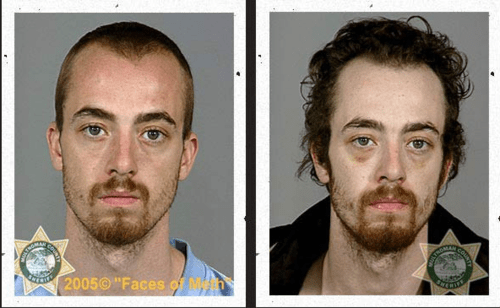
Mine is a cautionary tale of the pernicious nature of meth, especially in relationship to the transmission of HIV.
By the time I was 17 in 1984, I had been having sex for several years. Whether as a result of luck or the grace of God (I say this as a Catholic agnostic), I did not contract HIV despite quite a number of sexual partners. However, during the summer of 1984, I was about to engage in potentially dangerous sexual behavior when my older sexual partner scolded me and taught me what was and wasn't safer sexual practice. I cried from humiliation, but that gentleman probably saved my life.
When I moved to NYC in the early 1990s, I volunteered for ACT UP, interned for alternate gay magazines, and became a buddy for Gay Men's Health Crisis, helping to take care of men dying from AIDS. I saw firsthand HIV's and AIDS's physical and emotional devastation. I am a smart, Ivy League educated guy (I think I might have been at Harvard as an undergraduate when you were a graduate student) and knew what needed to be done to prevent my contracting the virus.
Unfortunately, I also have always had a strain of self-destructiveness. However, despite my impulse to undermine myself, I had always been able to prevent myself from doing irreparable harm to myself. A suburban kid at heart, I flirted with more marginal behavior but made sure to separate, even compartmentalize, such behavior from my more respectable veneer of a life, which included work on Wall Street. All that changed when I decided – despite my full knowledge of its dangerous nature – to try meth.
During my 20s, I smoked pot every so often. I took Ecstasy maybe one to three times a year. I hated snorting coke. People would use it around me and I would avoid it because I didn't like how it made me feel and I hated losing my erection. Up until about my 30th birthday, I refused to try meth or smoke coke. Unfortunately, during a very emotionally vulnerable time in my life, I stupidly smoked coke. My biochemical wiring was immediately altered. For the first time in my life, I craved a drug. Within a few weeks, I got myself to 12 step meetings because I knew where such use could lead me. I was a binge user who would use once every few months. I won't say I had it under control but I was able to hold down a job, despite these occasional relapses.
I might have continued this way for several years but I eventually added meth into the mix. Eventually, I partied with nothing but meth. I lost my job on Wall Street and used my severance package to live a life of meth and sex. Meth gave me the artificial delusion that I was deeply and passionately connected to my sexual partners – a feeling I found nearly impossible to feel when I was sober. And even if I got rejected while on meth, I didn't feel it. I could move on to my next partner and any rejection was a distant memory. Meth freed me from those nagging feelings of self-doubt and self-hatred I had suffered since I was a child. It was far more powerful and seemingly effective than years of therapy and anti-depressants.
However, along with losing my crippling self-consciousness, I also lost my impulse for self-preservation. Despite years of being a top, I found myself wanting to bottom and to do so without a condom. In the summer of 2004 – 20 years after learning what I needed to do to prevent my contracting HIV – I seroconverted. I had for years been nearly a hypochondriac when it came to feeling shitty, suspecting it might be my having contracting HIV. I was so strung out on meth that I didn't even realize that the fever and sore throat, which wouldn't respond to antibiotics, were indications of my having contracted the disease.
Five and a half years later, I am healthy as a result of a great physician and anti-viral regiment. I still battle my addiction and find myself still feeling unsure of myself on a daily basis. I have struggled to not live in isolation and remain a productive part of society. I battle the overwhelming desire to not use meth and know that the recidivism rate of meth users is high because, unlike other drugs (including cocaine), the brain does not naturally start producing dopamine and serotonin after meth use. I try not to live in regret and try my best to treat myself with compassion, if for no other reason than my knowing that beating myself over the head will not make my life any better.
I lived a charmed life and felt that I would not fall victim to the dangers of meth as others around me had. Such feelings of invincibility led to where I am today.


 The Dish