Jonathan Bernstein goes through the possibilities.
Her James Frey Moment?
Palin looks to be returning to the Oprah Show tomorrow. Will the host confront her on the multiple odd lies she told last time? Yeah, right.
“I’m Not Done”
A reader writes:
I’m a 24 year old Massachusetts resident. I plugged my nose and I voted for Martha Coakley. But that’s all I did. In the months leading up to Barack Obama’s historic win, I made phone calls, I drove up to New Hampshire and I walked door to door in support of a candidate who I knew could finally bring up positive change in this country. But I, like many young voters checked out after that.
Even though I knew the work had only just begun, I got complacent. I didn’t even vote in the Massachusetts’ primary. I stopped making phone calls, I stopped e-mailing friends and family and I stopped making my opinion heard. For me, it was enough to simply post a link on Facebook to one of your blog entries.
The Scott Brown win was enough to wake me up and I hope it was enough to wake up the millions of young Obama supports across the nation who have gotten lazy in the last year. Give up now? Are you kidding me? Now is the time to get fired up. Now is the time to write letters, make phone calls, and send e-mail. If we can get a skinny black guy with a middle name of Hussein elected, we can overcome an upset in Massachusetts.
Deep Thought Of The Day
"I have masturbated myself out of serious problems in my life. The phone doesn’t pick up because I’m masturbating. And I have excused myself at the oddest times so as to not make mistakes. If Tiger Woods only knew when to jerk off. It has a true market value, like gold bullion. [The reason is] because I want to take a brain bath. It’s like a hot whirlpool for my brain, in a brain space that is 100 percent agreeable with itself," – musician John Mayer.
Obama As The Red And Blue President
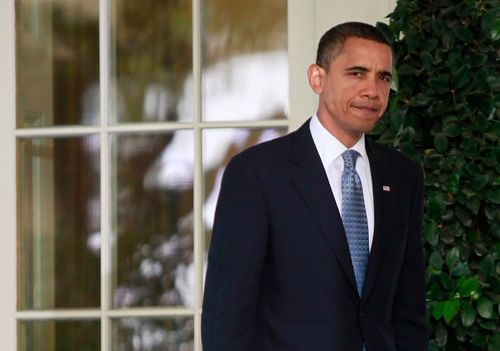
Manzi thinks over the Brown win:
I don’t know anybody who supports the status quo health care finance system in the U.S. Reform is required, and what is likely more important than the specifics of the first step is that we get underway on what will, if we’re lucky, be iterative reform in which we have a political system that can learn from experience. Sensing just how much reform is possible, and getting a nation to go along with you is one mark of a statesman.
FDR, Churchill and Reagan all had this mysterious ability (and good luck) – they were each able to reconcile the eternal tensions of a society, as manifest in the specifics of their time and place, inside one mind. I believe that Bill Clinton and Newt Gingrich were able to do this only in productive tension with one another; in combination, they produced pretty good governance. As per Ross’s comments, I suspect that we will discover during 2010 whether Obama is able to do this, or will require tension with a more conservative congress.
My sense is that Obama understands that his core responsibility as president is not being a partisan figure. That's what he ran against in many ways. And I think he sees all this in terms of eight years. He is gambling on democracy working over time, on the president setting the general direction but allowing the Congress and the public to decide how fast and how specific they want to get. He always said he wanted to be the president of the red states and the blue states. His major problems right now are a) an apoplectic and incoherent opposition that feels it is doing something by randomly harnessing populist frustration in a recession and playing the Rovian politics which is all they know and b) a useless bunch of disorganized morons and cowards who make up the Congressional Democrats.
But he's still by far the best thing we have going for us. And this struggle has just begun. Politics is not magic; it's not a one-off event. It's a process of grueling argument, tussling and debate. And the deeper truth is: many Independents who are ornery right now like Obama. His decency and civility and reason are plain to see. And so this is his moment as well. To be the anchor in a turbulent time and to keep making the arguments for necessary reform.
The Angry White Guy Factor, Ctd
Alvin Felzenberg calls Coakley’s defeat a “vindication of the Cambridge cop”:
It is an outright rejection of the “identity” politics [Obama] and his party have championed for more than a generation. A friend of mine put it best when he asked me when the Democratic party ceased voicing the concerns of ordinary Americans, working-class Americans, ethnic voters, and people trying not just to make ends meet, but to actually get ahead? I told him 1972. That was the year the Democrats nominated George McGovern. They treated themselves to one heck of a convention at which group after group championed its “rights” and voiced its “grievances.”
Ackerman is aghast:
Felzenberg’s construction works under one condition and one condition only: you have to read “ordinary Americans” as excluding “black people” and “Hispanic people” and “Asian people” and ”gay people” and “actual working-class people.” The people in Felzenberg’s fairy tale get more “ordinary” the lighter they get. As Adam [Serwer] notes, Professor Gates gets treated as some kind of exotic bogeyman because he’s “reported to own more than one European-made luxury car.” How uppity of him.
Barack Obama has many flaws. But treating American politics as a zero-sum circumstance in which black people prosper at white people’s expense — what Al calls “the ‘identity’ politics he and his party have championed for more than a generation” — is not one of them. This is the fiction created by racial anxiety. Felzenberg’s myths are animated by a white grievance that bears no relationship to the objective reality of what it means to be white in America in 2010. And yet he never spares a minute to diagnose himself as practicing “identity politics.” No, that stuff is what those people do.
Unrepresentative Democracy
Fallows notes:
Counting the new Republican Senator Scott Brown from Massachusetts, the 41 Republicans in the Senate come from states representing just over 36.5 percent of the total US population. The 59 others (Democratic plus 2 Independent) represent just under 63.5 percent. (Taking 2009 state populations from here. If you count up the totals and split a state's population when it has a spit delegation, you end up with about 112.3 million Republican, 194.7 million Democratic + Indep. Before Brown's election, it was about 198 million Democratic + Ind, 109 million Republican.)
Let's round the figures to 63/37 and apply them to the health care debate. Senators representing 63 percent of the public vote for the bill; those representing 37 percent vote against it. The bill fails.
I believe this health reform bill is as good as it will get in confronting a real and pressing problem. But the system we have is designed to prevent change. And that's the underlying reality here: if the governing political party is not united, and the opposition party is determined not to improve legislation but to kill a presidency, and exploit populism for purely partisan purposes, then it's very, very hard to pass major legislation.
Two Options: Something Or Nothing
Chait breaks the blogger code and picks up the phone:
The Democrats biggest worry right now, I have been reliably informed (Yes — reporting! I try not to make a habit of it), is that they think health care has just taken too much time. The want to pivot to an economic message. Writing a new, even smaller health care bill takes a lot of time…There are only two options on health care: Something that involves passing the Senate bill through the House, and nothing. There's no fantasy moderate bipartisan alternative. Once Congress gets that through its head, I think — I don't know but I think — they'll make the obvious choice.
So let this process play out. Let Obama use SOTU to argue that nothing is not an option and if the Republicans prove they really do want nothing, then the argument for passing the Senate bill gets stronger. But doing this now, greeting public anxiety with contempt, would be dreadful politics.
It would destroy Obama's commitment to open dialogue and respect for the process, which has already been battered by some of the necessary sausage making to get a final deal. It would make Obama look like a brutally partisan president. That would break Obama's presidency.
I see no reason why Obama should not put the GOP on the spot now and ask them how they would solve the problems we face. One aspect of this is health insurance reform; the other is tackling the debt. Put them together in the SOTU and demand action.
The truth is: Obama has the better argument. He's right in understanding that the sheer tasks of government have made it hard for him to press this message day after day after day as the Democrats negotiated with themselves endlessly. So let the impact of Massachusetts sink in, expose the nihilism of the opposition, take the black eye as a necessary evil in such a turbulent time … and fight on.
The Marriage Rate
The Courage Campaign, FDL, and San Jose Mercury News live-blogged day seven of the Prop 8 trial. Live-tweets here. Margaret Talbot dismantles the pernicious work of Stanley Kurtz, which “purportedly showed a connection between the legalization of same-sex marriage or partnership in Scandinavian countries and a decline in the heterosexual marriage rate”:
[T]here’s no doubt that the rates of marriage have been falling throughout the Western world. Meanwhile, the age at first marriage has gone up, as have the rates of cohabitation and and out-of-wedlock child bearing. But all of these are trends that long precede the legalization of single-sex marriage, and that generally hold as true for countries without legalized same-sex marriage or the equivalent as they do for those with it. As statistics from, for example, the Organization for Economic Cooperation and Development (O.E.C.D.) show, the marriage rate has been declining in almost all E.U. countries since 1970. And in fact, according to a 2008 O.E.C.D. report, the pace of decline has actually slowed since the nineteen-nineties, “and the downward trend” nearly “come to a halt in the Czech Republic, Denmark, Hungary, Iceland, the Slovak republic, and Sweden.”
The “Emily’s List Effect”
Wendy Kaminer contends that identity politics handed Coakley the primary but lost her the election:
Coakley, the only woman currently holding statewide office in Massachusetts, owed her '08 primary win largely to the state's Democratic sisterhood, committed to electing women. In my own informal conversations with politically active women, dating back over a year, Coakley regularly emerged as the Senate favorite, but her policies and politics and her conduct as a prosecutor, (which worried civil libertarians) were rarely if ever discussed. Progressive male candidates were rarely considered.
 The Dish