“Their Boldest And Most Ambitious Assault”

KABUL118MajifSaeedi:AFP:Getty

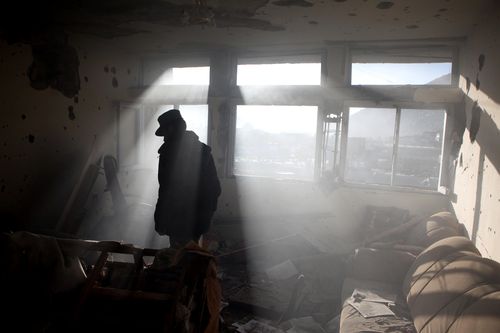
The Taliban assaulted a hotel and shopping mall as well as government buildings yesterday. Juan Cole ventures as to why:

The attack seems likely to have aimed at making Karzai look weak and not in control on the eve of his attendance at the upcoming London international conference on Afghanistan. It may also have been a reply to Karzai's appointment of about half the ministers on the way to forming a new government.

Watching the BBC video of the attack was indeed alarming. If suicide bombers managed to create chaos within blocks of the White House and the government was unable to stop them, we'd have a parallel. Of course, Afghanistan is not America. And Gates was unfazed. One reader even saw the attack as containing seeds of good news:

The Taliban went into Kabul heavy, with a dozen militants, plenty of explosives and weapons, elaborate plans, and visions of the Mumbai debacle.  They failed, utterly, and in view of the capital's population.  The dead militants outnumbered their victims.  And most hearteningly, they were thwarted and then destroyed not by westerners, but by Afghan security forces.  This should be a major morale-builder for the Afghans, and a bright, if still distant, point of light at the end of the tunnel for an eventual reduction in western forces.

(Photo: Afghan security forces look over a building where Taliban fighters were located after clashes between Taliban-linked militants and security forces in a market on January 18, 2010 in Kabul, Afghanistan. Taliban militants launched multiple suicide attacks at key government targets. At least five people were killed and nearly 40 others wounded in fighting between Taliban militants and security forces, the public health ministry said. The death toll did not include four militants who were also killed during the attacks, which lasted more than three hours. President Hamid Karzai had stated that security had been restored to the capital. By Majid Saeedi/Getty Images).

Will Infighting Stymie Recovery?

George Packer fears that Haitian politics will poison the relief efforts. He visited Haiti to report in the early 1990s:

[T]here was something in Haiti’s political life that was warped: everything became personal and Manichean. Discussion and compromise were alien. One of my Haitian friends, a leader of the teachers union, spoke endlessly about the need for a culture of tolerance. He had been in exile in Boston on my first trip, and the one person he insisted I see in Port-au-Prince was a colleague of his in the union movement. It struck me as an ill omen to discover, on the second trip, that the two of them had fallen into a bitter—almost a mortal—dispute, over a matter that seemed small and easily resolved yet had ended their professional and personal relationship. A clear analysis of your own political culture does not make you immune to it.

Brown-Out

Ambers explains what happens if Brown wins in the protest special election:

There are several built-in election procedure traps, including the counting of absentee ballots and ballots from soldiers overseas. If for some reason these ballots are counted and there are no significant challenges by the seventh day after the election — that's next Wednesday — State of the Union Day — then Secretary of State Bill Galvin could certify the election if he wanted to. Harry Reid, the majority leader, won't seat a senator until the secretary of state certifies him or her.  But a week is too short a time frame here: under federal law, overseas votes can arrive as late as January 29. Throw in a few days for the counting of provisional ballots, and we're into early February. Then the formal certification meeting happens, which

can take an extra day, depending on who is where.

After the results are received from the local election officials, the secretary of state will present the total results to the governor and the Governor's Council for certification. Only after the results are certified by the governor and the Governor's Council can a certificate of election be issued. (The governor and the council schedule their own meetings, which usually take place on Wednesdays.)  Note: it is not unusual for the Senate to wait for certification before seating the senator. (Recall how Al Franken wasn't seated; recall how Roland Burris had to jump through hoops before he could enter the building.)  Republicans will demand that, if the margin of victory is sufficiently large (and assuming Brown wins), that he be seated immediately.  Democrats will cry: "Count all the votes, follow the rules."

Court TV

Orin Kerr counters Dahlia Lithwick:

Lawsuits challenging the constitutionality of high-profile and controversial laws are often part lawsuit and part plaintiffs’ public-relations campaign. The plaintiffs pick the forum, draft the complaint, pick the timing, and pick their witnesses. The plaintiffs shape the litigation so that it puts their case forward in the best possible light. In that environment, the plaintiffs will almost always want the case televised. Defenders of the law will almost always object.

It’s not about constitutional theory, but about designing a p.r.-friendly case and hoping it gets a lot of public attention — or, if you’re representing the defendant, hoping it doesn’t. There’s nothing hypocritical about either position.

From his closing paragraph:

What would be inconsistent is having different views of whether the same-sex marriage trial and the hypothetical affirmative action trial should be broadcast. It seems to me that we need a consistent answer for what to do with that kind of case: Either broadcast them both or broadcast neither.

Getting The Bomb

Mark Hosenball reported on Friday:

U.S. intelligence agencies are quietly revising their widely disputed assertion that Iran has no active program to design or build a nuclear bomb. Three U.S. and two foreign counterproliferation officials tell NEWSWEEK that, as soon as next month, the intel agencies are expected to complete an "update" to their controversial 2007 National Intelligence Estimate, which concluded that Tehran "halted its nuclear weapons program" in 2003 and "had not restarted" it as of mid-2007. The officials, who asked for anonymity to discuss sensitive information, say the revised report will bring U.S. intel agencies more in line with other countries' spy agencies (such as Britain's MI6, Germany's BND, and Israel's Mossad), which have maintained that Iran has been pursuing a nuclear weapon.

Tyler Cowen looks at old estimates for when the Soviets would get the bomb and asks "“whether today’s estimates of Iranian production are any better.”  Yglesias thinks "they are almost certainly worse", and Justin Logan lists a few.

How Long Do The Dems Have If Brown Wins?

Fifteen days:

Looking over these statutes, it seems clear that unless the result is very, very close (think Al Franken and Norm Coleman in Minnesota, or Scott Murphy and Jim Tedisco in NY-20), we should probably know on election night who has been elected when the vast majority of votes are counted. But even then, state law is clear that a certificate of election cannot be issued until at least 15 days later.

And if Senate Democrats insist on a completed certificate — just as the Senate Dems did in their unsuccessful attempts to keep out Sen. Roland Burris (D-IL), and Senate Republicans did in their successful blocking of Al Franken during the Minnesota litigation — that would keep the winner out for at least 15 days.

The Shape Of The Recovery

Posner is blogging again:

I had thought when I agreed with my publisher on a deadline for the new book that by the end of 2009 the shape of recovery would be clear. It is not. We simply cannot responsibly gauge the pace of the recovery. Nor is it even clear whether we are better off with a fast recovery or a slow one. A fast recovery could create an acute risk of dangerously high inflation. A slow recovery could greatly increase the size of the federal deficit, threatening all sorts of economic and political harms, with eventual unacceptable inflation only one of them. I am particularly concerned with the danger of social and political turmoil if high unemployment and related economic pathologies persist.