Proving Animus

One fascinating aspect of the Prop 8 trial is whether the proposition was a good faith effort to support what its backers think of as traditional marriage, or whether it was a campaign driven by animus to a small minority. Of course, proving intent on this is hard. Except when it isn’t. In a court room you have to assess the facts pertaining to the specific issue at hand and cannot rely on emotional or religious or psychological distractions. The deposition of one of the “Official Proponents” of Prop 8, Harry Tam, is pretty devastating:

Question: “And it is your understanding that part of the gay agenda is legalizing underage sex?” Answer: “Right.”

The conflation of homosexuality with child abuse was a central issue for the people who ran the Prop 8 campaign, hence the ads that focused on the threat that gays posed to children. Since this plays on the oldest blood libel against gays, it certainly implies that the Proposition was motivated by prejudice. Imagine a Proposition that argued that Jews should be denied, say, being school-teachers because of the threat to the kids. No one would dispute that that’s a vile, blood libel motive for a constitutional amendment. But when exactly the same bigotry fuels a Proposition to deny gays the core right to marry, a right deeper in the constitution than the right to vote, it’s all apparently motivated by high-minded concern for family life. Among the emails retrieved by the court from Tam – who was a year-long organizer and fundraiser for the Proposition – is this one:

This November, San Francisco voters will vote on a ballot to “legalize prostitution”. This is put forth by the SF city government, which is under the rule of homosexuals. They lose no time in pushing the gay agenda — after legalizing same-sex marriage, they want to legalize prostitution. What will be next? On their agenda list is: legalize having sex with children … We can’t lose this critical battle. If we lose, this will very likely happen…

1. Same-Sex marriage will be a permanent law in California. One by one, other states would fall into Satan’s hand.

2. Every child, when growing up, would fantasize marrying someone of the same sex. More children would become homosexuals. Even if our children is safe [sic], our grandchildren may not. What about our children’s grandchildren?

Tam has requested to withdraw from the case. Because he helps prove just how powerful some of the most vile slurs against gays were in fomenting the denial of civil equality under the law in California. No wonder Maggie Gallagher wants as little sunlight in this trial as possible. Because it reveals the true motives of those who are in her movement.

Watching Beck And Palin, Ctd: “She Is Not A Republican”

A reader writes:

Seeing Palin and Beck talk about "God" (and the Founding Fathers and–Palin's interjection–"The Founding Mothers") on Fox today was indeed revealing. She is not a Republican: she is a religious nut. Hence, as you discern, dangerous.

Aimee Semple McPherson plus Joe McCarthy plus George Wallace (or maybe substitute Joan of Arc for Aimee) plus the secular celebration of ignorance as a virtue = trouble, especially for a mixed-race, "Muslim," "non-American" President,

who can be portrayed as both Lenin and Hitler simultaneously. 

It wasn't that she didn't know how to say "Biden" and said "O'biden" by mistake. And it wasn't "O'Biden," as in trying to make him more Irish. It was "Obiden" as in "Obama" as in trying to make him appear to be equally not an "American."

Roger Ailes believes she can turn Fox News from the $700 million per year profit engine it is now into the billion dollar per year company he envisioned it as from the start (see David Carr's Sunday NYTimes piece.) Once she does, Roger can retire into his Putnam County bunker to await the AQ assassination attempts. And the rest of us will have to deal with what he's wrought.

Jesus, I used to think Nixon was bad.

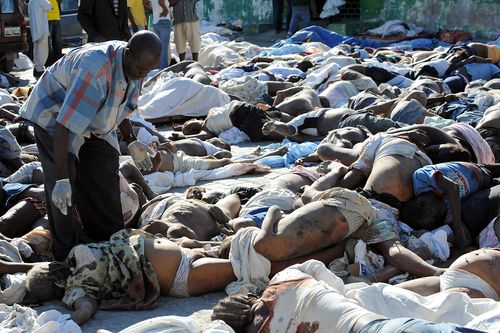
The News From Haiti

HORRORJuanBarreto:AFP:Getty

TPM is still live-blogging. Tyler Cowen is gloomy:

[It's] not just a matter of offering extra food aid for two or three years. Very rapidly, President Obama needs to come to terms with the idea that the country of Haiti, as we knew it, probably does not exist any more. 

In what sense does Haiti still have a government?  How bad will it have to get before the U.N. or U.S. moves in and simply governs the place?  How long will this governance last?  What will happen to Haiti as a route for the drug trade, the dominant development in the country's economy over the last fifteen years?  What does the new structure of interest groups look like, say five years from now?

(Photo: A worker of the morgue arranges the bodies of victims outside the morgue in Port-au-Prince on January 14, 2010, following a devastating earthquake that rocked Haiti on January 12. Desperate Haitians awaited a global effort to find and treat survivors from the quake that left streets strewn with corpses and a death toll that may top 100,000. Hundreds of thousands of homeless, injured and traumatized victims spent a second night on the streets and sidewalks, transforming Port-au-Prince into a gigantic and under-equipped refugee camp. By Juan Barretto/AFP/Getty.)

Addiction In The Heartland

Ht_meth_teeth_071001_ssh
 
A reader writes:

As someone who grew up in a small town in rural Illinois where meth is a big problem, I’m glad that you’re focusing on it lately in the Dish.  But I would say to be careful in linking the social problems of rural America to “Christianism.” The more you look into it, I think you’ll find that meth use has much more to do with poor economic conditions and the general lack of opportunities facing small towns. I think that, like meth use, “Christianism” springs from these same conditions. So I’d just say to be careful of calling the relationship between Christianism and social problems in rural towns a causal one; try to look for the source of both phenomena.

Well, since I’m not a Marxist, I do not believe that rigid fundamentalism is a simple by-product of poverty. But I do agree with my reader that economic decline, unemployment and cultural alienation undoubtedly fuel meth and probably contribute to fundamentalism’s growth. But the interaction is almost certainly complex and two ways, creating a mixture of economic despair, collapse of self-confidence, bewilderment at modernity and the lack of a traditional Christianity that, at its best, really did help people confront the ordeal of living. Fundamentalism’s failure to encourage genuine, humble and humane faith that can finally come to terms with science and history is critical to this, which is why, increasingly, I think a reform of Christianity is central to preserving the liberal constitutional state. What has replaced real faith is, in fact, a form of neurotic attachment to literalism in Scripture (effectively debunked by scholarship), to authority figures who enforce order, if not coherence, onto otherwise chaotic lives (think Dobson or Ratzinger or Warren), rigid attachment to untruths in human history (as in denial of evolution), or the insistence of maintaining the appearance of Godliness to avoid confronting real human sin (think Ted Haggard or the countless child-abusing priests). None of this helps anyone actually cope with modern life, because it is too opposed to modern life. And so fundamentalism as a coping mechanism in fact  makes it all much worse, as rising rates of dysfunction, family breakdown, illegitimacy, abortion, HIV transmission, and drug abuse in the Christianist states reveal – just as the sexual dysfunction in Islamist societies cripples and immiserates them. If you want to find Ground Zero for this confluence of poverty, isolation, Christianism and meth, take a trip to Wasilla, Alaska, whence the new Esther has emerged. The core element of Christianism and Islamism is denial: denial of a diverse world, denial of history, denial of science, denial of secular authority in favor of an ever-more rigid ideology, conveyed directly into the bloodstream through the web or FNC or other propaganda outlets. This strikes me as the core evolution of our time, as I lay out with some urgency in the opening chapters of The Conservative Soul. I regard it not as a rebirth of faith but as a collapse of faith into neurosis.

It has profound political ramifications, which secular conservatives and liberals have been far too coy in taking on.

A reader writes:

Your observation about the drug problem facing rural America is spot on and touches on a larger point:  the problems facing the underclass in rural and urban America are more similar than different.  

During the course of my adult, I have lived in D.C., West Virginia, New York City, rural New York State and, most recently, East Tennessee.  I currently travel to state courts throughout East Tennessee, including many rural counties, and I am always struck by how similar the problems of rural Appalachia are to those faced by the inner city poor of New York and D.C.: substance abuse, poor education, incarceration, unwed mothers, abuse, teen parents, gun violence, diminished opportunities, etc. The thing that I have found so ironic about the current Red State/Blue State, us versus them mentality is how wrong it is.  The same problems that a poor teen from the Bronx faces are the same that an indigent teen living in Tazewell, Tennessee faces.  Folks in both areas like to think they’re very different from one another, but they really aren’t.

Another writes:

As long as you’re on the subject of meth and how it’s devastating rural America, you should check out a book called Methland: The Death and Life of an American Small Town. In addition to some pretty horrific anecdotes about meth addiction, it ties the its spread to the rural economy and globalization in a pretty convincing fashion.

One Man In Haiti

Please pray. From the blog we cited yesterday:

All I could see was her face and left arm, and she frantically called out to me. I asked her to calm down because it would help me to work and asked her to pray for both of us. She calmed down and became very brave. I was having trouble seeing her where she was jammed under the slab. I pulled out a very large piece of rubble that didn’t really help Jacqueline at all (her name was Jacqueline). There was some sort of object behind that rubble and when I went to move it it turned out to be another girl’s bottom. The girl cried out but I could barely hear her – her whole head was underneath rubble.

At this point I began to realize that I was in over my head.

All I had was a hammer, and it was quickly becoming pitch dark with twilight fading and no electricity anywhere. I tried to borrow a flashlight, but it was impossible. I had a moment of feeling intense helplessness. After thinking and praying for a minute, I told Jacqueline that I had to leave her and find more help. I couldn’t do anything without a flashlight, and she needed to keep praying and remember that her parents were coming to look for her.

I walked 4 or 5 miles to a place where I could get a bus, then got on one eventually made it home just after 9pm. On my way home, I resolved to return to Port au Prince the next day with 2 trucks full of tools and workers to do whatever we could. I met a guy on the bus who was holding a sandwich. He had left his house to go buy a sandwich when the earthquake hit. He returned to his home to find it flattened, then went to the school that he teaches at to find it flattened. With nothing left but a sandwich in his hand, and $7 in his sock, he set out for Cap Haitien to be with the rest of his family.

I slept a little bit last night even though I kept thinking of Jacqueline and her classmate stuck in the rubble, in the dark. This morning all of the workers enthusiastically loaded all the tools we could use into the trucks along with food and water and set off for Port au Prince. I took them to the school and quickly made my way to the place Jacqueline and the other student were but both of them were dead.

The Theological Split, Ctd

Larison counters Abbas Milani:

Is there anything more useful to the [Iranian] regime than identifying leading thinkers of the Green movement with a highly liberalized form of Shi’ism?

When a political protest movement has been able to tie its cause together with a people’s traditional religion, or at least when the movement does not appear to attack that religion openly, it tends to win far broader and deeper support. If it appears to challenge established claims of the religion as part of its “reform” project, it necessarily meets with stiffer resistance and wins less support. It opens itself up to charges of impiety and religious error, which the movement may not take seriously, but which a majority of the general population may be only too ready to believe. Instead of appropriating traditional religious language and ideas and turning them against the regime, these Green theological arguments distance the movement from the religion of the majority and they permit the regime to reclaim some of its lost authority.