
Copenhagen, Denmark, 10.15 am
Copenhagen, Denmark, 10.15 am
Between Christmas and the new year, the Dish tracked details of the fundie-undie bomber here, here, here, here, here, here, and here. Andrew's first impressions on the terrorist attack here and some broader perspective here. An email from Nigeria here. Some of the sanest perspectives were here and here. Among those calling for torturing Abdulmutallab were Marc Thiessen (over and over), Pat Buchanan, Bill Kristol, Michael Goldfarb, and Charles Krauthammer. (And for the hell of it, Cliff May joked about killing innocent detainees and the Corner defended the Crusades.) Reader discussion here and here. Andrew had it out with Glenn Reynolds here and here. He also called for Napolitano to resign here, here, and here (dissents here and here).
Andrew dubbed Levi Johnston the "real rogue" of 2009, but cast some doubt on his credibility. Coverage of Palin's custody battle against Tripp's baby-daddy here, here, here, here, here, here, here, here, and here. More lies here. Todd Palin led the charge to ban bloggers. More cowardice here and here.
Mousavi anticipated his own death here and here. Netanyahu called the settlement freeze "apartheid." Andrew jumped on the neocon campaign against Hannah Rosenthal here, here, and here. He got on Mike Allen's back over Cheney here and here. Marriage equality popped up in Argentina and Malawi. Karl Rove divorced. And the Dish remembered Bowe Bergdahl, the captured US soldier.
In his latest column, Andrew evaluated Obama's first year in office. He also took a long look at the first decade of the war on terrorism. Readers responded here and here.
Looking back at the most significant posts of the year, Andrew plucked out "The Presider," "A Question Of The Rule Of Law," "Clinging To The Wreckage," "What Happened In 1990?," "It's So Personal: A Round-Up," "Mousavi: 'I Followed Them'," "They Tortured A Man They Knew To Be Innocent," and "Email Of The Year." For the most popular posts based on traffic, click here. We also took stock of the Dish's 2009 traffic and beyond.
In the final results of the 2009 Dish Awards, Ed Schultz won the Moore, Rush Limbaugh won the Hewitt, Glenn Beck won the Malkin, Bill O'Reilly won the Yglesias, and Jonah Goldberg won the Poseur. Oren Lavie's "Her Morning Elegance" edged out Cartman's "Poker Face" for the best Mental Health Break, a commentary on gun violence won for the coolest ad, and the Face Of The Year was a tie.
Some fun, year-end virals here, here, and here. Year-end lists here. The last of the Depressing Christmas Songs here, here, and here. More Recession View updates here, here, and here. A fresh view from Alaska here. Beards of the year here and here. Some of the most animated emails of 2009 here and here. More feedback on the Window View book here and here.
We posted a separate wrap for the Day of Ashura protests; read it here.
— C.B.
Frum explains what keeps him going:
At another bad moment for conservatism, Bill Buckley was asked by an interviewer why he bothered. His mission seemed so hopeless. He answered to the effect: I’ve built a landing strip in the jungle. We’re here to welcome the planes as they begin to look for a place to land.
Someone needs to get Brett Berk into a cold shower.
DiA compares contemporary Iran to the USSR circa 1989:
[If] 1989 is your analogy (and there are reasons it shouldn't be), listen to the American president at that time. First do no harm. Publicly deplore the violence and remind Iran's leaders of the universality of the right to free assembly and expression. But do not call for the regime's overthrow, much less threaten to bring it about. It can be painful to do (mostly) nothing, but acting "flamboyantly", as the elder Bush so memorably called it, would be worse.
Will Wilkinson defends the Senate's snail-pace:
The ideologue insists that her intensely favored conception of justice demands or forbids certain policies no matter the complexion of public opinion or democratic procedural ideals. She insists that certain odious preferences and ridiculous beliefs must not to be taken into account at all, or only at a steep discount. Having no sincere interest in the deliberative and balancing aspects of democracy, then, the ideologue tends to confuse democracy with majoritarian head-counting.
Douthat defends the filibuster from a different angle:
[U]nless Americans suddenly turn extraordinarily self-sacrificial, you’re never going to persuade vulnerable legislators to join a party-line vote to, say, implement a VAT (if they’re Democrats) or means-test Social Security (if they’re Republicans). We’ll get fiscal responsibility through a bipartisan compromise, engineered by centrists in both parties and capable of getting 65-70 votes, or else we won’t get it at all. We may need a better class of centrist to make such a compromise possible — but we probably don’t need to abolish the filibuster along the way.
In the five minutes that she was governor of Alaska, she kept two email addresses – her public one and a private one that was also used for public business she wanted to keep confidential:
In a Feb. 2, 2007 e-mail, Palin told her inner circle, including
family members, advisors and her chief of staff, that "My NEW personal/private/confidential account will now be:
gov.sarah@yahoo.com All other people will be emailing me through the state system at governor@gov.state.ak.us and that is NOT a confidential/private account so — warning — everyone and their mother will be able to read emails that arrive via that state address."
Should those allegedly private emails now be released?
Palin's definition of "private", like her definition of most things, is post-modern:
Palin addressed the Feb. 2, 2007 e-mail to "Friends/Family." Among those who received her note were her new attorney general, chief of staff and a few advisors, including John Bitney and Ivy Frye.
Alaska Dispatch has received and just published the contents of several of Palin's "private" emails. They bust her cover-story.
James Joyner isn't impressed. Who would be?
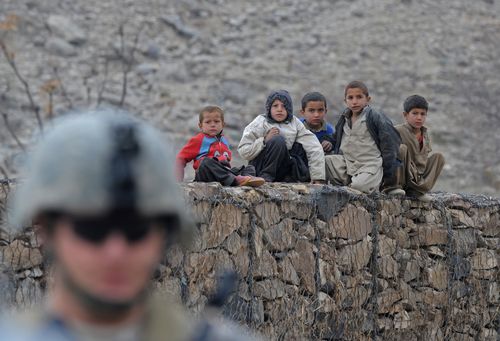
These three things – core aspects of the classically conservative temperament – are what Rory Stewart sees in Obama's finely callibrated Af-Pak policy. Here's Stewart's must-read response to Obama's Afghanistan speech (which reads better to me now than it did at the time):
I felt as though I had come to hear a fifteenth-century scholastic and found myself suddenly encountering Erasmus: someone not quite free of the peculiarities of the old way, and therefore haunted by its elisions, omissions, and contradictions; but already anticipating a reformation. Obama's central—and revolutionary—claim is that our responsibility, our means, and our interests are finite in Afghanistan. As he says, "we can't simply afford to ignore the price of these wars." Instead of pursuing an Afghan policy for existential reasons—doing "whatever it takes" and "whatever it costs"—we should accept that there is a limit on what we can do. And we don't have a moral obligation to
do what we cannot do…
What would this look like in practice?
Probably a mess. It might involve a tricky coalition of people we refer to, respectively, as Islamists, progressive civil society, terrorists, warlords, learned technocrats, and village chiefs. Under a notionally democratic constitutional structure, it could be a rickety experiment with systems that might, like Afghanistan's neighbors, include strong elements of religious or military rule. There is no way to predict what the Taliban might become or what authority a national government in Kabul could regain. Civil war would remain a possibility.
But an intelligent, long-term, and tolerant partnership with the United States could reduce the likelihood of civil war and increase the likelihood of a political settlement. This is hardly the stuff of sound bites and political slogans. But it would be better for everyone than boom and bust, surge and flight. With the right patient leadership, a political strategy could leave Afghanistan in twenty years' time more prosperous, stable, and humane than it is today. That would be excellent for Afghans and good for the world.
What I admire about Obama is a willingness to embrace such unsatisfying but least worst policy options. I find this sort of muddling through congenitally unpleasant. I tend to gravitate, as thinkers rather than doers can, toward the surge-or-leave mentality. But it may be that some deeply unsatisfying form of muddling through really is the best strategy now in confronting the forever erupting volcano of the evolving Muslim world.
And again: note how this strategy is not utopian. It has not succumbed to the grand sweep of eschatological nirvana that pulsed through some of the more purple of Bush's speeches. Nor has it given in to the high Tory pessimism that animates Stewart or yours truly. It is an embrace of the practical, and a respect for the details of the doing. It's influenced by Bob Gates, I suspect, whose temperament is an almost uncanny match with Obama's.
(Photo: A US soldier from the Provincial Reconstruction team (PRT) Steel Warriors is watched by Afghan children during a patrol in Nuristan Province on December 27, 2009. By Tauseef Mustafa/AFP/Getty).
Rod Dreher is becoming the John Templeton Foundation's publications director (manna from theocon heaven) but will still be blogging in a less partisan manner (we'll see how long that lasts). His linking policy is the Dish's:
I will link generously to partisans on a given issue, not because I necessarily approve of their point of view (seriously, no approval should be assumed), but because I've judged that their position deserves serious consideration for whatever reason (possibly because it's extremely wrong-headed, but influential).
 The Dish