
A fighting dog bleeds after the weekly dog fights on December 11, 2009 in Kabul, Afghanistan. Dogfighting is facing a resurgence after it was banned under the Taliban for being un-Islamic. By Majid Saeedi/Getty Images.
My First Recording
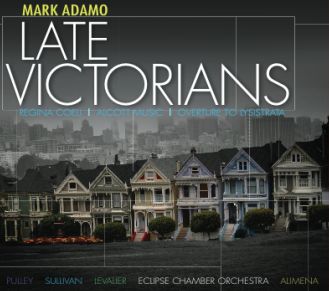
That's a litle over-statement, since my contribution to Mark Adamo's new release is minor. Don't worry. I don't sing. I do narrate a sublime piece composed by Mark in honor of those who died in the plague years in San Francisco, "Late Victorians". The text is by Richard Rodriguez. Here's the description of the piece:
Acclaimed as ‘one of the best opera composers of the moment’, American composer-librettist Mark Adamo has also ventured into symphonic composition and other fields in each of which his theatrical sensitivity, political commitment and musical mastery are equally evident. The vivacity of his Overture to Lysistrata accentuates the play’s anti-war theme, while Alcott Music rethinks the music from his hit opera Little Women. Regina Coeli pays tribute to the Queen of Heaven and Late Victorians is dedicated both to the memory of those who have died and to those who have survived AIDS.
As a proud survivor, I found Mark's work painfully moving, and am honored to have narrated it. He writes about it here. You can buy it here and here as a download. Amazon's four-star review:
"Late Victorians" is a great piece about a terrible thing. It is a sonic essay commemorating the losses of the AIDS plague in late 80's San Francisco. Composer Adamo evokes this in a theatrical collage of spoken word, operatic poetry, and bittersweet music. The narrative voice, based on Richard Rodriguez's essays, carries the tone of his spare, wise, sad clarity. Hardwon, wounded, a stark certainty come to from quiet, persistent, painful shifts. Stripped down to life and death, each moment becomes an epiphany, each memory a parting gift. Andrew Sullivan deftly narrates in harmony alongside soprano Emily Pulley, who instills melodic ease into unflinching lines from Emily Dickinson. Pulley in particular delivers a delicate balancing act of operatic beauty, witty phrasing, and topical modernity.
Quote For The Day II
"Did you expect us to shop at the Wasilla Fred Meyer looking like Adam Lambert at the AMA's? Did you expect us to kiss in line at Home Depot? We have strong survival instincts and know better than to look, act, or talk queeny in a town like this. You might not know we're gay, but I'm sure you've seen us," – "Your gay Wasilla homeboys," in a letter to Levi.
Since Glenn Asks
I'll try to answer. Here's Greenwald's question (Update III):
I don't find anything about Obama's foreign policy positions surprising; as opposed to his civil liberties positions, which he has routinely violated, he outlined these broad foreign policy sketches during the campaign (though added much more detail, and I'd suggest much more receptiveness to war generally, during yesterday's speech). I don't agree at all with the criticism that his escalation in Afghanistan (as opposed to his civil liberties positions) is a "betrayal." This is who Obama is and that has been clear for quite awhile.
Still, the question remains: why did so many Bush-loving neocons and progressives alike react the same way to Obama's comprehensive foreign policy speech yesterday? What could explain that? Does Sullivan have an answer?
The reason the neocons liked it is because Obama said that evil exists and that we sometimes have to fight it. Since they have been unable to listen to him for the past three years, while calling him a commie peacenik Muslim, this seems to have come as a surprise. I suspect it was his reiteration of these beliefs in accepting the Nobel Peace Prize that finally woke them up. Or, rather, allowed them to take their blinders off for a brief moment (they'll be back on soon enough, one fears).
The neocons are also trying to coopt Obama for Bush, while his speech, if you examine it closely, is, in fact, as brutal a debunking of Bush utopianism and incompetence imaginable. Just give the principled neocons time to save face and they'll understand (and appreciate) him in the end for how he is marshalling and rescuing American power from the Cheney wreckage.
As for "progressives", they got this:
More and more, we all confront difficult questions about how to prevent the slaughter of civilians by their own government, or to stop a civil war whose violence and suffering can engulf an entire region. I believe that force can be justified on humanitarian grounds, as it was in the Balkans, or in other places that have been scarred by war. Inaction tears at our conscience and can lead to more costly intervention later. That's why all responsible nations must embrace the role that militaries with a clear mandate can play to keep the peace.
Obama is much more conservative than Bush (one reason I backed him) but he remains a liberal internationalist humanitarian (one reason I worry about him). He'd use the military for purposes a true realist would be leery of: humanitarian intervention or even nation-building. This positive vision for the use of military and civilian power to combat poverty and enhance human dignity is also part of Obama's vision. A Tory realist would be much more circumspect.
So Obama – as from the beginning – threads part of the conservative and liberal traditions together. The paradox is that it's his conservatism that will make his liberalism more effective. And already has.
Maybe the neocons will get this before some lefties. But some of us have gotten this for a long time. Because he told us.
Rick Warren’s “Catalyst”
Religion Dispatches interviews filmmaker Lisa Dargen, who pressured the evangelical leader to condemn the Uganda bill:
Darden believes that Warren’s noncommittal statement [to Newsweek] revealed that the evangelical Christian community didn’t believe that the Uganda story would be such big news in the United States and that they would not be asked to address it. Darden said she tried to impress upon [Warren's publicist and Darden friend Larry] Ross just how serious this story was, and with Maddow pushing it nightly on her show, how important it would become for Warren to speak out boldly against the measure, rather than dodge the question.
“I gave them a heads up. They didn’t have a clue what was coming down the pike, but I hoped that my call would be a catalyst for them to finally respond,” she said, noting that Ross has subsequently sent her a thank-you note for her involvement.
The Tragedy of Hope, Ctd
A reader writes:
I still can't quite get over the fact that, in front of that audience, Obama defended coercion and force in world politics. He could have soft-peddled that speech in so many different ways, but didn't. He took it to the "children of light." I think it will be one of his most important addresses as president — not because of the short term political impact it might have (say, inducing a kind word from Pete Wehner) but because of how it illuminates his cast of mind and his approach to politics. Its as "telling" as Bush's utopian second inaugural.
One other Niebuhr quote:
"Thus wisdom about our destiny is dependent upon a humble recognition of the limits of our knowledge and our power. Our most reliable understanding is the fruit of 'grace' in which faith completes our ignorance without pretending to possess its certainties as knowledge; and in which contrition mitigates our pride without destroying our hope."
Those are the final words to The Nature and Destiny of Man. So literally the last word of Niebuhr's greatest work is "hope."
Interestingly, during Niebuhr's Gifford Lectures (which Nature and Destiny is based on) in Edinburgh, that city was bombed by the Nazis. The Germans hit a naval base not far from where Niebuhr was lecturing, and you could hear anti-aircraft guns firing in return. This was during an actual lecture of his. Niebuhr spoke a word of hope, and held onto a Christian understanding of our destiny, as the city he was lecturing in was attacked by Nazis. I always found that detail remarkable!
The two greatest works of Christian hope that I know of during that period are Eliot's Four Quartets and Messiaen's Quartet For The End Of Time. I had the chance of dramatizing the former and combining it with the latter in a production I directed at Harvard a quarter century ago. Sometimes, the extremity of evil allows the purity of good to break through. Messiaen composed his masterwork in a prison camp; Eliot wrote his as the Blitz continued.
De profundis …
Mental Health Break
Tina Brown As Fag Hag
She always had it in her; now she’s embracing it on video.
Adjusting The Data, Ctd
DiA takes the time to counter Eschenbach's anti-climate change "smoking gun":
[A]fter hours of research, I can dismiss Mr Eschenbach. But what am I supposed to do the next time I wake up and someone whose name I don't know has produced another plausible-seeming account of bias in the climate-change science? Am I supposed to invest another couple of hours in it? Do I have to waste the time of the readers of this blog with yet another long post on the subject? Why? Why do these people keep bugging us like this? Does the spirit of scientific scepticism really require that I remain forever open-minded to denialist humbug until it's shown to be wrong? At what point am I allowed to simply say, look, I've seen these kind of claims before, they always turns out to be wrong, and it's not worth my time to look into it?
Obama Is Not, And Never Was, Anti-War
Greenwald rounds-up those on the left and the right who enjoyed Obama's Nobel speech. Greenwald is predictably upset by this consensus, but Obama's foreign policy positions should have been clear to anyone playing attention during the campaign. Greenwald:
Obama puts a pretty, intellectual, liberal face on some ugly and decidedly illiberal polices. Just as George Bush's Christian-based moralizing let conservatives feel good about America regardless of what it does, Obama's complex and elegiac rhetoric lets many liberals do the same. To red state Republicans, war and its accompanying instruments (secrecy, executive power, indefinite detention) felt so good and right when justified by swaggering, unapologetic toughness and divinely-mandated purpose; to blue state Democrats, all of that feels just as good when justified by academic meditations on "just war" doctrine and when accompanied by poetic expressions of sorrow and reluctance. When you combine the two rhetorical approaches, what you get is what you saw yesterday: a bipartisan embrace of the same policies and ideologies among people with supposedly irreconcilable views of the world.
Some of us have long understood Obama's defense of war from the left. And why it might not be as tragic as Greenwald implies.
 The Dish